
How to Run a Virtual Networking Event That Produces Real Meetings
Thursday, 5 p.m. A trade association opens its quarterly online networking evening: 120 registered, 68 log in, the moderator sends everyone into six random breakout rooms. By minute 25, a third of the screens have gone dark. The membership manager watching the attendance curve knows exactly how this ends: a polite survey, a handful of LinkedIn requests, no meetings.
The medium did not fail her. The plan did. The difference between a tired video call and a virtual networking event that produces business meetings is decided before anyone logs in: the meeting calendar is already full. This guide shows you how to get there in seven steps, which formats work for which goal, and how to measure whether any of it paid off.
The short version: Virtual networking events are back on B2B agendas in 2026, but attendees no longer accept breakout-room roulette. Decide one outcome and one KPI, pick a format to match, keep it between 45 and 90 minutes, collect matching data at registration, and fill the 1:1 meeting calendar before the event starts. Moderate like a host, follow up within 48 hours, and judge the event by completed meetings, not attendance.
Why virtual networking events are back on the 2026 agenda
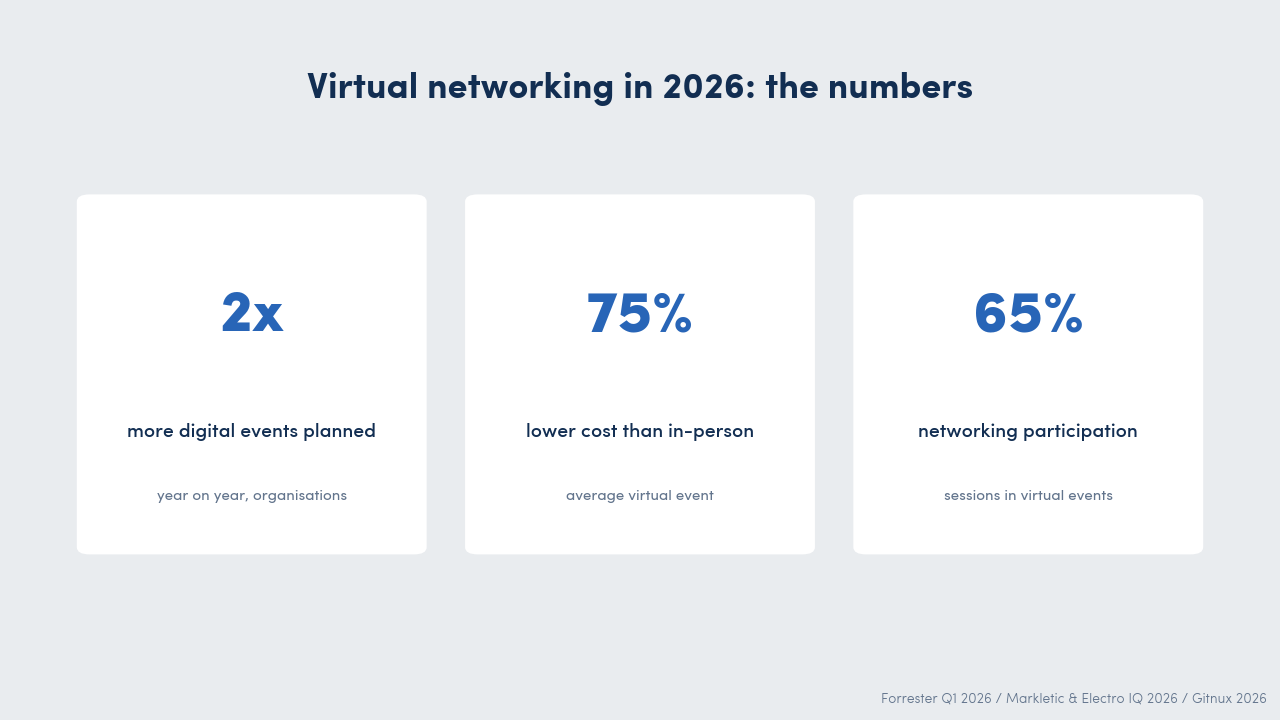
For three years, virtual formats were the thing organisers apologised for. That has turned. In Forrester’s Q1 2026 State of B2B Events Survey, the number of organisations planning more digital events doubled year on year. For you, that means your audience will compare your online networking evening against a rising standard, not against the emergency Zoom calls of the past.
The commercial logic is hard to argue with. Virtual events cost around 75 per cent less to run than comparable in-person gatherings, and 63 per cent of organisers plan to increase their virtual investment, according to Markletic and Electro IQ data from 2026. A cancelled venue contract does not just save money; it frees budget for the part attendees actually come for.
And they do come for it. Networking sessions inside virtual events reach roughly 65 per cent participation, and 90 per cent of virtual attendees rate their online event experience as successful. The appetite is there. What Forrester’s respondents no longer plan is passive broadcasting: two thirds of organisations say they will run more workshops, roundtables and structured networking instead. One survey participant put it bluntly: an event that feels like watching TV has no point.
What a virtual networking event is (and what it is not)
That shift towards structure starts with a clear definition. A virtual networking event is an online event whose primary purpose is creating business connections between attendees, typically through pre-scheduled one-to-one video meetings, timed speed-networking rounds or moderated small-group sessions rather than broadcast content. It is one of the ten common virtual event types, and the only one where the attendees themselves are the programme.
That last point separates it from a webinar. A webinar survives a passive audience; a networking event dies with one. In a conference centre, the coffee queue and the corridor do quiet matchmaking work all day. Online, there is no corridor. Whatever chance encounters a venue produces for free, your agenda has to produce on purpose. Structure is not a nice-to-have in virtual networking; it is the venue.
Choose the format before the platform
Once the purpose is clear, the format follows, and only then the software. Four formats cover most B2B use cases:
| Format | Group size | Duration | Best for |
|---|---|---|---|
| Speed networking rounds | 2 per round, 20 to 60 total | 3 to 5 minutes per round | First contact in communities, association onboarding |
| Pre-scheduled 1:1 meetings | 2 per meeting, up to thousands | 10 to 20 minutes per meeting | Buyer-seller programmes, investor formats, lead generation |
| Moderated roundtables | 6 to 10 per table | 20 to 40 minutes | Peer exchange, member retention, expert positioning |
| Community mixers | 15 to 80 in one space | 45 to 60 minutes | Informal culture, alumni groups, team-adjacent formats |
Mixing two formats in one hour works well; running all four at once rarely does. If you want a broader pool of concepts to borrow from, our collection of networking event ideas that lead to actual meetings includes several that translate directly to screens. Pick one primary format, one supporting one, and stop there.
How to run a virtual networking event: seven steps
With a format on the table, the remaining work is a sequence. Each of these seven steps feeds the next, and the first one costs nothing but honesty.
Step 1: Define one outcome and one KPI
“Bring people together” is a wish, not an outcome. Decide what the event exists to produce: qualified buyer conversations, member-to-member introductions, first meetings between startups and corporates. Then pick one KPI (key performance indicator) that proves it, such as completed meetings per attendee or the share of attendees with at least two conversations. The membership manager from the opening scene would have skipped the breakout roulette the moment her KPI was “two relevant contacts per member”. A number like that redesigns the evening for you.
Step 2: Pick the format and cap the length
Match the format table above to your outcome, then resist the urge to fill an afternoon. Between 45 and 90 minutes is the reliable window for focused virtual networking; energy drops fast beyond it. Schedule against your audience’s time zones, not your office hours: late morning on the North American east coast reaches Europe’s late afternoon, which is why 11 a.m. to 2 p.m. Eastern has become the default corridor for transatlantic sessions.
Step 3: Choose the platform for networking features, not streaming quality
Most virtual event platforms were built for broadcasting with networking bolted on. You need the reverse. The features that matter here: automated 1:1 meeting scheduling with personal calendars, timed speed-networking rotation, small-room moderation controls, and profile-based participant search. Streaming polish is secondary; nobody remembers the bitrate of a good conversation. Our guide on choosing a virtual or hybrid event platform walks through the full evaluation, including pricing patterns.
Step 4: Collect matching data at registration
Registration is where the event is quietly won. Ask three or four structured questions: industry, role, what the person offers, what they are looking for. Free-text fields feel friendly but cannot be matched; dropdowns and tags can. A participant who states “looking for logistics partners in Scandinavia” at registration can be paired with intent two weeks before the event. One who only left an email address cannot. Every field you skip at registration becomes a blind date later.
Step 5: Fill the meeting calendar before the event
Here is the thesis of this guide in operational form. Use the registration profiles to propose or pre-book one-to-one meetings, so that attendees log in to an agenda, not an empty lobby. This is the practical difference between open networking and structured matchmaking: one hopes the right people bump into each other, the other schedules it. An attendee who sees three confirmed meetings in their calendar shows up. One who sees a lobby link finds a reason not to.
Solution: matchmaking that fills calendars before the login
Solution: This pre-filled calendar is exactly what Converve was built for. Participants submit structured profiles at registration, and rule-based matching pairs them on a meeting matrix, with mutually confirmed time slots and video rooms attached. The logic stays transparent, so when someone asks why they met a particular contact, there is an answer instead of an algorithm shrug. Organisers running buyer-seller programmes, investor days or association meetups use the same mechanics at different scales. Talk to us if you want to see a meeting matrix on your own event.
Step 6: Run the room like a host, not a broadcaster
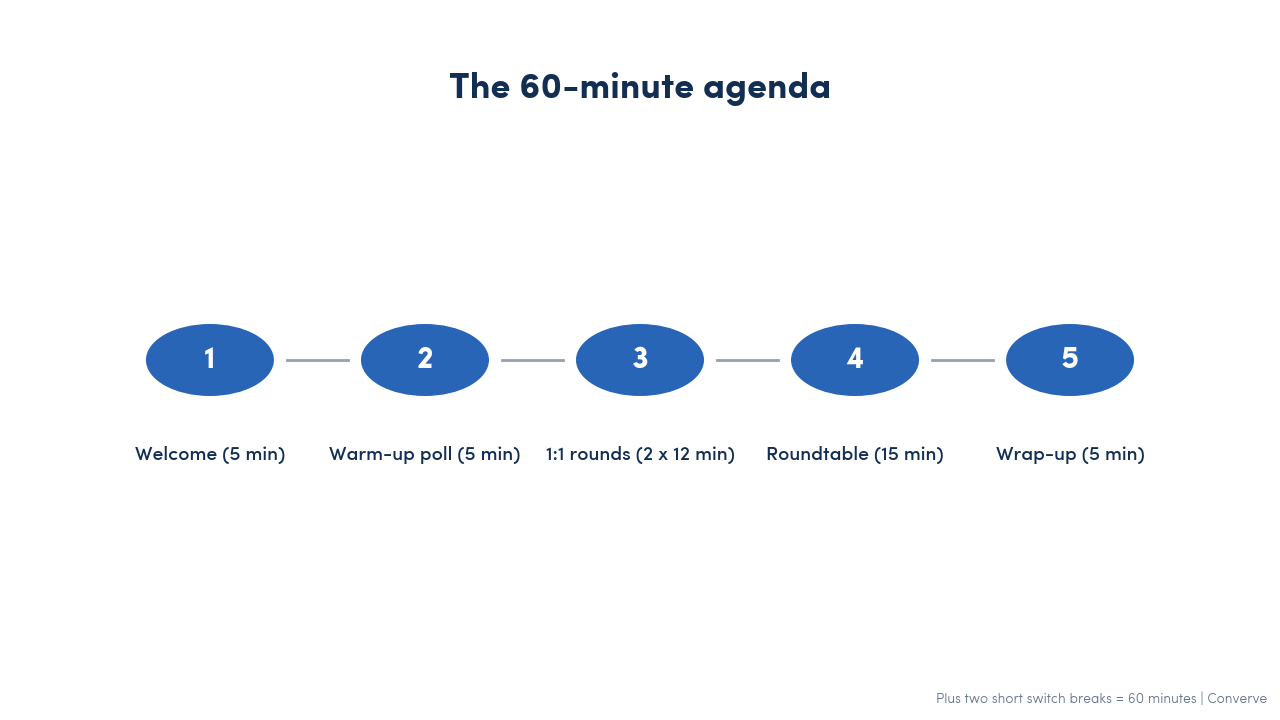
With the calendar full, the live hour becomes logistics and warmth. Open with five minutes of orientation: what happens when, where the help channel is, what to do if a meeting partner does not show. Rotate activity every 15 to 20 minutes to keep energy up. Keep one moderator on the chat at all times; 73 per cent of virtual attendees interact there, and unanswered chat is where engagement goes to die. A tight 60-minute agenda looks like this: five minutes welcome, a five-minute warm-up poll, two pre-scheduled meeting rounds of 12 minutes with short breaks, one 15-minute roundtable, five minutes of wrap-up and next steps.
Step 7: Close the loop within 48 hours
Research on trade show attendees shows that only 20 to 30 per cent of event contacts ever get followed up. Those follow-ups are your event’s actual product, so do not leave them to chance either. Within 48 hours, send every attendee their personal meeting list with contact details, a short survey, and one clear next step, whether that is the date of the next session or a booking link for a continued conversation. Then read the data against the KPI from Step 1 and decide what changes next time. The event ends; the loop should not.
Five mistakes that quietly kill virtual networking events
The seven steps describe what to do. In practice, most failed events break one of the same five rules, so check your plan against this list before you send invitations:
- Breakout roulette: Random room assignment outsources your core job, the matching, to luck. Two strangers with nothing in common do not become a success story because the room was cosy.
- Webinar in disguise: Forty minutes of presentations with “networking” appended at minute 50 trains attendees to leave early. Content earns attention; it does not create connections.
- No-show blindness: Planning for 100 per cent turnout breaks the format when 40 per cent stay home. Overbook rotations slightly and give moderators a live re-pairing option.
- Registration without profile data: If sign-up only captures an email, matching is impossible and the event reverts to roulette. Three structured questions solve this.
- Silence after the event: No meeting list, no survey, no next date within 48 hours, and the momentum is gone. The follow-up is not admin; it is the return on everything above.
FAQ: virtual networking events
How long should a virtual networking event be?
Between 45 and 90 minutes. Shorter than 45 minutes rarely allows more than one meaningful conversation; beyond 90, drop-off accelerates sharply. If you have more programme than 90 minutes can hold, run a series instead of a marathon.
How many attendees do you need?
Speed networking works from about 20 participants, roundtables from 12, and pre-scheduled 1:1 programmes scale from 30 to several thousand because the matching, not the room, carries the format. Below roughly 12 attendees, a single moderated conversation beats any format mechanics.
Which KPIs measure virtual networking success?
Four numbers cover it: registration-to-attendance rate, completed meetings per attendee, meeting completion rate against the pre-booked calendar, and the 14-day follow-up rate. Attendance alone flatters events that produced no conversations.
What is the difference between a webinar and a virtual networking event?
A webinar transfers content from a few speakers to a passive audience. A virtual networking event exists so attendees meet each other; the participants are the programme, and interaction is measured in meetings rather than viewing minutes.
Conclusion: structure is the venue
Virtual networking has outgrown its emergency-substitute phase. The 2026 numbers say the format is back; the same research says attendees will not sit through unstructured video calls to prove it. What replaces the venue, the corridor and the coffee queue is a plan: one outcome, one KPI, a fitting format, matching data from registration, and a meeting calendar that is full before the first login. Get that sequence right and the medium stops mattering, because the meetings happen either way.
If you want the calendar-first version of that plan on your next event, get in touch and we will walk you through a live meeting matrix.