Event Networking vs Matchmaking: The Real Difference in 2026
What’s the Real Difference Between Event Networking and Matchmaking?
Most event organisers use the words networking and matchmaking interchangeably. Sponsors do the same. Vendors do the same. And the result, predictably, is a string of muddled briefings: someone asks for a “networking app” and means structured 1:1 meetings; someone else buys a “matchmaking platform” and expects spontaneous bar conversations. The two words describe different things, with different cost profiles, different KPIs and different failure modes.
Honest admission first. We have not always been certain where exactly the line sits either. Marketing meetings at Converve have circled this question more than once, with people on both sides making perfectly sensible arguments for slightly different definitions. What settled it for us was not a whiteboard session. It was twenty-five years of hands-on event work: hundreds of trade shows, hosted buyer programmes, association annual meetings, startup conferences, plus the post-event reports that came back from them. The patterns that emerged from that experience are what this guide is built on.
The plan from here is straightforward. We pin the distinction down, then translate it into the format decisions you actually have to make: when networking is enough, when matchmaking is the better tool, and when serious events need both at the same time. The data points throughout come from 2025 and 2026 industry reports (Swapcard, Clarion Events, Mordor Intelligence, PCMA) so you can quote them in your next budget review.
Event Networking, Defined
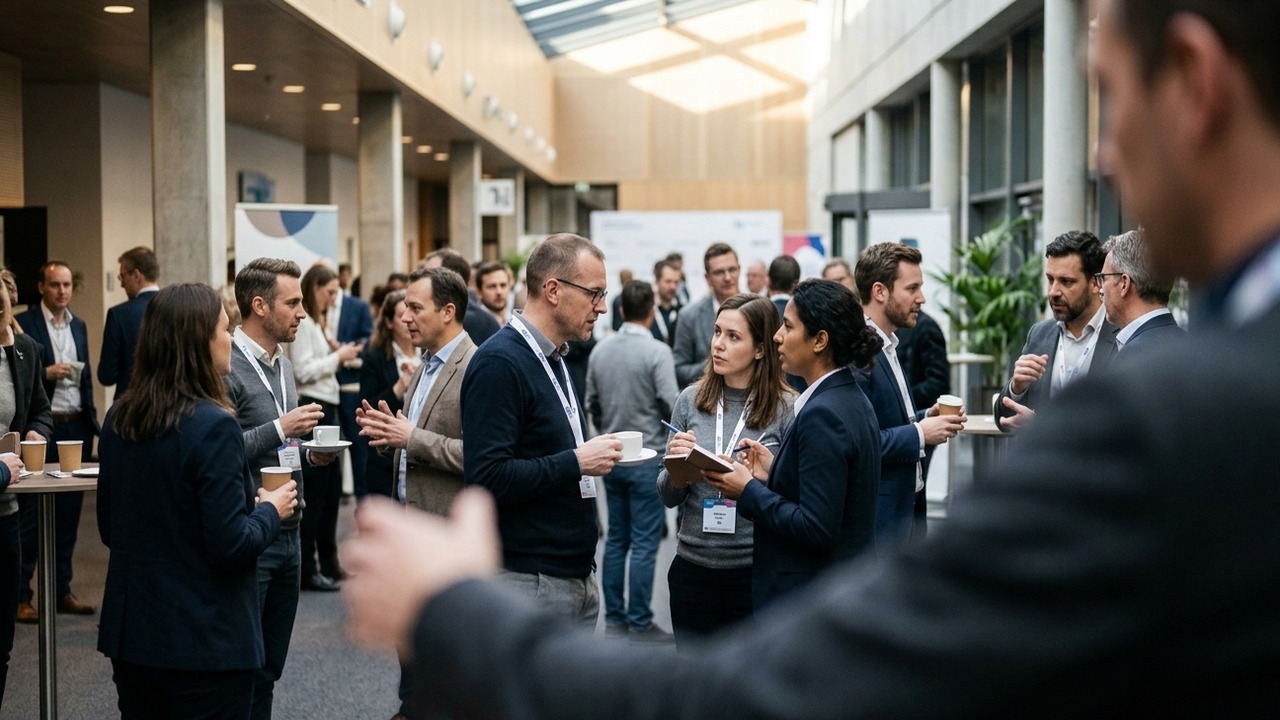
Event networking is the open, unscheduled interaction between attendees during an event. It happens at coffee breaks, in the hallway between sessions, at the evening reception, around stand-up tables in the foyer. The protocol is informal: people drift, look at name badges, start conversations, exchange business cards or LinkedIn requests, then move on. Whether the right people meet is largely down to chance, location and how outgoing they are.
Networking is the oldest interaction pattern at business events, and it still matters. A 2025 study by PCMA (the Professional Convention Management Association) found that 75 per cent of conference attendees cite networking as their primary reason for showing up. An UpVisit industry survey reported a similar split: 78 per cent attend B2B events mainly to network, but 56 per cent are dissatisfied with the networking opportunities they get. That dissatisfaction is the gap matchmaking tries to close.
Event Matchmaking, Defined
Event matchmaking is the structured, profile-based scheduling of one-to-one meetings between attendees who have been identified as complementary partners. Three things characterise it. First, every participant fills out a profile before the event, declaring what they offer and what they look for. Second, a matching step (algorithmic, AI-driven or manually curated) identifies likely pairs. Third, the platform schedules the meetings into time slots with assigned tables or virtual rooms, so participants arrive knowing exactly who they will meet and why.
The category that calls itself “business matchmaking” or “B2B matchmaking” usually means exactly this. The platforms in the category (Converve, b2match, Brella, Grip, Swapcard, Bizzabo) all sell variations of the same idea: profile in, schedule out, meeting in the room.
Networking vs Matchmaking: The Real Difference
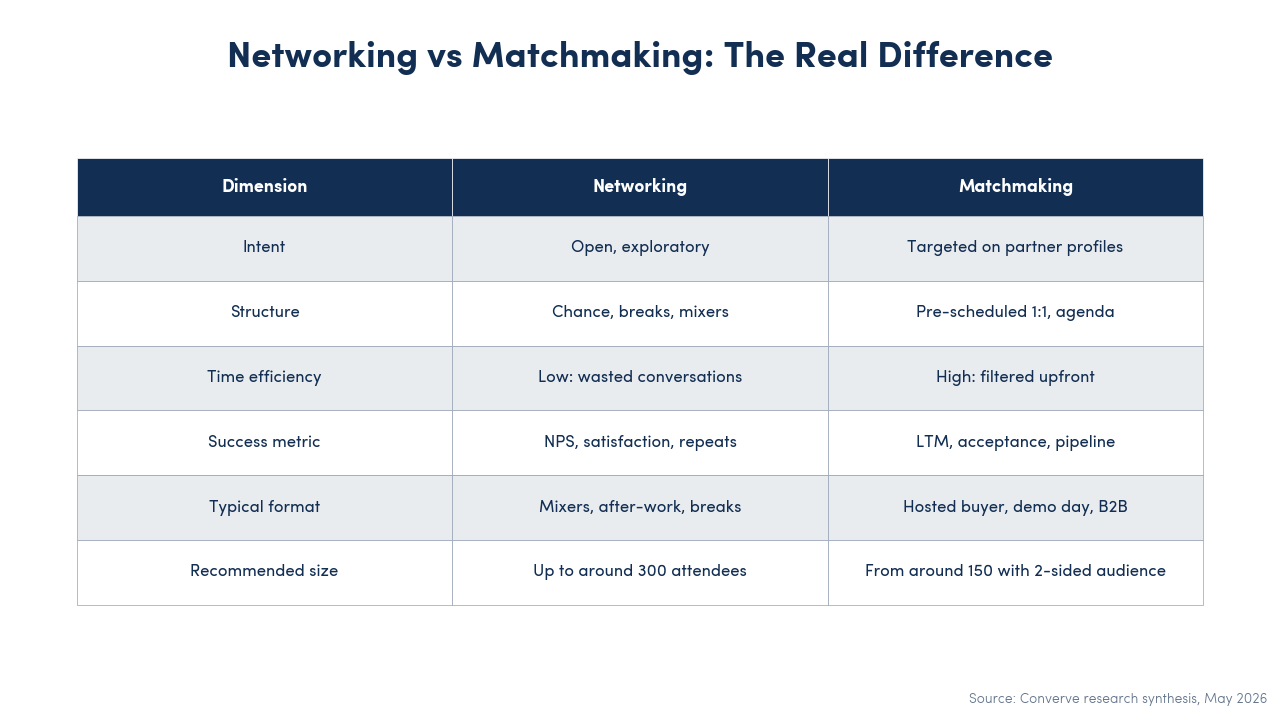
The simplest way to draw the line is across twelve dimensions that organisers actually budget for. Sponsors and stakeholders care about different rows depending on what they paid for.
| Dimension | Networking (classic) | Matchmaking (structured) |
|---|---|---|
| Intent | Open, exploratory | Targeted on declared partner profiles |
| Structure | Chance, breaks, mixers | Pre-scheduled 1:1, allocated tables, agenda |
| Initiation | Spontaneous, onsite | Pre-event via profiles and algorithm |
| Who meets | Whoever is standing next to you | Whoever has complementary needs or offers |
| Time efficiency | Low: many wasted conversations | High: filtered before the meeting |
| Technology | Light (badges, rooms) | Heavy (platform, matching engine, scheduler) |
| Success metric | NPS, mood surveys, repeat attendance | Leads-to-meeting (LTM), acceptance rate, pipeline value |
| Typical format | Mixers, after-work, breaks | Hosted buyer, demo day, investor-founder, buyer-seller |
| Strength | Serendipity, trust, spontaneity | Scale, measurability, ROI evidence |
| Risk | Quiet attendees disappear, mismatched chats | Garbage-in-garbage-out, over-scheduling, fatigue |
| Cost band (organiser) | Low: rooms, catering | Mid to high: licence, onboarding, reporting |
| Recommended size | Small to mid (up to around 300) | From around 150 with a clear two-sided audience |
Two rows on that table do most of the explaining. The intent row sets the philosophical difference: networking is open, matchmaking is targeted. The success metric row sets the operational one: if your sponsors expect a number at the end, you are not running networking. You are running matchmaking.
Why the Distinction Matters in 2026
For a long time, the two words could be used loosely because nobody measured event interaction precisely. That has changed. The global event-management software market, the segment that mostly enables matchmaking, is forecast to grow from USD 15.2 billion in 2026 to USD 24.17 billion by 2031, a compound annual growth rate (CAGR, the steady annualised growth figure used in market reports) of 9.73 per cent (Mordor Intelligence, April 2026). Buyers of that software ask harder questions every quarter.
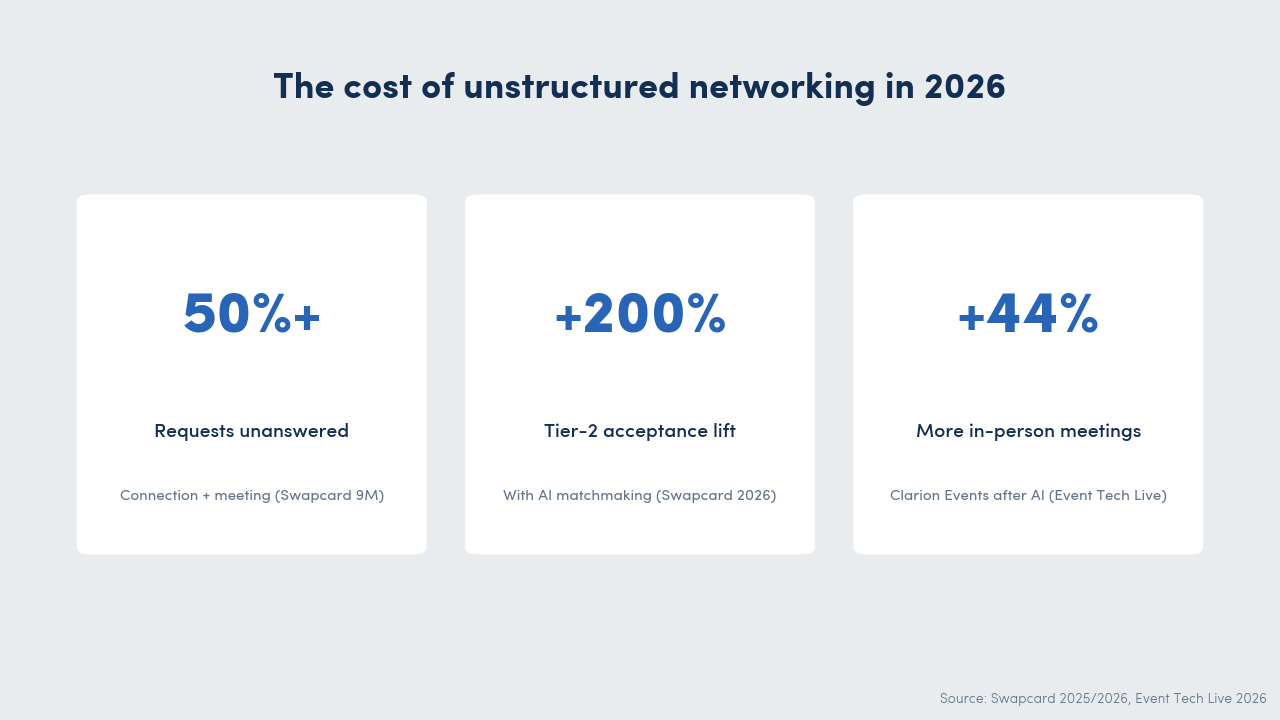
The data is also less forgiving of unstructured formats. Swapcard, analysing nine million connection and meeting requests across trade shows and conferences, found that over 50 per cent of all requests remain unanswered: 66 per cent of attendee-to-exhibitor connection requests and 68 per cent of meeting invitations go ignored. At trade-show organisations without AI-assisted matching, 65 to 75 per cent of attendee-to-exhibitor requests fall through. Tier-1 events perform worst, not best. Open networking, in other words, leaks.
AI-assisted matchmaking compresses that leak. Swapcard’s 2026 trend report reports a 200 per cent uplift in connection-acceptance rates at Tier-2 trade shows after AI matchmaking is switched on, and a 170 per cent uplift at Tier 1. Clarion Events reported a 44 per cent increase in in-person meetings after introducing AI matchmaking across its UK portfolio (Event Tech Live, 2026). None of that uplift is available to events that stay on pure networking.
The other half of the change is on the sponsor side. 95 per cent of B2B event teams now say proving event ROI is a top priority (Thunderbit, 2026). ROI is hard to claim if your reporting line is “we had a good vibe”. It is much easier to claim with a meeting log, an acceptance rate and a leads-to-meeting conversion number, and those numbers are matchmaking-native, not networking-native.
When You Need Networking, When You Need Matchmaking, When You Need Both
Most events do not need to choose one and abandon the other. The honest answer is that the larger and more transactional the event, the more matchmaking dominates the structure, and the more deliberately you should still preserve unstructured time. Below are four event types organisers ask about most often, and the recommendation each one deserves.
Trade shows and exhibitions
Matchmaking should be the spine. Trade shows have asymmetric audiences (buyers and sellers, exhibitors and visitors) and sponsors pay for outcomes. Hosted buyer programmes, pre-scheduled 1:1 meetings and meeting-area allocation should be the default. Keep open networking in the evening reception and on the foyer floor, where serendipity has a chance.
Conferences over 300 attendees
Use a matchmaking layer to take the load off the chance encounters. At that size, even motivated attendees miss most of the relevant counterparties through pure networking. A profile-based recommendation engine plus optional pre-booked meetings will lift quality without removing the conference’s open character.
Demo days, pitch events and investor-founder events
Matchmaking is essentially mandatory. Top investors get flooded with irrelevant pitches in any open format. A structured matching layer (preference declarations, thematic fit, optional cap on requests per investor) protects both sides. Leave the open mixer to the evening, where conversations can extend the matched meetings.
Verbandstagungen, association annual conferences and community events
Blend the two. Run matchmaking for the segments that need it (board meetings, sponsor introductions, partner pairings) and leave the rest of the agenda open. The members came partly for the relationships, not just the meetings, and a fully scheduled day will feel cold.
One rule cuts across all four formats: matchmaking-first, networking-in-pockets. Anchor the meeting blocks first, then design unstructured time around them. Reverse the order and the matchmaking slot will lose half its participants to the open floor.
What Each Approach Actually Measures
The cleanest test for whether you are running networking or matchmaking is what you put in the post-event report. If the headline numbers are subjective, you are running networking. If they are transactional, you are running matchmaking.
Networking KPIs: Net Promoter Score, post-event satisfaction survey, repeat-attendance rate, mention sentiment on LinkedIn, average dwell time in networking areas, ratio of name-badge scans to attendees. These tell you whether people enjoyed themselves and want to come back. They do not tell you whether a sale happened.
Matchmaking KPIs: meeting acceptance rate, meeting completion rate (of those accepted, how many actually happened), leads-to-meeting (LTM) conversion, pipeline value attributed to the event, hosted-buyer programme ROI. The LeadAngel 2026 benchmarks treat 50 to 60 per cent LTM as healthy, 60 to 75 per cent as strong, and 75 per cent and above as highly optimised for qualified inbound leads.
Mixing the two metric families is the most common reporting mistake. Reporting NPS for a hosted-buyer programme tells the funder nothing about whether the programme produced trade. Reporting LTM for a community mixer punishes the format for what it never set out to deliver.
Where Matchmaking Goes Wrong
For the sake of honesty: matchmaking does not always pay off. Three failure modes recur often enough to warn organisers about.
Garbage-in, garbage-out profiles. Matchmaking algorithms are only as good as the data attendees put in. If your registration form asks two tick-box questions and lets people skip the rest, the engine has nothing to work with and produces irrelevant matches. The fix is on the form, not on the algorithm: ask precise, structured questions about offer, demand, target segment and current priority.
Over-scheduling. Eight meetings a day is the practical maximum for most professionals. Push past that and attendees stop preparing, then stop showing up. Investor overload at demo days follows the same pattern. The fix is per-participant request caps and explicit “breathing slots” in the agenda.
Cultural friction. Some audiences resist pre-scheduled meetings on principle. Senior executives often prefer to choose their conversation partners onsite. Founders often want spontaneity. Imposing a fully scheduled day on those groups can backfire. The fix is to offer matchmaking as an opt-in layer, not a mandatory one, and keep enough unstructured time around it.
Related Terms: A Quick Glossary
The vocabulary around networking and matchmaking has accumulated over the years. Here are the terms organisers run into most often, with one-line definitions.
- Hosted buyer programme: a paid-for or sponsored format where a vetted “buyer” cohort attends a trade show with a contractual minimum of pre-scheduled meetings. Common at tourism trade shows and MICE events (meetings, incentives, conferences and exhibitions).
- Speed networking: a structured format where attendees rotate through brief 3 to 5 minute conversations, often with a bell or timer. Sits between open networking and full matchmaking.
- 1:1 meeting: the operational unit of matchmaking, where one participant meets one other for a scheduled slot.
- Smart meeting: a 1:1 meeting that the platform auto-schedules based on mutual availability and preferences, rather than requiring participants to negotiate the slot.
- Office hours: a startup-conference format where investors or mentors publish open time slots and founders book them. A hybrid of matchmaking and self-service networking.
- Open networking: any unscheduled interaction in dedicated time blocks such as receptions, breaks and foyer time.
- Facilitated introduction: a human-curated match, usually made by event staff who know both parties and explicitly suggest the meeting.
- Matchmaking algorithm: the rule set or machine-learning model that ranks potential pairs by fit score. Grip publishes that its engine uses 70 million data points across 16 strategies; Swapcard, b2match and Bizzabo run comparable engines.
Where Converve Fits
Solution: Converve’s matching layer is meeting-matrix-based: every participant declares a structured offer, a structured demand, and the relevant segment, and the engine builds the matrix of possible pairs against your event’s two-sided logic. It is not an AI-only black box. The matrix sits behind the platform’s scheduling and reporting, which is why hosted buyer programmes, tourism trade shows and structured investor-founder events tend to land on Converve when their organisers care about predictable, explainable outputs. The platform is GDPR-compliant (the EU General Data Protection Regulation), runs in German and English natively, and has been refined for European trade shows and DACH-region events since 2007.
Bottom Line
Networking is the chance you’ll meet the right person. Matchmaking is the system that ensures you do. They are not the same product, and they are not measured the same way. Treat your event-software brief and your KPI report as the two places where this distinction has to be sharp, and the rest of the planning gets easier.
If you want to discuss whether your next conference, trade show or hosted buyer programme should run pure networking, structured matchmaking or both, contact us. We are happy to walk through the meeting-matrix logic with you.
FAQ
What is the difference between event networking and matchmaking?
Networking is unstructured, spontaneous interaction between attendees. Matchmaking is pre-scheduled, profile-based one-to-one meetings between participants identified as complementary partners.
Is matchmaking just a type of networking?
No. Networking is the broad category of attendee interaction; matchmaking is a specific structured method within it, characterised by pre-event profiles, an algorithmic or curated matching step, and scheduled meetings with allocated time slots.
When should an event use matchmaking instead of open networking?
When the audience is structurally asymmetric (buyer-seller, founder-investor), when sponsors or funders expect measurable outcomes, or when the event exceeds about 150 attendees, the point where chance encounters statistically miss most relevant counterparties.
Do attendees prefer networking or matchmaking?
An UpVisit survey from 2025 found that 78 per cent attend B2B events primarily for networking, yet 56 per cent are dissatisfied with the networking opportunities they receive. Matchmaking is the structured response to that dissatisfaction.
How does AI matchmaking change the picture?
AI analyses attendee profiles, behavioural signals and meeting history to recommend high-fit partners. Swapcard’s 2026 data shows AI lifts connection acceptance by up to 200 per cent at Tier-2 trade shows and 170 per cent at Tier 1; Clarion Events reported 44 per cent more in-person meetings after AI was introduced.
What are the typical KPIs for matchmaking?
Meeting acceptance rate, meeting completion rate, leads-to-meeting (LTM) conversion, and pipeline value attributed to the even