
How to Choose a Virtual or Hybrid Event Platform in 2026
Choosing a virtual or hybrid event platform in 2026 looks easier than it is. Most listicles tell you which tool ranks first. Few tell you which tool fits your event. A platform that runs a brilliant SaaS webinar may collapse under a 1,200-buyer tourism trade show. A platform that handles a Demo Day with 80 investors may have no realistic answer for a multilingual hosted-buyer programme across three time zones.
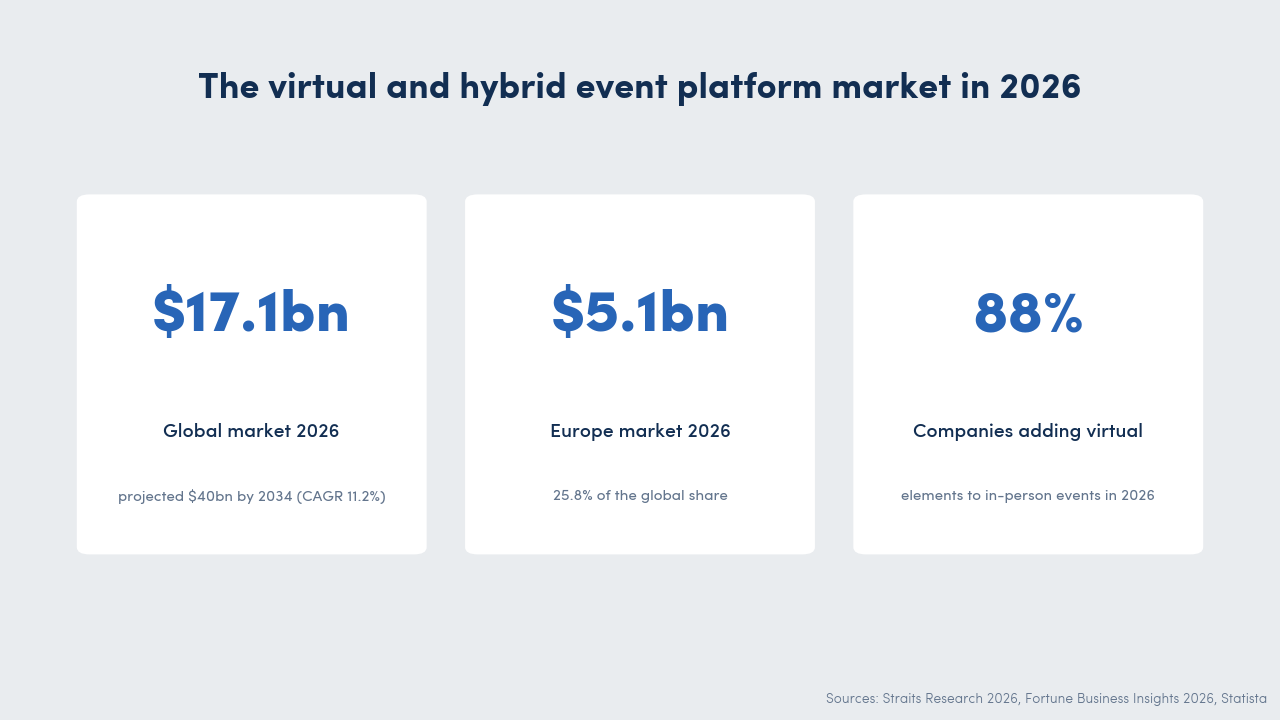
The market is also in motion. The global virtual events platform market is projected at USD 17.11 billion in 2026 and will reach USD 40.07 billion by 2034 at a CAGR (compound annual growth rate) of 11.23 per cent, according to Straits Research. Europe alone accounts for USD 5.09 billion of that 2026 spend (Fortune Business Insights). Vendor consolidation and a wave of AI-led features mean the “default” platform you picked in 2022 is probably not the right one for 2026.
This guide gives you a structured way to make the call: five decision criteria that actually matter, a comparison grouped by event type instead of by company size, a realistic pricing example at 500 attendees, and a switch-without-data-loss checklist. We list Converve first because Converve is built specifically for B2B matchmaking-driven events such as trade shows, hosted-buyer programmes and multilingual MICE (meetings, incentives, conferences, exhibitions) formats. The other platforms below are the ones we see most often in real procurement conversations.
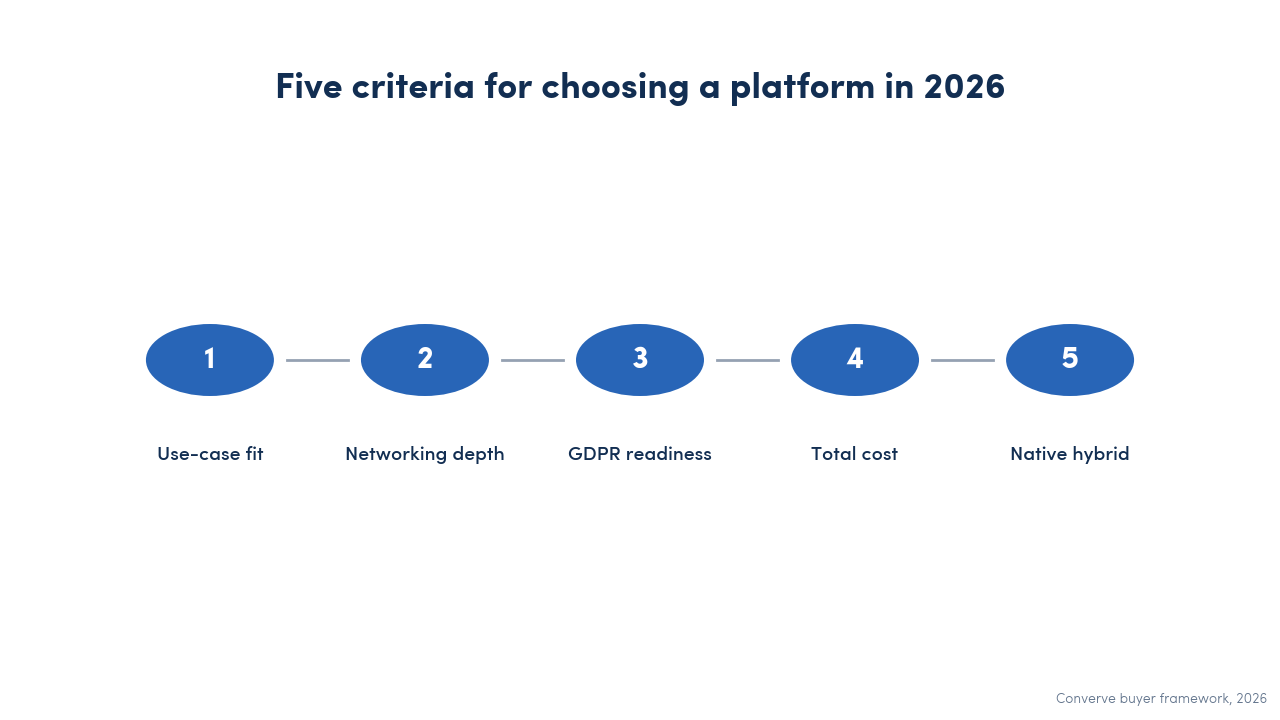
The short version: Stop comparing platforms by feature list. Compare them by your event type. A trade show with 1,200 buyers needs hosted-buyer workflows and rule-based matchmaking. A Demo Day needs investor-side capacity caps and curated matching. A hybrid association needs equal experiences for in-person and remote members. Decide first on use case, then on five criteria: use-case fit, networking depth, GDPR readiness, total cost of ownership at your audience size, and native hybrid support. Then read the comparison.
What is a virtual or hybrid event platform?
A virtual event platform is software that hosts a conference, trade show or webinar entirely online. It bundles registration, live streaming, attendee networking, sponsor visibility and analytics in one system. Attendees join from anywhere, the agenda runs on a digital stage, and engagement is tracked through the platform rather than at a venue door.
A hybrid event platform runs an in-person and an online audience inside the same event. It synchronises registration, agenda, attendee chat and analytics across both modes, so a remote attendee and an on-site attendee see the same speaker, ask the same poll question and can message each other in real time. In 2026, 88 per cent of companies plan to add virtual elements to their in-person events (Statista via gassProductions), so hybrid is the default mode for most B2B programmes, not a niche format.
The practical difference matters when you choose. A virtual-only platform that “added a livestream button” is rarely a good hybrid platform. A real hybrid platform treats the on-site experience as the spine and layers a fully equivalent remote experience on top, with a single attendee directory, a single analytics view and a single agenda. In our guide on hybrid event planning, we go deeper into the production trade-offs.
Why platform choice is harder in 2026
Three forces make this year different.
The first is consolidation, and it is not always orderly. The most-cited cautionary tale is Hopin, which was valued at USD 7.75 billion at the pandemic peak and then sold its Events and Session products to RingCentral in August 2023 for an upfront USD 15 million according to Skift Meetings. Hopin itself exited the events space and refocused on StreamYard and community products. The former Hopin Events product now ships as part of RingCentral Events. The expected acquisition of ON24 by Cvent is the other live consolidation story, and it has pushed many enterprise buyers to revisit their full event stack rather than just their webinar tool. Lesson: before you sign, confirm that the vendor still has a live events product roadmap, not just a marketing site. Buyers now seriously compare Swoogo, Webex Events, vFairs, Whova, RingCentral Events and Hubilo on the same shortlist.
The second is artificial intelligence. Seventy per cent of meeting professionals now use AI in their workflow (gassProductions, 2026), and platforms with AI-powered highlight clips, automated Q&A clustering and personalised agendas report a 60 per cent lift in user-satisfaction scores (vFairs Annual Stats Report, 2026). AI is no longer a marketing word on a sales page. It is a real differentiator in post-event content production and attendee engagement.
The third is buyer fatigue. Setup friction, mid-event downtime and brittle integrations come up repeatedly in 2026 procurement conversations, and “we tolerate it” is a common refrain even from teams that picked their platform two years ago. Switching costs are real, but so is the cost of staying on a platform that is no longer being invested in.
If you are evaluating a platform in 2026, you are evaluating it against a market that is bigger, more competitive and less consolidated than it was three years ago. That is good news for buyers. It also means a careful, criteria-driven shortlist is worth the time.
The five criteria that actually matter
Generic listicles rank platforms on scalability, integrations, customisability and ease of use. Those matter, but they do not help you separate the platforms that will work for your event type from the ones that will not. Use this shorter, more useful set.
1. Use-case fit (the question almost no comparison answers)
What kind of event are you running? A B2B trade show, a Demo Day, a hybrid annual conference for a professional association, a corporate kickoff, a public webinar series? Each has a different shape, and the right platform looks very different in each case.
A trade show needs hosted-buyer workflows, pre-scheduled appointments, sponsor booth analytics and multilingual buyer-seller matching. A Demo Day needs investor-side capacity caps so top funds are not flooded, and curated thesis-based matching. A hybrid association event needs equal experiences for in-person and remote members, plus a community layer that lives beyond the conference week. A corporate kickoff needs branded interactivity and easy mobile access. A webinar series needs a smooth registration funnel and a CRM (customer relationship management) push.
Map your event to one of these shapes before you compare features. Do not let a sales engineer reframe your event to fit their product.
2. Networking and matchmaking depth
This is the biggest hidden differentiator. “Networking” on a platform datasheet can mean almost anything from a chat room to a full rule-based matchmaking engine. Three things separate serious matchmaking from cosmetic networking.
The first is whether matching is rule-based (transparent, audit-trail-able criteria such as buyer category, seller offer and timezone), AI-powered (a black-box recommendation engine that may be faster to set up but harder to defend to sponsors) or both. For a trade show or a hosted-buyer programme, rule-based with an audit trail is usually non-negotiable because sellers want to know why they got the meetings they got. For a startup-investor track, AI may be useful as a supplement to a curated invite list. Our explainer on AI matchmaking at events covers the trade-off in detail.
The second is whether the platform supports a meeting matrix, which lets you cap meetings per attendee, per timezone or per category. Without caps, your top sellers and investors will be flooded.
The third is whether the matchmaking module integrates with the hosted-buyer workflow, including buyer qualification, travel-and-stay logistics for invited buyers and post-event ROI (return on investment) reporting per buyer. Most platforms still treat hosted-buyer programmes as a custom workaround. A few build it in.
3. GDPR readiness and data hosting region
If you are based in the EU or run events for European delegates, this is a procurement showstopper, not a nice-to-have. Ask three questions: Where is attendee data physically hosted? Is the vendor SOC 2 Type II compliant? Will the vendor sign a German Auftragsverarbeitungsvertrag (data processing agreement) without adding US sub-processors you cannot audit?
Most leading platforms tick the first two boxes by 2026. The third is where shortlists shrink. For DACH-based DMOs (destination marketing organisations), associations and corporate event teams, a European-hosted platform with a clean DPA (data processing agreement) is often the only acceptable answer.
4. Pricing model and total cost of ownership at your scale
Sticker prices mislead. A platform priced at USD 119 per month looks cheap until you add per-registration fees, mobile-app add-ons, on-site check-in hardware and a 24/7 support package for the event week. Large conferences with 500 to 2,000 attendees typically end up paying USD 675 to USD 10,000 per month all-in, according to published 2026 industry buyer-guide benchmarks.
Run your own 500-attendee model before you compare quotes. Include the registration tool, the mobile app, the streaming bandwidth, the analytics dashboard, the support hours and any sponsorship-management module. Compare on total cost, not headline price.
5. Native hybrid support (not bolted-on streaming)
Many platforms now say they support hybrid. Fewer do it well. A real hybrid platform shows the same attendee directory to remote and on-site users, lets them chat with each other in one thread, runs polls and Q&A across both audiences and reports analytics in a single dashboard. If hybrid is a separate tab with a separate attendee list, it is not native hybrid.
Watch for two warning signs. First, hybrid features that are an upcharge on top of the virtual plan often indicate retrofitted hybrid rather than native hybrid. Second, separate mobile apps for in-person and remote audiences usually mean two parallel experiences instead of one.
Platform comparison by event type
The most useful way to read this comparison is by event type, not by company size. Find your event below, then read the rest as context.
Best for B2B trade shows, hosted-buyer programmes and multilingual MICE events: Converve
Converve is built around B2B matchmaking and 1:1 meetings rather than around live streaming. The core is a meeting-matrix model that lets organisers define rule-based criteria for buyer-seller matching, with full audit trails for sponsor reporting. Hosted-buyer workflows are first-class, including pre-event qualification, multilingual buyer-seller interfaces and post-event ROI tracking per buyer. Data is hosted in the EU and the platform is GDPR-aligned by default, which is why tourism trade shows, DMOs and convention bureaus use it for events such as Travel News Market and similar buyer-seller programmes.
It is a focused platform, not a do-everything system. If you are running a webinar series for SaaS leads, Converve is not the answer. If you are running a trade show with hosted buyers, a hybrid investor day with rule-based matching or a multilingual MICE event with strict EU data requirements, it is one of the only platforms that handles those workflows as a primary use case.
Best for: B2B trade shows, hosted-buyer programmes, MICE events, tourism boards, convention bureaus, association annual meetings with matchmaking.
Best for investor conferences and Demo Days: Converve and Swapcard
The choice here usually comes down to how much control over matching the organiser wants. Swapcard has a strong reputation for AI-led networking at startup conferences and investor matchmaking. Its recommendation engine is fast to set up and works well when you want a curated-but-still-flexible matching layer. The trade-off is the typical AI-recommendation black box: easy to launch, harder to explain to a top fund that asks “why did we get exactly these 12 founders and not those 12?”. For some events, that opacity is fine. For investor-heavy Demo Days where capacity caps and thesis-fit defensibility matter, it is a problem.
Converve is the right answer when you want the opposite — full control over the matching logic, transparent rule-based criteria that you can defend to investors and sponsors, hard caps per investor or per founder, and an audit trail that survives a post-event question. Combine that with the meeting-matrix model and you can run a 200-founder, 80-VC Demo Day where every meeting can be explained on the basis of thesis fit, stage, geography and capacity, not an opaque recommendation score. Optional AI layers are available on top of the rule-based core, so AI is a supplement rather than a default.
For larger marketing-led portfolios that need a single reporting layer across registration, sponsor analytics and CRM, Bizzabo and Cvent are still strong enterprise candidates (covered below). Read our companion piece on matching founders with the right VCs for the matchmaking logic behind Demo Days.
Best for hybrid associations and member communities: Whova and Webex Events
Whova is the most common choice for hybrid annual conferences run by professional associations, scientific societies and higher-education events. It has a strong attendee-networking layer, an integrated community board and an easy mobile experience. Speaker management, multi-track agendas and award-winning hybrid streaming round out the package. The limitation is that Whova is less suited for highly customised enterprise programmes or for trade-show booth analytics.
Webex Events (formerly Socio) is the favoured choice for associations and corporates that already run on the Cisco stack. It integrates cleanly with enterprise SSO (single sign-on), security tooling and corporate AV (audio-visual) systems. Hybrid is a first-class mode rather than an add-on, and the platform handles large attendee volumes well. Pricing is quote-based and tends to be in the enterprise tier.
Best for webinars, lead-gen and webinar-funnel events: Zoom Events, GoTo Webinar, EasyWebinar
If your “event” is really a webinar or a lead-generation funnel, a full event platform is usually overkill. Zoom Events starts at around USD 124 per month and handles multi-session webinars, hybrid streaming and lightweight monetisation. GoTo Webinar is the long-standing default for B2B webinars with automated registration funnels and CRM push. EasyWebinar focuses on always-on automated webinars and is positioned for marketing teams running scheduled webinar series. None of these are a real choice for a trade show, but they are the right answer for the webinar use case.
Best for immersive virtual environments and trade-show booths: vFairs
vFairs is the strongest choice if you want a visually rich, 3D-style virtual environment with branded lobbies, auditoriums and exhibitor booths. It supports event sizes from 100 to over 10,000 participants and adds on-site check-in gear, badge printing and a mobile app for hybrid setups. The platform is hands-on at implementation and most users rely on the vendor’s support team for backend changes, which is fine for many event teams but limits self-service flexibility.
Best for networking-first conferences: Airmeet and Hubilo
Airmeet is built around social lounges, breakout rooms and immersive networking. The webinar plan starts at USD 199 per month, with the full event plan available on quote. It is a good fit for medium-sized conferences where networking depth is the headline feature and budgets are mid-market rather than enterprise.
Hubilo positions itself for corporate event teams that want to maximise sponsor revenue and engagement across virtual and in-person audiences. Interactivity and gamification are strong points. The platform is quote-based and tends to be priced in the upper mid-market.
Best for enterprise event portfolios: Cvent and Bizzabo
If you run a portfolio of 30 or more events per year and need a single reporting layer across registration, sourcing, sponsor analytics and CRM, the conversation usually narrows to Cvent and Bizzabo. Both are quote-based, both require a real implementation project, and both pay back when the portfolio is large enough to justify the platform overhead. For a single event a year, both are overkill.
Pricing comparison at 500 attendees
Here is a realistic rough-cut model for a single 500-attendee hybrid B2B conference with three tracks, ten sponsor booths and basic mobile-app needs. Numbers are derived from published starting prices and from typical procurement quotes reported by industry buyers in 2026.
| Platform | Starting price (per month) | Realistic event budget (500 attendees, hybrid) | Pricing model |
|---|---|---|---|
| Converve | Quote-based | Mid four-figure to low five-figure EUR per event, including matchmaking module and EU hosting | Per-event or annual subscription |
| Zoom Events | USD 124 | USD 1,500 to 3,500 per event with add-ons | Per-attendee + monthly |
| RingCentral Events | USD 119 virtual / USD 239 hybrid | USD 3,000 to 6,000 per month equivalent | Per-user monthly |
| Airmeet | USD 199 webinar / event quote | USD 4,000 to 8,000 per event | Per-event or subscription |
| Swoogo | USD 817 | USD 10,000 to 15,000 annual baseline | Annual subscription |
| vFairs | Quote-based | USD 8,000 to 18,000 per event | Per-event package |
| Bizzabo, Cvent, Webex Events | Quote-based | Enterprise tier, typically USD 40,000+ annual | Annual contract |
Three notes on this table. First, “starting price” is the headline number on the vendor site, not what you will actually pay. Second, the realistic-budget column assumes a normal sponsor and exhibitor footprint and a mobile-app need. Third, EU-hosted platforms such as Converve are usually price-comparable with the upper-mid-market US options on a per-event basis when matchmaking is the primary need.
How to switch platforms without losing attendee data
If you are considering a switch, the migration risk is real. Follow this five-step pattern.
Begin by exporting your historical attendee data from the current platform in a clean CSV (comma-separated values) format. Include opt-in status, consent timestamp and any custom fields. Confirm with your new vendor that they can import these fields without re-asking for consent. Pilot the new platform on a small internal event first to verify reporting parity. Then migrate one external event of medium size before you commit the flagship event. Keep the old platform contract overlapping with the new one for at least one full event cycle, so you can roll back without dropping attendee data mid-migration.
The most common failure pattern is not the migration itself. It is the marketing automation downstream: attendee data flows into HubSpot or Salesforce, and lists, lifecycle stages or scoring rules break when the source platform changes. Audit those flows before you flip the switch.
Solution: If your priority is B2B matchmaking, hosted-buyer workflows and EU data hosting, Converve is built specifically for that use case and supports a structured migration from Cvent, Bizzabo, Swapcard and other matchmaking-adjacent platforms. We will run a parity check on your existing matchmaking criteria before any data moves. Talk to our team if you want a 30-minute platform-fit review.
Frequently asked questions
What is the difference between a virtual and a hybrid event platform?
A virtual event platform hosts the entire event online. A hybrid event platform runs an in-person and an online audience inside the same event with a synchronised agenda, attendee directory and analytics. Native hybrid platforms treat both audiences as equal; retrofitted hybrid platforms add streaming on top of a virtual product and usually deliver an inferior remote experience.
How much does a hybrid event platform cost in 2026?
For a single 500-attendee hybrid conference, expect a total platform cost of roughly USD 3,000 to USD 18,000 per event depending on features, mobile app and on-site equipment. Enterprise platforms with full sourcing, registration and analytics modules typically start at USD 40,000 per year. Starting prices on vendor websites are not reliable indicators of real budget.
Which platform is best for a B2B trade show with hosted buyers?
Look for native hosted-buyer workflows, rule-based matchmaking with an audit trail, multilingual buyer-seller interfaces and EU data hosting. Converve is built specifically for this use case. vFairs, Swapcard and Whova handle parts of the workflow but typically need custom configuration.
Do I need a separate platform for matchmaking?
Not necessarily. Many event platforms include matchmaking as a module. The real question is whether the matchmaking depth fits your event. If you need rule-based matching with audit trails, capacity caps and hosted-buyer logic, a matchmaking-first platform usually outperforms a general event platform with a matchmaking add-on. Our guide on event networking versus matchmaking explains the difference.
Can I switch platforms mid-programme without losing attendee data?
Yes, with a structured migration. Export historical attendee data in clean CSV with consent timestamps. Pilot the new platform on an internal event first. Migrate a medium-size external event before the flagship. Keep both contracts overlapping for one event cycle. Audit your downstream marketing automation before you flip the switch.
Are AI features in event platforms actually useful in 2026?
Yes for content production (highlight clips, Q&A clustering, personalised agendas) and yes as a supplementary matching layer. AI matchmaking on its own is rarely sufficient for trade shows or hosted-buyer programmes where sponsors want to see why meetings were scheduled. Pair AI with rule-based matching wherever audit trails matter.
Which platforms are GDPR-compliant for DACH organisations?
Converve hosts data in the EU and signs a German Auftragsverarbeitungsvertrag (data processing agreement) without adding US sub-processors. Bizzabo, Cvent and Webex Events offer EU-hosted options and are SOC 2 Type II compliant. Always request the current DPA and the sub-processor list before signing, and check that the data hosting region matches your procurement requirements.
Conclusion
The platform market in 2026 is bigger, more competitive and less loyal than it was three years ago, which is good news if you are buying. The five criteria above give you a working shortlist in less than a day: use-case fit, networking depth, GDPR readiness, total cost at your audience size, and native hybrid support. Apply them in that order. Run your own 500-attendee budget model. Pilot the new platform on a small event before you commit the flagship.
If your event is a B2B trade show, a hosted-buyer programme or a multilingual MICE format, talk to us. Converve is built for that use case, EU-hosted by default and integrates with the matchmaking workflows your sponsors will ask about. Request a 30-minute platform-fit review and we will walk through your event type, your data requirements and the realistic budget at your audience size.