
How to Match Founders with the Right VCs: A Conference Organiser’s Playbook
Most articles on this topic are written for founders looking for the right venture capitalist (VC). This one is not. This one is for the conference organiser who has to make 200 founders meet 80 investors in two days without leaving anyone disappointed.
The problem is rarely a lack of people in the room. The problem is that random networking produces random results, while pre-scheduled meetings with the wrong investors produce a flood of polite no-shows. In the next 2,000 words you will learn the seven layers that actually predict a productive founder-investor meeting, how Slush, Web Summit and Bits & Pretzels handle matching at scale, and the five-phase playbook you can adopt for your own event.
TL;DR. Investor-founder matchmaking at a conference is the structured process by which an event organiser pairs participating founders with venture capitalists based on investment thesis, funding stage, sector focus, geography, and ticket-size fit, and confirms each meeting via double opt-in before the event begins.
Why “Random” Networking Doesn’t Work Anymore
Investors used to attend conferences for serendipity. Today they attend for curated deal flow. Analysis published by RAISE Summit in February 2026 describes the shift as “deal flow density” beating “scale”: a curated summit with 100 pre-qualified founders now beats a generic tech fair with 1,000 unfiltered ones, because the investor’s time is the scarce resource.
That shift forces the organiser to take a position. You are no longer running a venue. You are running a marketplace, and the value you deliver is the precision of the match. Forbes summed it up about Web Summit in January 2026: “Web Summit’s matchmaking platform is genuinely good, probably the best among large conferences.” Notice the framing. The event is judged on its app, not on its stage.
The data backs the framing up. Techstars research cited by Capwave shows that founders who attend two to three high-quality events per quarter build stronger investor relationships than founders who attend six or more. Investors apply the same calculus. If your conference does not pre-qualify, top funds will skip you and go to the event that does.
The Three Mechanisms of Investor-Founder Matching
Before designing your matching engine, understand the three mechanisms in use today. Most successful events combine all three.
- Algorithmic pre-matching: A software platform analyses each founder’s stage, sector, geography and ticket size, compares them against each investor’s stated thesis and past investments, and recommends the top candidates on both sides. This is what Web Summit’s app and the more recent generation of business matchmaking platforms do.
- Curated human matching: A team of experienced matchmakers reviews the lists and overrides the algorithm where appropriate. Bits & Pretzels runs more than 70 trained matchmakers as a human layer on top of the platform. The humans catch context the algorithm misses, such as a founder who is technically Series A but pitching a Pre-Seed spinout.
- Open opt-in marketplaces: Founders see the list of attending investors, send meeting requests, and the investors accept or decline. This is the marketplace model used by Slush. It works when both sides are pre-qualified, because the cost of a bad request is low, but the quality is high.
The mistake is to pick only one of these. Algorithmic matching alone produces robotic pairings. Human-only curation is unscalable beyond 50 founders. Pure opt-in marketplaces overwhelm the top investors. The combination delivers volume and quality, which is what the next sections will help you build.
The Seven Match Layers That Actually Predict Productive Meetings
A meeting is productive when both sides leave with a defined next step. To produce that outcome reliably, your matching system should screen each potential pair through seven layers, in this order.
- Stage match: Pre-Seed founders waste Series B investors and vice versa. Most early-stage VCs say so explicitly. Filter on funding stage first, because it cuts the longest tail.
- Sector match: Match the founder’s vertical to the investor’s stated focus areas. Vertical Software, AI infrastructure, Climate, Fintech, and Healthtech are the dominant 2026 buckets. Generalist investors are the exception, not the rule.
- Geography match: Apply geographic constraints where they exist. US investors often need a US entity for governance reasons. European investors prefer European GDPR-compliant cap tables. Cross-border deals happen, but at lower conversion rates.
- Ticket-size match: The check the investor writes must match the round the founder is raising. A €25 million growth fund looking at a €500K Pre-Seed founder is a courteous waste of both sides’ time.
- Thesis alignment: Look beyond the headline thesis at the actual portfolio. An investor whose last six investments were B2B SaaS will not suddenly back consumer hardware, regardless of what their website says. Past behaviour predicts future allocation.
- Capacity cap: No investor produces 25 productive one-to-one meetings in a single day. Realistic ceilings sit at 8 to 12 high-quality conversations daily. Cap the algorithm so top investors are not blown out by request volume.
- Double opt-in: The final filter, and the one most algorithms forget. A meeting only confirms when both sides have actively agreed. This is non-negotiable, because every unconfirmed meeting damages both reputations. Echelon’s 2026 communication put it well: “Every meeting has a reason to exist. Both sides opted in. Both sides are relevant to each other.”
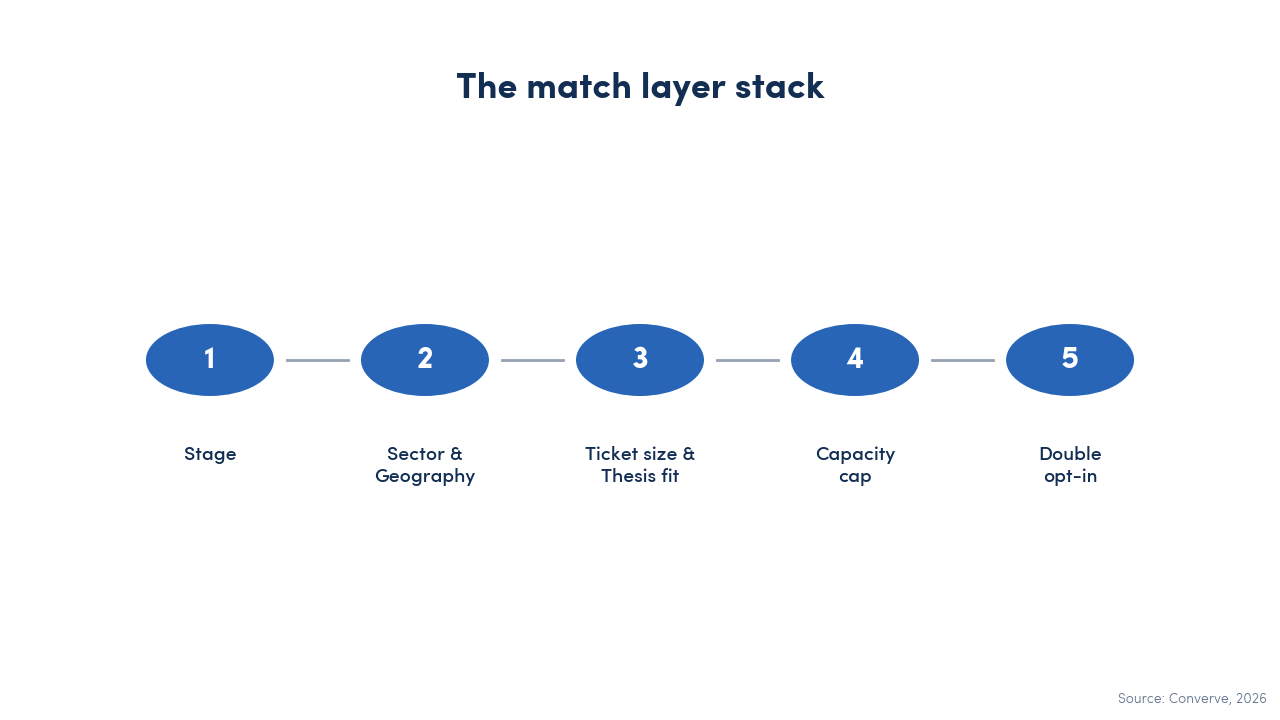
If you implement these seven layers properly, you will find that the throughput of your event drops on paper, but the conversion to follow-up meetings rises sharply. That trade-off is the goal.
How Slush, Web Summit and Bits & Pretzels Run It
Three European flagship events have built mature matchmaking engines, each with a distinct philosophy. Studying them is the fastest way to calibrate your own.
Slush, Helsinki. Roughly 13,000 attendees, of whom about 5,000 are startup founders and 3,300 are investors. That ratio matters: 70 per cent of all attendees are either pitching or buying. Slush facilitated more than 21,000 pre-booked one-to-one meetings across two days in 2024, up from about 10,000 in 2019. The My Slush app uses a request-and-accept model with strong upfront curation: founders apply for the investor stream, and investors confirm the meetings they value. The model works because both sides have been screened before they ever open the app.
Web Summit, Lisbon. Over 70,000 attendees and a dedicated investor lounge. Web Summit’s matchmaking platform organises tens of thousands of meetings and is consistently rated as the best app among the large generalist conferences. The trade-off Web Summit makes is volume: there are more random encounters in the corridors, but the app gives serious investors a curated path through the chaos.
Bits & Pretzels, Munich. About 7,500 attendees and more than 1,500 investors with a combined €390 billion of AuM (assets under management). Bits & Pretzels pairs algorithmic matchmaking with two human layers: 70 plus trained matchmakers who guide founders through the platform, and 270 plus Table Captains who host curated lunch tables at the Oktoberfest finale. The format works because the informality lowers the access bar to investors who would otherwise decline a cold meeting request.
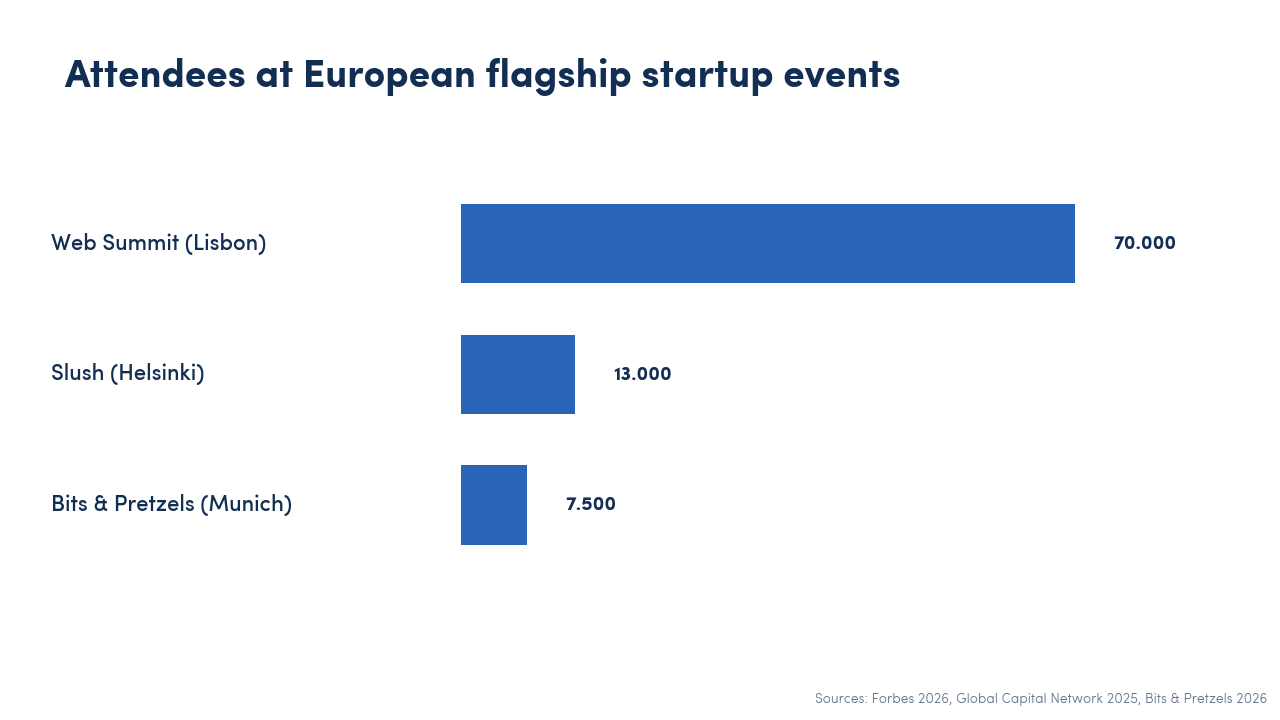
The pattern across all three is consistent. The pitch stage is the headline, but the matchmaking platform is the engine. Organisers who buy only the headline get applause. Organisers who buy the engine get follow-ups. If you want a deeper view of the Slush, Web Summit and Bits & Pretzels deal-making formats, see our companion piece on what a demo day really is and how to run one.
The Organiser’s Playbook in Five Phases
Adapt the following five-phase sequence to your own event. The phases stack: you cannot skip ahead without paying for it later.
Phase 1: Pre-event curation (four to six weeks out). Decide who gets in on both sides. Apply hard filters on funding stage, sector, geography and ticket size. Reject politely but firmly. The temptation to widen the funnel for ticket revenue is real, and it is wrong. Every unqualified founder you accept costs you investor goodwill.
Phase 2: Profile enrichment (two to three weeks out). Push both sides to complete their profiles in depth. Founders need to upload a one-page pitch summary, current round size, lead status, traction metrics and prior round details. Investors need stage, sector, ticket range and geography. Auto-flag profiles that are less than 70 per cent complete and chase them. Profile quality is the single biggest predictor of match quality downstream.
Phase 3: Slot scheduling (one week out). Open the matchmaking app to both sides at the same time. Operate it as a marketplace: founders send requests, investors accept. Cap investor inboxes at 30 to 40 active requests so no fund partner sees an inbox of 200. Apply a double-opt-in rule. Publish slot times only after both sides have confirmed.
Phase 4: Live matching adjustments (during the event). Reality on the ground always differs from the plan. Founders cancel because of travel issues. Investors arrive late or want to add meetings on day two. Maintain a small ops team with the authority to insert ad-hoc meetings within the existing slot structure. Track no-shows in real time and reassign slots to the standby list.
Phase 5: Post-event follow-up. The conference ends. The opportunity does not. Push both sides to log their follow-ups inside the platform: which meetings produced a follow-up call, which produced an offer to participate in due diligence, which produced nothing. Use this data to refine your matching algorithm for the next edition, and to write a credible benchmark line into your investor outreach next year.
KPIs That Tell You If the Match Worked
Most organisers measure the wrong things. Attendance is a vanity metric and pitch-stage applause is unmeasurable. Replace them with four indicators that reflect actual deal motion.
- Confirmed-meeting density: Average number of confirmed one-to-one meetings per attending investor. Slush sits north of 20 in two days. If your own event is below 10, the matching engine is underperforming.
- Follow-up conversion: Percentage of meetings that produced a follow-up exchange within 48 hours. Capwave benchmarks the well-prepared range at 20 to 30 per cent. If yours is below 10 per cent, the pre-qualification is too loose.
- Investor re-booking rate: Percentage of attending investors who confirm for next year before they leave the venue. This is the cleanest single signal that the match quality satisfied them.
- Diligence-stage outcomes: Number of conversations that progress to formal due diligence in the 90 days after the event. The hardest metric to track, and the only one a CFO will care about.
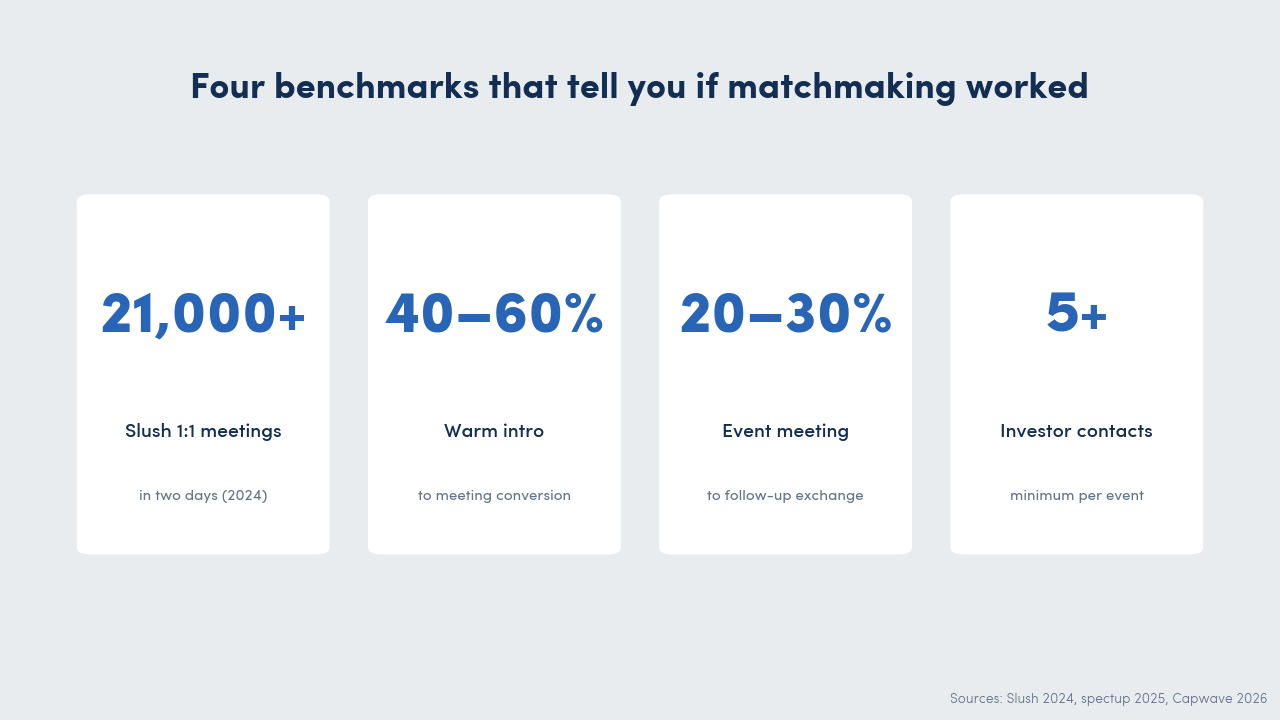
Track these in a single sheet across editions and you will have a credible deck for next year’s investor partner outreach. For a broader KPI framework that translates these signals into a benchmark you can defend in front of a board, see our work on structuring demo days for maximum investor follow-ups.
Common Pitfalls and How to Avoid Them
- Overloading top funds: If a Sequoia or Index Ventures partner attends, every founder will request them. Cap the inbox. The top investor protected from spam is the top investor who returns next year.
- Stage drift in the algorithm: Marketing your event as “Series A focus” while letting Pre-Seed founders through the door erodes investor trust. Be honest about who actually attends.
- Geography ignored: Putting a US-only fund in front of a Berlin Pre-Seed founder produces a polite no. Apply the geography filter before scheduling, not after.
- No double opt-in: Forcing investors into meetings they did not confirm is the fastest way to lose them. Treat the second opt-in as a hard requirement, not a UX nicety.
- No post-event data loop: Without follow-up tracking, every edition starts from zero. The compounding value of a matchmaking engine comes from the data it accumulates.
Solution: A Matching Engine Built for Organisers
Solution. Converve gives event organisers a configurable matching engine that operationalises all seven layers in this article. Investor and founder profiles capture stage, sector, geography, ticket size and thesis. The algorithm produces a ranked match list. The human-curation layer lets your team override it. Capacity caps and double opt-in are built in. The KPI dashboard surfaces confirmed-meeting density and follow-up conversion in real time, so you can see what works before the conference ends.
Conclusion
Matching founders with the right VCs is no longer a side feature of a startup conference. It is the product. Decide which of the three mechanisms suit your event, apply the seven match layers, and operate the five-phase playbook. The result is fewer meetings, higher quality, and an investor cohort that re-books for next year.
You want to compare matchmaking engines for your next event? Book a demo with the Converve team and we will walk you through the configuration that matches your conference profile.