Hosted Buyer Programme vs. Open Registration: Which Format Delivers More Qualified Meetings?
A well-run hosted buyer programme closes 79 per cent of its pre-scheduled meetings. A typical open-registration trade show fails to follow up on 79 per cent of the leads it captures. The number is the same; the direction is opposite. For destination marketing organisations (DMOs), convention bureaus, and tourism trade-show producers deciding how to structure next year’s event, that gap is the central question.
The hosted buyer model is no longer the only premium option on the table. Open registration has matured. A new hybrid format, often labelled “visitor buyer”, has emerged at IBTM World 2025 and is spreading. In this guide we compare the three formats on cost, meeting guarantees, match quality, and discovery breadth, then give you a clear decision matrix to pick the right one for your show.
TL;DR. Hosted buyer programmes suit curated, high-stakes deal-making where deal sizes justify subsidised travel. Open registration suits broad market discovery, regional shows, and tight margins. Hybrid models combine both audiences and have become the default at large MICE trade shows such as IMEX, which currently hosts roughly 3,500 buyers in Frankfurt alongside 900 to 1,200 self-paying buyers.
What is a Hosted Buyer Programme? What is Open Registration?
A hosted buyer programme is a curated event format in which the organiser pre-qualifies senior buyers and covers their travel, accommodation, and meals in exchange for committing to a set number of pre-scheduled one-to-one meetings with exhibitors. The model emerged in the meetings, incentives, conferences and exhibitions (MICE) industry in the 1990s and now defines flagship tourism trade shows including IMEX, IBTM, The Meetings Show, and ITB Asia.
Open registration is the traditional trade-show format in which any qualifying professional registers and attends at their own cost. Buyers walk the show floor freely, drop into booths, attend sessions, and arrange meetings as they go. The format dominates regional and consumer-adjacent shows, where attendance volume matters more than pre-curated commercial outcomes.
A hybrid or visitor-buyer model sits between the two. The buyer pays a premium ticket fee in exchange for full meeting-platform access, lead-capture tools, and pre-scheduling capability, but without the strict meeting quota of a fully hosted programme. IBTM World 2025 in Barcelona launched the model at €399 early bird and €499 late, and other large trade shows are studying the playbook.
The Three Trade-Show Formats Side-by-Side
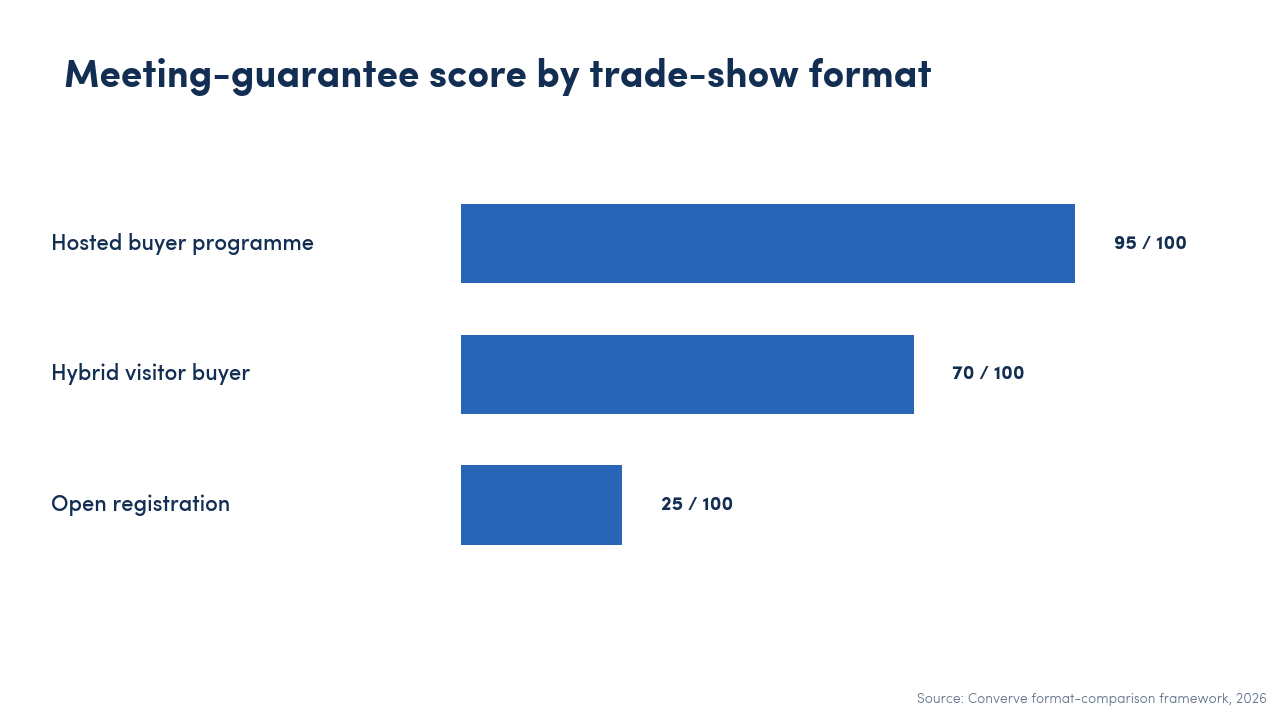
Each format makes a different trade-off between buyer commitment, organiser cost, and the predictability of commercial outcomes. The table below summarises the three on the dimensions that matter most when you brief a board or a tourism ministry on which model you intend to run next year.
| Dimension | Hosted Buyer | Open Registration | Hybrid / Visitor Buyer |
|---|---|---|---|
| Buyer pays for attendance | No (organiser subsidises) | Yes | Yes (premium tier) |
| Meeting quota commitment | Yes (typically 8 to 20) | No | Optional |
| Pre-scheduling platform access | Full | Limited or none | Full |
| Organiser cost per buyer | High (€1,500 to €4,000) | Low | Low to medium |
| Match quality | High (pre-vetted) | Variable | Self-selected |
| Discovery breadth | Narrow (curated roster) | Wide | Medium |
| Exhibitor ROI predictability | High | Low | Medium |
| Best suited to | International deal-making | Regional discovery | Mid-to-large mixed shows |
The table is the headline; the next four sections explain when each format actually wins.
Where Hosted Buyer Programmes Win
The hosted model wins whenever deal economics justify the hospitality investment and exhibitor renewal depends on demonstrable meeting outcomes. Four scenarios make the case clearly:
- International tourism trade shows: when buyers cross borders to attend, organic attendance is unreliable. IMEX, IBTM World, and ITB Asia all use hosted programmes precisely because their buyer base is globally distributed and unwilling to self-fund speculative travel.
- High-ticket procurement categories: destination marketing, convention venues, group-travel contracting, and corporate-events sourcing involve annual deal values well into six figures. Subsidising a buyer’s €2,500 trip to secure a €250,000 contract is a defensible margin.
- Exhibitor renewal depends on measurable meetings: if your sellers buy stands on the promise of qualified introductions, a hosted programme is the only format that delivers a written meeting quota. Without it, exhibitor satisfaction collapses to luck.
- Public-sector accountability: tourism boards, convention bureaus, and trade ministries answer to budget committees that ask “what did the event produce”. A hosted programme produces traceable meetings, follow-up surveys, and signed-business data; an open show produces footfall.
The benchmark to beat is roughly 79 per cent meeting completion, with 100 per cent fulfilment of contracted meeting quotas, the level that Swapcard reported for the GovAI Summit 2025 hosted buyer rollout. ExpoPlatform reported that pre-event meeting requests grew by 4.5 per cent year on year in 2025, an indicator that buyers themselves prefer the structured format.
Where Open Registration Wins
Open registration is the right choice more often than hosted-buyer evangelism admits. It wins under four conditions:
- Regional shows with strong organic attendance: when buyers are local, motivated, and self-funded already, paying to fly them in adds cost without lifting outcomes. National hospitality shows, regional MICE exchanges, and city-level travel trade events typically belong here.
- Exploratory or mass-market discovery: consumer travel shows, destination-promotion fairs aimed at small operators, and product-launch contexts all prioritise breadth over depth. According to the Center for Exhibition Industry Research (CEIR), 67 per cent of trade-show attendees are completely new prospects for exhibitors. Open registration is the format that maximises that discovery rate.
- Tight exhibitor margins: when stand pricing has to stay accessible to small DMCs (destination management companies), small tour operators, and emerging destinations, the load of a hosted programme is too high. Open registration keeps the cost base lean.
- Brand-led attendance: if your trade show’s brand alone drives attendance (think the long heritage of ITB Berlin or FITUR Madrid), incentivising buyers with paid travel is often unnecessary. The brand does the work.
The honest counterpoint is the follow-up problem. CEIR data, popularised in Lensmor’s 2026 lead-capture analysis, shows that 79 per cent of trade-show leads receive no follow-up at all. Open registration produces volume; turning that volume into pipeline requires post-show discipline that many exhibitors simply do not have.
The Hybrid Middle Ground: Visitor-Buyer Models
The most interesting recent development is the rise of the hybrid visitor-buyer model. Under the old rules, buyers had to complete a set number of meetings to qualify for airfare and hotel. At IBTM World 2025 in Barcelona, organisers launched a parallel “Visitor Buyer” option: a paid premium ticket (€399 early bird, €499 late) that grants full meeting-booking access without any meeting quota.
The logic is simple. Buyers want control over their own time. Carina Bauer, CEO of IMEX, told Skift Meetings in mid-2025: “Our model is centred around the needs of the buyer.” IMEX has long offered multiple formats in parallel. At a typical IMEX Frankfurt show, around 3,500 buyers attend on hosted terms; another 900 to 1,200 attend on open or self-paid tickets. That roughly 75/25 hosted-to-open mix is the current MICE trade-show standard.
The hybrid model unlocks two things at once. It lifts the ceiling on buyer numbers without inflating the hospitality bill. And it produces a self-segmenting buyer roster: hosted buyers commit deeply, visitor buyers explore opportunistically, and exhibitors see both pre-scheduled meetings and walk-up traffic. The downside is operational complexity. You now run two programmes in parallel, with two registration flows, two contractual frameworks, and two reporting layers.
What the Numbers Say
The case for each format is rarely settled by debate; it is settled by data. The benchmark figures below are the ones to anchor on when you build a board paper or a sponsor pitch.
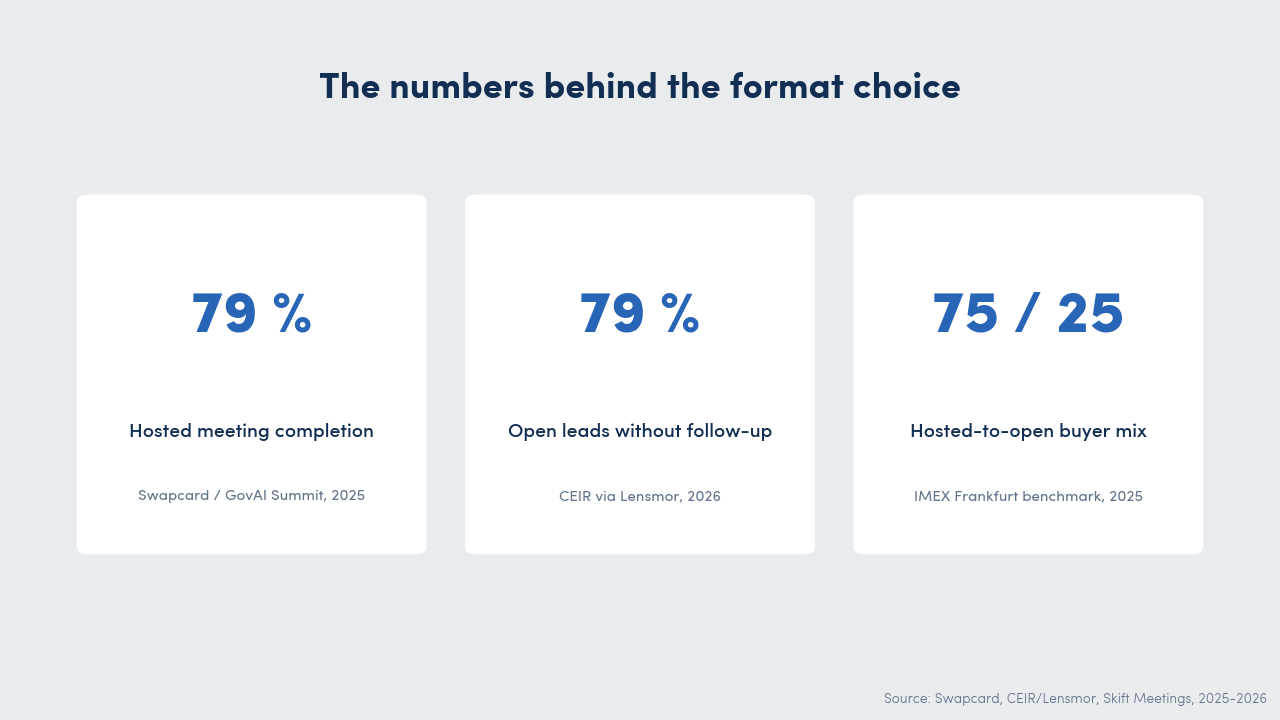
- 79 % meeting completion rate: the Swapcard hosted-buyer benchmark from GovAI Summit 2025. Programmes below 70 % are leaking value somewhere in qualification, scheduling, or follow-up.
- 100 % fulfilment of contracted meeting quotas: the same benchmark for what buyers actually receive against what was promised to exhibitors. This is the number that drives exhibitor renewal.
- 79 % of trade-show leads receive no follow-up: CEIR data via Lensmor, 2026. The mirror image of the hosted figure, and the strongest single argument against running pure open registration without a structured meetings layer.
- 81 % of trade-show attendees have purchasing authority: CEIR. Exhibit Surveys puts the number even higher at 84 %. Both formats reach decision-makers; the difference is what you do with the access.
- 67 % of attendees are completely new prospects: CEIR. The single strongest argument in favour of preserving an open-registration tier even in otherwise hosted-led shows.
- +4.5 % year-on-year growth in pre-event meeting requests (2024 to 2025): ExpoPlatform case data. Pre-scheduled formats are growing faster than open formats.
- Global MICE market: 1.34 trillion US dollars in 2026: Straits Research and Ezus 2026 data. The market grows; the format question is how much of that growth your event can capture.
Decision Matrix: Which Format for Which Event
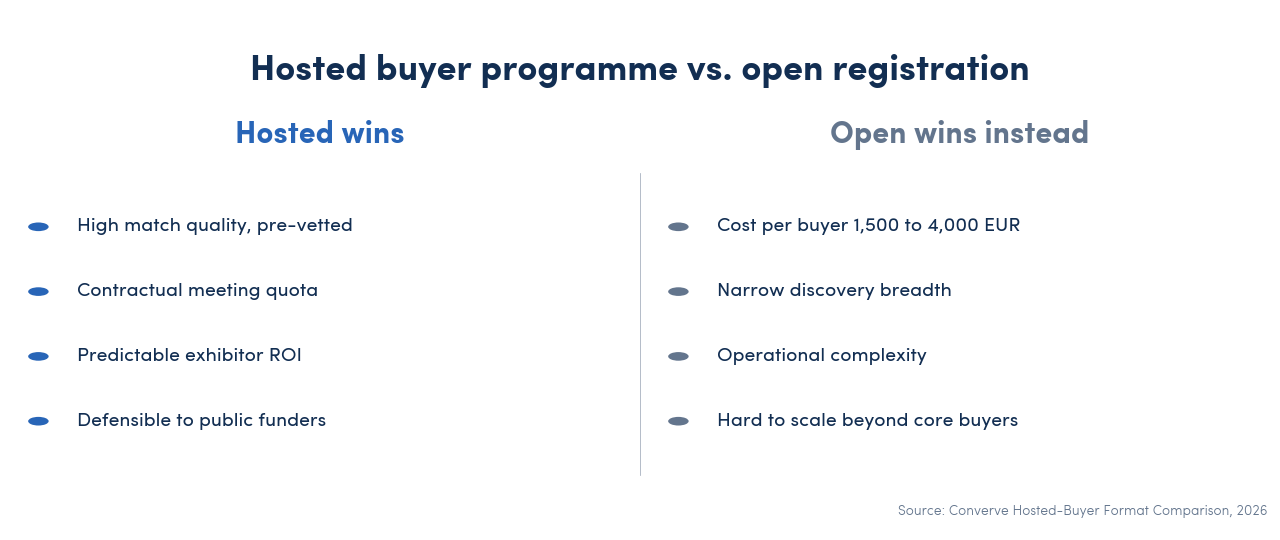
The decision is not philosophical. It is mechanical. Six event characteristics determine the right format. Score each, then read the matrix.
| Event characteristic | Signal toward Hosted | Signal toward Open | Signal toward Hybrid |
|---|---|---|---|
| Average deal size | Over €50,000 | Under €10,000 | Mixed |
| Buyer geography | International, multi-continent | Regional or national | Continent-wide mix |
| Exhibitor base | Premium, contract-driven | Small operators, margin-thin | Tiered exhibitor list |
| Event size | 500 to 4,000 qualified buyers | 10,000+ general attendees | 5,000 to 15,000 attendees |
| Brand pull | Format-led | Strong show brand | Established but evolving |
| Public-sector funding | Yes, with accountability burden | Self-funded by exhibitors | Partial public support |
Four or more rows pointing the same direction is your answer. A split scorecard usually means hybrid, which is also why the hybrid model has spread so fast: it absorbs ambiguity in a way the two pure formats cannot.
What a Hosted Buyer Programme Actually Costs
The unspoken obstacle to running a hosted programme is the per-buyer cost. The four cost blocks are predictable and worth sketching honestly when you compare formats.
- Travel and accommodation: typically €800 to €1,800 per international buyer, depending on origin region and host city pricing. Long-haul Asia-Pacific buyers can run higher.
- On-site hospitality: catering, transfers, welcome reception, gala dinner. Plan €250 to €500 per buyer across a three-day show.
- Platform and matchmaking technology: licence fees for a B2B matchmaking platform scale with buyer numbers but rarely exceed €15 to €40 per buyer for established events. Internal-team setup time is the larger hidden cost.
- Programme management: dedicated hosted-buyer manager, qualification reviewers, on-site concierge team. For a show with 500 hosted buyers, plan two to three full-time roles for the three months around the event.
Total cost per hosted buyer typically lands between €1,500 and €4,000. Compared with the lifetime contract value of a qualified tourism buyer, the maths usually work; but only if the qualification bar is honest and the matchmaking platform actually delivers. Cut either, and the spend produces footfall, not pipeline. For a deeper operational walkthrough, see our step-by-step guide to running a hosted buyer programme.
Solution: Converve runs hosted, open, and hybrid formats inside a single B2B matchmaking platform. The same engine handles application qualification, diary build, in-person and hybrid meeting modes, multi-language interfaces for international buyer rosters, and post-event reporting back into your customer relationship management (CRM) system. For a wider view of the tooling landscape, see our overview of the top event networking apps.
Conclusion
The hosted buyer versus open registration debate has matured into a three-way choice. Hosted programmes still produce the highest-quality meetings and the most defensible exhibitor return on investment, especially in international tourism trade shows. Open registration still wins on cost, scale, and discovery breadth, particularly at regional or brand-led events. The hybrid visitor-buyer model now absorbs the messy middle, and we expect it to become the default at mid-to-large MICE trade shows over the next two seasons.
The format choice is upstream of every other decision in your event design. Match it to your audience, your deal economics, and your exhibitor renewal model. If you would like to talk through which format makes sense for your next event, you can contact our team for a working-session walk-through.
Frequently Asked Questions
Can a single trade show run hosted and open registration at the same time?
Yes. The hybrid visitor-buyer model is exactly this combination. IMEX has run parallel hosted and self-paid buyer tiers for years; IBTM launched a paid visitor-buyer option in 2025. The operational requirement is a matchmaking platform that supports both flows inside one event and clearly separated commitments for each tier.
What is the minimum number of pre-scheduled meetings a hosted buyer should commit to?
Eight per day is the working benchmark in the MICE category. Some shows go to ten on the busiest days, but completion rates fall when you push beyond that without rest gaps. The Meetings Show 2026 publishes its commitment as six to eight per day with masterclasses and familiarisation trips layered on top.
How long before the show should a hosted buyer programme open applications?
Twelve weeks before the event is the comfortable window. Earlier than that and travel pricing is volatile; later than that and your best buyers are booked elsewhere. Run two qualification waves, with a hard application close at six weeks out.
How do you measure the return on investment of a hosted buyer programme?
Measure four things: meeting completion rate (the operational health metric), buyer satisfaction (the renewal-of-buyer metric), exhibitor pipeline lift at 90 days (the commercial outcome metric), and exhibitor renewal rate at the following year (the trust metric). A hosted programme that hits 79 per cent completion and 70 per cent exhibitor renewal is operating at industry benchmark.
Is open registration suitable for international tourism trade shows?
Rarely as a standalone format, but useful as a secondary tier. International buyers are unwilling to fund speculative long-haul travel, which is why the hosted model became standard in MICE. Adding an open tier on top of a hosted core is the hybrid model and is increasingly the default for shows above 5,000 attendees.
What is the typical mix between hosted and open buyers at a flagship show?
Roughly 75 per cent hosted to 25 per cent open, based on the IMEX Frankfurt benchmark of around 3,500 hosted buyers and 900 to 1,200 self-paid buyers per edition. Smaller MICE shows lean further toward hosted; larger consumer-adjacent travel shows lean further toward open.