Best Event Networking Apps 2026: AI Matchmaking, Pricing, and How to Pick the Right One
A decade ago, an event networking app meant a digital attendee list with a search bar bolted on. In 2026, attendees expect something closer to a personal concierge: AI matchmaking that recommends the right meetings, pre-event preparation that surfaces buyer intent before doors open, and an integration layer that pushes leads straight into the CRM. The number of platforms has multiplied, the price spread has widened, and the gap between the best-in-class and the average is now obvious within the first session. With our guide on the 12 leading event networking apps for 2026, you will know exactly what features to insist on, how the major platforms compare, and which one fits the type of event you actually run.
Why Event Networking Apps Look Different in 2026
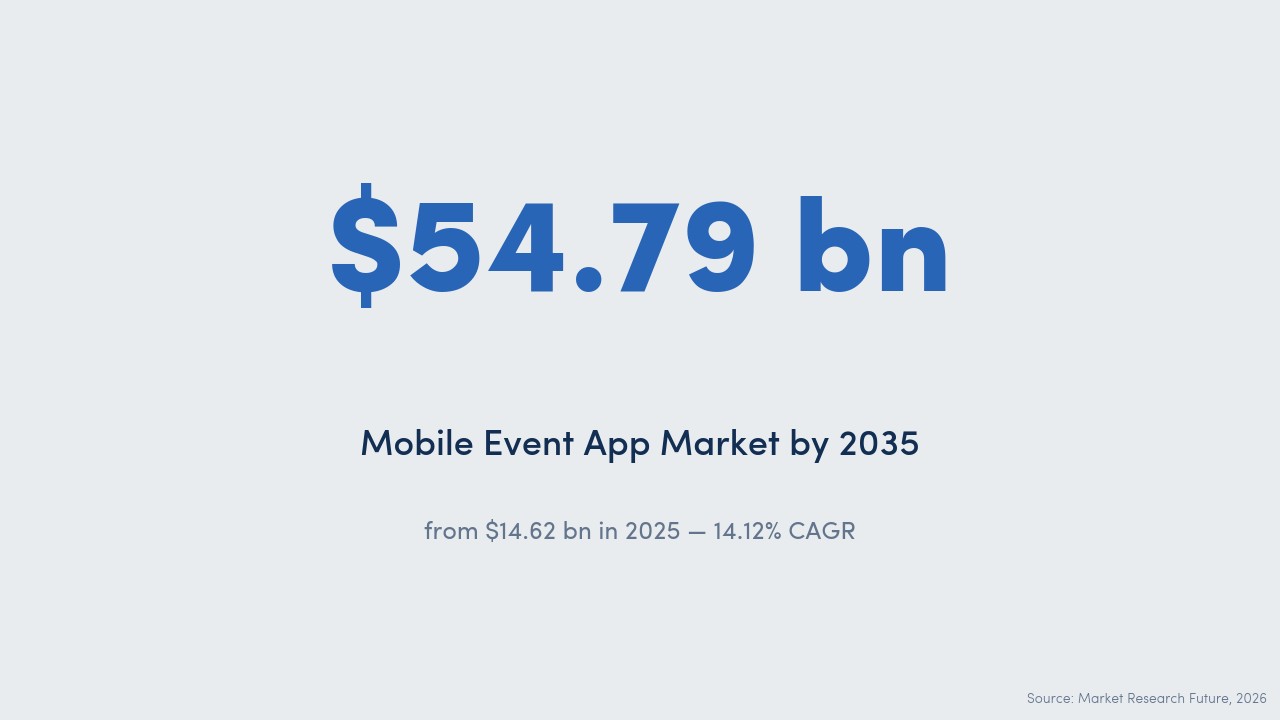
The mobile event app market sat at $14.62 billion in 2025 and is on track to reach $54.79 billion by 2035, a compound annual growth rate of 14.12 per cent (Market Research Future, 2026). That growth is not driven by new venues or larger audiences — it is driven by AI, and by the shift from passive event apps to active intelligence layers that touch every stage of the attendee journey.
Three macro shifts define the 2026 category:
- AI matchmaking has become the baseline, not the differentiator. Bizzabo’s Event Marketing Statistics 2026 found that 95 per cent of event professionals expect their organisation’s use of AI in events to grow this year. Buyers no longer reward vendors for having an AI feature — they penalise vendors that do not.
- Pre-event preparation is where ROI is decided. The phrase that keeps appearing in vendor positioning is the move from “who is here” to “who should I meet, and why”. Profile data, stated goals, and CRM signals collected before the event determine the quality of every match made on-site.
- Integration is now the price of entry. Roughly 79 per cent of event organisers have their event platform connected to a CRM or marketing-automation tool (Agorify, 2025/26). Vendors that cannot push attendee and meeting data into Salesforce, HubSpot, or a Marketing Cloud quietly drop out of shortlists.
For event planners, the practical question has changed. It is no longer “do I need an app?” — 67.5 per cent of attendees consider a mobile event app a crucial part of the event, and 55 per cent say it can make or break their experience (Agorify, 2025/26). The new question is which app fits which kind of event.
Two Categories of Event Networking Apps
The 2026 market splits into two distinct categories, and confusing them is the most common mistake we see at vendor selection.
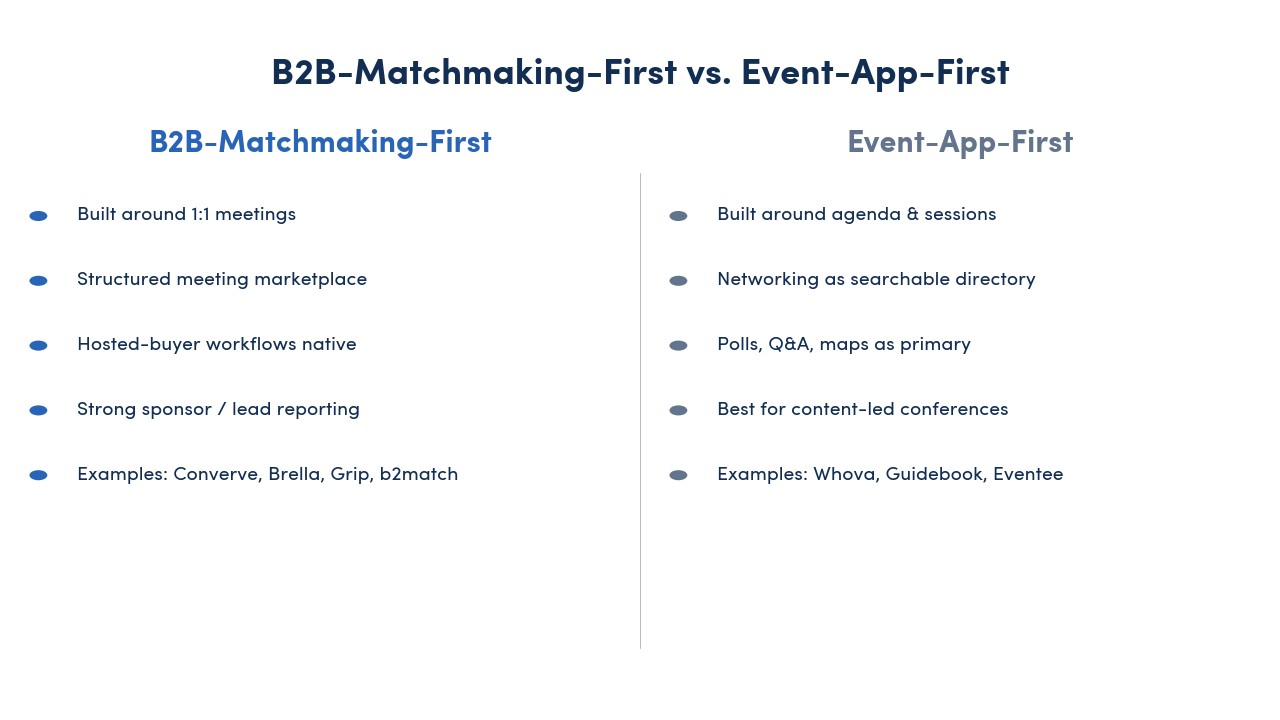
B2B-Matchmaking-First platforms. These tools are built around 1:1 meetings as the central event format. The matchmaking engine, meeting scheduler, and lead-capture flow are the product — the agenda, maps, and push notifications are supporting features. Examples: Converve, Brella, Grip, b2match. Use them when meeting volume and quality is the metric your sponsors and exhibitors care about. Trade shows, hosted-buyer events, MICE programmes, and B2B conferences with sponsorship inventory all sit in this category.
Event-App-First platforms. These tools start from the agenda, sessions, and content — networking is a feature alongside live polls, Q&A, and floor plans. The matchmaking engine is usually a directory with smart search rather than a structured meeting marketplace. Examples: Whova, Guidebook, Eventee, EventMobi. Use them when content is the centrepiece and networking is a layer on top — for general conferences, association meetings, and university events.
You can absolutely run a B2B trade show on an Event-App-First platform, or a content-led conference on a B2B-Matchmaking-First platform. The trade-off is that you will pay for capacity you do not need or fight against a tool that was not designed for your model. Picking the right category is worth more than picking the strongest brand inside the wrong category.
7 AI Features Every 2026 Event Networking App Should Have
If a vendor cannot show you these seven capabilities in a live demo, treat them as a 2024-era platform with a 2026 sales deck.
- Behaviour-signal matching: Matches built on profile data plus session attendance, past interactions, and stated goals — not just shared tags. This is the difference between guessing and recommending.
- AI attendee copilot: A conversational assistant inside the mobile app that answers attendee questions, navigates the agenda, and surfaces sessions, speakers, and matches in plain language. Bizzabo’s “Bizzy” is the reference implementation.
- Pre-event intent capture: Goal surveys, meeting wish-lists, and CRM-linked profile data collected before the event so the first match suggestion lands on day one, not day three.
- Dynamic personalised agendas: Each attendee sees a different running order, with sessions and networking slots reordered around their goals.
- MCP / API integration with external AI tools: Swoogo became the first event vendor to ship a native Model Context Protocol server in early 2026, so an attendee or organiser can query event data directly from ChatGPT, Claude, or an in-house copilot. Treat this as where the category is heading.
- Real-time event intelligence for organisers: Dashboards that surface adoption rates, session resonance, and engagement heatmaps while the event is still running, so you can intervene rather than diagnose afterwards.
- AI translation and accessibility as defaults: Live speaker translation and accessibility features have moved from nice-to-have to measurable performance metric. International events without these now lose significant attention from non-English audiences.
The 12 Best Event Networking Apps for 2026
We have ranked the 12 platforms most often shortlisted by serious event organisers in 2026, with a clear “best for” pointer so you can spot your category quickly.
1. Converve
Best for: B2B matchmaking events, trade shows, hosted-buyer programmes, MICE and tourism trade events, association meetings in DACH and the EU.
Converve has been a B2B-Matchmaking-First platform for over twenty years and is the choice for event organisers whose sponsors and exhibitors are paying for meetings, not for ticket access. The platform combines profile-based matchmaking, structured 1:1 meeting scheduling, hosted-buyer workflows, and a mobile event app — built so that 90 per cent of meetings on-site are pre-scheduled and the remaining 10 per cent are filled through walk-up matchmaking. AI-supported recommendations factor in stated goals, behaviour signals, and supplier-buyer fit. EU-hosted infrastructure, full GDPR compliance, and multi-language support make Converve the default for European trade fairs, tourism trade shows, and pan-European association events. Pricing is per-event with transparent quotes for hosted-buyer extensions and is generally accessible to mid-sized organisers from a few hundred attendees upward.
2. Brella
Best for: Large enterprise B2B conferences with five-figure attendee counts.
Brella positions itself around AI-powered matchmaking refined over a decade of conference data and is the go-to choice for very large enterprise B2B events with substantial sponsorship inventory. The matching engine handles multiple meeting formats — one-to-one, sponsor, mentor-mentee, investor — and integrates with Brella’s own ticketing and registration stack. Pricing is enterprise and quoted per event, which makes Brella a strong fit at the top of the market and a heavy lift below a few thousand attendees.
3. Swapcard
Best for: Hybrid conferences that need a single platform for in-person and remote attendees.
Swapcard sits next to Brella as a top choice for hybrid B2B conferences and is particularly strong for associations and trade organisations with mixed in-person and virtual audiences. Tag-based smart networking, built-in community features, and a mature recommendation engine sit alongside virtual session streaming and on-demand content. The pricing model is enterprise and sales-led, which makes Swapcard most suitable for events with at least a thousand attendees and a budget for a sales onboarding cycle.
4. Grip
Best for: AI-deep B2B events where meeting quality matters more than meeting quantity.
Grip markets itself as an AI-powered platform for business networking and is the platform most often deployed at tech, finance, and life-sciences events where every meeting needs to be high-signal. Recommendations factor in behavioural data, stated interests, and mutual goals. Grip publishes ROI numbers — including up to 250 per cent more meetings and connections in deployments compared with directory-based alternatives. Pricing is enterprise and sales-led; integrations with CRMs and marketing-automation platforms are mature.
5. b2match
Best for: Mid-sized matchmaking events, EU-funded innovation programmes, regional trade fairs.
b2match has found a strong fit between enterprise matchmaking platforms and DIY tools, with transparent per-event pricing starting in the mid-three-figure range. It is heavily used by EU innovation programmes, regional convention bureaus, and government-backed business matchmaking events, with multi-language support and a mature meeting scheduler. The interface is functional rather than design-led, which is a fair trade for organisations that need predictable pricing and structured matchmaking without an enterprise contract.
6. Whova
Best for: Large content-led conferences that want strong community engagement.
Whova has built a solid reputation around community boards, in-app messaging, and a social wall that keeps conversation moving between sessions. Matchmaking is directory-style with smart filters rather than structured meeting marketplaces, which suits content-first events with a networking layer rather than meeting-first events. Whova is web-based, which is a real consideration in convention centres where venue Wi-Fi is unreliable.
7. Bizzabo
Best for: Marketing-led events where the event team reports into marketing and ROI tracking is critical.
Bizzabo has invested heavily in AI in 2026 and shipped Bizzy, an in-app attendee copilot, alongside a deep CRM and marketing-automation integration layer. The platform is at its strongest when the event team needs to attribute pipeline back to specific sessions, sponsors, and 1:1 meetings. Pricing is premium, and the tool delivers most value when there is real budget and stakeholder appetite for ROI dashboards.
8. Cvent Attendee Hub
Best for: Enterprise event teams running a portfolio of large, complex events.
Cvent is the enterprise heavyweight of event tech and covers everything from venue sourcing and registration to the attendee app and analytics. Cvent Attendee Hub is the attendee-facing layer of that stack and works best when the wider Cvent platform is already in place. The breadth comes with operational complexity and pricing to match — strong fit for organisations with a dedicated event-operations function, less suited to mid-sized teams.
9. EventMobi
Best for: Corporate events with strict CRM, SSO, and brand-control requirements.
EventMobi is purpose-built for corporate event teams and integrates cleanly with Salesforce, HubSpot, and Marketing Cloud. Native live streaming, single sign-on, and granular branding controls make it a strong fit for internal sales kick-offs, customer conferences, and partner events. Pricing reflects the enterprise focus.
10. Guidebook
Best for: Higher education, associations, and organisations running multiple recurring events under one platform.
Guidebook ships true native iOS and Android apps with offline-first storage, which matters in venues with patchy Wi-Fi and on campuses with year-round programming. It is widely used in higher education and by associations whose member engagement runs across many small events rather than one annual flagship. The Unlimited Events pricing model is well suited to that volume.
11. Eventee
Best for: Mid-sized conferences with a small organising team and a tight setup window.
Eventee is built for speed and simplicity, with public pricing, no hidden fees, and a self-service builder that an organiser can stand up in days rather than weeks. The matching layer is a searchable attendee directory — suitable for content-led conferences, less so for meeting-first formats.
12. Apella
Best for: Newer entrants looking for AI-native networking without enterprise overhead.
Apella is one of the more recent platforms to enter the AI-driven networking space, with a focus on intent-based matching and lightweight setup. Worth a look for organisers who want a modern AI matchmaking layer at a smaller scale than Brella or Grip and are willing to pilot with a newer vendor.
How to Choose: A 5-Step Decision Process
Treat platform selection as a structured exercise, not a feature comparison. The wrong tool in the right category will outperform the right tool in the wrong category every time.
- Define your event type honestly. Is the event meeting-first or content-first? If sponsors are paying for meetings, you need a B2B-Matchmaking-First platform. If sponsors are paying for content placement, you need an Event-App-First platform.
- Audit your data sources. What attendee data will you have before the event? CRM records, registration forms, goal surveys, past-event behaviour? AI matchmaking ROI is a function of the data you feed in. If your data layer is thin, choose a vendor that helps you collect goal data through the registration flow.
- Set adoption targets and a notification plan. Aim for at least 80 per cent app adoption — 40 per cent of events achieve that, and another 35 per cent land between 60 and 80 per cent (Agorify, 2025/26). Plan for 11 to 14 push notifications across the event, which is the band associated with a 20 per cent uplift in adoption. More than that, attendees disable notifications.
- Compare total cost of ownership, not headline price. Many vendors advertise a base price and charge extra for white-labelled apps, advanced analytics, dedicated support, and CRM integrations. Ask for a quote that covers everything you actually need.
- Run a real trial with real attendees. A vendor demo proves nothing about adoption. If you can, run a small chapter event or pre-event mixer on the shortlist platform before signing a full-event contract.
Solution: If your event lives or dies on the quality of 1:1 meetings — trade shows, hosted-buyer programmes, MICE events, B2B matchmaking conferences — Converve handles registration intake, goal-based matchmaking, hosted-buyer workflows, structured meeting scheduling, and an attendee app from one platform. Request a Converve demo and we will walk through your specific event format.
How AI Matchmaking ROI Actually Looks
The ROI conversation has moved past “will AI make matches better” and into measurable outcomes. The numbers below come from public 2026 vendor case studies and industry data, and they are useful as benchmarks rather than guarantees.
- +250 per cent more meetings and connections in Grip deployments compared with directory-only baselines (Grip case studies, 2026).
- 94 per cent meeting attendance rate at events using Event Butler-style structured AI matchmaking, against an industry average below 50 per cent (Bridged Media, 2026).
- Up to +40 per cent additional sponsor and exhibitor spend at events with effective matchmaking, measured through targeted-meeting revenue and renewal rates (Bridged Media, 2026).
- 2,800 one-to-one meetings generated at a single two-day conference using AI-powered matchmaking, with a 39 per cent meeting acceptance rate (AIforEvents, 2026).
These numbers share a common pre-condition: the events that produce them invested in pre-event data collection, integrated their CRM, and ran a deliberate adoption campaign. AI matchmaking does not rescue an event with thin attendee data — it amplifies the data that is already there. The implication for vendor selection is that you should optimise for data ingestion as much as for the matching engine itself.
Frequently Asked Questions
What is an event networking app?
An event networking app is the attendee-facing mobile or web application used during a business event to manage matchmaking, meeting scheduling, attendee directories, and in-app messaging. In 2026, most event networking apps include AI-driven matchmaking, agenda personalisation, and CRM integration as standard features.
How is AI matchmaking different from filter-based search?
Filter-based search returns attendees who match a tag set you specify. AI matchmaking ranks attendees against your stated goals using profile data, session attendance, past interactions, and behavioural signals — and improves over the course of the event as more data flows in. The practical difference is that AI matchmaking surfaces relevant people you would not have searched for.
How much does an event networking app cost in 2026?
Pricing ranges widely by category. Self-service Event-App-First platforms start in the low hundreds per event. Mid-tier B2B-Matchmaking-First platforms like b2match start in the high three figures per event. Enterprise platforms — Brella, Grip, Cvent, Bizzabo, Swapcard — are quoted in the low five figures per event and up. Always ask for total cost of ownership, not the headline number.
Which app is best for B2B matchmaking events?
For meeting-first events, the strongest options are Converve (especially for European, hosted-buyer, MICE, and tourism trade events), Brella (very large enterprise B2B), Grip (deep AI matching for tech and finance), and b2match (EU-funded and regional matchmaking).
How do I increase event app adoption at my event?
Promote the app in pre-event communications, simplify login with magic links or QR codes, train onsite staff to direct attendees to the app, and plan 11 to 14 strategic push notifications across the event. Events that land in this notification band see roughly 20 per cent higher adoption than those that under- or over-notify.
Do I need GDPR-compliant infrastructure for European events?
For events with European attendees, EU-hosted infrastructure and a clear data-processing agreement are the safe default. Vendors with EU data centres and explicit GDPR documentation reduce legal review time substantially during procurement.
Conclusion
Event networking apps in 2026 are no longer a single category. The split between B2B-Matchmaking-First platforms and Event-App-First platforms is where most of the value sits, and choosing the right category is more important than choosing the strongest brand. AI matchmaking has become the default rather than the differentiator, pre-event data is where ROI is decided, and integration with the rest of your stack — CRM, marketing automation, registration — is now the price of entry rather than a nice-to-have.
If you are evaluating platforms for a business matchmaking event, a trade show, or a hosted-buyer programme, book a Converve demo and we will walk through your event format, your attendee data, and the specific matchmaking workflow that fits. For related reading, see our guides to hybrid events pros and cons, virtual event sponsorship packages, and the expanding horizons of MICE tourism.