How to Attract International Buyers to a Tourism Trade Show: A Five-Lever Playbook
In October 2025, Las Vegas had a difficult autumn. Tourist numbers fell by 7.5 per cent, and far fewer Canadians and Europeans flew to the United States at all. In exactly that month, IMEX America filled Mandalay Bay with a record 17,633 participants, among them more than 6,100 buyers from over 40 countries (A Media Operator, 2026).
Those buyers did not come for the destination. They came because their diaries were full before they boarded the plane: 92,000 meetings were scheduled for the three show days, 8 per cent more than the year before (IMEX, 2025). The lesson for every tourism trade show is uncomfortable and useful at the same time. International buyers do not follow venues, receptions or brand campaigns. They follow a calendar of relevant meetings.
If you organise a tourism trade show, the seller side is rarely your problem. Hotels, destination management companies (DMCs) and experience providers queue up for stand space. The scarce resource is the other side of the table: qualified tour operators, travel agents and planners for meetings, incentives, conferences and exhibitions (MICE) from your target markets. Buyer recruitment is the structured process of identifying, qualifying and incentivising exactly these people so they attend pre-scheduled 1:1 meetings with your exhibitors. This guide walks through the five levers that top shows use, with benchmarks from 2025 and 2026 you can measure yourself against.
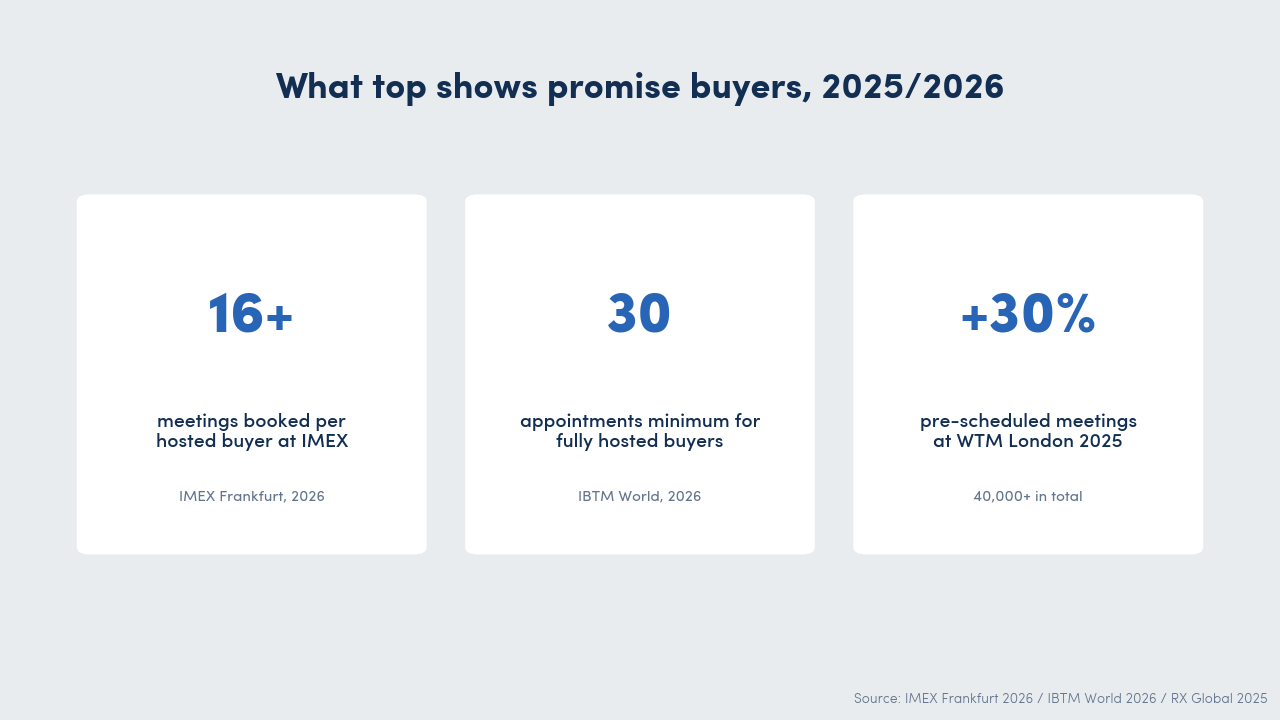
The short version: International buyers choose fewer events and expect more from each one. The shows that win them combine five levers: a defensible incentive package, hard qualification, deliberate regional sourcing, a guaranteed meeting diary and published proof that the meetings led to business. The diary is the core. Hosted buyers at IMEX book 16 or more meetings per show, and IBTM World ties free travel to a minimum of 30 appointments.
Why international buyers decide whether your trade show works
Your exhibitors pay for one thing: access to buyers they could not reach on their own. Everything else on the invoice is packaging. That is why ITB Asia advertises its roughly one to one ratio of buyers to exhibitors as a headline feature, right next to its 132 represented countries (ITB Asia, 2026). A balanced ratio tells sellers that their meeting slots will be filled with counterparts worth flying for.
The commercial stakes are measurable. At Tianguis Turístico 2025 in Mexico, participants held 71,882 business appointments, and roughly half of them converted into direct sales (Recommend, 2025). When meetings convert at that rate, every additional qualified buyer changes your sellers’ return on investment (ROI), and with it your rebooking rate for next year.
At the same time, the buyer side has become more selective. IMEX CEO Carina Bauer describes buyers who choose “fewer but more impactful events” (A Media Operator, 2026). Analysts see niche and regional shows growing faster than broad expos, and exhibitors who “track transactions, not badge scans” (Research FDI, 2026). Buyer recruitment in 2026 is therefore not a mailing list exercise. It is a product you design, price and prove.
The five levers at a glance
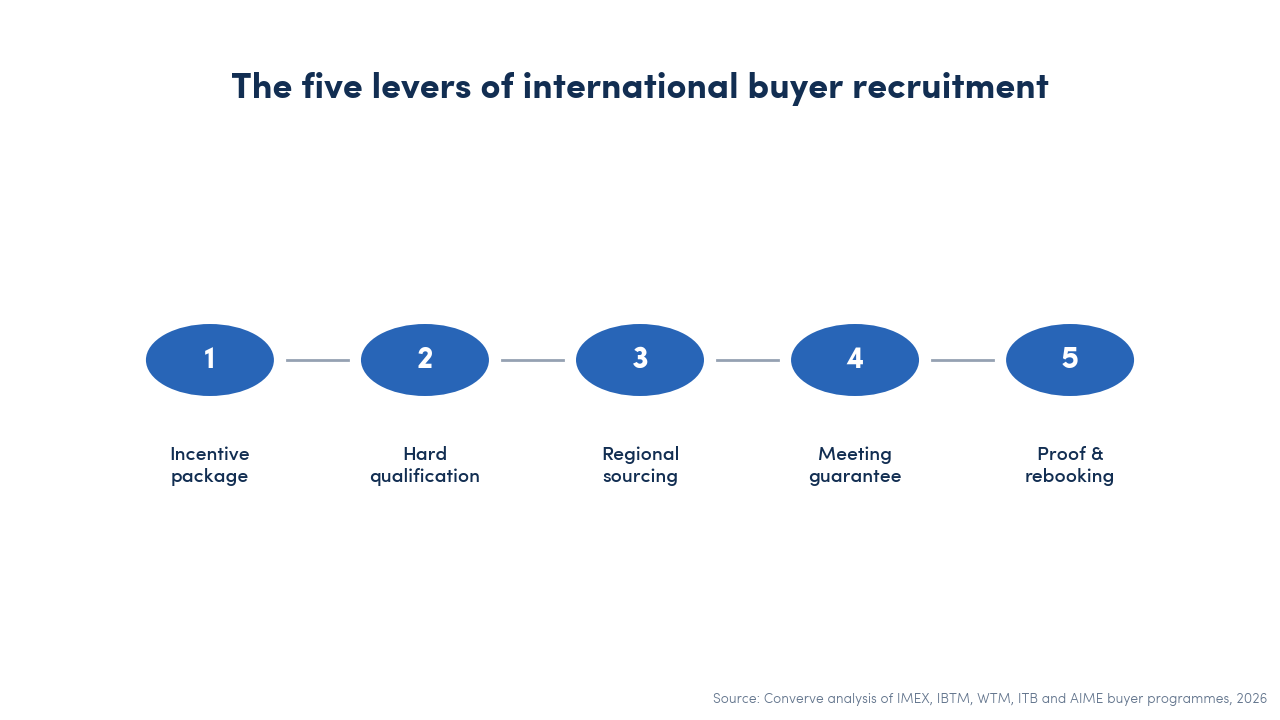
Across ITB Berlin, IMEX, IBTM World, WTM London and AIME, the same recruitment mechanics appear again and again. They can be summarised as five levers:
- Incentive package: fund travel, accommodation and transfers for the buyers you want most, in tiers.
- Qualification: admit buyers by budget, decision-making power and purchase intent, and communicate the bar openly.
- Regional sourcing: recruit actively in the source markets your sellers care about, through boards, airlines and roadshows.
- Meeting guarantee: promise a full diary of pre-scheduled 1:1 meetings, and make buyers commit to it in return.
- Proof: publish meeting volumes and conversion outcomes after the show, and recruit the next cohort with them.
Lever 1: Design an incentive package buyers can justify
A tour operator in São Paulo or a MICE planner in Seoul does not decide alone whether to spend three days at your show. A manager approves the trip. Your package exists to make that approval easy. The classic hosted buyer package covers an economy return flight, three to four hotel nights and airport transfers. At IMEX America, the value of that package can exceed 2,000 US dollars per buyer (Smart Meetings, 2025), and the show has worked with the charter specialist Air Partner on hosted buyer flights for years (PR Newswire).
Full hosting for everyone is neither necessary nor sensible. The established pattern is a tier model, and IBTM World spells it out in its terms: fully hosted, semi hosted and visitor buyers (IBTM World, 2026).
| Tier | What the buyer receives | What the buyer commits to |
|---|---|---|
| Fully hosted | Flights, accommodation, transfers, lounge access | Minimum meeting quota (IBTM World: 30 appointments), attendance on all show days |
| Semi hosted | Accommodation or a flight rebate, partial benefits | Reduced meeting quota, pre-scheduled diary |
| Visitor buyer | Free entry, access to the meeting platform | Self-funded travel, scheduling freedom |
The commitment column is the point. Incentives without obligations produce tourists with badges. Africa Food Manufacturing, outside tourism but instructive, ties its package of flights, two hotel nights and transfers to at least six matchmaking sessions per day and a purchase list submitted in advance. If your budget is small, start with semi hosting for two or three priority markets rather than thin support for everyone. A regional flight rebate for the right ten buyers beats free coffee for a hundred unqualified ones.
Lever 2: Qualify hard, and say so publicly
Qualification sounds like an internal compliance step. Used well, it is marketing. ITB Berlin publishes the profile of its Buyers Circle: 79 per cent are direct decision-makers, and 40 per cent control annual purchasing budgets above 10 million euros (ITB Berlin, 2026). Numbers like these do two jobs at once. They tell exhibitors that meeting slots will not be wasted, and they tell senior buyers that they will meet peers rather than students with lanyards.
Practical qualification criteria for a tourism trade show are budget responsibility, booking volume for your destination type, decision-making authority and concrete purchase intent for the coming season. Ask for them in the application form, and ask for specifics: which product categories, which regions, which volume. A purchase list submitted at application, as in the Africa Food Manufacturing model, turns vague interest into matchable data. If you are building this process from scratch, our guide on what a hosted buyer programme is covers the mechanics step by step.
Then publish the bar you set. A visible rejection rate is not a bug. It is the reason the accepted buyers and the paying sellers both show up.
Lever 3: Source buyers where your sellers want to sell
Even the biggest shows have a concentration problem. 78 per cent of ITB Berlin’s senior buyer pool comes from Europe (ITB Berlin, 2026). If your exhibitors want growth from North America and Southeast Asia, a buyer pool that mirrors your home region quietly breaks your value promise.
Recruiting internationally works through partners, not cold lists. Three channels carry most of the load:
- National tourism boards and trade bodies: they know which operators actually send business abroad and can nominate delegations. Government export programmes, like the trade missions run by the US International Trade Administration, organise entire buyer groups around shows.
- Airlines and alliances: flight partnerships lower your hosting costs and signal seriousness. IMEX has used chartered hosted buyer flights for years.
- Local roadshows and webinars: a two-hour buyer briefing in the source market, in the local language, converts better than any email sequence. WTM London grew its Asian participation by roughly 20 per cent year on year on the back of regional outreach (RX Global, 2025).
Pick two or three source markets per edition and go deep: local partner, local language application page, local proof points. Depth in three markets beats presence in fifteen.
Lever 4: Make the meeting diary the headline promise
Look at how the strongest shows talk to buyers. AIME in Melbourne promises applicants that they will “arrive with your diary filled” with 32, 20 or 10 pre-scheduled meetings depending on tier (AIME, 2026). IMEX reports that hosted buyers book 16 or more meetings per show (IMEX Frankfurt, 2026). WTM London 2025 generated over 40,000 pre-scheduled meetings, 30 per cent more than the previous year, and led its results communication with that figure (RX Global, 2025).
None of these shows leads with the gala dinner. The guaranteed, qualified, pre-scheduled diary is the recruitment pitch, because it answers the only question the buyer’s manager asks: what will you bring back?
The guarantee cuts both ways, and that is what makes it credible. Buyers who accept hosting accept meeting obligations, and the show tracks attendance. IMEX keeps the no-show rate for scheduled meetings below 5 per cent through exactly this combination of funded travel and visible commitments (Smart Meetings, 2025). A meeting diary that both sides have confirmed in advance changes the economics of your whole event. How you size it, how many meetings per buyer per day are realistic, is a planning question of its own; the short answer at leading shows sits between six and ten per day. Whether you run this as a closed hosted buyer format or an open registration model is a strategic choice we compare in hosted buyer programme vs open registration.
Solution: a meeting matrix that carries the promise
Solution: You can only promise a full diary if something reliably builds it. Converve runs buyer and seller meetings on a meeting matrix: both sides submit structured profiles and availability, matching rules pair buyers with the exhibitors they asked for, and every accepted request lands in a time slot with a table number. The logic is rule-based by default, so you can explain and audit every pairing when a seller asks why they met whom. Profiles and communication run multilingually, which matters when your buyers apply from a dozen countries, and commitments stay visible so no-shows are the exception rather than the rule. If a full diary is your recruitment promise, the matrix is how you keep it. Talk to us if you want to see it on your own buyer programme.
Lever 5: Prove it worked, then recruit with the proof
The strongest recruitment asset for your next edition is the outcome data from your last one. RX Global publicised WTM London’s 40,000 meetings and 8 per cent buyer growth within days of the show. IMEX publishes official statistics every year. Tianguis Turístico reported not just 71,882 appointments but a conversion rate: about half became direct sales. These numbers do double duty, reassuring exhibitors and giving next year’s buyers a reason to apply early.
Collect three figures at minimum: meetings held per buyer, the share of meetings both sides rated as relevant, and follow-up intent within two weeks of the show. Meetings held, not badge scans, is the metric your sellers actually buy. If you have not defined that measurement layer yet, our KPI framework for trade shows breaks it down by event phase.
Common mistakes when recruiting international buyers
- Buying reach instead of fit: a large buyer database from an agency looks impressive and meets nobody your sellers want. Fifty operators with purchase lists beat five hundred contacts.
- Incentives without commitments: funded travel with no minimum meeting quota produces well-rested sightseers. Every benefit needs an obligation.
- One source market: a buyer pool that mirrors your home region caps your sellers’ growth and your show’s pricing power. Diversify deliberately, two or three markets at a time.
- Counting badge scans: attendance is not outcome. Track meetings held and business initiated, and publish both.
Frequently asked questions
How many international buyers does a tourism trade show need?
Enough to fill your exhibitors’ meeting slots with relevant counterparts. Work backwards: exhibitors multiplied by available slots, divided by a realistic six to ten meetings per buyer per day. ITB Asia markets a roughly one to one buyer to exhibitor ratio; most regional shows run well below that and compensate with tighter matching.
What does a hosted buyer cost the organiser?
Flights, accommodation and transfers typically add up to a package worth over 2,000 US dollars per fully hosted buyer at international level. Semi hosting with hotel nights or flight rebates costs a fraction of that and works for shorter distances.
What is the difference between fully hosted, semi hosted and visitor buyers?
Fully hosted buyers receive flights, accommodation and transfers and commit to a minimum meeting quota, at IBTM World 30 appointments. Semi hosted buyers receive partial benefits for a reduced quota. Visitor buyers fund themselves and keep full scheduling freedom.
How far in advance should buyer recruitment start?
Nine to twelve months before the show for source market planning and partner agreements, with applications opening around six months out. Buyers plan trade show travel in annual cycles, and hosted places at the big shows are allocated months before the doors open.
How do you reduce buyer no-shows?
Tie benefits to commitments: minimum meeting quotas, confirmed diaries and attendance tracking. IMEX keeps meeting no-shows below 5 per cent this way. Meetings that both sides actively accepted are the strongest single protection.
Conclusion
International buyers are the scarce side of every tourism trade show, and they behave like the investors they are: selective, outcome-driven and loyal to events that fill their calendars with the right people. The five levers work as a system. The incentive package gets attention, qualification creates trust, regional sourcing aligns the pool with your sellers, the guaranteed meeting diary wins the internal approval, and published proof compounds the whole cycle for the next edition.
Start with the diary. Everything else in your buyer programme becomes easier to sell, to buyers and to their managers, once the meetings are the product. If you want to see how a meeting matrix keeps that promise at your scale, contact us for a walkthrough with your own event parameters.