
Why Is Matchmaking Important for Tourism Trade Shows? The Business Case in Numbers
It is 8:40 on the Monday after your trade show. The hall is stripped, the destination banners are back in their crates, and the board expects its report by Friday. Your spreadsheet holds three numbers so far: visitors through the door, stands sold, room nights booked. The number the funding committee will actually ask about is missing: how many qualified buyer meetings took place, and what business came out of them?
That missing number is rarely a reporting problem. It is a format problem. A show built around open aisles and evening receptions produces encounters nobody can count. A show built around matchmaking produces a meeting record you can measure, audit and defend. Footfall fills halls. Meetings fill order books.
This article makes the business case in three parts: why buyers now choose shows by the diary they arrive with, what structured meetings measurably deliver, and why counted meetings are the currency that boards and public funders accept.
The short version: Matchmaking is the structured process of qualifying buyers and sellers before a tourism trade show and pre-scheduling their 1:1 meetings. It matters for three reasons: buyers pick events by the quality of their meeting diary, structured meetings convert into real contracts at measurable rates, and counted meetings are the number funders trust.
What matchmaking means at a tourism trade show
At a tourism trade show, matchmaking connects buyers (tour operators, corporate travel planners and MICE (meetings, incentives, conferences and exhibitions) agencies) with sellers (hotels, destinations, destination management companies (DMCs) and experience providers) through pre-scheduled 1:1 appointments. Before the event, both sides declare what they offer and what they need: target markets, segments, languages, deal sizes. The organiser turns those attributes into a meeting schedule. Most large travel trade shows run this inside a hosted buyer programme, a format we unpack in our guide to hosted buyer programmes.
Two approaches dominate. Most leading travel trade shows run curated, rule-based matchmaking: transparent matching rules over explicit attributes, controlled by a curation team that can explain every pairing to any stakeholder. AI-assisted matching is the second option. It can lift acceptance rates, but its logic is harder to explain when a board asks why buyer X met seller Y. For now, hold on to one thing: the method matters less than the discipline of scheduling before the show.
Reason 1: Buyers come for the diary, not the hall
That discipline has quietly become the deciding factor in where buyers travel. Picture a tour operator in São Paulo weighing two November shows. Her manager approves one trip, and the approval email asks a single question: what will you bring back? The show that answers with a confirmed diary of relevant suppliers wins the flight. This is not a niche behaviour: 76 per cent of attendee agendas are set before arrival (Event Marketing Research, 2025). If your show is not in the diary before the show, it is not in the week at all.
The strongest shows have turned the diary into their recruitment pitch. AIME in Melbourne promises applicants 10, 20 or 32 pre-scheduled meetings depending on tier (AIME, 2026). IMEX reports that hosted buyers book 16 or more meetings per show (IMEX, 2026). IBTM World ties its travel package to a minimum of 30 appointments (IBTM, 2026). WTM London 2025 generated over 40,000 pre-scheduled meetings, 30 per cent more than the previous year, and led its results communication with exactly that figure (RX Global, 2025).
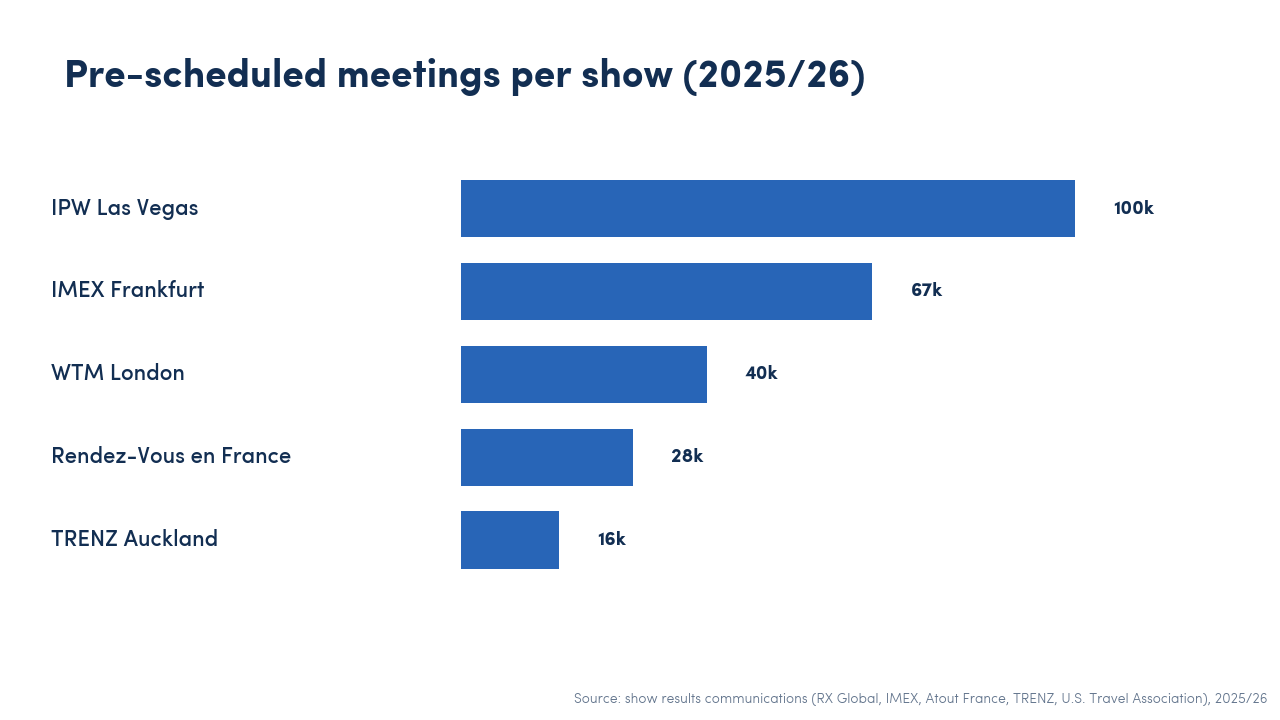
None of these events leads with the gala dinner. The guaranteed, qualified schedule is the pitch, because it answers the only question the buyer’s manager asks. How to build a buyer programme around that promise is its own playbook, which we cover in how to attract international buyers to a tourism trade show.
Reason 2: Structured meetings convert, chance encounters rarely do
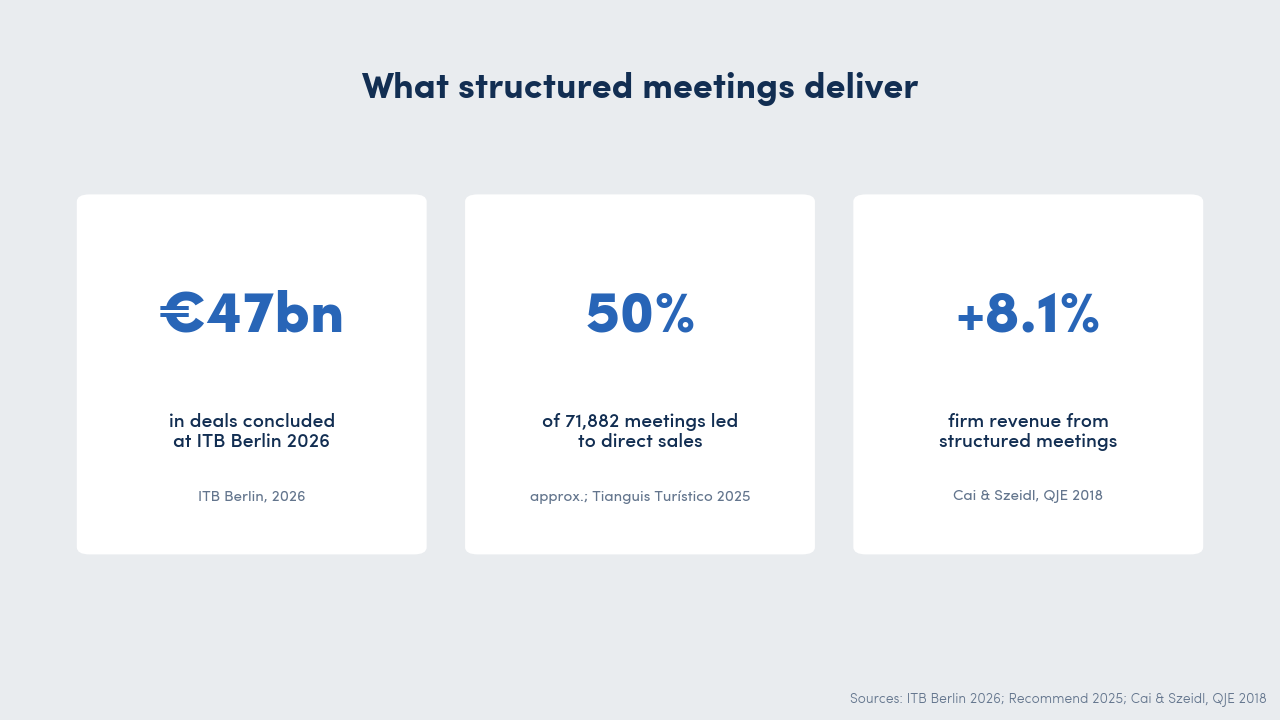
A full diary would mean little if the meetings in it did not produce business. The evidence says they do. Tianguis Turístico 2025 in Mexico recorded 71,882 business appointments, and roughly half converted into direct sales (Recommend, 2025). That is not a claim by a software vendor; it is a national tourism fair counting its own meeting outcomes. At conversion rates like that, every additional qualified meeting changes what a seller earns per euro of stand fee.
The research points the same way. A randomised study published in the Quarterly Journal of Economics assigned managers to regular, organised business meetings and measured a revenue increase of 8.1 per cent, with effects still visible a year after the meetings ended (Cai and Szeidl, 2018). A 2026 study of international trade fair participation found that pre-fair activities, goal-setting and pre-arranged contacts above all, correlate more strongly with export results than anything firms do during or after the fair (Weerasinghe et al., 2026). Preparation, not floor space, drives the outcome.
Compare the two Tuesdays a seller can have at your show. In one, a regional hotel group spends the day hoping the right tour operators stroll past the stand. Badge scans pile up, most of them irrelevant. In the other, the same team walks into eight 20-minute meetings with buyers who declared demand for exactly their region and price band. Same stand, same fee, different business model. Trade fair research calls these structured contacts socialisation episodes and links them directly to long-term relationship quality (Sarmento et al., 2014).
The raw material is already in the hall. Across B2B trade shows, more than 80 per cent of attendees hold buying authority and about two thirds are new prospects (CEIR and Exhibit Surveys via Wave Connect, 2026). Matchmaking is what routes that authority to your sellers’ tables instead of past them.
Reason 3: Meetings are the number your funders accept
Conversion wins the seller’s rebooking. The third reason matchmaking matters is closer to home: it protects your own budget. Most tourism trade shows answer to somebody, a tourism ministry, a regional government, a destination marketing organisation (DMO) board. When that committee reviews the event, “the hall felt busy” does not carry a budget line. Counted meetings do. ITB Berlin 2026 reported deals and purchasing decisions worth 47 billion euros concluded at the show, and 96 per cent of visitors emphasised the high quality of their meetings (ITB Berlin, March 2026). The industry’s flagship events report meeting figures because meetings are what auditors can verify.
Most organisers are not there yet: 62 per cent of marketers name ROI (return on investment) measurement as the biggest barrier when defending event budgets (Forrester, 2025). A matchmaking layer solves the data problem at the source. Every meeting has two named parties, a timestamp, a declared interest and a feedback field. Aggregated, that becomes the Friday report: meetings held per buyer, per segment, per market, with outcomes attached. The committee gets a number nobody has to take on faith.
What this means if your show is not IMEX
You do not need 67,000 meetings for any of this to work in your favour. The mechanics scale down well: a regional workshop with 40 vetted buyers and 60 sellers can produce 400 to 500 qualified meetings in two days, enough to change every exhibitor’s result. What carries over from the flagship shows are three moves:
- Qualify before you invite: a smaller, vetted buyer list beats an open door. Whether you run a closed hosted buyer format or open registration is a format decision we compare in hosted buyer programme vs. open registration.
- Schedule before doors open: set a realistic per-buyer diary instead of a maximal one. The capacity maths, slot length, meetings per day, no-show buffers, is in how many 1:1 meetings per hosted buyer. Or skip the spreadsheet: our meeting calculator works out your event’s realistic meeting capacity from participants, meeting length and event days in under a minute.
- Report after: publish meetings held and follow-up rates to sellers and funders. It is your strongest rebooking and refunding argument.
Solution: This is the job Converve was built for. Organisers define the matching rules in a configurable meeting matrix: buyer and seller categories, destination interests, languages, deal sizes, VIP quotas. The platform turns those rules into full, pre-scheduled diaries for every participant and keeps the audit trail your board and funders expect, compliant with the EU General Data Protection Regulation (GDPR) and fully under your control.
The diary is the deliverable
A tourism trade show is judged by what its participants take home, and what they take home is decided largely before the doors open. Matchmaking is not a convenience feature. It is the production system for the one deliverable everyone pays for: qualified meetings. Buyers travel for full diaries. Sellers rebook when meetings convert. Committees fund what they can count.
If you are evaluating tooling for that job, start with our comparison of matchmaking software for tourism trade shows. Or skip ahead and see a meeting matrix configured live: talk to us and we will walk you through how organisers set one up in practice.
FAQ: matchmaking at tourism trade shows
Why do tourism trade shows use hosted buyer programmes?
Because they guarantee both sides a productive schedule. Buyers receive travel support in exchange for a minimum meeting commitment, and sellers get a diary of vetted counterparts. IBTM World requires a minimum of 30 appointments per hosted buyer (IBTM, 2026), and hosted buyers at IMEX book 16 or more meetings per show (IMEX, 2026).
Do pre-scheduled meetings actually lead to sales?
Yes, measurably. At Tianguis Turístico 2025, roughly half of 71,882 pre-arranged appointments converted into direct sales (Recommend, 2025). In controlled research, regular structured business meetings raised firm revenue by 8.1 per cent (Cai and Szeidl, Quarterly Journal of Economics, 2018).
How many meetings should a buyer have at a tourism trade show?
Leading international shows plan 16 to 32 pre-scheduled meetings per buyer across two to three days (IMEX and AIME, 2026). For a regional workshop, 8 to 12 well-matched meetings per buyer is a realistic and defensible diary. Slot length and no-show buffers matter more than the raw count. For your own numbers, the free Converve meeting calculator estimates your event’s meeting capacity in under a minute.
How do DMOs measure trade show success beyond attendance?
By meeting-based results: meetings held per buyer and segment, follow-up and conversion rates, and reported deal value. ITB Berlin 2026, for example, reported 47 billion euros in deals concluded at the show (ITB Berlin, 2026). A matchmaking platform records these figures automatically as the event runs.