Multilingual Buyer-Seller Meetings: Best Practices for Trade Show Organisers
Table 14, late afternoon, an international travel trade show. A receptive operator from Munich has 20 minutes with a buyer from São Paulo who books 4,000 room nights a year. Both ticked “English” on their registration forms. After four minutes of careful small talk, the conversation settles into short sentences and safe questions. At minute 20 they exchange cards and promise to follow up. Neither will.
Meetings like this rarely appear in a post-event report. The slot counts as used, the satisfaction survey collects a polite three out of five, and the schedule moves on. Yet the deal died on language, not on fit. The profiles matched perfectly; the languages never did. Organisers who avoid this trap treat language as a matching criterion, not as an on-site add-on.
This guide shows you how to plan multilingual buyer-seller meetings from registration to reporting: which language data to capture, how to match on it, when to book human interpreters, when AI (artificial intelligence) translation is enough, and how to prove the spend paid off.
The short version: Capture primary and working languages at registration and let your matching engine treat them as a pairing rule. Tier meetings by value to decide between English, AI translation and human interpreters, extend interpreted slots by 30 to 50 per cent, and measure no-shows and ratings by language pair. Interpreters rescue single conversations; matching rescues the programme.
Why language decides meeting quality at international trade shows
The scale of the issue is easy to underestimate from an English-speaking office. At ITB Berlin 2025, 87 per cent of roughly 100,000 trade visitors came from outside Germany (ITB Berlin, 2025). WTM London 2025 hosted buyers from 182 countries (RX Global, 2025). For your meeting programme this means that English-only planning quietly handicaps a share of every delegation you paid to fly in.
The commercial damage is documented far beyond the events industry. In research compiled by Slator, 49 per cent of global executives reported financial losses caused by language barriers, and 64 per cent of companies admitted losing international deals because they lacked multilingual staff (Slator, 2025). Your exhibitors meet the same effect at the meeting table. They just file it under “the meeting went nowhere”.
Research explains why those meetings go nowhere. A study in the Journal of International Business Studies found that language barriers slow down trust formation in international teams (Tenzer, Pudelko and Harzing, 2014). Trust is the entire currency of a first 20-minute meeting. Without a working language, meetings stay polite and stay shallow.
Interpreters and translation apps can rescue individual conversations on the day. What they cannot repair is a schedule that paired people without a common language in the first place. That part is matching, and it is decided weeks before the show opens.
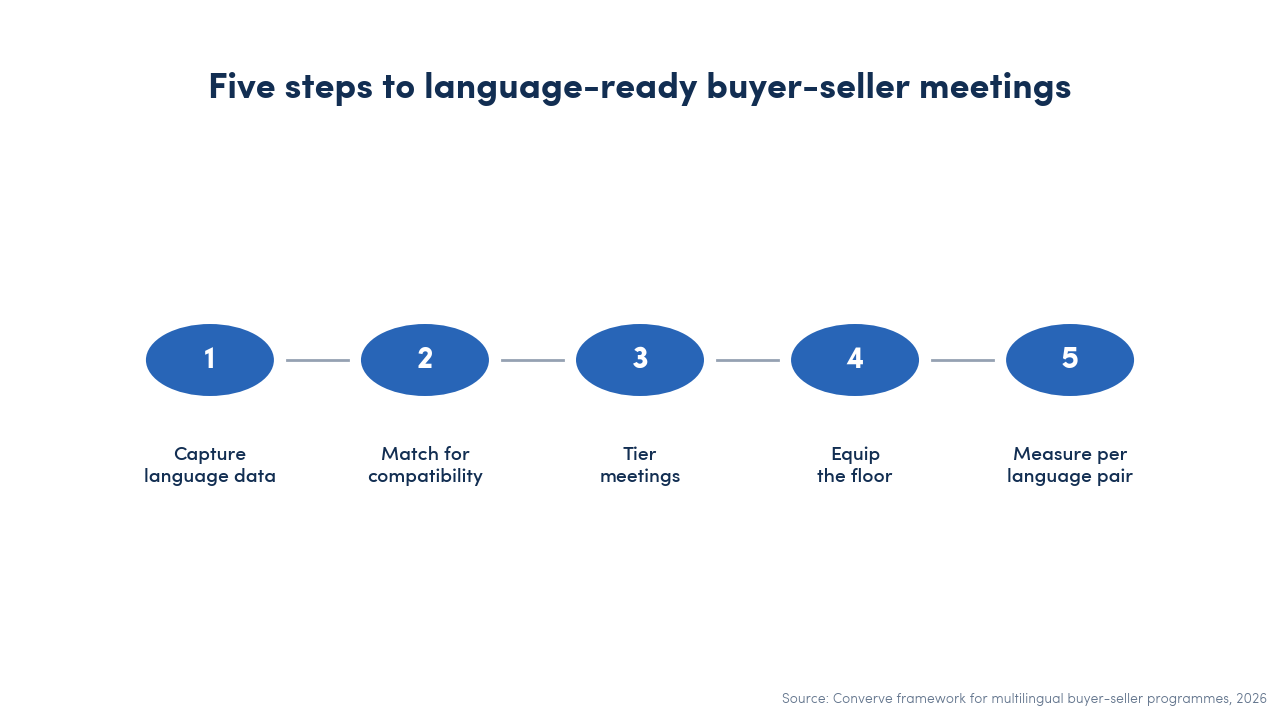
Five steps to language-ready buyer-seller meetings
If language can sink a meeting before it starts, it has to enter your planning where meetings are made: in the registration form and the matching rules, not in the on-site technology order. Five steps take you there.
Step 1: Capture language data at registration
Your registration form decides what your matching can see later. Three fields cover it:
- Primary language: the language a participant negotiates in most comfortably, which is not always their passport language.
- Working languages: every language they can hold a business meeting in. A plain “comfortable negotiating in” wording beats a five-level self-assessment nobody fills in honestly.
- Preferred meeting language: the tiebreaker your schedule uses when a pair shares two options.
Keep the fields mandatory and short. Every extra form minute costs completions, and every missing language field costs a match. For hosted buyer programmes, record the language mix per delegation as well: if twelve of your buyers arrive from Brazil, interpreter planning starts with that list, not with the venue. How those buyers entered your programme in the first place is its own craft, which our playbook on attracting international buyers to a tourism trade show covers lever by lever.
Step 2: Match for compatibility, not identity
Two participants do not need the same mother tongue. They need one shared working language. Set your matching rules so that any overlap counts as compatible and only pairs with no overlap get flagged. A Spanish seller with solid English and a Colombian buyer are a better pair than a “perfect” match neither can talk to.
Rule-based matching lets you choose per event how hard the language rule bites. As a hard filter, the system never suggests a pair without a shared language; that protects quality but shrinks the pool. As a soft signal, a missing overlap lowers the match score, and the pair only surfaces with an interpreter note attached; that protects volume. A proven middle path is to run the hard filter for your top buyer tier only, exactly where a wasted slot hurts most. If structured buyer-seller scheduling is new territory, our guide on what a hosted buyer programme is explains how profiles, availability and matching rules come together.
Step 3: Tier your meetings, then assign support
Somewhere above your programme sits a director who signs off the interpreter invoice. You will not get budget for professional interpretation across 800 meetings, and you do not need it. Tier instead. Top-tier meetings, the key accounts and contract-ready buyers your sellers care most about, get a human interpreter by default. The middle tier runs on AI live translation with a human on call. The broad base runs in English or in whatever shared language the pairing produced.
The tiering answers the only question the director will actually ask: why does this meeting get 400 dollars of language support and that one 40? Because one renews a partnership worth six figures and the other is a first hello. Write that logic down before the budget meeting. It turns a cost debate into a risk decision.
Step 4: Design slots and floor logistics for interpreted meetings
An interpreted meeting is a different physical product. Consecutive interpreting roughly doubles speaking time, so a standard 20-minute slot holds ten minutes of actual content. Either extend interpreted slots by 30 to 50 per cent or trim the agenda to match. Nothing erodes a schedule faster than every interpreted meeting running over.
Three habits keep the floor calm. Brief interpreters like team members: buyer list, destination names, rate vocabulary and last season’s glossary, sent a week ahead. Seat interpreted meetings at the edge of the meeting zone, where the noise floor is lower. And give every table an AI fallback: a QR code participants scan to read live captions in their own language on their own phone, a pattern Wordly demonstrated at IMEX America 2025. The fallback catches the pairs your planning missed.
Step 5: Measure by language pair
Your post-event report should answer one question it probably never asked before: how did meetings perform per language setup? Compare no-show rates and meeting ratings across English-only, AI-supported and interpreted meetings, and track the share of meetings held in a participant’s preferred language. If interpreted meetings rate half a point higher and produce more follow-ups, next year’s conversation with your director gets short. Where these numbers sit in the wider measurement stack is mapped in our KPI (key performance indicator) framework for trade shows.
Human interpreters, AI translation or both?
Steps 3 and 4 assume you know what each support level delivers and costs, and in 2026 that calculation looks different from even two years ago. In a May 2026 survey of 205 enterprise event and meeting leaders, 66 per cent said AI translation and captions now deliver higher quality than human interpreters, and 88 per cent had expanded their use of interpretation or captioning (Dimensional Research for Wordly, 2026). If your last serious look at AI translation dates from 2023, your mental price-performance table is out of date.
The cost gap is an order of magnitude. Professional simultaneous interpreters run at roughly 1,200 to 3,000 US dollars per day and language before booth and technician fees, while AI live translation is typically billed at 60 to 200 US dollars per hour (Snapsight, 2026). One interpreted language pair over three days can cost more than an AI layer across the whole meeting floor. That difference is exactly why the tiers in step 3 exist.
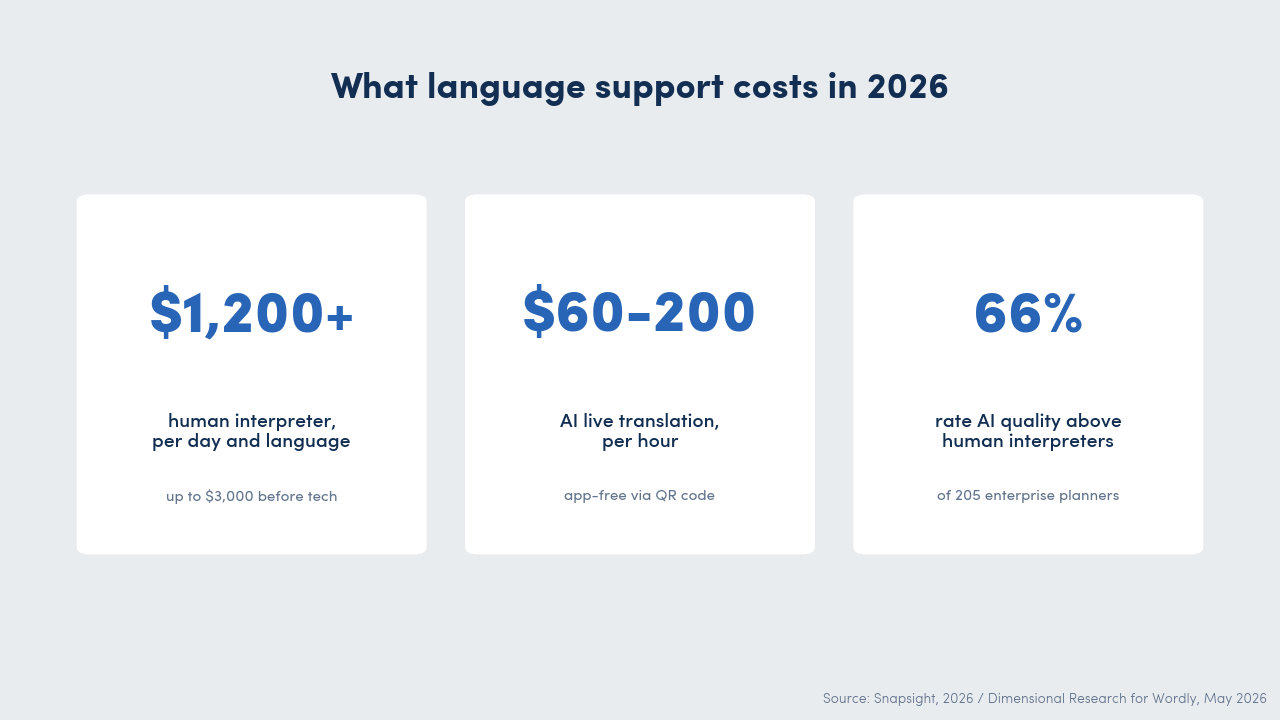
None of this retires the interpreter. AI systems still stumble over dialects, crosstalk and the half sentences of a fast negotiation, and 25 per cent of planners in the same survey continue to prefer human interpretation. A mistranslated allotment clause costs more than an interpreter’s day rate. The rational split follows your meeting tiers:
| Setup | Typical cost (2026) | Strongest at | Best for |
|---|---|---|---|
| Human interpreter | $1,200 to $3,000 per day and language | Nuance, negotiation, trust building | Top-tier meetings, contract talks, delegations |
| AI live translation | $60 to $200 per hour | Coverage, scale, spontaneous pairs | Middle tier and a fallback at every table |
| Hybrid (human plus AI) | Human core plus AI overflow | Budget control at scale | Multi-day shows with mixed meeting values |
Solution: matching that reads language data
Solution: Everything above stands or falls with whether your platform can act on language data. Converve runs buyer-seller programmes on a meeting matrix: both sides submit structured profiles, including language fields, and rule-based matching pairs participants only where the profile logic allows it. Language can work as a hard filter or as a weighted signal per event, and every pairing stays explainable when a seller asks why they met whom. The platform itself runs multilingually for international delegations, and interpreter notes attach to individual meetings so your floor team sees where support is booked. Talk to us if you want to see language-aware matching on your own buyer programme.
FAQ: multilingual buyer-seller meetings
How much does interpretation cost at a trade show?
Professional simultaneous interpreters cost roughly 1,200 to 3,000 US dollars per day and language, plus booth and technician fees where full equipment is needed. AI live translation runs at about 60 to 200 US dollars per hour (Snapsight, 2026). Most organisers blend both: human interpreters for a small top tier, AI coverage everywhere else.
Is AI translation good enough for B2B meetings?
For most first meetings, yes. In a 2026 survey by Dimensional Research for Wordly, 66 per cent of enterprise event planners rated AI translation above human interpreters on quality, and 88 per cent had expanded their usage. For contract-level talks, dialect-heavy conversations and high-stakes negotiations, a human interpreter remains the safer choice.
How do you match buyers and sellers who speak different languages?
Capture primary and working languages at registration, then let the matching engine require one shared working language per pair. Run that rule as a hard filter for top-tier buyers and as a score signal for the rest, and attach an interpreter note to any pair that lacks an overlap.
How long should an interpreted buyer-seller meeting be?
Plan 30 to 50 per cent more time than for an equivalent single-language meeting. Consecutive interpreting roughly doubles speaking time, so a 20-minute agenda needs a 25 to 30 minute slot to reach its close without cutting anyone off.
Conclusion
Language is a matching criterion. Capture it at registration, match on it, tier your support, size the slots honestly and measure the result by language pair. Organisers who work this way stop paying for meetings that were never going to work, and they defend next year’s language budget with data instead of anecdotes. The interpreter at table 14 is the last line of defence. The schedule that put the right people there is the first. If you want to see how a language-aware meeting matrix looks with your event’s numbers, contact us for a walkthrough.