Only 15 per cent of event organisers rate their networking as very effective, even though 73 per cent of attendees now expect modern event technology and 95 per cent of event professionals expect to use more AI in 2026 (Bizzabo 2026 State of Events Benchmark Report). The gap between what attendees want from networking and what events actually deliver has become the defining quality question of the year, and matchmaking sits right in the middle of it.
Most public matchmaking FAQs are vendor pitches with three or four shallow answers. This guide is different. It is written for organisers, it pulls the 15 operational questions we hear most, and every answer carries a dated 2026 source. The same answers should help a tourism trade show producer running a hosted buyer programme and a startup conference team running a demo day, because the underlying questions are the same: how do you make sure the right people meet, how do you prove it worked, and how do you stay compliant while doing it.
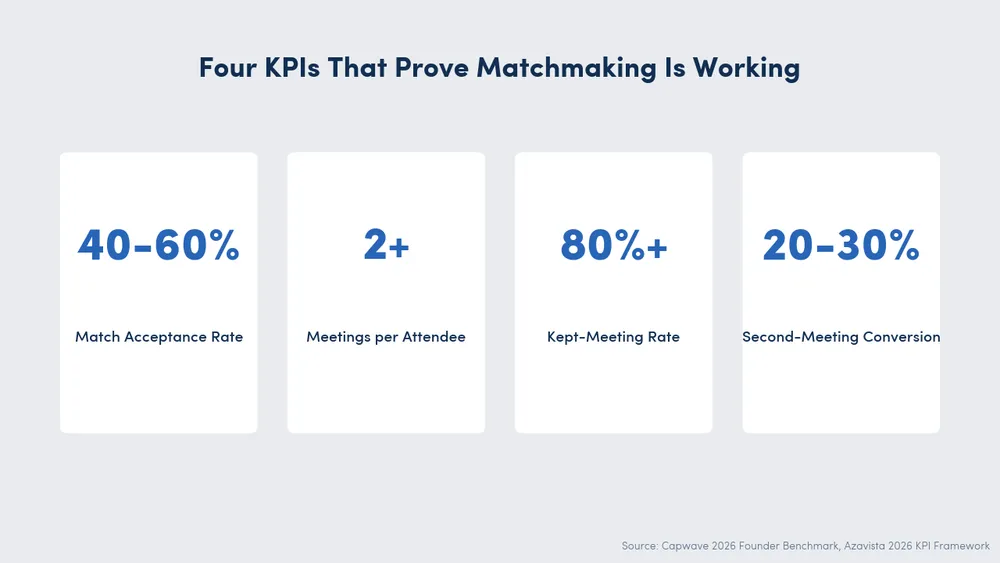
The short version: Event matchmaking is the structured engineering of one-to-one meetings before and during an event. In 2026, AI matchmaking roughly doubles meeting-acceptance rates compared to no algorithm at all (Swapcard 2026), and Clarion Events reports a 44 per cent year-on-year lift in in-person meetings after deploying it (Event Tech Live 2026). The benchmarks to aim for are a 40 to 60 per cent acceptance rate, at least two meetings per attendee, an 80 per cent kept-meeting rate and a 20 to 30 per cent second-meeting conversion. Software fits one of four pricing models (per-attendee, per-event, annual licence or freemium), and the right model depends on your event format more than on a sticker price.
Section 1: Definitions and Terminology
1. What is event matchmaking?
Event matchmaking is the structured process of pairing attendees, exhibitors, buyers or investors at a B2B event into pre-scheduled one-to-one meetings, based on declared interests, profile data and either rule-based or AI-driven similarity scoring. Modern platforms run matchmaking on a meeting-matrix layer that respects caps, buffers and conflict rules, then publishes a personal schedule into each participant’s calendar. It is the difference between hoping the right people find each other and structurally engineering that they do. The format shows up under different names (hosted buyer programmes at IMEX and IBTM, founder-investor meetings at Slush, smart meetings at Swapcard), but the core mechanic is the same.
2. How is matchmaking different from open networking?
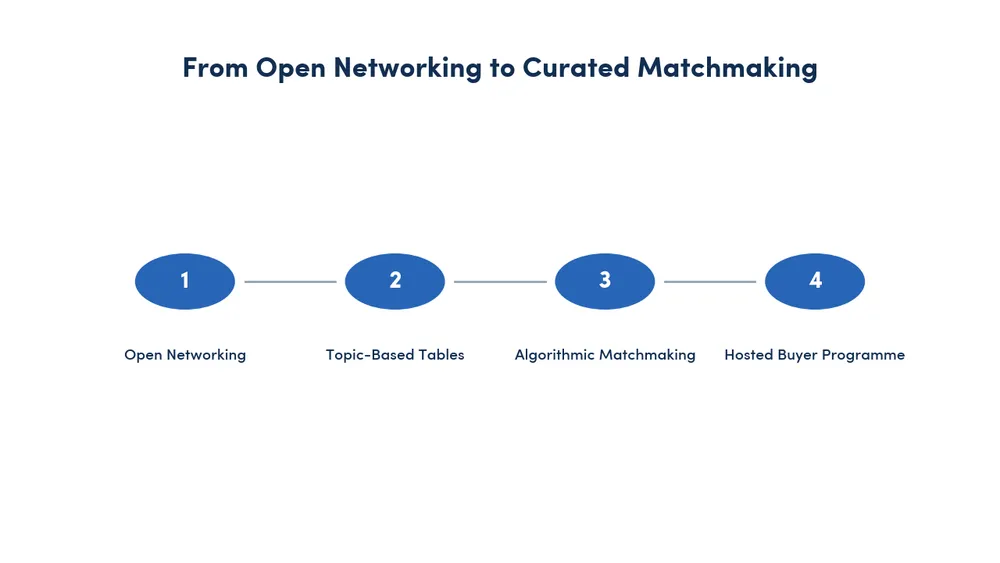
Networking happens whenever two attendees meet; matchmaking happens when an algorithm or human curator decides they should meet and books the meeting before the event begins. Open networking optimises for serendipity and is measured in coffee chats. Matchmaking optimises for intent and is measured in qualified meetings. The two formats are complementary rather than competitive: most successful B2B events in 2026 run both, with structured matchmaking as the spine and open networking around the edges. We go deeper on the trade-offs in our pillar on event networking versus matchmaking, including a twelve-axis comparison table and the decision logic for which format fits which event.
3. AI matchmaking versus rule-based matchmaking: what is the trade-off?
Rule-based matchmaking gives organisers an auditable trail, predictable outcomes and EU AI Act-friendly explainability. AI matchmaking gives sharper surface relevance at scale but trades transparency for personalisation. Most 2026 platforms combine both: declared rules at the floor (only this buyer tier can request meetings with that exhibitor tier), AI re-ranking on top. The honest answer for organisers under public-sector or compliance scrutiny is rule-based first, AI optional. Our deeper analysis of AI matchmaking at events walks through three generations of match logic and where each one sits on the trust-versus-relevance curve.
4. What is a hosted buyer programme, and is it the same as matchmaking?
A hosted buyer programme is a curated subset of an event where the organiser invites pre-qualified buyers, often subsidises their travel, and requires them to complete a fixed number of pre-scheduled meetings in return. The format dates back to IMEX founder Ray Bloom in 1989 and is the dominant matchmaking pattern in tourism trade shows. IMEX Frankfurt 2026 ran roughly 3,500 hosted buyers and IMEX America 7,800. So matchmaking is the engine; a hosted buyer programme is one particular vehicle that runs on it. Two related deep dives: what is a hosted buyer programme for the definition, and hosted buyer versus open registration for the format choice.
Section 2: Selection and Implementation
5. How do organisers actually choose matchmaking software?
Start by defining the event format (trade show, conference, demo day, hybrid), the participant tiers (buyers, sellers, founders, investors, sponsors), the meeting-volume target, the language and time-zone requirements, and the compliance constraints. Then evaluate platforms against an eight-criteria framework: match-engine depth, scheduling reliability, multi-language support, hosted-buyer workflow, exhibitor tooling, reporting depth, data residency and integration ecosystem. We have published two vertical guides that walk through this scoring in detail: best matchmaking software for tourism trade shows and best matchmaking apps for startup conferences. The wrong question is which vendor scores highest on G2; the right question is which one matches your vertical defaults.
6. How long does it take to set up an event matchmaking platform?
A safe implementation timeline is 12 to 16 weeks: two to four weeks of vendor research, two weeks of demos, one to two weeks of contract, two to four weeks of platform setup, one to two weeks of internal testing and three to four weeks of attendee promotion (Guidebook 2026 Buyer’s Guide). A focused four-week sprint is possible only if the registration data, integrations and KPIs are already defined (Azavista 2026 implementation blueprint). Rushing the timeline almost always leads to either incomplete attendee profiles or a launch with broken integrations, which destroys match quality before the event even begins.
7. What does event matchmaking software typically cost?
Software pricing in 2026 sits in four model families. Per-attendee pricing runs roughly 2 to 15 US dollars per registered participant. Per-event pricing combines a 500 to 2,000 US dollar base with a 1 to 5 US dollar per-attendee add-on. Annual licences range from around 10,000 US dollars at the small-platform end to well over 100,000 US dollars at the enterprise end. Freemium tiers exist but cap critical features such as hosted buyer workflows or API access. Our affordable matchmaking software guide for startup pitch events works through cost-per-qualified-meeting as a more honest decision metric than sticker price.
8. Does every event need the same matchmaking software?
No. The same matchmaking engine can serve very different events, but the configuration is fundamentally different. Tourism trade shows optimise for hosted buyer programmes, multi-language meetings, EU data residency and public-sector ROI reporting; cost-per-hosted-buyer (typically 1,500 to 4,000 euros) is the operative budget unit. Startup conferences optimise for founder-investor density, anti-overload limits on top venture capital firms and follow-up tracking; cost-per-qualified-founder-meeting is the unit. Association annual meetings, corporate summits and hybrid product launches each add their own constraints. The same software can handle all of them, but if a platform treats one of those workflows as an afterthought, it is the wrong tool for that vertical regardless of how strong its raw match engine is.
Section 3: Operations and Performance
9. Which KPIs prove a matchmaking platform is working?
Four numbers, measured at every event. First, match-acceptance rate of 40 to 60 per cent: below 40 and either profiles are weak or the algorithm is noisy; above 60 and you may be under-curating. Second, at least two meetings per attendee, the floor for proving that matchmaking is more than a side feature. Third, a kept-meeting rate of 80 per cent or higher. Fourth, a second-meeting conversion of 20 to 30 per cent (Capwave 2026 founder benchmark, applied across personas). If a platform cannot report on at least three of those four out of the box, that is the answer. Azavista’s 2026 framework adds two more useful metrics: useful-meeting rate of 65 per cent and time-to-first-meeting under 24 hours.
10. How do we reduce no-shows for scheduled meetings?
Free in-person events see 40 to 60 per cent no-shows; paid events sit around 10 per cent, climbing to 20 to 30 per cent in certain audiences (Eventtia 2026 benchmarks via Event Tech Live). Conferences that introduce refundable deposits report a 15 to 20 per cent attendance lift. The operational pattern that works in 2026 has four layers: SMS or push reminders at T-15 minutes, an in-app “running late” button that auto-pings the counterpart, one-click reschedule that respects the meeting matrix, and clear no-show penalties for hosted-buyer participants. Each layer alone moves the needle a little; together they push kept-meeting rate from the 60s into the 80s.
11. How do we increase match-acceptance rates?
Without AI assistance, 65 to 75 per cent of meeting requests at large B2B events stay unanswered (Swapcard 2026 trend report). With AI matchmaking enabled, acceptance roughly doubles at Tier-2 trade shows and approaches 100 per cent for Tier-1 requests. Clarion Events reported a 44 per cent year-on-year lift in in-person meetings after deploying AI matchmaking (CI Group, Meetings & Incentive Travel 2026). The non-technical levers matter just as much: pre-crafted opening messages, an “explain this match” panel that shows why two people were paired, and connection caps that protect senior investors and platinum sponsors from request overload.
12. When should we open the matchmaking platform before the event?
Seven to ten days before doors open is the sweet spot (EventHex 2026). Earlier than that and attendee profiles are incomplete; the algorithm trains on noise and surfaces weak matches. Later and participants arrive on day one without a packed schedule, which kills the perceived value of the platform. Slush, for context, runs a longer pre-approval gate (typically two days of organiser review per request) plus a year-round matchmaking sprint cadence between editions, which is the heavyweight version of the same idea. For most mid-sized events, the seven-to-ten-day window with three reminder pushes hits the right balance.
Section 4: Privacy, Compliance and Risks
13. Is attendee data GDPR-compliant on a matchmaking platform?
It can be, but compliance is the organiser’s responsibility, not the vendor’s. Every event collecting data from EU or EEA participants falls under the General Data Protection Regulation (GDPR) regardless of where the organiser is based. The five operational defaults are: consent-first registration with explicit opt-in to matchmaking and sponsor sharing, data minimisation (only collect what drives match quality), transparency (show why a match was suggested), retention limits (purge participant data after 90 days unless contractually required), and bias monitoring of recommendation outputs. EU data residency has moved from nice-to-have to procurement default for public-sector and tourism-funded shows.
14. Does the EU AI Act change how matchmaking platforms work in 2026?
Yes, in two concrete ways. First, Article 22 of the GDPR, reinforced under the EU AI Act framework from 2026, gives attendees the right to demand a human review of an algorithmic matchmaking decision. That means platforms need an audit trail and a path to override. Second, high-risk AI classification under the Act requires stronger monitoring and documentation when matchmaking informs decisions with material consequence, such as which startups enter a curated investor day. The practical implication for organisers: prefer platforms with explainable rule-based defaults that can demonstrate why a match was made, and treat AI re-ranking as a layer on top rather than a black box.
15. When is matchmaking the wrong format for an event?
Matchmaking is not the answer when the audience is too small for an algorithm to learn meaningful patterns (under roughly 60 to 80 attendees), when the event format is dominated by content over meetings, when there is no buyer-seller or founder-investor asymmetry, or when the organiser cannot enforce qualification gates. In those cases, a curated human concierge, a topic-based table format or a structured speed-networking round outperforms a matchmaking stack at a fraction of the cost. The honest rule: matchmaking earns its place when participants come with explicit goals, when there is a hierarchy in who needs whom, and when the organiser is willing to curate.
For small events, headcount alone does not settle the question. What matters is whether participants have more relevant counterparts than meeting slots, and enough of them to fill a diary. Our guide Is matchmaking worth it for a small B2B event? turns that into four tests with a worked example.
How we think about this at Converve: We run matchmaking on a meeting-matrix layer that has been the engine of international trade shows, MICE programmes, hosted buyer events and startup conferences for over two decades. It is rule-based by default, with an auditable trail that satisfies public-sector reporting and EU AI Act explainability, and it is hosted in the EU under GDPR. Organisers who want sharper surface relevance can layer AI re-ranking on top, but they keep the audit trail underneath. That is the architecture we believe in for tourism boards, convention bureaus, B2B trade shows and curated investor days where every meeting needs to defend itself.
Conclusion
Matchmaking in 2026 is no longer a feature on a checklist; it is the operating layer that decides whether your event delivers the meetings attendees came for. The questions above are the ones we hear most because they are the ones organisers actually have to answer in front of their boards, their sponsors and their funders. The good news is that the 2026 data, from Bizzabo to Clarion to Swapcard, finally gives concrete numbers to point at. The work that remains is choosing the configuration that fits your event, training your team on it, and protecting the participant experience under the privacy and AI rules that now sit around every decision.
If you want help mapping these answers onto your next edition, come and talk to us. We have been doing matchmaking for over twenty years, and there is a good chance we have already solved the version of your problem that you are about to face. Let’s compare notes.