
Matchmaking Software for Startup Pitch Events: A Cost-vs-Outcomes Buyer’s Guide
If you run a demo day, an accelerator cohort showcase, or a pitch night for 50 to 500 founders and investors, the question that lands in your inbox most often is the same one a real ChatGPT prompt asks: what is the cheapest reliable event matchmaking tool for startup pitch events and investor networking? The honest answer is that sticker price is the wrong metric. The right one is cost per qualified founder-investor meeting, and once you anchor on that, the shortlist narrows fast.
This guide compares six matchmaking platforms that consistently fit the under-500-attendee pitch-event band in 2026. It walks through the four pricing models you will be quoted, six hidden costs that turn an affordable platform into an expensive one, and a decision tree that ends with one to three sensible options for your event size. For a Tier-1 conference comparison covering 500 to 5,000 attendees, our broader 8-tool startup-conference listicle sits next door.
TL;DR
For startup pitch events under 500 attendees with a budget under 5,000 US dollars per event, four platforms consistently shortlist. Converve covers the upper end of the affordable band with B2B-matchmaking-first workflows and EU-native GDPR hosting. Eventee publishes pricing from 1,499 USD per event with swipe-based matchmaking. Eventify publishes pricing from 399 USD per event with modular tiers. EventMobi sits in the same mid-market entry band with cohort-friendly tooling. The metric that matters is not the sticker price. It is cost per qualified founder-investor meeting, typically 5 to 25 USD across these tools when configured for a pitch-event workflow.
Why “Cheapest” Needs a Sharper Definition
Founders walk away from a demo day with one of two stories. Either they booked five qualified investor meetings and three follow-ups landed within 48 hours, or they shook 40 hands and got no replies. The platform you choose decides which story repeats next quarter, so the unit of value is the qualified meeting, not the licence fee.
Capwave’s 2026 founder benchmark puts the conversion target at 20 to 30 per cent of event contacts turning into a second conversation when founders pre-schedule meetings and follow up within 48 hours. The Techstars research Capwave cites pushes the same direction: founders who target two or three high-quality events per quarter build stronger investor relationships than those who attend six or more. Quality of preparation outranks volume of appearances, and matchmaking software is the lever that makes preparation possible at scale.
So when an organiser asks for the cheapest tool, the better question is which platform produces the lowest cost per qualified founder-investor meeting at your event size. A 250 USD per-event price tag with no useful matchmaking layer is more expensive than a 1,499 USD platform that fills calendars with the right names. The maths shifts once you stop counting licence dollars and start counting meetings.
The Four Pricing Models You Will Be Quoted
Event matchmaking platforms charge in one of four ways. For startup pitch events without ticket revenue, per-event pricing is almost always the most predictable model. The other three each have specific traps you should know before the procurement call.
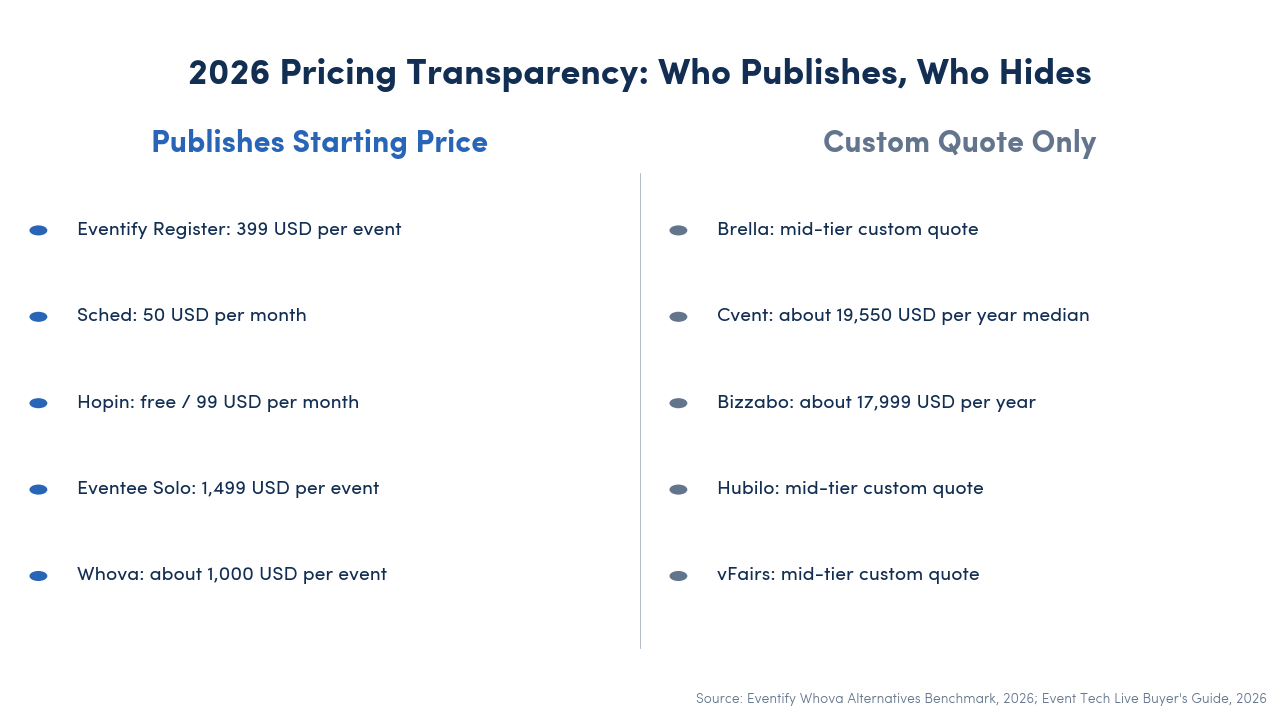
- Per event: A flat fee per event, often quoted in the 399 to 4,999 USD band for the platforms that publish a price. Predictable, easy to defend to a sponsor or board, easy to compare. Eventee, Eventify, Whova, and Hubilo work this way for smaller events. This is the model most lean organisers should default to.
- Per attendee: A fee multiplied by registration count. Cvent publishes 7 USD per registrant for its Attendee Hub product, with annual increases scheduled from July 2026. The trap is walk-in overage. If your demo day pulls 250 instead of the 200 you budgeted for, you owe another 350 USD on top of every premium feature.
- Annual subscription: A flat fee for the year, typically gated by user seat count. Bizzabo sits at around 17,999 USD per year with a three-user minimum, per Software Advice 2025 data. Only worth it if you run more than three serious events per year and can spread the cost.
- Per ticket sold: A percentage of every ticket plus a fixed cent fee, common for Eventbrite-style registration but increasingly attached to networking layers like Whova. Useless for free pitch events because zero revenue means zero coverage of the cost you still owe for the platform features.
Guidebook’s 2026 buyer’s guide says the same thing more bluntly: avoid per-attendee fees for large events. The pricing model itself is a procurement signal. Platforms that publish their starting price typically cost 30 to 60 per cent less than the equivalent custom-quote tier from a peer with comparable features.
A Cost-per-Meeting Calculator
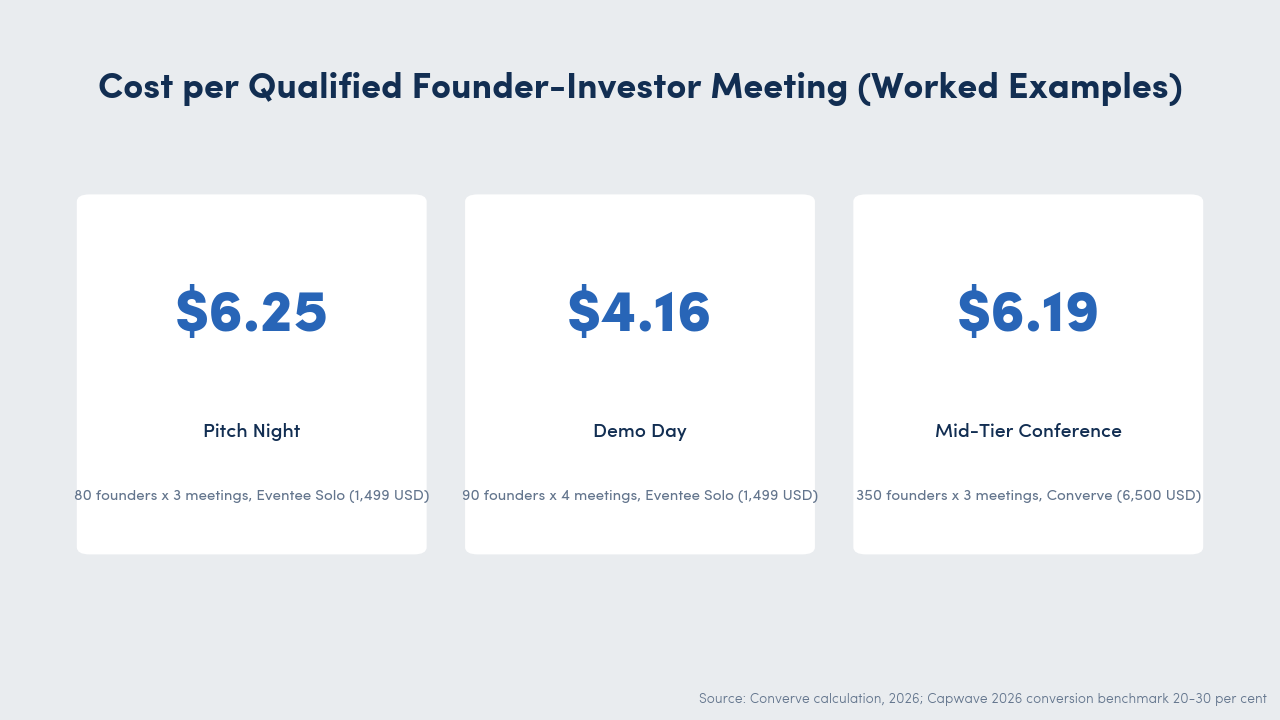
The maths is straightforward, and it changes the shortlist. For each platform on your list, multiply your founders by the meetings each one is expected to book, then divide the platform’s per-event cost by that number. Three worked examples make the shape obvious.
Pitch night, 80 founders and 25 investors. If every founder books three meetings, the event produces 240 founder-investor meetings. On Eventee Solo at 1,499 USD, the cost per meeting is 6.25 USD. On Eventify Register at 399 USD, the cost per meeting is 1.66 USD, but the matchmaking layer is lighter and acceptance rates may suffer. The Capwave acceptance benchmark of 40 to 60 per cent is the tie-breaker.
Accelerator demo day, 90 founders and 60 investors. Four pre-scheduled meetings per founder produces 360 meetings. On Eventee at 1,499 USD, the cost per meeting is 4.16 USD. On a 7 USD per-registrant platform with 150 attendees, the paper cost is 2.92 USD per meeting, but onboarding and sponsor-module add-ons usually push it to 4 to 6 USD per meeting in practice.
Mid-tier pitch conference, 350 founders and 120 investors. Three meetings per founder produces 1,050 meetings. Converve mid-market entry at around 6,500 USD per event lands at 6.19 USD per meeting, and the B2B-matchmaking workflows typically push acceptance and kept-meeting rates above the budget-tier average. At 1,050 meetings, the maths starts favouring a slightly higher sticker price.
Six Affordable Matchmaking Platforms in 2026
The six platforms below cover the affordable end of the startup-pitch-event spectrum. Each entry sticks to the same questions: what it costs, what it actually delivers, and the trade-off you accept when you choose it.
1. Converve
Converve sits at the upper end of the affordable band and is the right choice when a pitch event is large enough that a B2B-matchmaking-first workflow earns its keep. The platform runs a meeting-matrix model that lets organisers structure pre-scheduled founder-investor slots, accept or decline at the founder side, and report on kept-meeting rates after the event. Hosting is EU-native and GDPR-compliant by default, which removes a frequent procurement objection for German, Swiss, and Austrian accelerators. Customer base skews toward trade shows, hosted-buyer programmes, and accelerator-style pitch events between 200 and 3,000 attendees.
Best for: 200 to 500-attendee accelerator demo days where structured B2B matchmaking and EU data hosting are procurement requirements.
Trade-off: not the cheapest option under 100 attendees, where lighter tools cover the workflow.
2. Eventee
Eventee publishes pricing transparently, which is rare in this category. Solo is 1,499 USD per event for up to 500 attendees, Business is 2,999 USD per year for six events, Enterprise is 4,999 USD per year for twelve events. The matchmaking layer is swipe-based and lightweight, the mobile app is polished, and meeting scheduling is straightforward. It suits demo days, accelerator-cohort events, and smaller pitch nights where matchmaking is a feature rather than the entire show.
Best for: demo days and accelerator cohorts under 500 attendees where a clean attendee experience and speed to launch matter more than configurability.
Trade-off: lighter on customisation and sponsor-side workflows than mid-market specialists.
3. Eventify
Eventify has the lowest publicly quoted entry tier in this comparison. Register starts at 399 USD per event or 99 USD per month. Engage adds the event app and networking at 999 USD per event or 149 USD per month. Advance adds sponsor portals, lead scanning, and CRM plugins at 1,499 USD per event or 299 USD per month. The matchmaking layer combines tag-based matching with AI similarity scoring, which performs respectably for pitch events with clean founder and investor profiles.
Best for: B2B pitch events between 150 and 1,000 attendees that need transparent pricing and modern AI integration on the matching side.
Trade-off: a relatively new entrant compared with the long-established specialists, so reference customers in your specific niche may be thinner.
4. EventMobi
EventMobi covers similar ground to Eventee in the under-500-attendee band but with stronger cohort tooling for accelerator programmes that run mentor-mentee sessions alongside founder-investor matchmaking. Pricing is not publicly published but lands in the same mid-market entry band, typically 2,000 to 4,500 USD per event for the smaller tiers. The mobile app is polished and the configuration speed is reasonable.
Best for: accelerator programmes that combine demo-day matchmaking with mentor-cohort logistics in the same platform.
Trade-off: opaque pricing means you need a procurement call before you can shortlist.
5. Whova
Whova is widely used and delivers reliable in-app meeting scheduling, AI-generated attendee suggestions, and a strong mobile app. The pricing model is the catch for pitch events. Whova publishes a 3.0 per cent plus 0.99 USD per-ticket fee structure, which assumes ticket revenue. For free pitch events and demo days that do not sell tickets, the per-event platform fee typically lands around 1,000 USD, sometimes higher with add-ons. Always confirm the platform fee in writing before signing.
Best for: pitch events that sell tickets and want a polished mobile experience.
Trade-off: per-ticket pricing logic is awkward for free demo days and adds opacity to the total cost.
6. Sched
Sched belongs on the shortlist only as a comparison anchor. It starts at around 50 USD per month and handles multi-track scheduling beautifully, but it has no real matchmaking layer. Use it for the schedule and bring a separate tool for matchmaking, or treat it as the floor your matchmaking platform must clear on usability.
Best for: scheduling-heavy academic and developer conferences where matchmaking is not a primary workflow.
Trade-off: not a matchmaking platform.
Six Hidden Costs That Turn an Affordable Platform Into an Expensive One
The sticker price you compare in the shortlist is rarely the total cost. Six line items are responsible for most of the budget surprises, and every one of them belongs in the contract before you sign.
- Onboarding and configuration fees: 500 to 2,000 USD on top of the licence, often presented as a separate line item only after the verbal price agreement. Always ask the vendor whether the quoted price includes setup and how many configuration hours come with it.
- Sponsor-module add-on: 1,000 to 3,000 USD extra for the sponsor-side workflow on platforms that price the core attendee app separately. Critical because sponsors are usually the ones financing the event.
- Walk-in overage on per-attendee pricing: 2 to 7 USD per uncounted attendee on platforms like Cvent. A demo day that pulls 30 more founders than expected can owe 200 USD on top of the original quote.
- Integration fees: CRM, registration, payment, calendar sync. Standard integrations may be free, custom ones often quoted at 500 to 3,000 USD as one-off engineering work.
- Pass-through payment-processing fees: a percentage of ticket revenue handed to the payment processor on top of the platform fee. Easy to forget when the platform quote looks clean.
- Multi-event discount lock-in: a discounted annual rate that assumes six or twelve events per year, on a platform that bills you anyway if you run only three. Annual subscriptions are a trap when the event calendar shrinks.
A Decision Tree by Event Size
The shortlist changes meaningfully with attendee count. Three bands cover the under-500 segment, and the right tool in each band is rarely the right tool in the next.
Under 100 attendees: Eventee Solo or Eventify Register. Both publish prices under 1,500 USD per event, both deliver a workable matchmaking layer, both deploy in days. Avoid enterprise tools at this scale because configuration time eats the budget you saved on the licence.
100 to 300 attendees: Converve, Eventee, or EventMobi. The structured B2B-matchmaking workflows start to pay back at this size because founders and investors stop being able to navigate the room manually. Budget for 1,500 to 4,500 USD per event including onboarding.
300 to 500 attendees with sponsor inventory: Converve mid-market entry or Whova at 3,500 to 6,500 USD per event. The sponsor-ROI reporting becomes a real procurement requirement above 300 attendees, because sponsor renewals depend on the report you ship after the event.
When “Cheapest” Is the Wrong KPI
Three situations make the affordable shortlist the wrong place to look entirely. The first is sponsor revenue above 50,000 USD with sponsors who expect a Tier-1 mobile app as a procurement requirement, which usually means Brella, Swapcard, or Grip. The second is a regulated industry, where SOC 2 Type II or EU-only data hosting must be documented from day one. The third is a calendar of more than three pitch events per year where an annual subscription at a mid-market tier pencils out at a lower total cost than per-event pricing on a budget tool repeated four times.
If none of the three apply, the affordable band is the right place to look and the four published-pricing platforms above are the right starting point.
Solution: Meeting-Matrix Matchmaking, Transparent at the Upper End of the Band
Converve runs a meeting-matrix model for pre-scheduled founder-investor matchmaking, with kept-meeting reporting and EU-native GDPR hosting included by default. For pitch events between 200 and 3,000 attendees the platform sits at the upper end of the affordable band, with mid-market entry typically falling in the 3,500 to 6,500 USD per event range depending on configuration. If you want to see what cost per qualified founder-investor meeting looks like in your specific event, our team is happy to walk through the maths in a short demo.
Conclusion
The cheapest event matchmaking tool is rarely the right one. The right one is the platform with the lowest cost per qualified founder-investor meeting at your event size, and the maths usually picks one of four published-pricing platforms in the under-500-attendee band. Anchor the procurement conversation on cost per meeting, ask the vendor for two reference customers in your size and region, and the shortlist resolves itself in an afternoon.
FAQ: Affordable Matchmaking Software for Pitch Events
What is the cheapest reliable event matchmaking tool for startup pitch events?
Eventify Register at 399 USD per event has the lowest publicly quoted entry tier with a working matchmaking layer. Eventee Solo at 1,499 USD per event is the next step up with a polished mobile experience. Converve covers the upper end of the affordable band for events above 200 attendees.
How much should a startup pitch event budget for matchmaking software?
For pitch events under 500 attendees, budget 500 to 5,000 USD per event for the matchmaking and event-app layer. The unit-economic target is 5 to 25 USD per qualified founder-investor meeting.
Is per-attendee pricing or per-event pricing better for demo days?
Per-event pricing for predictability. Per-attendee pricing only makes sense when attendance is highly capped and confirmed, because walk-in overage at 2 to 7 USD per uncounted attendee turns a clean budget into a surprise.
Onboarding and configuration fees, sponsor-module add-ons, walk-in overage on per-attendee pricing, integration fees for CRM and registration, pass-through payment-processing fees on ticketed events, and multi-event discount lock-ins that assume a calendar you do not run.
How does Converve compare to Eventee for a 250-person pitch event?
Eventee is lighter, cheaper, and faster to launch with swipe-based matchmaking and a clean mobile experience. Converve adds structured B2B-matchmaking workflows, kept-meeting reporting, and EU-native GDPR hosting at the upper end of the affordable band. The right choice depends on whether your event needs procurement-grade reporting or a clean attendee experience first.
Can I run a serious demo day on a free or freemium event app?
For a tight cohort under 50 attendees, yes. Free tiers from Sched or Hopin cover the basics. Above 50 attendees with active VC matchmaking, freemium tiers run out of features within a week of setup, and the time you spend working around the limits costs more than a 399 USD Eventify licence.
What KPIs prove a budget matchmaking platform was worth the money?
Cost per qualified founder-investor meeting, with a target of 5 to 25 USD. Meeting-acceptance rate, with a target of 40 to 60 per cent. Kept-meeting rate, with a target of 80 per cent or better. Second-meeting conversion, with a target of 20 to 30 per cent per the Capwave 2026 benchmark. If the platform cannot report on at least three of the four, that is your answer.
When is it worth paying more than 5,000 USD per event for matchmaking?
When sponsor inventory exceeds 50,000 USD and sponsors expect a Tier-1 mobile app, when the event sits in a regulated industry requiring SOC 2 Type II or EU-only hosting, or when the calendar runs more than three pitch events per year and the annual maths picks up a cheaper total cost on a mid-market platform.