
How to Maximise Investor Meetings at a 2-Day Startup Conference: An Organiser’s Playbook
Slush 2026 expects more than 25,000 pre-booked meetings across two days. Bits & Pretzels facilitates 21,000 founder-investor meetings every year with a 70-person matchmaking team. IMEX Frankfurt 2025 ran 67,000 scheduled meetings at an 87 per cent acceptance rate. None of those numbers come from luck or from a louder LinkedIn campaign. They come from how the event is architected.
Most 2-day startup conferences leak meetings before the venue opens. Swapcard’s 2026 trend data shows that 65 to 75 per cent of meeting requests at large business-to-business events stay unanswered when there is no curation layer. That gap is where most of the perceived value of a conference quietly disappears, while sponsors pay full price for a booth and founders fly in from three time zones away.
This is a playbook for the conference organiser, not the founder. It covers the six operational layers that decide whether two days produce 200 useful meetings or 20,000, the benchmarks the top events in the world publish about their own performance, and the small number of metrics that separate a high-output conference from a busy one.
The short version: Maximising investor meetings at a 2-day startup conference is not about cramming more meetings into the calendar. It is the structured engineering of six operational layers that work together: pre-event curation, platform configuration, the 1:1 meeting engine, the multi-format layer during the event, real-time operations, and the follow-up architecture. The 2026 benchmarks to aim for are 40 to 60 per cent match-acceptance, at least two pre-scheduled meetings per attendee, an 80 per cent kept-meeting rate, and a 20 to 30 per cent second-meeting conversion within 48 hours (Azavista 2026, Capwave 2026, Swapcard 2026).
Why a Two-Day Format Is the Hardest to Get Right
Two days is the worst-case planning window for B2B matchmaking. A single-day event is essentially a programme problem: you fit what fits and accept that anything more is overflow. A three-day event has slack: late starts, recovery time, the third-day cooldown for the second meeting wave. Two days has neither cushion. Every slot fights every other slot for the same calendar.
On top of that, attendees treat two days as a sprint. Founders arrive with 30 target investors and a fundraising deadline. Investors arrive with 250 inbound requests, of which they will realistically take 20. Sponsors arrive expecting 26 qualified buyer meetings, because that is the published industry benchmark for top private-equity conferences (SourceCo 2026). If your platform opens too early, the early profiles are stale by event day. If it opens too late, the booking window collapses and your top investors walk in with an empty calendar.
The conferences that publish meeting numbers the rest of the industry envies are not running more matchmaking. They are running tighter matchmaking, on a stack of layers that each do one thing well.
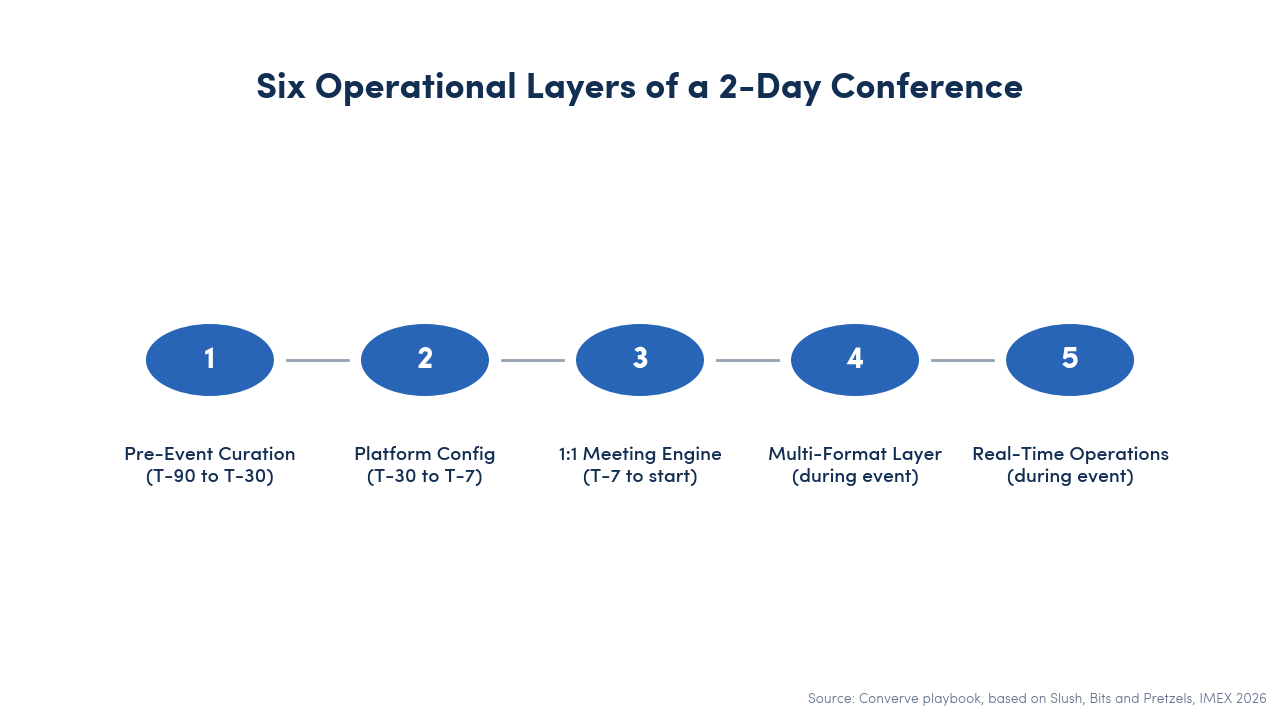
The Six Operational Layers That Carry the Output
Each layer below answers a different question. Skip one and the others compensate badly. The order matters: a brilliant 1:1 engine cannot save a curation step that let the wrong people in.
Layer 1: Pre-Event Curation (T-90 to T-30)
Curation is the single highest-leverage layer, and it happens entirely before anyone opens the matchmaking app. Bits & Pretzels admits 7,500 attendees from 70 countries and explicitly describes them as “carefully curated”. Slush 2026 deliberately shrank its 2025 footprint by around 10 per cent to push attendee quality (Slush Newsroom 2026). Web Summit Vancouver 2026 hosted 20,235 attendees, 768 of whom were investors, and surfaced 157 curated meetups via its AI recommender system before the show floor opened.
Three jobs sit inside this layer. First, founder tiering by stage and traction, so a pre-seed founder is not surfaced into the same matching pool as a Series C. Second, investor pre-approval, with check size, geography, sector and stage declared up front so that the algorithm has something other than keywords to work with. Third, side-event coordination, because the dinners, the breakfast briefings and the morning runs do a disproportionate share of the trust building that produces the second meeting later.
Layer 2: Matchmaking Platform Configuration (T-30 to T-7)
The platform decisions that matter for 2-day events are not which vendor logo sits on the login screen. They are the configuration choices made inside whichever platform you have already paid for. Three of those decisions move the meeting acceptance rate by tens of percentage points.
The first is whether the matching engine is rule-based with an audit trail or AI-driven with a recommendation black box. Rule-based engines pair attendees on declared intent: I am a series A SaaS founder raising in Europe, I want to meet European fund partners with check sizes between EUR 1 million and EUR 5 million, here is my deck. The output is auditable and explainable, which matters when an investor or a regulator asks why a specific match was suggested. AI engines lift acceptance further at the cost of explainability: Swapcard reports that AI matchmaking roughly doubles acceptance at tier-2 trade shows compared to no algorithm at all, and Clarion Events reports a 44 per cent year-on-year lift in in-person meetings after deploying it (Event Tech Live 2026). The right answer is not “use AI”; it is “decide which trade-off your event needs and configure deliberately”.
The second decision is connection caps. Top-tier investors at major conferences receive 200 to 500 inbound meeting requests within hours of the platform opening. Without caps, the requests pile onto the same 30 partners and 80 per cent of founders walk away with nothing. Slush caps outgoing requests at 50 per founder. The cap is not stingy; it is what keeps the inbox usable.
The third decision is the opening date. The current best practice is to open the platform seven to ten days before the event (EventHex 2026). Earlier means cold profiles and meetings booked before founders refine their narrative. Later means investors miss the booking window and arrive with an empty calendar. The seven-to-ten-day rule applies to most tier-2 trade shows and startup conferences.
Layer 3: The Pre-Scheduled 1:1 Meeting Engine (T-7 to Event Start)
This is the layer most organisers think of as “matchmaking”. It is really just the layer that ships what the previous two layers built. The mechanics are well understood now.
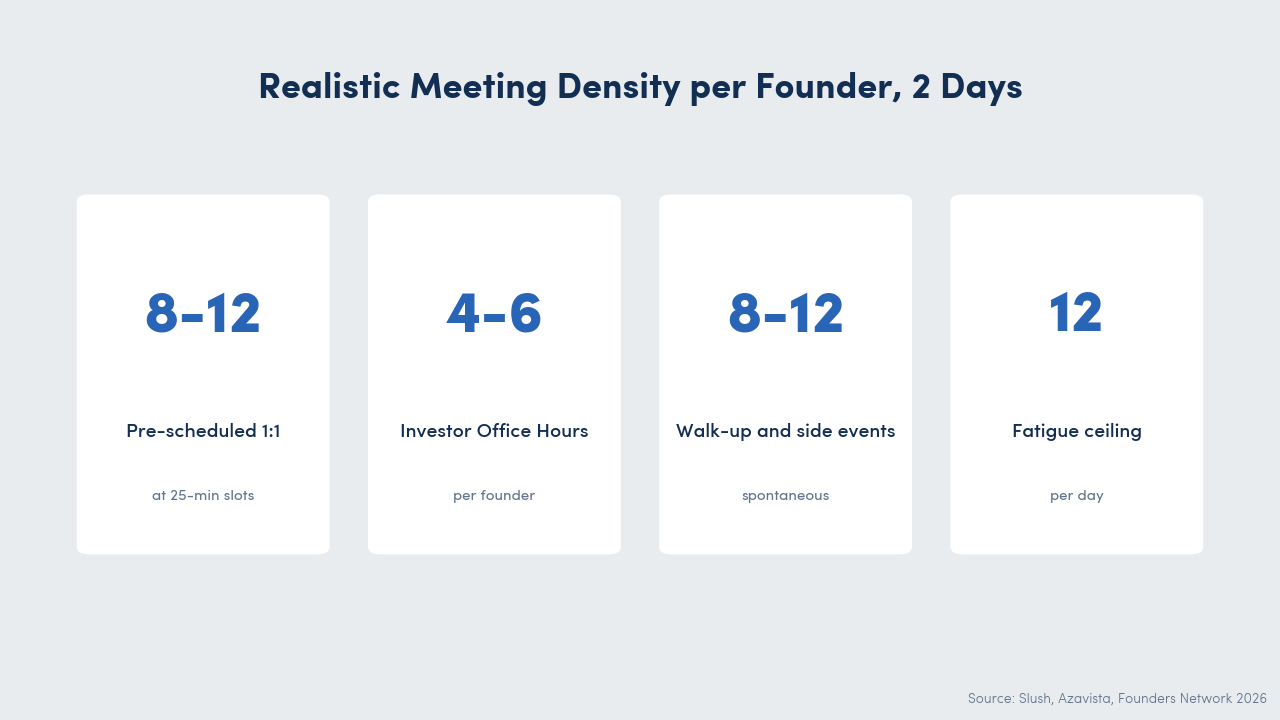
The realistic slot length is 20 to 25 minutes with a 10-minute walking buffer between meetings. Shorter slots strip out everything except the elevator pitch and the calendar invitation. Longer slots break the calendar: at 30 minutes per slot with buffers, a founder can run six meetings a day. At 25 minutes, the same founder can comfortably run 8 to 10 per day, which is the ceiling before fatigue degrades the conversation. Across two days that is 16 to 20 pre-scheduled 1:1 conversations per founder, plus another 4 to 6 in office hours and a roughly equal volume of walk-up encounters. Plan for fewer than the upper bound; budget for fatigue after meeting 12.
Acceptance targeting is the other lever. The Azavista 2026 industry benchmark is 40 to 60 per cent match-acceptance. Below 40 per cent and either the profiles are weak or the algorithm is noisy. Above 60 per cent and you are probably under-curating, which means founders are saying yes to meetings they should have screened out. Three small interventions move the number: pre-crafted opening messages that include a specific “why this match” sentence, profile completion gates that block half-finished profiles from being surfaced, and a calibration pass on the algorithm using the first 200 sent requests.
Layer 4: The Multi-Format Layer During the Event
Pre-scheduled 1:1s alone are not enough, and the conferences with the highest published meeting numbers all run a stack of formats in parallel.
The dominant pattern, copied across Slush, Bits & Pretzels and Web Summit, has five elements: pre-scheduled 1:1 tables for the planned meetings, investor office hours for the requests that did not make the 1:1 cut, curated roundtables for limited-partner-general-partner and corporate-founder matches, walk-up lounges for serendipity, and curated dinners for trust building. Slush 2025 ran more than 600 side events alongside the main hall, with Investor Day hosting 2,000-plus investors across 36 roundtables, 75 1:1 tables and seven stage talks over five hours. Office hours absorbed up to 70 founders per 75-minute session, which is roughly a one-minute window per founder, but it cleared out the request backlog that the 1:1 engine could not fit.
The trap to avoid is treating office hours as a substitute for 1:1s. They are a complement, designed for the high-demand investors who cannot grant individual slots and for founders who missed the booking window. If they become the main format, you have effectively downgraded every conversation to a one-minute pitch and removed the second-meeting hook.
Layer 5: Real-Time Operations
Two days of high meeting density produces a constant stream of small operational fires: no-shows, double-bookings, overruns, broken matches, missing badges. Wait-list routing matters more than most organisers expect: when an investor cancels a slot at 9.47 a.m., the platform should re-offer that slot to the next compatible founder by 9.50. If the routing takes hours, the slot is dead.
The metric to monitor live is time-to-first-meeting. Azavista’s 2026 framework sets the target at under 24 hours from platform opening. If a founder logs in and cannot book a meeting within a day, they will mentally write the event off and stop engaging with the platform, even if the actual booking volume across the room is healthy. A live operations dashboard with three numbers, acceptance rate, kept-meeting rate and time-to-first-meeting, lets the matchmaking team intervene during the event, not after it.
Layer 6: Post-Event Follow-Up Architecture
The conference that ends at 6 p.m. on day two is not done. Capwave’s 2026 founder benchmark is that 20 to 30 per cent of event contacts convert into second conversations when founders follow up within 48 hours. The conversion drops to under 10 per cent without that window. Patrick de Laive’s analysis of 500-plus startups across GITEX, Web Summit, HLTH, CES and VivaTech found that 82 per cent of founders fail to convert event leads into follow-ups within seven days, which is where most of the EUR 5,000 to EUR 15,000 spent on the event evaporates.
The organiser’s job in this layer is to make the 48-hour window operationally trivial. In-app message persistence, automatic meeting-history exports to LinkedIn or CSV, suggested follow-up templates and a year-round sprint cadence (Slush runs monthly 15-minute back-to-back matchmaking sprints between events) all help. The point is not to do the founder’s follow-up for them. The point is to remove every minute of friction between “we met yesterday” and “let us schedule a deeper conversation”.
Industry Benchmarks: What Top Conferences Actually Deliver
The numbers below are useful for two reasons. They give your board something concrete to compare your event to, and they give your platform team a sense of the architectural ceiling. They are not meant to be matched on day one of a new event; they are what a mature operating stack produces.
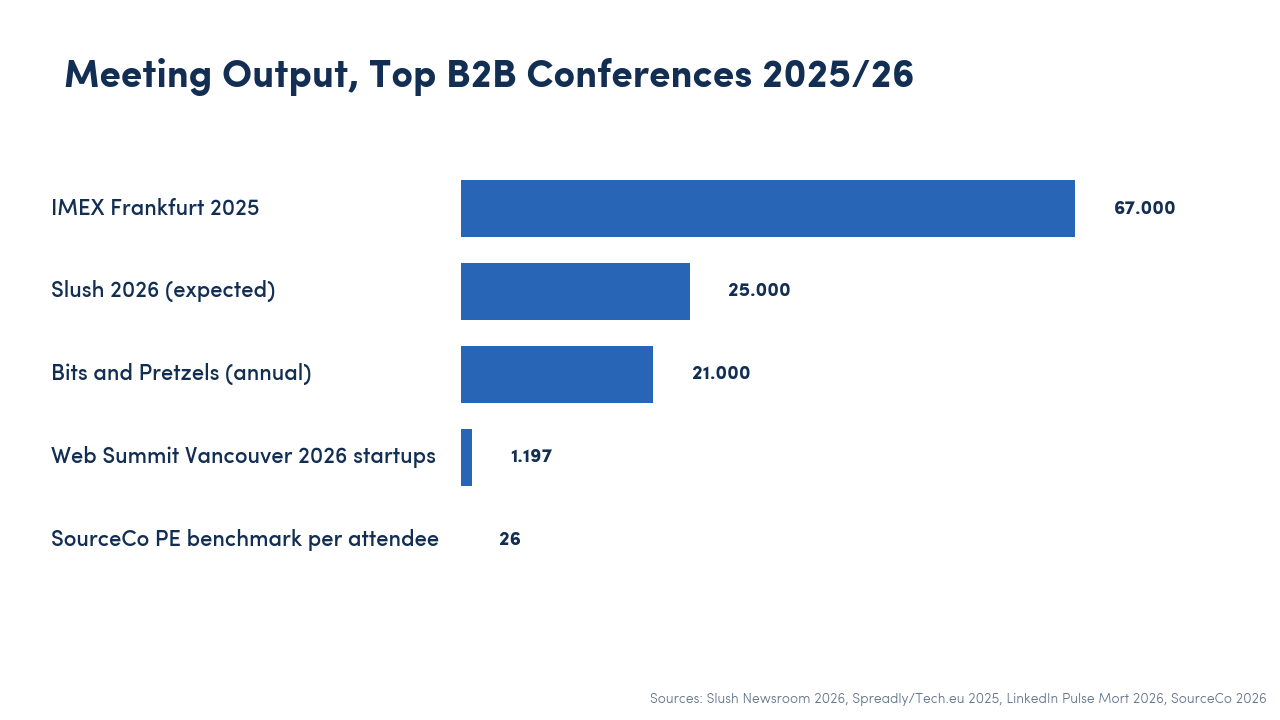
Slush 2024 ran 21,000 pre-booked meetings, up 110 per cent from 10,000 in 2019. The 2026 edition expects more than 25,000 meetings across two days, with a peak of around 1,000 meetings per hour during the event (Slush Newsroom 2026). Bits & Pretzels facilitates 21,000 founder-investor meetings annually, runs a 70-person matchmaking team and is associated with around EUR 4.2 billion in capital raised over its history (Tech.eu, October 2025). IMEX Frankfurt 2025 produced 67,000 scheduled meetings at an 87 per cent acceptance rate with more than 100,000 badge scans, on an ExpoPlatform stack that most observers misidentify as a different vendor (LinkedIn Pulse, Richard Mort 2026).
Web Summit Vancouver 2026 brought 20,235 attendees including 768 investors and used its AI recommender to seed 157 curated meetups before the floor opened. Y Combinator’s W26 demo day, by contrast, produced 196 companies pitching one-minute slides to 1,500 investors in six hours, with the typical post-demo-day round defaulting to USD 4 million on a USD 40 million post-money cap. SourceCo’s reference benchmark for top private-equity conferences is 26-plus pre-scheduled 1:1 meetings per attendee over two days, executed via a matchmaking platform. Each format optimises for something different. None of them is “more meetings”; all of them are “the right meetings”.
The KPI Framework: Six Metrics That Separate High-Output From Busy
If you can only report on six numbers to your board after the event, these are the ones to choose. Azavista’s 2026 industry framework and Capwave’s 2026 founder benchmark line up cleanly with the numbers Slush, Bits & Pretzels and Swapcard publish about their own events.
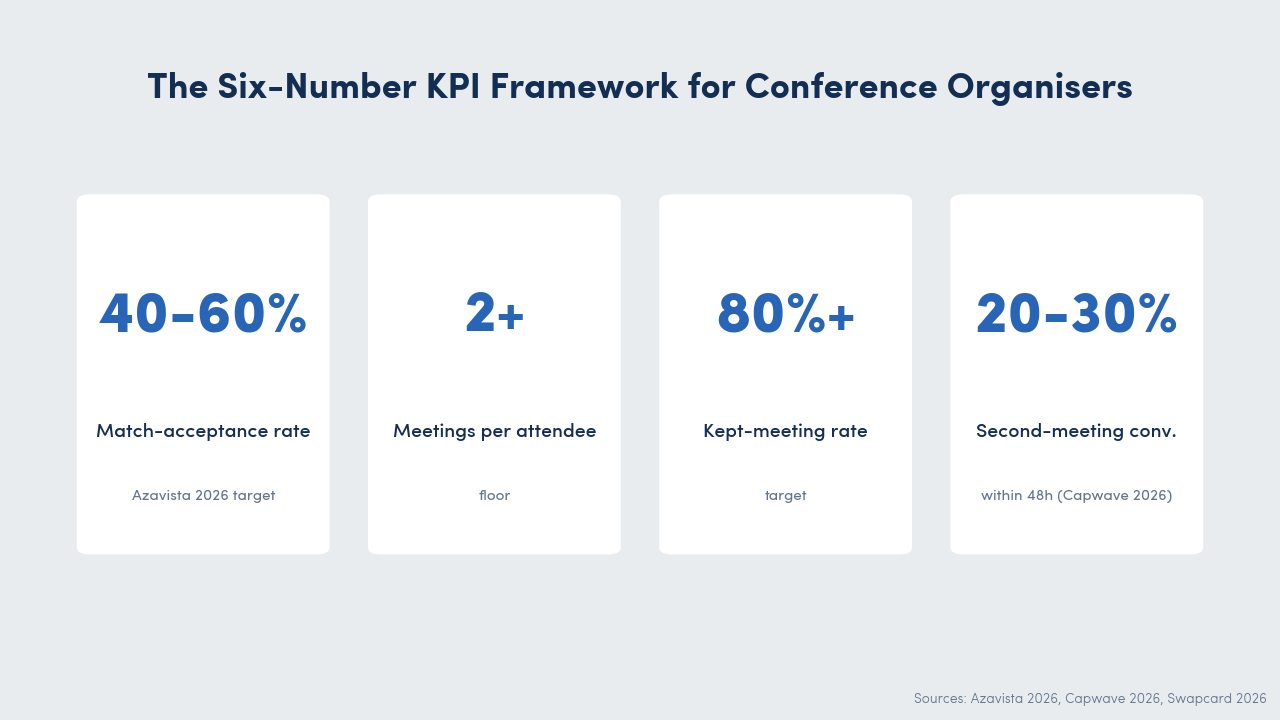
The first is match-acceptance rate, targeted at 40 to 60 per cent. The second is meetings per attendee, with a floor of two for the event to count as a matchmaking event rather than a content event with a networking lounge. The third is kept-meeting rate, with a target of 80 per cent or higher; below that, no-shows are eating the operational cost. The fourth is useful-meeting rate, with a target of 65 per cent or higher, defined as the share of completed meetings that both sides rate as worth a follow-up. The fifth is second-meeting conversion within 48 hours, targeted at 20 to 30 per cent. The sixth is time-to-first-meeting, with a target of under 24 hours from platform opening.
Two diagnostic ratios sit on top of the six. The first is the ratio of pre-scheduled meetings to walk-up meetings, which tells you whether the matchmaking layer is doing its job or whether the room is doing the job in spite of the platform. The second is the cost per kept meeting, calculated as total event operations cost divided by kept meetings. American Express Global Business Travel pegs the corporate cost-per-attendee-per-day at USD 169 in 2026, up 4.3 per cent year on year. For a 1,000-attendee 2-day event, that is roughly USD 338,000 in attendee-cost basis alone. A 20 per cent slot-failure rate translates to around USD 67,000 of operational waste, before you count reputational damage and lost investor return rates.
Solution: Where Converve Fits in This Stack
Solution: Converve is a rule-based meeting-matrix platform built for organisers who need the engineering of Layer 2 and Layer 3 without giving up the audit trail. We pair attendees on declared intent (stage, sector, geography, check size, languages), enforce per-attendee connection caps to protect senior investors from request floods, and route around real-time no-shows automatically. Every match has a “why this match” explanation, every block has a recorded reason, and the data stays in the European Union by default. For DACH organisers running buyer-seller matchmaking under General Data Protection Regulation (GDPR) constraints, that audit trail is not optional; for everyone else, it is the cheapest insurance policy against a regulator question you cannot answer.
If your event currently runs a one-stop platform that bundles registration, networking and matchmaking but quietly under-delivers on the meeting numbers, the question to ask is which of the six layers above are configured and which are absent. In most cases, layers two and three are present, layer four is partly present, and layers one, five and six are missing or manual. Closing those gaps is where the 200-to-2,000 meeting jump lives.
When This Playbook Is the Wrong Approach
The six-layer architecture is overhead for events below 200 attendees. At that scale, walk-up plus curated dinners produce the meetings without the cost of a matchmaking platform. The playbook is also wrong for pure pitch events with no 1:1 component, where the Y Combinator demo day model dominates and the right read is our companion piece on demo-day structure rather than this one.
The third place it fails is closed-circle association meetings, where the attendee list barely changes year to year and matchmaking by intent surfaces matches the room already knows. There the right tool is a smaller curation step and a different agenda, not a configured platform. The signal that you are in one of these wrong-tool cases is when the matchmaking algorithm cannot find five distinct matches per attendee from the existing profile pool.
Frequently Asked Questions
How many investor meetings can a founder realistically take at a 2-day conference?
Eight to twelve pre-scheduled 1:1 meetings is the working ceiling for a single founder over two days at a 25-minute slot length, with diminishing returns above twelve as fatigue degrades the conversation. Add four to six investor office hours interactions and roughly the same in walk-up encounters and the realistic total ranges from 18 to 28 conversations across both days.
What is a good acceptance rate for investor meeting requests?
Forty to sixty per cent is the Azavista 2026 industry target. Below 40 per cent suggests weak profiles or a noisy matching algorithm. Above 60 per cent typically means the curation step before the platform opened was too loose, which produces yes-by-default meetings that do not convert into follow-ups.
How long before the event should we open the matchmaking platform?
Seven to ten days before the event start is the EventHex 2026 best practice. Earlier yields cold profiles and meetings booked before founders refine their narrative. Later misses the booking window for the top investors, who arrive with empty calendars.
How do we prevent top investors from being overloaded?
Three things in combination. Connection caps of around fifty outgoing requests per founder, AI-curated suggestions on the investor side that filter the inbound list by thesis fit, and office hours as a complement to 1:1 slots for the requests that did not make the cut. Together these keep the inbox usable for the senior investors and prevent the platform from collapsing into the 20-investor scrum that everyone has seen at least once.
What slot length works best for founder-investor 1:1?
Twenty to twenty-five minutes plus a ten-minute walking buffer is the consensus. Fifteen-minute slots strip out everything except the elevator pitch. Thirty-minute slots cut the daily meeting ceiling from ten to six and rarely produce a deeper conversation than the 25-minute slot.
What KPIs prove the conference delivered investor meetings?
Six numbers: match-acceptance rate (40 to 60 per cent), meetings per attendee (at least two), kept-meeting rate (eighty per cent or higher), useful-meeting rate (sixty-five per cent or higher), second-meeting conversion within 48 hours (20 to 30 per cent), and time-to-first-meeting (under 24 hours from platform opening).
How should we measure success after the event?
Second-meeting conversion within 48 hours, which the Capwave 2026 founder benchmark puts at 20 to 30 per cent for well-prepared founders. Add founder net promoter score, investor net promoter score, and capital raised attributable to the event over a 90-day window. Avoid head-count vanity metrics; they do not predict whether the event repeats.
Is AI matchmaking worth the trade-off in 2026?
For tier-2 events where acceptance currently sits below 50 per cent, the Swapcard 2026 data shows that AI matchmaking roughly doubles acceptance and Clarion Events reports a 44 per cent year-on-year lift in in-person meetings after deploying it. The trade-off is explainability: AI engines surface matches you cannot audit line by line, which matters in regulated regions and for events that publish their methodology. Rule-based matching keeps the audit trail at the cost of leaving some lift on the table. Most mature events run both, with the rule layer as the default and the AI layer as an opt-in surface for serendipity.
Conclusion
A 2-day startup conference that maximises investor meetings is not the one that schedules the most meetings. It is the one that schedules the right meetings, keeps eighty per cent of them, and pushes a quarter of them into a second conversation within 48 hours. The numbers Slush, Bits & Pretzels and IMEX publish are downstream of an architecture, not a marketing budget. The architecture is six layers deep, configurable inside whatever platform you already run, and worth the effort because the cost of the alternative, measured at USD 169 per attendee per day, is what your sponsors and your founders are quietly absorbing every time a slot fails.
If you are configuring this stack for your next event and want an audit-friendly matchmaking layer that handles the connection caps, the wait-list routing and the GDPR-native data residency without an opaque AI box on top, the Converve team is happy to walk through how the meeting-matrix engine fits the six-layer playbook. Contact us or explore the platform.