What Is a Hosted Buyer Programme? Definition, Mechanics and a 2026 Decision Framework
At IMEX America 2025, organisers welcomed more than 7,800 hosted buyers and recorded over 150,000 pre-scheduled meetings on the show floor. At IBTM World in Barcelona later the same year, the team launched a brand-new “visitor buyer” tier alongside the traditional hosted programme. Both numbers tell the same story: the hosted buyer model is alive, dominant in the tourism trade show world, and quietly evolving.
The trouble is that the term itself has stretched. Some events still mean the original 1990s IMEX format. Others use “hosted” loosely to describe anyone with a discount code. New variants like “visitor buyer”, “semi-hosted” or “executive hosted” sit somewhere in between. For a Destination Marketing Organisation (DMO), a convention bureau or a tourism trade show producer comparing platforms, audiences and budgets, that fuzziness gets expensive fast.
This pillar sets the definition straight. You will get the IMEX-era origin, the mechanics that every hosted programme shares, the 2026 format spectrum that organisers actually choose between, the real cost structure per buyer and an honest answer to when the format is the wrong choice for your show.
TL;DR — Hosted Buyer Programme in 60 Words
A hosted buyer programme is a curated trade show format in which the organiser pre-qualifies senior buyers and covers their travel, accommodation and on-site hospitality, in exchange for a contractual commitment to a set number of pre-scheduled one-to-one meetings with exhibitors. The model emerged in the meetings, incentives, conferences and exhibitions (MICE) industry in the late 1980s and early 1990s, and now defines flagship tourism trade shows including IMEX, IBTM, The Meetings Show and IPW.
A Brief History — From the IMEX Pioneer Model to a 2026 Format Spectrum
The format has a clear origin. Ray Bloom, founder of the IMEX Group, pioneered the hosted buyer concept in the late 1980s, refined it through the 1990s and built the modern IMEX shows around it. Smart Meetings traces the evolution explicitly: hosted buyers were Bloom’s solution to a recurring complaint from exhibitors at trade shows of that era. Exhibitors said the show floor was busy, but the right people rarely walked past the stand. Inviting qualified senior decision-makers, covering their costs and contracting them to attend pre-scheduled meetings fixed both halves of the problem at once.
Three decades on, IMEX still defines the canon. IMEX Frankfurt typically hosts around 3,500 fully hosted buyers each May, plus 900 to 1,200 non-hosted buyers; IMEX America in Las Vegas runs at roughly 4,300 hosted plus 900 to 1,200 non-hosted, according to figures published by Skift Meetings in July 2025. IBTM World gathers more than 12,000 industry professionals in Barcelona each November, with hosted buyers at the centre. The format is the operational backbone of the global MICE trade show calendar.
What has changed is the spectrum. In 2025, IBTM World launched a paid “Visitor Buyer” option alongside the classical hosted programme. For 399 euro early-bird or 499 euro thereafter, attendees book as many meetings as they like with exhibitors of their choice, at their own pace, with no minimum commitment. IMEX has long offered parallel hosted and non-hosted tracks. Business Travel Show America and Europe split their programmes into fully hosted and semi-hosted tiers, each with its own travel-coverage rules and meeting quotas. The base definition has not moved; the buyer’s options around it have multiplied.
How a Hosted Buyer Programme Actually Works
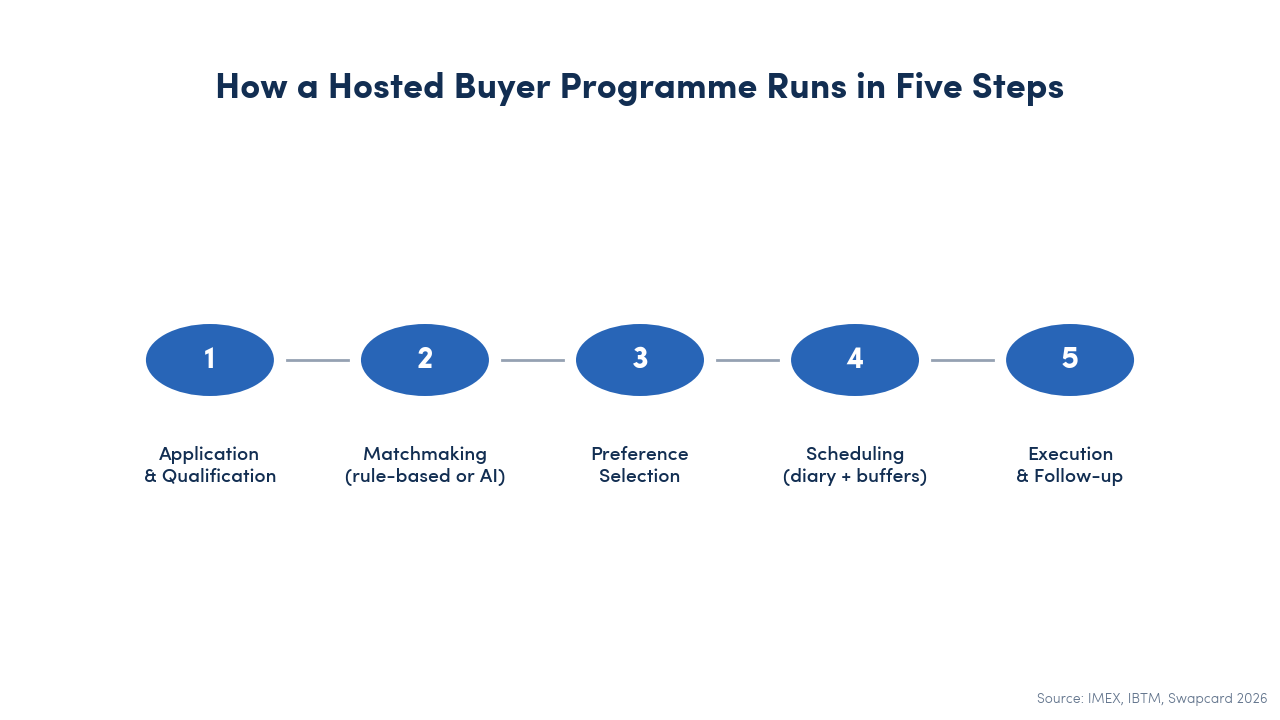
Strip away the branding differences and the mechanics are remarkably consistent across IMEX, IBTM, IPW, MICE Show Asia and ICCA partner events. A hosted buyer programme runs in five operational steps.
Step 1 — Application and Qualification
Buyers apply or are invited. The organiser screens applicants against three criteria: budget authority (the buyer holds or directly influences a meaningful spending decision), event scale (they regularly commission events of a relevant size for the show’s seller mix) and influence (they represent a real account, not a freelance opportunist). At IAAPA, for example, the executive hosted tier requires a proven purchasing intent of 250,000 US dollar or more at IAAPA expos. The qualification step is the single biggest predictor of programme quality downstream.
Step 2 — Matchmaking
Qualified buyers and registered exhibitors are loaded into a matchmaking engine. Two approaches dominate in 2026. Curated rule-based matchmaking works over explicit attributes (destination interest, buyer segment, deal-size band, language) and lets the team see exactly why each meeting was proposed. AI-assisted scoring layers a learned ranking on top, often with a measurable performance lift but at the cost of explainability. Most tourism flagship shows still run rule-based by default and add AI assist only when buyer volumes outgrow what a human curation team can handle. We unpack the trade-off in the matchmaking section below.
Step 3 — Preference Selection
Both sides mark whom they want to meet, whom they prefer not to meet and which time bands they will block out for other commitments. The seriousness of this step distinguishes premium hosted programmes from light “matchmaking lite” exercises. Buyers who do not invest time in preference selection produce low-quality meeting outcomes regardless of the engine behind the matching.
Step 4 — Scheduling
The platform builds the final meeting diary: time slots, table assignments, breaks, buffers and travel time between zones. IMEX commits hosted buyers to six to eight 30-minute meetings per day; in practice, hosted buyers there book around 16 or more meetings across the full show. Business Travel Show America requires 10 fifteen-minute meetings per day from fully hosted buyers, and 5 from semi-hosted buyers per attendance day. Cancellation and no-show penalties are enforced contractually.
Step 5 — Execution and Follow-Up
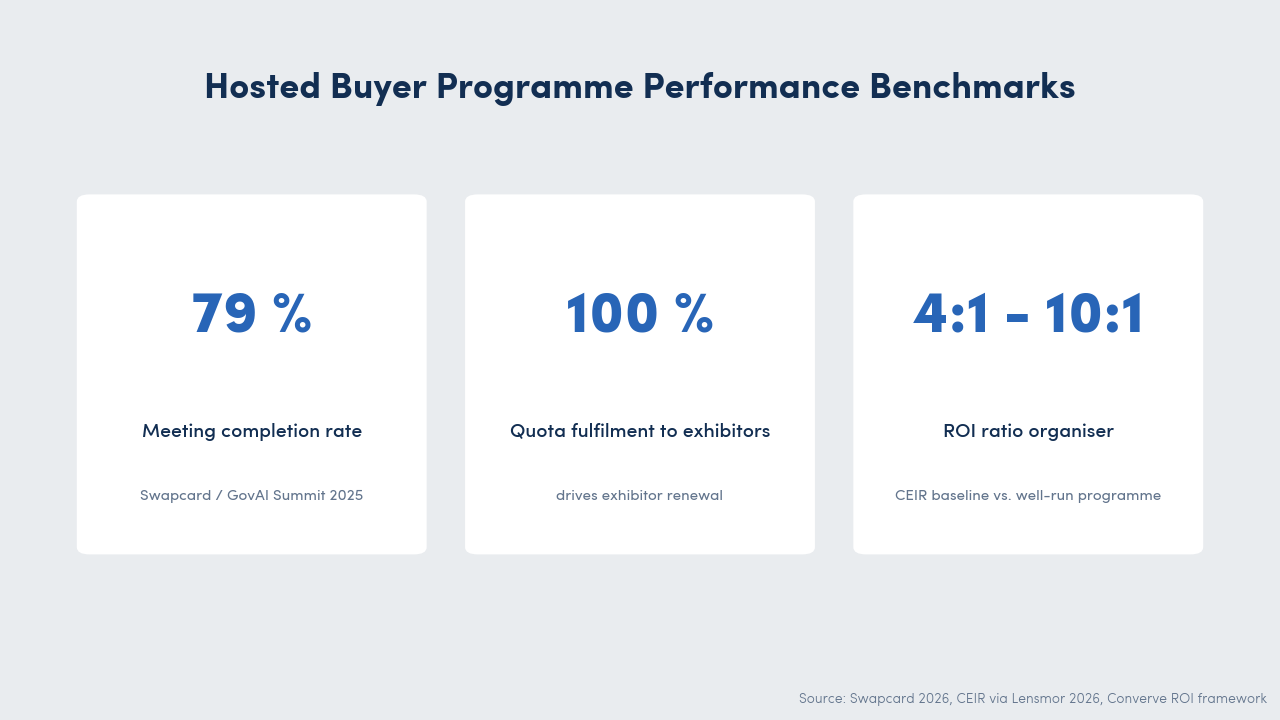
Meetings run during the show floor hours. Both sides log notes, ratings and next steps on the platform. Post-event, the organiser captures buyer satisfaction, exhibitor pipeline lift at 30, 60 and 90 days and renewal commitments for the next edition. This is where the operational health of the programme becomes commercial intelligence: a programme below 70 per cent meeting completion is leaking value somewhere in the chain.
The 2026 Format Spectrum — Fully Hosted, Semi-Hosted, Visitor Buyer, Open Registration
In 2026, a tourism trade show organiser deciding how to structure buyer access typically chooses between four formats. The differences run along two axes: how much the organiser covers and how much commitment is asked in return.
A growing share of large tourism trade shows now combine all four tiers on the same event. IMEX has long run hosted plus non-hosted side by side. IBTM World now overlays a Visitor Buyer tier on top of its traditional hosted programme. The hybrid pattern reflects a simple commercial truth: different buyer profiles deliver different value, and a one-size-fits-all programme leaves money on the table.
Who Hosted Buyer Programmes Are Built For — A Tourism Trade Show Lens
Hosted buyer programmes are technically format-neutral. In practice, they have always been at home in tourism. The Global Tourism Forum, the Africa Travel Week portfolio, the IPW US Travel Association event, MICE Show Asia and the IBTM portfolio all sit on the model. Three reasons make the format natively tourism-shaped.
- Long booking cycles, high deal sizes: A qualified tour operator or MICE buyer commissions group programmes worth tens of thousands of euro per meeting outcome. The subsidised travel cost per buyer is small against the lifetime contract value of the relationship.
- Cross-border buyer pool: Tourism trade shows are inherently international. Without subsidised travel, the right Asian buyer never crosses the door of a European destination show, and the destination loses pipeline that funded the event in the first place.
- Public-sector accountability: Tourism boards, convention bureaus and trade ministries answer to budget committees that ask “what did the event produce”. A hosted programme produces traceable meetings, follow-up surveys and signed-business data. An open show produces footfall.
That is also why generic event-matchmaking software treats hosted buyer as an optional plug-in, while tourism-vertical software treats it as the default workflow. We explore the distinction in detail in our pillar on the best matchmaking software for tourism trade shows in 2026.
What a Hosted Buyer Programme Costs the Organiser
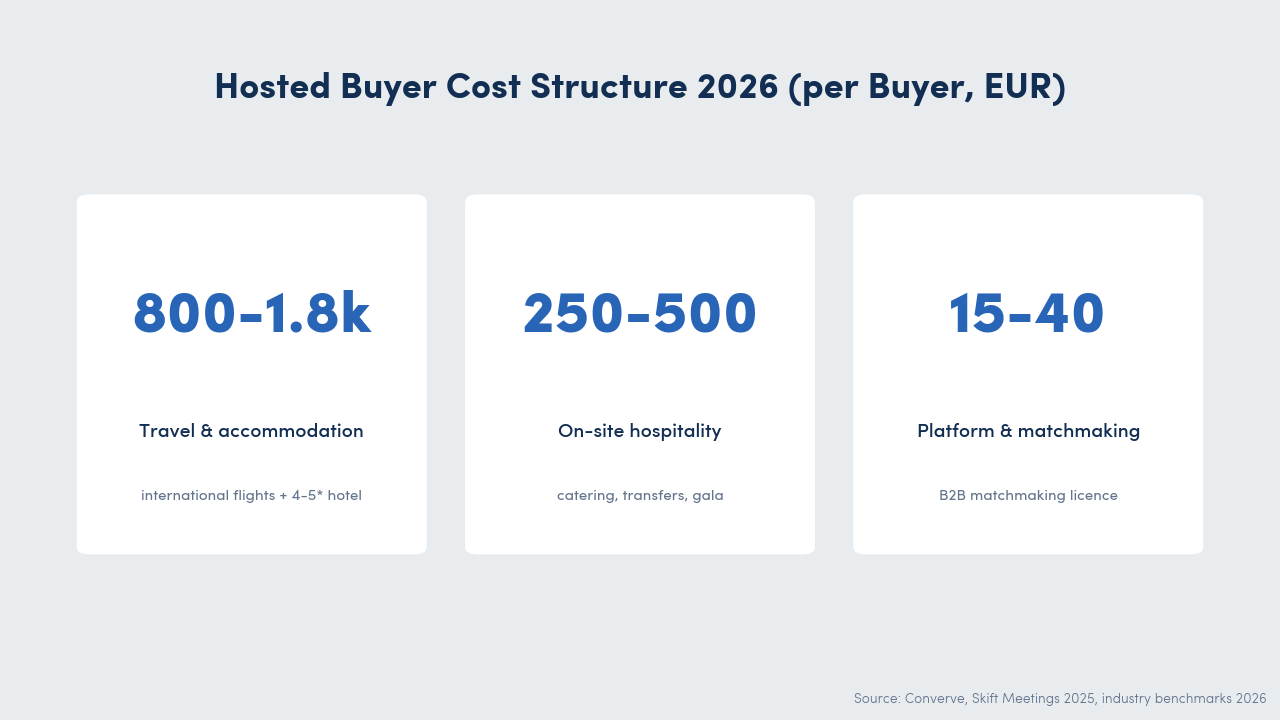
Few discussions of hosted buyer programmes name the real numbers, which makes board-level conversations needlessly painful. The honest cost structure per hosted buyer in 2026 looks roughly like this.
- Travel and accommodation: Typically 800 to 1,800 euro per international buyer, depending on origin region and host city pricing. Long-haul Asia-Pacific buyers can run higher.
- On-site hospitality: Catering, transfers, welcome reception, gala dinner. Plan 250 to 500 euro per buyer across a three-day show.
- Platform and matchmaking technology: Licence fees for a B2B matchmaking platform scale with buyer numbers but rarely exceed 15 to 40 euro per buyer for established events. Internal-team setup time is the larger hidden cost.
- Programme management: Dedicated hosted buyer manager, qualification reviewers, on-site concierge team. For a show with 500 hosted buyers, plan two to three full-time roles across the three months around the event.
Total cost per hosted buyer typically lands between 1,500 and 4,000 euro. Compared with the lifetime contract value of a qualified tourism buyer, the maths usually works, but only if the qualification bar is honest and the matchmaking platform actually delivers. Cut either, and the spend produces footfall, not pipeline. For the operational walkthrough that turns this budget into a working programme, see our step-by-step guide to running a hosted buyer programme.
When a Hosted Buyer Programme Is the Wrong Format
Not every show needs one. Three honest tests rule the format out before you build the business case.
- Your average deal value will not carry the subsidy: A useful rule of thumb in tourism is that the lifetime contract value per buyer account should exceed 20,000 euro for the maths to work. Below that, semi-hosted or visitor buyer tiers are usually the better fit.
- Your audience is largely local: If your sellers and buyers sit within the same region and travel barriers are low, the subsidy delivers little marginal value. Open registration plus a structured meetings layer outperforms a full hosted programme on cost-to-yield.
- Your commercial goal is brand discovery, not pipeline: Hosted programmes are deal machines. If your strategic objective for the show is reach, awareness or community engagement rather than contracted meetings, the operational overhead is misaligned. The newer visitor buyer model from IBTM is a cleaner answer.
If two or more tests fail, do not run a full hosted programme. Choose a semi-hosted or visitor buyer tier, or scale down. We unpack the trade-offs in our comparison piece Hosted Buyer Programme vs. Open Registration.
Glossary — Hosted Buyer Programme vs Adjacent Formats
Several adjacent formats get confused with the hosted buyer programme in casual conversation. The distinctions matter when you choose a platform or write a board paper.
- Hosted Buyer Programme: organiser-funded programme with contractual meeting quotas at a trade show.
- Familiarisation Trip (FAM Trip): destination-funded educational trip for buyers, focused on supplier visits and product knowledge, without a pre-scheduled meeting architecture.
- Trade Mission: government or trade-promotion-funded delegation, often cross-industry and politically framed.
- Buyer-Seller Matchmaking: the pure algorithmic layer that supports both hosted and open formats; not a format on its own.
- Smart Meeting or 1:1 Meeting: the individual meeting unit inside a hosted buyer programme, also used in non-hosted contexts.
- Speed Networking: a time-compressed group format, often complementary to a hosted programme rather than a substitute.
The pillar that connects these definitions across personas is our piece on event networking versus matchmaking.
Matchmaking and the Modern Hosted Buyer Workflow
The mechanics described above are matchmaking-agnostic. What has changed in 2026 is the choice organisers face at the matchmaking step itself. Two approaches sit on the table and they trade off differently against operator control.
Curated rule-based matchmaking is the model that built IMEX, IBTM and IPW. It uses explicit rules over buyer and seller attributes: destination interest, buyer segment, deal-size band, language, region. The matchmaking team and the platform can see exactly why a meeting was proposed, can override a result and can defend the logic to a sponsor, a tourism board or a public-sector funder. Most tourism flagship shows still run on this model. It scales more slowly than AI, but it is transparent and auditable from end to end.
AI-assisted matchmaking uses embedding or learned-ranking models to score buyer-seller pairs at a finer granularity than a rule engine reaches. The performance lift is real where it fits. Swapcard’s 2026 trend report documents acceptance rates roughly doubling on Tier-2 trade shows once AI scoring is switched on, with Tier-1 requests approaching 100 per cent acceptance. Clarion Events publicly reported a 44 per cent rise in in-person meetings after introducing AI matchmaking. The trade-off is explainability: AI models are black boxes by default, and many organisers, especially those answering to public funders or association boards, prefer to keep the matching logic readable.
The honest 2026 answer is not “use AI” or “stay rule-based”. It is choose deliberately. If your show carries public-sector accountability, has a tight curation team and is built on long-running seller relationships, rule-based matchmaking gives you control and an audit trail. If your show has outgrown what a human curation team can rank by hand, AI assist layered on top of a rule-based core is the path most large trade shows now take.
Solution: a hosted buyer programme stitches together pre-qualification scoring, travel and accommodation logistics, contractual meeting quotas, the matchmaking layer and post-event compliance reporting. Converve handles this as one connected workflow with a meeting matrix at the centre, built on curated rule-based logic over explicit buyer-seller attributes (destination interest, segment, deal-size band, language, region). The matrix gives organisers a single auditable view across all five layers and keeps every match decision traceable, so the team can defend any individual meeting proposal to a sponsor or a funder.
A Note on DACH Compliance and EU Data Protection
For DMOs and convention bureaus operating in the DACH region or anywhere inside the European Union, the hosted buyer workflow touches sensitive personal data: passport details for visa support, travel and accommodation bookings, dietary and accessibility preferences, behavioural data from the matchmaking engine. The General Data Protection Regulation (GDPR; in German law DSGVO) requires explicit consent, defined retention periods and clear vendor-data-processing agreements with your platform. Tourism trade show platforms hosted inside the EU and explicitly audited against GDPR remove a significant compliance burden from your team. This is one of the reasons large European tourism boards prefer EU-resident matchmaking pla