How to Run a Hosted Buyer Programme: A Step-by-Step Guide for Tourism Trade Shows
A trade-show booth converts conversations into closed deals at 1.9 per cent. A hosted buyer meeting converts at 13 per cent. That is 6.8 times more often, and the resulting sales cycle closes on average 39 per cent faster. For destination marketing organisations (DMOs), convention bureaus, and tourism trade-show producers, that gap is the difference between justifying next year’s budget to the board and watching the line item disappear.
If you are planning a hosted buyer programme for the first time, or rebuilding one that has been quietly disappointing your exhibitors, this guide is for you. We walk through what a hosted buyer programme actually is, why the format works so well for tourism, the seven steps that separate a programme that delivers from one that does not, the 90-day pre-show timeline that prevents last-minute scrambles, the key performance indicators (KPIs) you should be measuring, and the most common mistakes you should avoid.
TL;DR. A hosted buyer programme is a structured B2B model where pre-qualified buyers receive complimentary travel, accommodation, and event access in exchange for attending a set number of pre-scheduled one-to-one meetings with exhibitors. In tourism, it is the format that turns a generic trade-show floor into a measurable revenue engine for sellers. Done well, it converts at roughly 13 per cent (compared with 1.9 per cent for booth traffic) and delivers around 237 per cent return on investment for sellers.
What is a Hosted Buyer Programme?
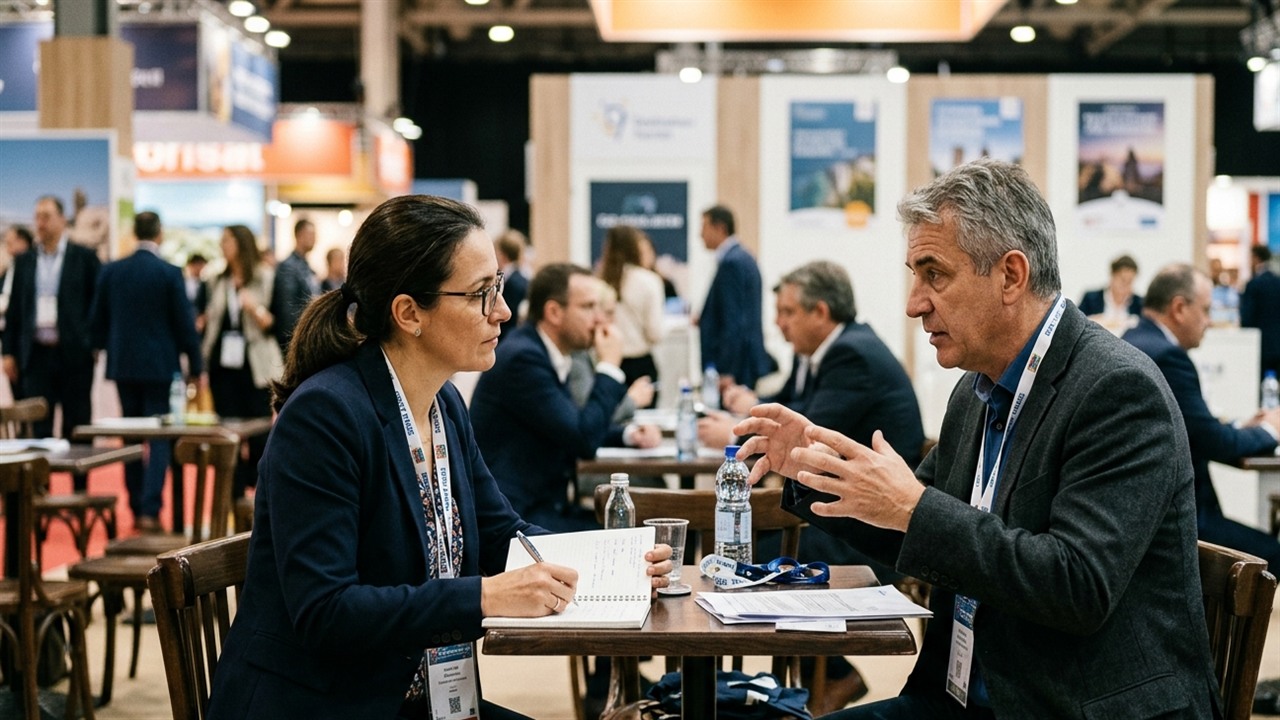
A hosted buyer programme is a curated business-meeting format that takes place as part of a wider event, usually a trade show, exhibition, or industry conference. The host organisation (a DMO, a convention bureau, a private trade-show operator, or a venue) invites a vetted group of qualified buyers to attend at no cost. The buyers in return commit to a set number of pre-scheduled one-to-one meetings with exhibitors, typically 12 to 20 over two or three event days.
The format is most common in tourism, meetings, incentives, conferences and exhibitions (MICE), travel trade, and B2B sectors where the buyer side carries clear procurement authority. IBTM World in Barcelona, IMEX Frankfurt and IMEX America, The Meetings Show in London, ITB Berlin, and TTG Travel Experience in Rimini all run hosted buyer programmes as their commercial backbone. Smaller regional shows increasingly copy the model.
What it does for buyers is obvious: it concentrates supplier attention into a focused, expense-paid format. What it does for organisers is less obvious but more important. It forces every weak link in the programme to surface in a single event week. A weak buyer roster cannot hide. An under-segmented exhibitor list cannot hide. An absent follow-up process cannot hide. The hosted buyer programme is, in effect, a stress test of how seriously your event treats commercial outcomes.
Why the Format Works So Well in Tourism
Tourism is a category designed for the hosted buyer model. Three structural reasons explain why.
- Buyer authority is concentrated: tour operators, MICE planners, corporate travel managers, and travel-trade media decide procurement on behalf of large outbound volumes. Connecting one qualified buyer to the right hotel chain, DMO, or experience supplier can be worth six- and seven-figure annual commitments. That justifies a hospitality budget per buyer that few other categories can match.
- Suppliers are geographically scattered: a regional DMO in Switzerland and a boutique hotel group in Vietnam have no efficient way to reach the same Belgian outbound tour operator without a trade-show context. The hosted buyer programme is the bridge that compresses dozens of bilateral conversations into one event week.
- Outcomes are measurable in revenue: tour operators sign contracts on margins that flow through the following year’s catalogue. That makes return on investment traceable, which makes the programme defensible to boards and ministerial supervisors of public tourism bodies.
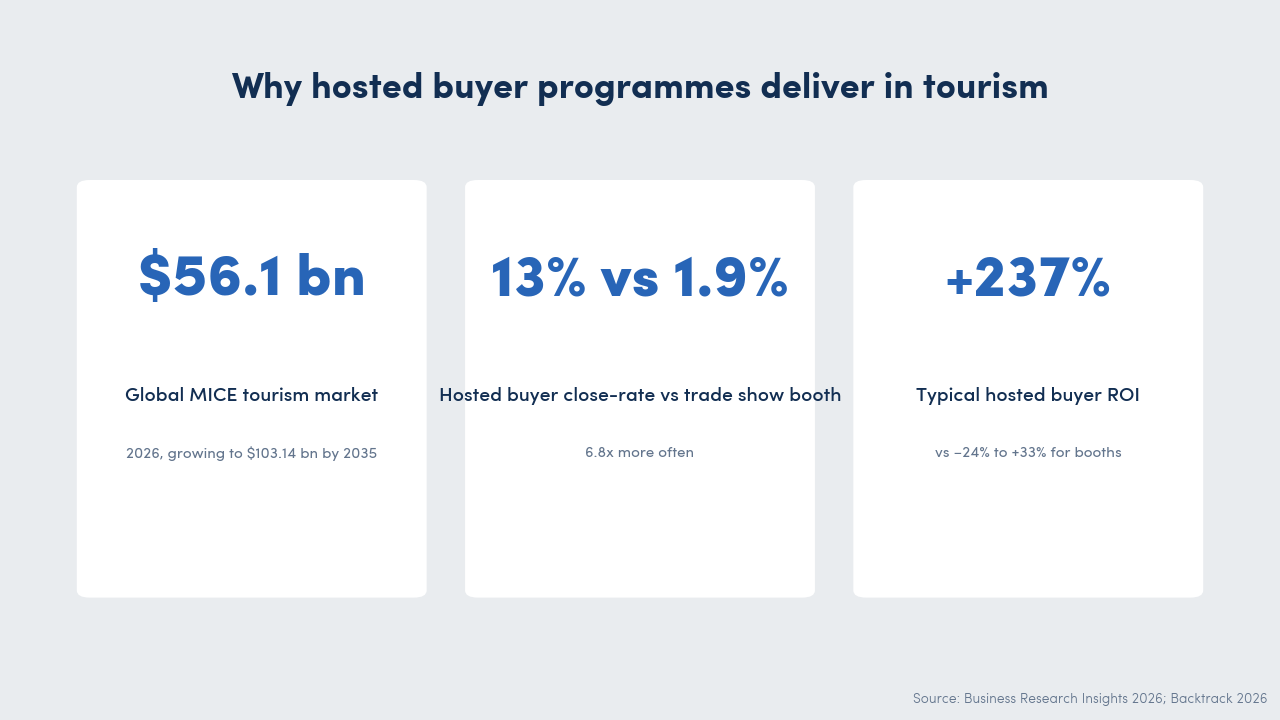
The market context is large and growing. The global MICE tourism market was valued at 56.1 billion US dollars in 2026 and is projected to reach 103.14 billion by 2035, a compound annual growth rate (CAGR) of 7 per cent, according to Business Research Insights. Europe holds around 51.7 per cent of global market share, with Asia-Pacific the fastest-growing region at 8.75 per cent CAGR through 2031 (Mordor Intelligence, 2026).
The return-on-investment data is even more striking. Hosted buyer programmes consistently deliver around 237 per cent return for sellers, compared with a wide and often negative range of minus 24 to plus 33 per cent for traditional trade-show booth investment, according to Backtrack’s 2026 benchmark study. The same study found hosted buyer meetings close at 13 per cent against 1.9 per cent for booth conversations, and shave the average sales cycle from 147 days to 89 days. Those numbers explain why the format keeps spreading even as overall event budgets tighten.
For broader context on the tourism segment that powers these programmes, see our deeper look at the expanding horizons of MICE tourism.
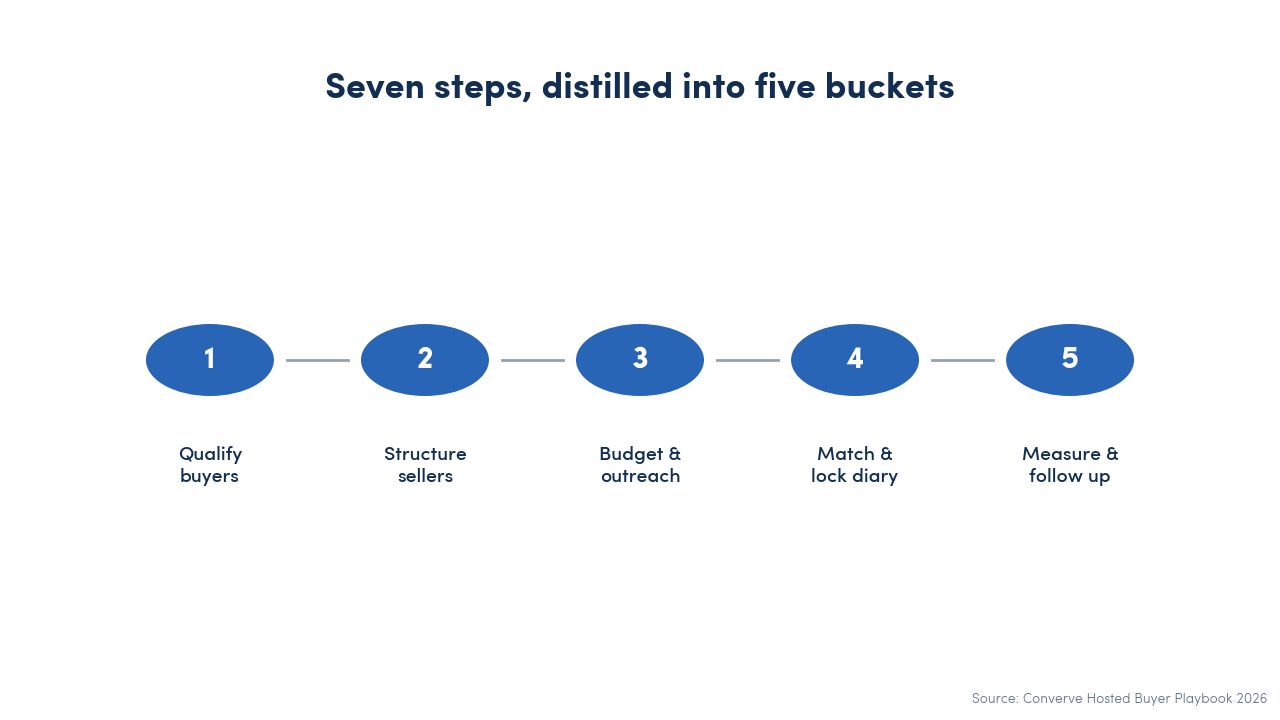
The Seven Steps to Running a Hosted Buyer Programme
Most programmes succeed or fail on operational design that the audience never sees. The seven steps below cover the full path from buyer profile to post-event measurement. Run them in sequence; cut none of them.
Step 1 — Define Your Buyer Profile and Qualification Criteria
Start with the buyer you want, not the buyer who applies. Write a one-page profile that names the role, the company size, the outbound buying volume, the regions covered, and the procurement authority. For a tourism trade show, qualification criteria typically include verifiable outbound volume in passengers or revenue, active sourcing authority for the season ahead, Global Distribution System (GDS) access or equivalent contracting infrastructure, and confirmed availability for a minimum number of pre-scheduled meetings.
Be honest about the threshold. A hosted buyer who books fewer than 200 outbound passengers per year does not justify the cost of flights, hotels, and on-site hospitality. Set the bar at the level where the cost per qualified meeting still returns positive economics for your sellers.
Step 2 — Structure Your Seller and Exhibitor Inventory
Your exhibitor list is the supply side of your matchmaking marketplace. If buyers are the buy side, sellers are what is on offer. Segment them by destination, product category (hotels, DMCs, experiences, MICE venues, travel tech), stand tier, and the maximum number of meetings each is contractually entitled to receive.
Pre-show, brief every exhibitor on what a qualified buyer looks like in your programme and what they should bring to each meeting. A two-page seller briefing typically lifts meeting-rating averages by a measurable margin, because it eliminates the most common cause of disappointed buyers, which is exhibitors arriving without relevant offers ready to discuss.
Step 3 — Build the Budget and Hospitality Package
The hospitality package is your contractual exchange with the buyer. The buyer commits to a fixed number of pre-scheduled meetings; you commit to flights (often economy with a cap), hotel nights at the host destination, transfers, on-site catering, optional pre or post-event familiarisation trips, and a welcome reception or networking dinner.
Set the meeting minimum at a level that justifies the hospitality. THAIFEX-Anuga 2026 sets a minimum of 16 pre-scheduled meetings per hosted buyer across three event days, which has become a workable benchmark in the wider MICE category. The Meetings Show 2026 layers in masterclasses, fam trips, and exclusive evening receptions on top of the meeting minimum. The richer the package, the higher the buyer quality you can credibly demand.
Step 4 — Design Your Outreach and Application Funnel
You need an application funnel, not an open registration. Build a buyer landing page that explains the value exchange clearly: what the buyer gets, what they commit to, and how applications are reviewed. Open the funnel 12 weeks before showtime and run two qualification waves, with reference checks for first-time applicants.
Outreach should run on two parallel tracks. The first is direct outbound to known qualified buyers from previous editions or from sister events; this is your highest-yield channel. The second is partnership-driven, with industry associations, sister DMOs, and trade media. Avoid lifestyle and consumer channels entirely; they generate volume but not qualification.
Step 5 — Configure the Matchmaking Logic and Platform
This is where the operational engine lives. A modern hosted buyer platform replaces what used to be a spreadsheet-and-email coordination job with rule-based automation. The platform manages buyer-seller preference capture, weights matching against thesis-fit, runs the diary build, schedules meetings against capacity constraints, sends reminders, captures ratings, and feeds a dashboard for the organiser.
Solution: A B2B matchmaking platform like Converve handles the full hosted buyer workflow, from application qualification through diary lock to post-event reporting. It runs both in-person and hybrid meeting modes, supports multi-language interfaces for international buyer rosters, and produces clean handover data into your CRM (customer relationship management) system. For a wider view of the tooling landscape, see our overview of the top event networking apps.
Step 6 — Lock the Diary, Brief On-site Teams, Plan the Multi-language Setup
Two weeks before showtime, lock the diary. After lock, every change has knock-on effects. Print buyer schedules, run a logistics dry-run with the on-site team, and brief everyone on the escalation path for no-shows or last-minute cancellations.
If your buyer roster is international (and in tourism, it almost always is), plan the multi-language setup explicitly. Assign translator slots for meetings flagged as needing language support, build cultural-briefing notes into the seller briefings, and place language signage at meeting points. The cost is modest; the satisfaction lift from buyers in second-language situations is substantial.
Step 7 — Measure, Follow Up, Iterate
The event is the midpoint of your programme, not the endpoint. In the first 48 hours after the show, send every buyer and seller a short rating form. In the first two weeks, send a structured follow-up nudge to every meeting pair: “Did this meeting lead to a follow-up conversation? Would you like an introduction?”
At 30, 60, and 90 days, send outcome-tracking surveys to a sampled cohort of sellers, asking which meetings led to signed business. This is what gives you the data you need to defend the programme in the following year’s budget cycle.
The 90-Day Pre-Show Timeline
Most programmes underperform because pre-show work compresses into the last fortnight. The timeline below is the version that works.
| Time before show | Key action |
|---|---|
| T minus 90 days | Buyer profile and qualification matrix locked; seller segmentation complete |
| T minus 75 days | Application funnel opened; outreach to known qualified buyers begins |
| T minus 60 days | Exhibitor inventory closed; stand-tier briefings sent |
| T minus 45 days | First wave of buyer approvals; travel logistics start |
| T minus 30 days | Matchmaking platform live; preference capture opens |
| T minus 14 days | Diary lock; on-site briefings issued |
| T zero | Showtime |
| T plus 7 days | Initial follow-up nudge sent to every meeting pair |
| T plus 30 / 60 / 90 days | Outcome-tracking surveys; programme retrospective |
What this timeline buys you is room to respond when something goes wrong. A buyer drops out at T minus 30; you can backfill. The matchmaking platform throws an unexpected error at T minus 14; you can fix it. Without the timeline, both of those become event-week emergencies.
KPIs That Prove Your Programme Worked
Hosted buyer programmes need three categories of measurement, not one. Mixing them up is the single most common reporting mistake.
- Participation KPIs (the leading indicators): application-to-confirmation ratio, attendance rate, meeting-show-rate. These tell you whether the operational engine ran correctly. A confirmation ratio below 60 per cent suggests the qualification gate is too narrow or the hospitality package is too thin. A meeting-show-rate below 90 per cent points to diary problems or on-site logistics failures.
- Quality KPIs (the satisfaction indicators): buyer Net Promoter Score (NPS), seller satisfaction score, meeting-rating average, qualified-conversation share. These tell you whether the experience was good enough that participants will come back. An NPS below 30 means the curation was wrong. An NPS above 50 means you have a returning roster.
- Outcome KPIs (the revenue indicators): follow-up rate at 30, 60, and 90 days, deal velocity, revenue per hosted buyer. These tell you whether the programme produced commercial value. A 30-day follow-up rate below 60 per cent is a warning. Revenue per hosted buyer is the metric that wins board approval for the next edition.
Track all three categories every edition. Report all three to your sponsoring board. The participation KPIs prove the operation ran; the quality KPIs prove the experience worked; the outcome KPIs prove the money flowed.
Hosted Buyer Programme vs Open Registration — When Each Format Wins
Hosted buyer programmes are not the only format. Open registration shows still produce volume and visibility that hosted-only models cannot match. The choice is rarely all or nothing.
- Hosted buyer wins when: the buyer side carries high procurement authority, sellers care about qualified meetings over booth footfall, the destination wants to justify a hospitality budget, and outcomes need to be measurable. Tourism trade shows, MICE marketplaces, and luxury travel summits are the classic fit.
- Open registration wins when: the goal is reach and brand visibility, the seller side relies on broad pipeline volume, and the event itself is a media moment as much as a buying moment. Consumer travel expos and general industry exhibitions are typical examples.
- The hybrid model wins most often: 80 per cent of the floor runs as open registration for visibility, 20 per cent runs as a curated hosted buyer programme for qualified deal flow. Most large international tourism shows operate this way now.
We are working on a deeper standalone comparison of the two formats. For now, treat the hosted buyer track as the commercial backbone and the open registration track as the marketing and visibility layer of the same show.
Common Mistakes and How to Avoid Them
The five mistakes below show up in almost every underperforming programme review. Catching any one of them in pre-production saves an editorial cycle of frustration.
- Under-qualifying buyers to fill the roster: the temptation is real, especially when applications come in slowly. Resist it. A roster padded with unqualified buyers depresses meeting-rating averages, sours exhibitors, and burns budget on hospitality that produces no return.
- Overloading buyer diaries: more than 18 to 20 meetings across two days produces fatigue rather than conversion. The marginal meeting late on day two is the lowest-quality slot in the entire programme. Cap the diary instead of cramming it.
- Running the operation on spreadsheets: manual coordination breaks at scale and produces visible chaos on site. The hosted buyer category is now mature enough that a dedicated platform pays for itself in any programme above approximately 30 buyers.
- Skipping the follow-up mechanism: a meeting without a structured follow-up is wasted hospitality budget. Build the 7-, 30-, 60-, and 90-day follow-up touchpoints into the workflow before the event runs, not after.
- Single-language setup for an international roster: tourism is by definition cross-border. Plan translator slots, multi-language signage, and cultural briefings as default, not as exception.
For a deeper look at how DACH-region DMOs have stumbled and recovered, our German-language guide on the five biggest pitfalls in hosted buyer programmes covers concrete cases from European tourism trade shows.
Frequently Asked Questions
What is a hosted buyer programme? A hosted buyer programme is a curated meeting format in which pre-qualified buyers receive complimentary travel and event access in exchange for attending a set number of pre-scheduled one-to-one meetings with exhibitors. It is most common in tourism, MICE, and B2B trade shows.
How many meetings should each hosted buyer take? The working benchmark for tourism trade shows is 12 to 20 meetings across two or three event days. THAIFEX-Anuga 2026 sets the minimum at 16. More than 20 meetings produces buyer fatigue and depresses meeting-rating averages.
How do you qualify hosted buyers in tourism? Standard qualification criteria are verifiable outbound buying volume, active procurement authority for the upcoming season, GDS or equivalent contracting infrastructure, and confirmed availability for the meeting minimum. First-time applicants typically require a reference check.
Hosted buyer programme vs open registration — which delivers more value? Hosted buyer wins on qualified meetings, ROI, and measurability. Open registration wins on reach and visibility. Most large international tourism shows now run both as parallel tracks, with hosted buyer carrying the commercial backbone.
What does it cost to run a hosted buyer programme? Cost depends on the hospitality package and roster size. A typical mid-size programme of 100 to 200 buyers budgets per buyer for flights, two to four hotel nights, transfers, on-site catering, and a welcome reception, plus a meaningful share of the matchmaking platform and on-site coordination team cost.
How do you measure the ROI of a hosted buyer programme? Track three KPI categories: participation (confirmation ratio, meeting-show-rate), quality (buyer and seller NPS, meeting-rating average), and outcome (follow-up rate at 30, 60, 90 days, deal velocity, revenue per hosted buyer). Outcome KPIs are what justify the programme to the board.
Conclusion — Design the Follow-up, Not Just the Meeting
The hardest truth in this category is that the meeting itself is not where deals close. The two weeks afterwards are. Most hosted buyer programmes invest 95 per cent of their operational attention in the days running up to the show and the show itself. The successful ones invest a meaningful share in the follow-up sequence that turns 89 days of sales cycle into actual contracted business.
Done well, the hosted buyer programme is the operational tool that turns a tourism trade show from a hospitality cost centre into a measurable revenue engine. Done badly, it is an expensive way to host the wrong people at the wrong hotel. The difference is operational design.
If you want to see how a modern B2B matchmaking platform handles the full hosted buyer workflow, from application qualification to post-event reporting, request a Converve demo. We will walk you through how our customers in MICE, tourism, and trade-show categories run programmes that convert.