How to Promote Events on LinkedIn: The 2026 B2B Guide
LinkedIn says 62 per cent of B2B marketers consider events one of their most essential marketing tactics for full-funnel outcomes, yet most LinkedIn event posts still struggle to break out of single-digit reactions. The reason is rarely the event itself. It is that most playbooks were written in 2023, before LinkedIn rolled out a quiet but consequential overhaul of its event-marketing toolkit in late 2025 and the first half of 2026.
If you are organising a trade show, conference, hosted-buyer programme, or association annual meeting, the way you promote it on LinkedIn this year looks meaningfully different from the way you did it last year. In this guide, we have compiled a step-by-step playbook for 2026: setting up an event page that actually converts, building organic reach before you spend a cent, running the new Event Ads with proper measurement, and, most importantly, turning registrations into pipeline, not just attendee lists.
Why LinkedIn Is Still the Most Valuable Channel for B2B Event Promotion
Before we get into tactics, it is worth being honest about why LinkedIn remains the default for B2B event promotion in 2026. The numbers favour it consistently, even as audiences shift across platforms.
- 1.12 billion members worldwide, 424 million monthly active: LinkedIn is not the largest social network, but its active base is heavily concentrated among decision-makers, recruiters, and content creators. That is exactly the audience your B2B event needs to reach.
- Four out of five members drive business decisions: LinkedIn is the only platform where decision-makers are the dominant cohort by design.
- Eighty-two per cent of B2B marketers report their greatest success on LinkedIn: Compared with every other paid social platform, LinkedIn delivers a 277 per cent higher effectiveness for lead generation than Facebook and X combined.
- Twenty-four-hour content half-life: A LinkedIn post keeps generating impressions for roughly 24 hours, compared to 18 minutes on X and 5 hours on Facebook. Your event teaser does not vanish overnight.
- Ninety-six per cent of B2B marketers already use the platform for content distribution: Your buyers are not just present: they are accustomed to discovering events here.
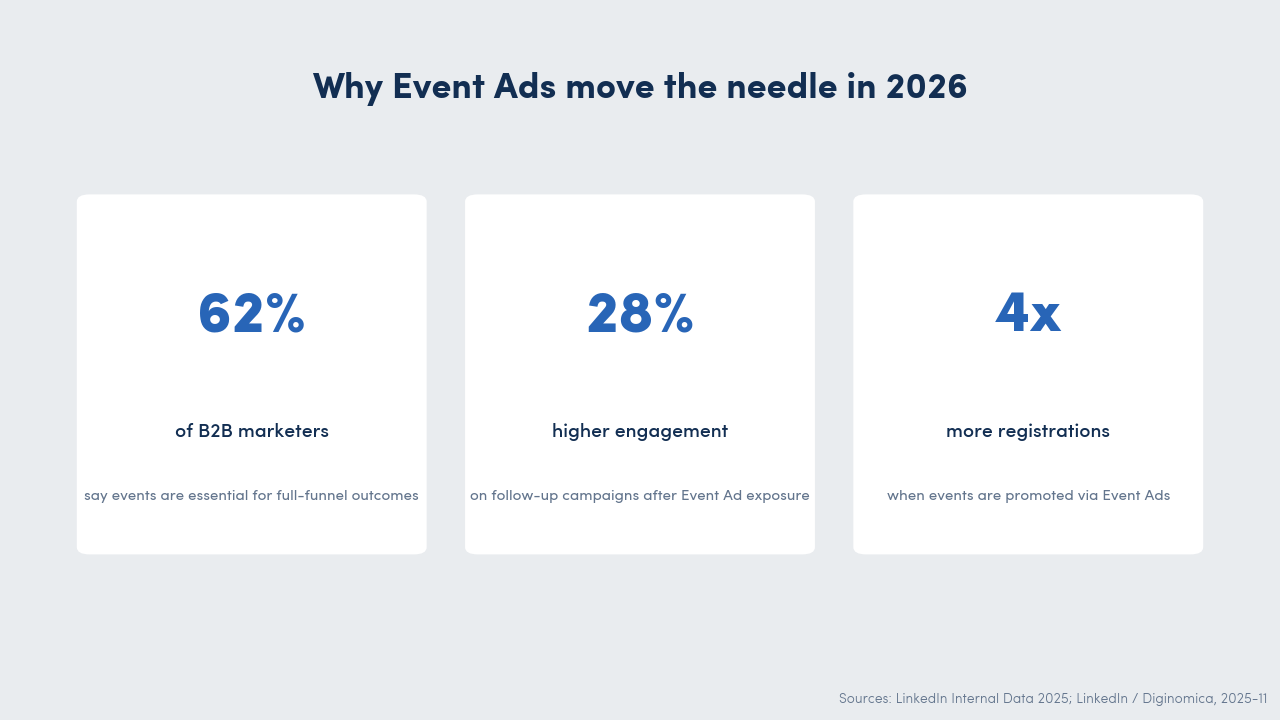
The takeaway is not that LinkedIn is hype-free or universally cheap. CPCs on LinkedIn are higher than on Meta or Google, and untargeted spend disappears fast. What LinkedIn offers is precision: the ability to put a specific event in front of a specific job title at a specific company size in a specific industry, at the moment they are most likely to consider attending. The rest of this guide is about converting that precision into a registration funnel that connects to your pipeline.
What Changed in 2026: LinkedIn’s New Event Marketing Toolkit
This is the section most competing guides skip, and the reason their advice is starting to feel dated. In November 2025 and again in April 2026, LinkedIn rolled out a set of event-marketing features that significantly change what is possible. Abhishek Shrivastava, VP Product at LinkedIn, summarised the direction in an interview with Diginomica: companies should now treat LinkedIn Events “like high-performance demand campaigns”, with data flowing directly into the rest of the marketing stack.
Here is what you need to know.
- Off-Platform Event Ads (rolled out globally by May 2026): Until recently, every Event Ad required a LinkedIn Event Page as the destination. That meant either rebuilding your event on LinkedIn or accepting a clunky two-step click-through. Off-Platform Event Ads remove that constraint. You can now run Event Ads that link directly to a webinar platform, a hosted-buyer registration page, or your event-platform microsite. LinkedIn’s professional targeting (job title, seniority, industry, company size) is fully available, and performance metrics remain in Campaign Manager.
- Lead Generation Objective for Event Ads: Previously, Event Ad registrations stayed on the LinkedIn Event Page, and you had to download lists to import into your CRM or marketing automation system. Now the Lead Generation Objective lets registration data flow straight into Salesforce, HubSpot, Marketo, or any system you have connected. Whitney Donaldson, Global Director of Demand Generation at Impact.com, described the difference in the iPX case study as “apples to apples” with Impact’s other LinkedIn programmes: same scoring, same routing, same nurture flows.
- Live-Streaming via Event Ads: When your event is live, Event Ads can stream the LinkedIn Live feed directly into members’ feeds. According to LinkedIn’s internal data, companies that use Event Ads to promote their events see roughly 31x more viewers and 4x more registrations than events that are not promoted. For B2B brands running flagship moments (a keynote, a panel, a product reveal), this turns awareness into participation in real time.
- New integrations — Cvent, ON24, Integrate: If your event runs on Cvent, the new LinkedIn Audience Connector syncs registration data (contact and company lists) directly into Campaign Manager. ON24 covers webinar workflows. Integrate captures leads generated by the Event Ads Lead Gen Objective. These are first-party integrations, which matters more in 2026 than it did a year ago. Third-party tracking is degrading fast, and first-party flows are the safe ground.
- The Depth Score algorithm update: LinkedIn’s 2026 algorithm now weighs how long users actually engage with content, not just whether they clicked. Engagement pods are penalised, generic AI-written posts get filtered, and external links reduce organic reach by an estimated 30 to 50 per cent. For event promotion this means one thing: native, substantive posts (carousels, document posts, native video) significantly outperform link drops. The “share-and-pray” approach is finished.
If your last LinkedIn-event-promotion campaign happened before November 2025, treat your old playbook as a starting point, not a recipe.
Step 1 — Set Up a LinkedIn Event Page That Actually Converts
In 2026, the first strategic question is whether you need a LinkedIn Event Page at all. If your event runs on a third-party platform (your event-management software, your association portal, your trade-show registration system), Off-Platform Event Ads now let you promote directly to that destination. You may not need the LinkedIn Page at all.
That said, an Event Page still helps for two reasons: it builds your retargeting audience inside LinkedIn (everyone who clicks “Attend” becomes a first-party audience segment) and it gives the algorithm explicit signals about who your event is for. For most B2B events with a six-to-twelve-week promotion window, the answer is “use both”: Event Page as the organic anchor, Off-Platform Event Ads for the campaigns where you want registrants in your CRM immediately.
When you build the page, three elements move the click-through-rate more than anything else:
- Title: Front-load the specific value proposition and the audience. “Annual Tourism Trade Show — Buyer Meetings for European DMOs” beats “Annual Tourism Trade Show 2026”. Vague titles do not survive the algorithm’s preview test.
- Description: Lead with the takeaway, not the agenda. What will an attendee be able to do or decide after this event that they could not before? Keep the opening 150 characters tight. That is what appears in feed cards and email digests.
- Banner: Use a custom 1584×396 image that says where, when, and what, readable on mobile. Generic stock or LinkedIn templates underperform by a wide margin.
Add your speakers as co-hosts on the Event Page, not just as guests in the description. Each speaker becomes an authorised promoter, and their posts about the event get the algorithmic boost that comes with verified involvement. For multi-day trade shows, this is the single highest-leverage setup move.
Solution: For events hosted on a B2B matchmaking platform like Converve, you no longer need to duplicate the event on LinkedIn. Off-Platform Event Ads can drive traffic straight to the Converve event page, and the registrations flow back into the same matchmaking pipeline your buyer-seller meetings already run on.
Step 2 — Build Organic Reach Before You Spend a Cent
Paid promotion is the multiplier, not the foundation. If your event has not generated meaningful organic engagement by the time you start spending, the ads will work harder than they should. Build the organic layer in the four weeks before paid campaigns go live.
Speaker-First Content, Not Company-Page Broadcasting
LinkedIn personal profiles generate roughly 8x the engagement of company pages, a gap that has only widened since the 2026 algorithm update. For event promotion, this means posts from your speakers, your hosts, and your subject-matter experts will move further than the same content from your brand page. Brief each speaker with one short post (300 to 500 words), one short video (90 seconds max), and one carousel they can adapt. Make participation easy.
Native Video and Carousels Win the Depth Score
Because the algorithm now rewards dwell time, two formats have pulled ahead in 2026: native video uploads (not YouTube re-shares, which lose roughly half their reach) and document posts and carousels. A six-slide carousel teasing the event agenda will out-perform a single link-drop almost every time. The pattern: hook on slide one, three substantive insights on slides two through four, soft mention of the event on slide five, registration CTA on slide six.
LinkedIn Polls as Pre-Event Engagement
A well-framed poll three weeks before the event achieves two things: it surfaces your event in the feeds of everyone who votes, and it generates a list of warm contacts you can invite directly. Frame the poll around the event topic, not the event itself. “Which session would you most want to attend?” works far less well than “What is your biggest blocker on hosted-buyer ROI?”
Targeted Connection Requests, Not Mass Invites
LinkedIn limits connection requests to roughly 100 per week. Spend those on people who are genuinely in your ICP, not on broad scrapes. A personalised request referencing a shared session, sponsor, or industry context converts far better than the default template, and the algorithm penalises low-acceptance accounts, so high-quality outreach pays back twice.
LinkedIn Groups — Only When the Match Is Tight
For most events, Groups are a low-yield channel. They work when the topic is narrow and the Group is active (post-engagement rate above 5 per cent). For broad B2B events, your time is better spent on speaker posts.
Step 3 — Scale With Paid Promotion: A Tactical Look at LinkedIn Event Ads
Once organic reach is moving, paid promotion compounds it. The 2026 toolkit gives you several formats and objectives. Choosing the right combination for each stage of the funnel matters more than any single setup detail.
Match the Objective to the Funnel Stage
- Six to four weeks before the event — Awareness: Use Sponsored Content and Video Ads pointing to a teaser or speaker preview. Goal: prime your retargeting audience, not registrations.
- Four to two weeks before — Registration: Switch to Event Ads with the Lead Generation Objective. Lead Gen Forms convert at roughly 6.1 per cent on average, compared with 1.6 per cent on off-platform landing pages, a 5x gap that makes the choice nearly automatic for mid-funnel campaigns.
- Event day — Live Engagement: Activate Live-Streaming Event Ads to push your live feed into members’ feeds in real time. This is the format that produced the 31x viewer multiplier in LinkedIn’s internal data.
- Two weeks after — Retargeting: Build audiences from registrants, attendees, and viewers, then run Sponsored Content with thought-leadership pieces tied to the event topic. Impact.com reported a 57 per cent higher engagement rate on follow-up sponsored content from people who had watched the livestream, compared with an unexposed ICP control group.
Realistic Budget Expectations
Industry benchmarks for 2026 suggest a mid-funnel webinar registration costs around $87 per lead with Lead Gen Forms, with conversion rates between 5.9 per cent (ROI calculators) and 9.4 per cent (top-of-funnel whitepapers). Bottom-funnel offers (demo requests, pricing inquiries) sit in the $180 to $250 CPL range with 1.9 to 3.1 per cent CVR but much higher MQL-to-SQL ratios. Plan budget against the right benchmark for the offer you are running, not a single average.
Predictive Audiences and Account-Based Targeting
LinkedIn’s Predictive Audiences (an AI feature that finds users with conversion patterns similar to your historical registrants) consistently lowers CPL by roughly 20 per cent on global campaigns and up to 33 per cent in mature markets, based on agency composites. For ABM-style trade-show promotion, combine Predictive Audiences with a Company List Targeting layer. Upload your buyer list as domains, let LinkedIn match against company pages, and serve different creative to in-account audiences than to broader awareness audiences. Personalised ads do show fatigue after about a month, so plan a refresh cycle into the campaign.
Step 4 — Turn Registrations Into Pipeline (Not Just Attendees)
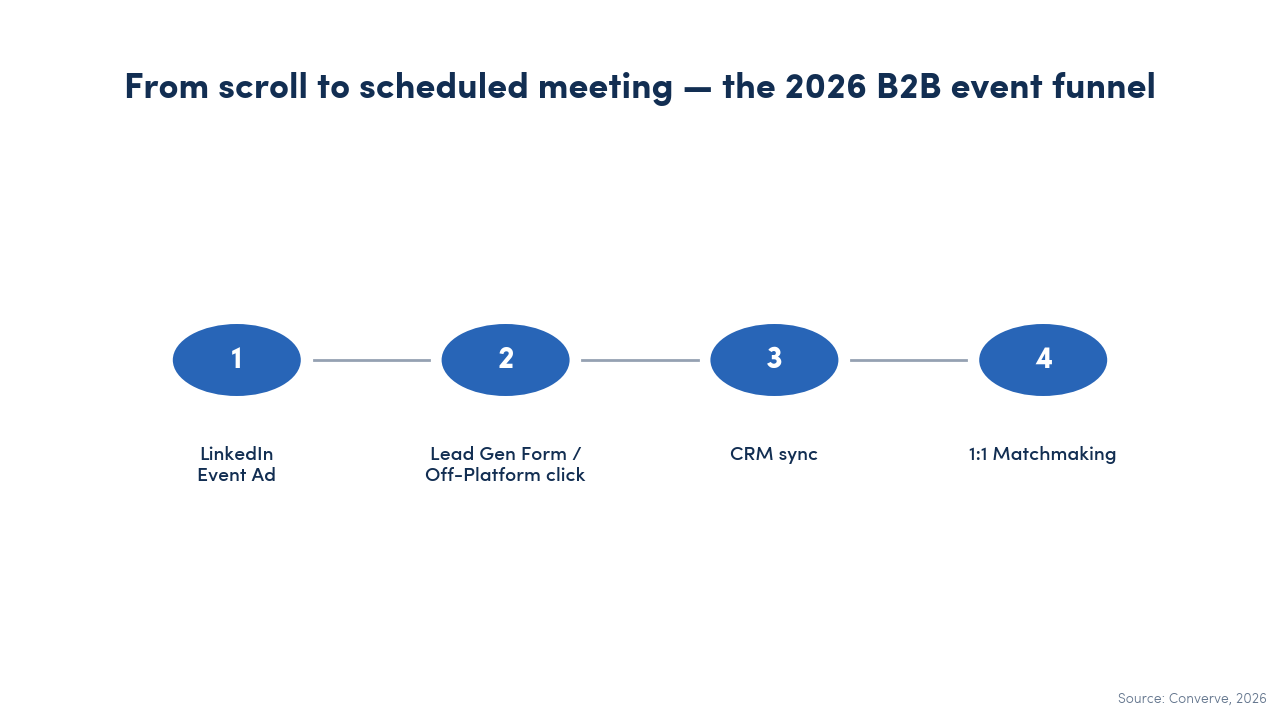
This is the step most LinkedIn-event guides treat as an afterthought, and it is where 2026’s changes matter most. Until last year, “registration on LinkedIn” was a one-way street: you collected sign-ups, exported them, and tried to remember to follow up. The Lead Generation Objective and the new CRM integrations close that loop.
Wire the CRM From Day One
If you are on Cvent, switch on the LinkedIn Audience Connector before the campaign launches. Your registrations will appear in Campaign Manager as a first-party audience and in your CRM as scored leads, simultaneously. ON24 customers have an equivalent integration for webinar workflows; Integrate covers a broader range of marketing automation systems. The point is not the specific tool. It is that registrations now belong in your scoring, routing, and nurture flows from the moment they happen, not days later.
Pre-Event Matchmaking: Turn Registrants into Scheduled Meetings
Registrations alone do not move revenue. Scheduled meetings between buyers and sellers do. For trade shows, hosted-buyer programmes, and any event where 1:1 connections are the core value proposition, the matchmaking layer is what justifies the LinkedIn spend. The pattern that consistently works:
- Day of registration: Send a single confirmation message asking three short profile questions (role, what you are looking for, preferred meeting slots).
- Two weeks before the event: Open the matchmaking platform to registrants and let them request meetings.
- One week before: Send LinkedIn-style nudges to anyone with fewer than three meetings booked: “12 sellers in your industry are looking for buyers like you”.
- Event day: Automated reminders, lightweight check-ins, no friction.
Lead Scoring Based on LinkedIn Engagement Data
The Impact.com iPX case study is worth studying. They built a segment of members who registered for or watched the livestream and a separate ICP-matched comparison audience that did not attend. Both groups received the same follow-up sponsored content. The livestream group engaged at a 57 per cent higher rate. Sales used that engagement-score delta to prioritise outreach. The lesson is not the specific number. It is that LinkedIn engagement data, when piped into your CRM, becomes a high-quality scoring signal that previously sat in a silo.
Step 5 — Post-Event Engagement That Actually Moves Pipeline
The post-event window is where most B2B teams underperform. Your audience is warm for roughly two weeks after the event before attention shifts elsewhere. Use that window deliberately.
- Retargeting audiences from event engagement: Build three layered audiences in Campaign Manager: registrants who did not attend, attendees who watched less than half, and full-session attendees. Each gets a different follow-up message and offer.
- On-demand replays as long-tail lead sources: Gate the replay behind a Lead Gen Form (not a generic landing page) and run a sustained low-budget campaign for 30 days after the event. This consistently produces 20 to 30 per cent additional registrations beyond the live audience.
- Speaker-led recap content: Two carefully written speaker posts in the week after the event will out-perform any company-page recap. Ask each speaker to share one substantive insight from their own session plus one observation about the audience.
- Sales follow-up based on engagement scoring: Push the engagement-tier lists into your CRM as priority tags. Reps should know, by the morning after the event, which of their accounts watched the keynote, attended a panel, or stayed for the entire programme.
Common Mistakes Event Managers Still Make on LinkedIn in 2026
A short list of patterns that consistently waste budget. Worth checking your own campaigns against:
- Treating Off-Platform Event Ads as optional: If your event runs on a hosted platform, sending traffic through a LinkedIn Event Page first costs you registrations. The 2026 feature exists precisely so you do not have to.
- Posting link-drops to the company page: With Depth Score, external links reduce reach significantly. Use native carousels, document posts, or video, and let speakers do the heavy lifting from personal profiles.
- Mass connection invites the week before the event: This triggers LinkedIn’s spam signals and drops your reach. One-hundred-per-week is the cap; treat it as a budget, not a target.
- Skipping the CRM integration “for now”: Manual list exports will still be sitting unsynced when the next event is already in flight. Wire it once at the start of the campaign.
- Ignoring the post-event window: The two weeks after the event have higher engagement potential than the two weeks before. If your follow-up is a single “thanks for attending” post, you are leaving most of the pipeline on the table.
Conclusion — Make Your Next B2B Event a Pipeline Engine
The 2026 LinkedIn event toolkit is the first version that treats event promotion as a full-funnel motion rather than a one-shot awareness play. Off-Platform Event Ads remove the platform tax, the Lead Generation Objective connects registration to pipeline, Live-Streaming Event Ads turn the event itself into media, and the Depth Score update rewards substantive content over volume.
Pulled together, the five steps in this guide form a single funnel: set up a page (or skip it deliberately) → build organic reach with speaker-led content → scale with the right paid objective at each stage → wire the CRM and matchmaking from day one → work the post-event window with retargeting and engagement scoring. None of the steps is glamorous on its own. The combination is what separates an event that fills a room from an event that fills a pipeline.
Want to see how Converve’s matchmaking layer connects LinkedIn-generated registrations to scheduled buyer-seller meetings? Book a demo, or read our related guides on the best event-networking apps in 2026 and hybrid event planning.