Hybrid Event Planning in 2026: A Practical Guide for B2B Organisers
Currently, around 64 per cent of hybrid event budgets go to remote streaming infrastructure — yet remote audience engagement sits below 5 per cent. The disconnect is not a tech problem. It is a planning problem. In this guide, we walk through what hybrid event planning actually looks like in 2026, why the old “stream-the-stage” model has stopped working, and the nine steps that separate a successful hybrid event from an expensive livestream.
You will leave with a practical 9-step process, a tech-stack table sized to your audience, a realistic budget frame, an ROI measurement framework, and a checklist you can hand to your team this week.
What “Hybrid Event Planning” Means in 2026 (And Why It Is Not 2022 Anymore)
A hybrid event is one where some people share a physical room while others connect online — at the same time, with comparable opportunities to engage. That definition has not changed. What has changed is the bar.
In 2022, hybrid mostly meant “we have a livestream now”. In 2026, that approach is what gets you the 5 per cent engagement number. Today, 88 per cent of businesses add a virtual element to in-person events, and 83 per cent of organisers report higher attendance with hybrid formats. Adding a virtual component lifts total event reach by roughly 2.5x on average. The audience expects the dual experience to be designed on purpose, not bolted on.
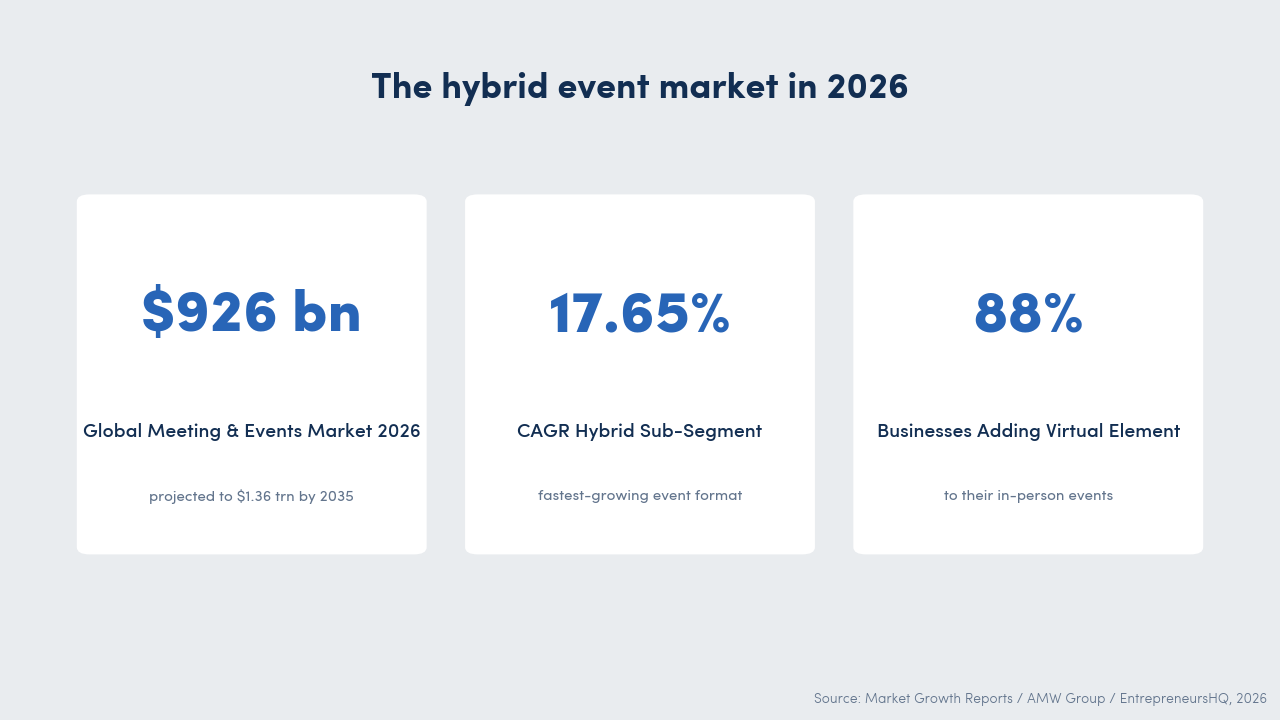
The market has caught up with the format. The global meeting and events market sits at $926 bn in 2026 and is projected to reach $1.36 trillion by 2035. The hybrid sub-segment is growing fastest at a 17.65 per cent CAGR (Compound Annual Growth) Rate, with more than 123 million hybrid events hosted globally in 2025 alone (AMW Group, 2026). Event-management software is now a $16.11 bn category in its own right.
If you want to compare hybrid against the alternatives in detail, our existing piece on hybrid events: the pros and cons covers the decision lane. The guide you are reading now is for the moment after that decision: you are doing hybrid — how do you actually plan it.
Plan Two Events, Not One — The Dual-Experience Principle
Most hybrid events fail because planners design one event and try to broadcast it. The successful ones design two events that share content but treat each cohort as a first-class audience.
SessionLab puts it bluntly: you are facilitating three designs at once — one for the in-person crowd, one for the online crowd, and one for the bridge between them. The bridge is where the magic happens, and where most planners under-invest.
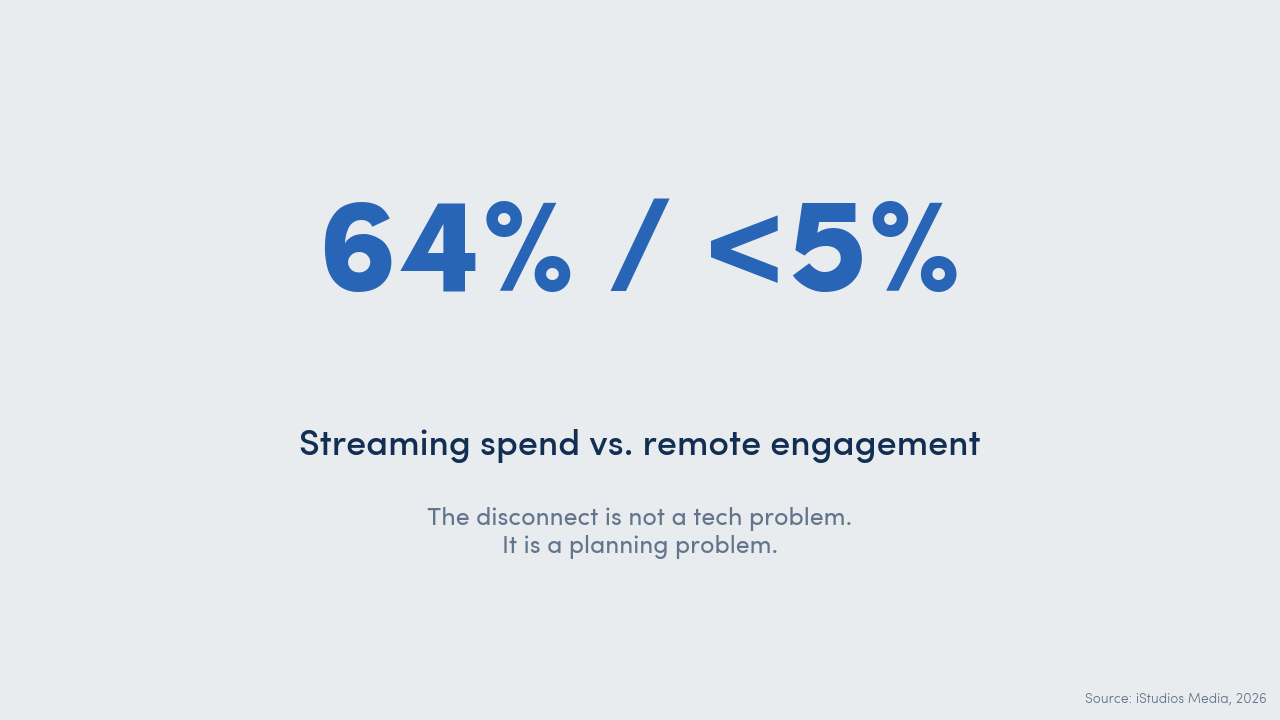
Why does the cost-allocation problem persist? Because streaming hardware has a vendor on the other end of the phone, and engagement design does not. The phone call is easy to make. The dual-design work is not. The next nine steps are how you do it.
9 Steps to Plan a Hybrid Event That Actually Works
Step 1 — Define Dual Goals
Write two goal statements, not one. Example: “300 in-person attendees with at least three qualified buyer-supplier matches each, plus 700 virtual attendees with a measurable lift in pipeline-touched accounts within 60 days.” If the in-person goal is networking and the virtual goal is content reach, that is fine — but you have to say it out loud. Goals you do not name will be ignored when budgets get cut.
Step 2 — Design Two Parallel Agendas with Bridging Moments
Build the in-person and the virtual agenda as two columns. Mark every moment where the two cohorts should be doing the same thing (a keynote, a Q&A) and every moment where they should diverge (in-person coffee, virtual breakout). SessionLab’s advice is worth quoting: approach hybrid agendas with spaciousness and generous time buffers. Tech adjustments take longer than you think, and cohort transitions need air. Ten-minute “no-content” windows between sessions are not waste — they are insurance.
Step 3 — Choose Your Tech Stack by Event Size
The right tools depend less on what is fashionable and more on how many people you serve. Use this as a starting frame:
| Event size | In-room AV | Streaming platform | Engagement layer | Networking |
|---|---|---|---|---|
| < 200 attendees | House AV + one operator | Zoom Events / Webex | Slido or Mentimeter | Built-in chat + dedicated remote moderator |
| 200–1,000 | Professional A/V crew, multi-camera | Bizzabo, Hopin, RingCentral Events | Native polls + Q&A | Dedicated networking platform (matchmaking-first if B2B) |
| 1,000+ | Production company, hybrid director | Cvent, ON24, custom platform | Multi-channel (app + web) | Matchmaking platform with API-grade integration |
A common 2026 mistake is paying for a 1,000-person stack to run a 250-person event. The tooling does not lift the experience above what the audience can actually consume.
Step 4 — Budget Realistically
AV typically takes 10–15 per cent of total event budget. For a 300-person, 3-day corporate conference with breakouts, expect $25,000–$50,000 for professional AV alone. Hybrid formats save roughly 40 per cent on venue and travel costs versus a same-size all-in-person event, but you give that saving back in production premium and platform fees. Net-net, a well-planned hybrid event costs roughly the same as the in-person equivalent — the line items just shift.
The most common mistake here is the streaming-budget trap from earlier: spending heavily on uplink hardware while under-spending on the moderator, the engagement platform, and the post-event content distribution. Read the budget as a portfolio, not a shopping list.
Step 5 — Solve the Engagement Asymmetry
This is the single biggest predictor of whether your hybrid event works. The data: 71 per cent of planners say connecting virtual and in-person guests is the hardest challenge, and 46 per cent say their presenters cannot engage both audiences at once (EMRG Media, 2026).
Three concrete moves:
- Hire a dedicated virtual moderator. Their only job is the chat, the Q&A, and relaying virtual voices into the room. Not a side task for the AV operator.
- Use the same poll for both rooms. Slido or Mentimeter results displayed on the venue screen and the virtual platform tells both cohorts they are part of one conversation.
- Build a “map of the group”. Borrowed from SessionLab: a simple whiteboard or slide that shows who is in the room and who is online (with names and locations). It signals visibility, and visibility is what virtual attendees report missing most.
Step 6 — Enable Hybrid Networking — Where Matchmaking Lives
Networking is the workload that breaks hardest in hybrid format. A coffee break is hard to ship over a network connection. Pre-scheduled 1:1 meetings, on the other hand, are easy — and they happen to be what B2B audiences actually want.
Solution: A B2B matchmaking platform like Converve lets attendees book qualified 1:1 meetings before the event, runs them in person or by video as appropriate, and produces a clean handover into your CRM. Trade shows, hosted-buyer programmes, association annual meetings, and tourism trade events are the obvious fits. Browse our event networking apps comparison for a fuller market view if you are still shortlisting tools.
Step 7 — Set Up ROI Measurement Before Doors Open
If you are reading the ROI numbers after the event, you will not have the data you need. Three things must be in place before day one:
- A short list of KPIs per cohort: in-person might be qualified meetings; virtual might be content engagement and pipeline-touched accounts.
- CRM integration on day zero. Your platform captures attendee data and engagement scores; those need to sync to the contact records that already exist in your CRM, not be exported as a CSV three weeks later.
- A 60- and 90-day pipeline check. 86 per cent of B2B organisations report positive ROI within seven months of a hybrid event (Eventify, 2026). You will not see it in week one — set the review meetings now.
Step 8 — Build for Accessibility, Time Zones, and EAA Compliance
Two thirds of hybrid organisers cite global time zones as a challenge. The fix is structural, not heroic: live for one or two regions, on-demand for everyone else. Pair it with regional moderation if the event has a flagship audience outside your headquarters timezone.
Accessibility is now also a compliance question in the EU. The European Accessibility Act became binding in June 2025; events streamed to EU audiences need accessible captioning, screen-reader-friendly platforms, and documented compliance. Treat it as a checklist item from kickoff, not a fix-it-later task.
Step 9 — Sustain the Community After the Event
A hybrid event ends; a hybrid community does not have to. Post-event platforms (the same one you used to run the event, kept open) are now reporting around 70 per cent attendee retention through the next 60 days when used well. That community is your warmest audience for the next event, the next campaign, and the next sales conversation. Plan the editorial calendar for the post-event window before the event starts.
5 Failure Modes That Kill Hybrid Events
- The Camera-on-a-Tripod Setup. A static wide shot of a stage is the cheapest possible way to lose your virtual audience. Multi-camera or no hybrid.
- The Forgotten Moderator. No one is responsible for the virtual room, so no one is in the virtual room. Hire the role explicitly.
- The Premium Platform with No Engagement. A $40k platform without polls, Q&A, or networking enabled is just an expensive video player.
- The Mirror-Schedule Mistake. Identical agenda for both cohorts ignores that the in-person experience is high-energy, the virtual experience is high-attention. Both need their own pacing.
- The Post-Event Vacuum. No follow-up email, no recordings, no community thread. Sixty per cent of the value of a hybrid event lives in the four weeks after it ends — and it leaves the building if no one tends to it.
Hybrid Event Planning Checklist
- Two written goal statements, one per cohort
- Two parallel agendas with explicit bridging moments
- Tech stack matched to event size, not to vendor pitch
- AV budget at 10–15 per cent of total, with line items, not a lump sum
- Dedicated virtual moderator named by role and person
- Same polls and Q&A surfaced on both screens
- Pre-scheduled 1:1 networking enabled (especially for B2B)
- KPI list and CRM integration live before doors open
- Captioning, screen-reader testing, and EAA-compliant platform
- On-demand replay tracks for global time zones
- Post-event community plan, content calendar, and follow-up email queue
- Professional production values — not laptop webcams or built-in mics
- Separate feedback surveys for in-person and virtual attendees
- Documentation of what worked and what failed, written within seven days
Hybrid Done Right Looks Like Two Equals
The best hybrid events of 2026 do not feel like an in-person event with a livestream attached. They feel like two parallel experiences, designed by people who genuinely cared about both audiences, that happen to share a keynote. Get the dual-experience principle right, fix the cost-allocation trap, and the rest of the playbook becomes legible.
If you want to talk about how matchmaking-first networking fits into your hybrid planning, or how Converve handles the B2B 1:1 layer for trade shows, association meetings, and tourism events, book a Converve demo and we will walk you through the workflow on a live event setup.