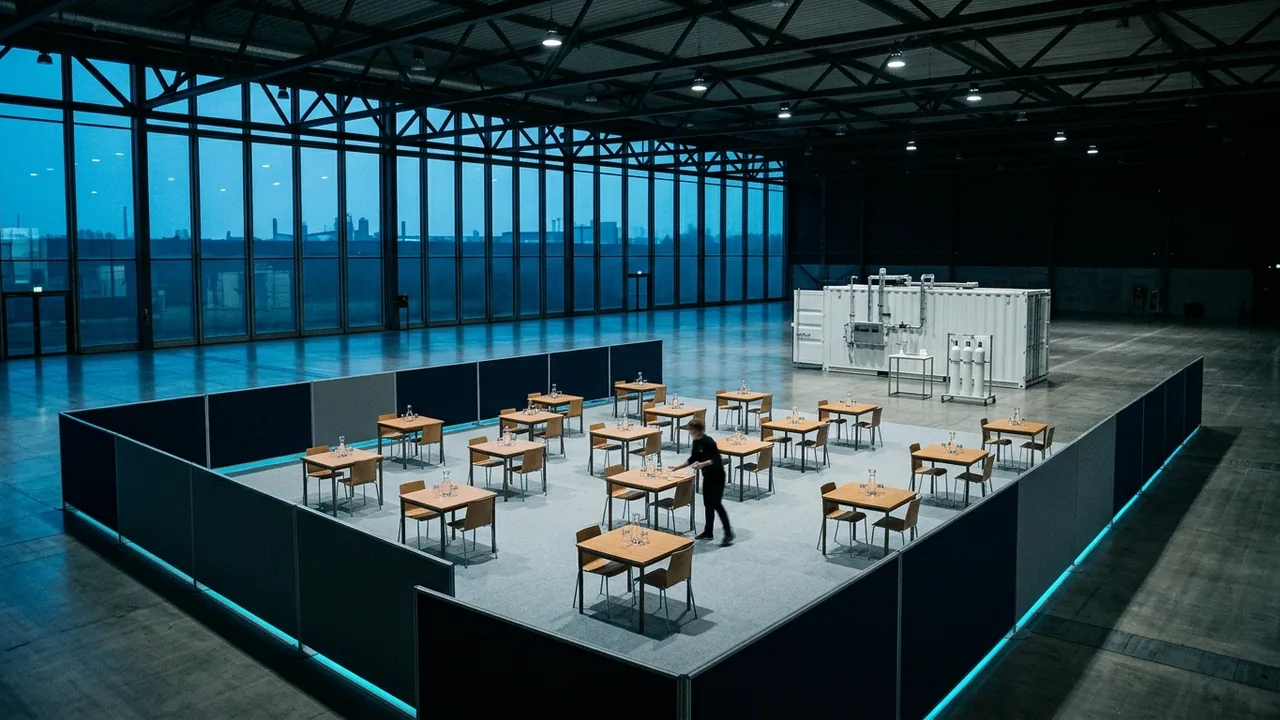
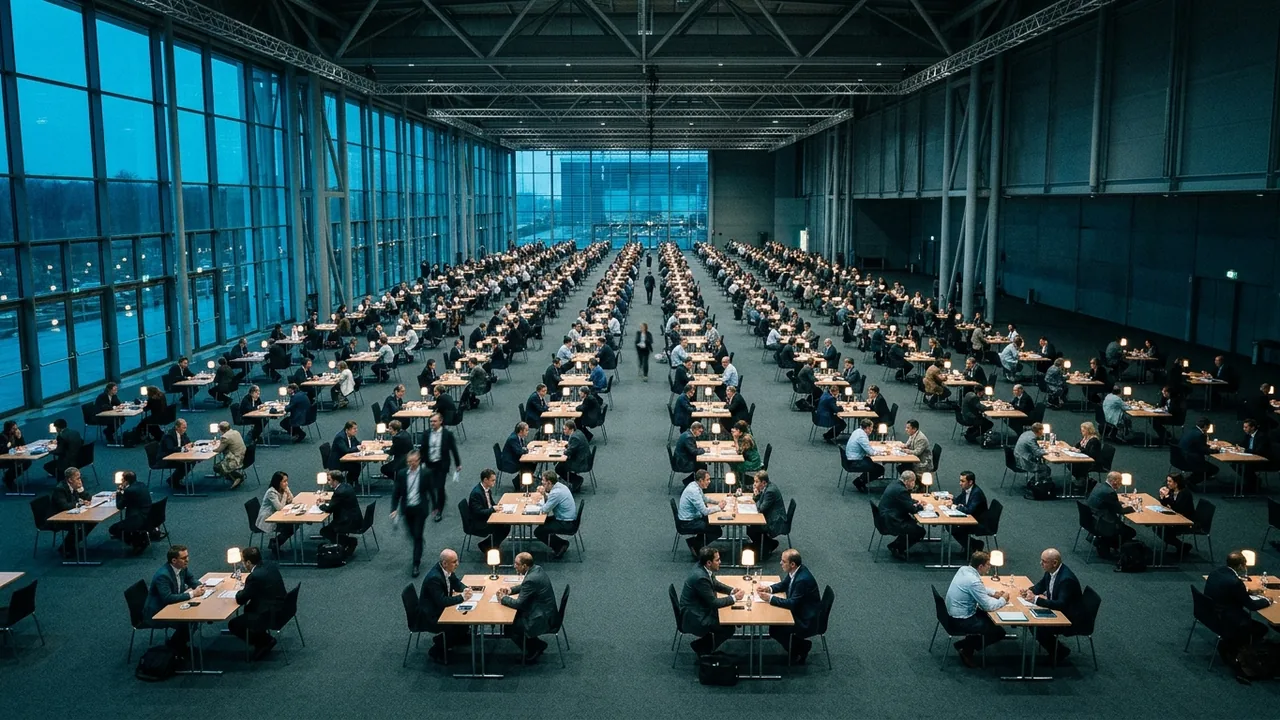
At the Brazil-Germany Economic Meeting in Salvador in June 2025, 60 Brazilian companies signed up for the business round. On the other side of the table sat 10 German buyers. Every meeting the Brazilian firms could hold had to fit into the diaries of those ten people.
That ratio is the hidden design problem of every bilateral forum. The ministers, the speeches and the gala dinner set the frame. The result depends on how many companies from one country meet the right counterpart from the other. And that number is capped by whichever side is smaller or less prepared.
This guide is written for the project manager who runs such a forum at an export agency, a binational chamber or an exchange organisation. She rarely runs it alone, because a partner agency in the other country shares the work. After the event, both funders will ask her the same question: what did our companies get out of it? Below you will find how to share the work between two organisers, recruit both sides in balance, set matching rules for two countries and report the result.
What a bilateral business and innovation forum is
A bilateral business forum brings companies, and often research organisations and public bodies, from two countries together for one programme. It usually combines political speeches and panels with pre-arranged meetings between participants from both sides. An innovation forum adds a narrower goal: partners who will apply together for joint research and development (R&D) funding.
The typical organisers are trade and investment agencies, bilateral chambers of commerce, the German Chambers of Commerce Abroad (AHKs), innovation agencies and exchange organisations. Many forums alternate between the two countries. The Brazil-Germany Economic Meeting is organised by the Brazilian National Confederation of Industry (CNI) and the Federation of German Industries (BDI). It has taken place every year since 1983, one year in Brazil and the next in Germany (CNI, Agência de Notícias da Indústria, June 2025).
Three neighbouring formats are easy to confuse with it:
- On a trade mission, a delegation of your companies travels abroad to meet local firms, as described in our guide to planning B2B meetings on trade missions.
- On an inbound buyer mission, you invite foreign buyers to meet local suppliers, so one side buys and the other sells.
- At an EU brokerage event, organisations from many countries look for partners for one funding call.
A bilateral forum differs in one point. Both countries send participants, and both expect results.
Two organisers, one diary
Because both countries send participants, two organisations usually share the work. The forum in Skopje on 6 November 2025 shows the pattern. The Hellenic Embassy and the Economic Chamber of North Macedonia brought together more than 60 companies from both countries. Together they held more than 200 B2B meetings (MIA, November 2025). A count like that is the visible result. The work behind it is two participant lists matched against each other.
Each organiser knows its own companies and recruits them. Neither knows the other side well. If each runs its own registration, you end up with two spreadsheets in two formats and two languages, and nobody can match them a week before the event.
Agree three things in writing before anyone is invited:
- One registration: a shared form with identical fields for both countries, in both languages if needed. Each organiser recruits, but every profile lands in the same place.
- One set of rules: who may request meetings with whom, how many requests each participant can send and receive, and who confirms the final diary.
- One owner for the schedule: one person who closes the request window and publishes the diaries. Two owners produce two versions.
Data protection belongs on the same list. Profiles travel across a border, so both organisers should agree who processes them and say so in the registration form.
The smaller side sets the ceiling
Shared rules matter most where the two sides are uneven. Back to Salvador. CNI organised the 2025 business round together with the Bahia industry federation FIEB, the CIN network of international business centres and the export agency ApexBrasil.
Brazil-Germany Economic Meeting, Salvador, June 2025
Six companies per buyer is a deliberate choice for a supplier showcase, and it can work. But do the arithmetic before you promise anything. If each of the ten buyers holds twelve meetings of 20 minutes, the round produces 120 meetings, or two per Brazilian company. That is our own illustration, not a published figure, yet it shows what each company can expect.
Picture the managing director of one of those 60 firms. She has flown in from another state and prepared samples. If her diary shows one meeting, she will not come back next year.
The fix starts with recruitment, not scheduling. Recruit the scarce side first and confirm it before you open registration on the other side. Then size the larger side to the time the scarce side has. If the scarce side cannot grow, cap the larger side. Or add a second format, such as a pitch session in which several companies present to all buyers at once.
The smaller delegation sets the ceiling.
Innovation forums: when the meeting has to become a proposal
The ceiling is even lower when the goal is a joint project. Bilateral innovation calls usually require partners from both countries and balance between them. The UK-Netherlands TechBridge call for quantum technologies required at least one company from each country. No participating country could cover more than 70 per cent of the eligible project costs (Netherlands Enterprise Agency RVO, 2025). It opened on 15 September 2025 and closed on 28 October 2025, six weeks later.
Six weeks is not long enough to find a partner from scratch. A forum that helps companies build such a project has to take place before or at the very start of the call window. The UK-Netherlands call held an online briefing a week after it opened (Innovate UK and RVO, 2025).
Balance rules also change who should meet. In a business forum, a meeting between two companies from the same country is a missed opportunity. In an innovation forum, it can be useless, because the project needs a partner across the border. The partner search for the 2025 French-German call for joint R&D projects shows what a balanced audience looks like. 34 participants from Germany and 30 from France registered, plus one from Luxembourg (AiF Projekt and Bpifrance, partner search page, 2025/26).
If you run the forum for a funding call, plan it like a brokerage event and count proposals, not meetings.
Profiles and matching rules for two countries
Balanced lists only help if the profiles let people find each other. Ask both countries for the same fields:
- Country side: which delegation the participant belongs to. This one field lets you allow or block meetings within the same country.
- What they offer and seek: two short sentences each, plus the partner type sought, such as distributor, supplier, investor or R&D partner.
- Sector or topic: chosen from a fixed list, so that both organisers use the same categories in both languages.
- Meeting language: the language the participant can negotiate in, and whether an interpreter is needed.
- Call or programme: for innovation forums, the funding call and the role the participant wants to play in a project.
Then set the rules. Allow requests only across the border, unless participants opt in to meetings with their own compatriots. Cap incoming requests for the scarce side, so that ten buyers do not receive 300 requests. Let both sides accept before a meeting is booked. A meeting both sides chose tends to happen.
How many requests a scarce group can handle is a sizing question of its own, covered in our guide to buyer to seller ratios at matchmaking events. If the two delegations do not share a working language, plan interpreters early, as our guide to multilingual buyer and seller meetings explains.
Solution: In Converve, both organisers work with one registration form and one rule-based meeting matrix. You define participant groups for each country and decide which groups may request meetings with each other. You also set how many requests each group can receive. Both sides confirm before the B2B matchmaking module books a table and a time slot.
A timeline for two organisers
Rules take time to work, and two organisers need more time than one. Count back from the forum date.
Planning a bilateral forum with a partner agency
- 6 months Agree goals and sectors Both organisers agree the sectors, the target numbers per country and who owns the schedule.
- 5 months Recruit the scarce side Confirm the buyers, investors or research partners that the other side will travel to meet.
- 4 months Open shared registration One form, identical fields in both languages, recruitment by each organiser in its own country.
- 8 weeks Check the balance Compare the numbers per country and sector, and adjust recruitment while there is still time.
- 6 weeks Open meeting requests Both sides browse profiles, send requests across the border and accept or decline.
- 2 weeks Publish the diaries Close the request window, fill gaps with proposals and send every participant a confirmed schedule.
- 6 and 12 months Ask both sides Run one follow-up survey in both languages about contacts, offers, deals and joint proposals.
The eight-week balance check is the step most often skipped. It is also the last moment when you can still recruit ten more companies on the thin side.
On the day: protect the meeting block
Even a perfect diary can fail on the day. Bilateral forums attract ministers and ambassadors, and their speeches tend to run late. If the meeting block follows the opening session, every delay comes out of your participants’ meeting time.
Imagine the opening running 40 minutes over. In a block of 20-minute slots, two full rounds of meetings disappear. The buyer who had twelve meetings now has ten, and two companies who flew in for one meeting go home without it.
Put the meetings in a separate block with a fixed start, ideally in a different room from the plenary. Keep the politics in the morning and the business in the afternoon, or the other way round. Do not let one eat into the other.
What to report to both funders
The meeting block also produces the figures for your report. Bilateral forums often have two funders, one in each country, and both ask about their own companies. Collect the same figures for both sides:
- meetings held, by country pair and sector, plus no-shows on both sides,
- the share of companies on each side with at least one meeting,
- follow-up contacts, offers and joint proposals after six months,
- deals, investments or approved projects after twelve months.
Expectations on the day are not results. At the 2025 business round in Salvador, CNI expected 5 million US dollars in deals over the following twelve months (CNI, June 2025). Only a survey a year later can tell you what really happened.
Ask the same questions in both languages and share one result table with your partner agency. Our KPI framework for B2B event matchmaking shows how to collect these figures with a few clean fields instead of a long questionnaire. When the project manager sits down with her funder, she can answer for her own companies and for the other side.
Conclusion
A bilateral business or innovation forum is a two-sided market. The speeches open doors, but the result depends on matched meetings between the two delegations, and the smaller or less prepared side sets the ceiling. So plan both sides together: one registration, one set of rules, a scarce side recruited first, a balance check eight weeks out and a protected meeting block. Then both organisers can tell their funders what their companies got out of it.
Are you planning a bilateral forum with a partner agency? If you want to see how one registration and shared matching rules work for both countries, get in touch with Converve.
Frequently Asked Questions
What is a bilateral business forum?
A bilateral business forum brings companies and institutions from two countries together for one programme. It is usually organised by a trade agency, a bilateral chamber or an exchange organisation, with a partner in the other country. It combines speeches and panels with pre-arranged meetings between participants from both sides.
What is the difference between a bilateral forum and a trade mission?
On a trade mission, a delegation from one country travels to meet companies in a target market, and only the travelling side is recruited as a group. At a bilateral forum, both countries send participants into one shared programme, so both sides need to be recruited, profiled and matched with the same care.
Who organises bilateral business and innovation forums?
Typical organisers are export and investment agencies, bilateral chambers of commerce, the German Chambers of Commerce Abroad (AHKs), innovation agencies and exchange organisations. The Brazil-Germany Economic Meeting, for example, is organised by CNI and BDI and has alternated between the two countries every year since 1983 (CNI, 2025).
How do you balance participants from two countries?
Recruit the scarce side first, then size the larger side to the time the scarce side has. Check the numbers by country and sector about eight weeks before the event. Cap incoming requests for the scarce group, and allow meeting requests only across the border unless participants choose otherwise.
When should an innovation forum take place relative to a bilateral funding call?
Before or at the very start of the call window. Bilateral calls can be short: the UK-Netherlands TechBridge call for quantum technologies was open for six weeks in 2025 and required at least one company from each country (RVO, 2025). Partners need that time to write the proposal.
How do you measure the success of a bilateral forum?
Report meetings held by country pair and the share of companies on each side with at least one meeting. Add follow-up contacts, offers and joint proposals after six and twelve months. Ask both sides the same questions in both languages, so that each funder can see the result for its own companies.