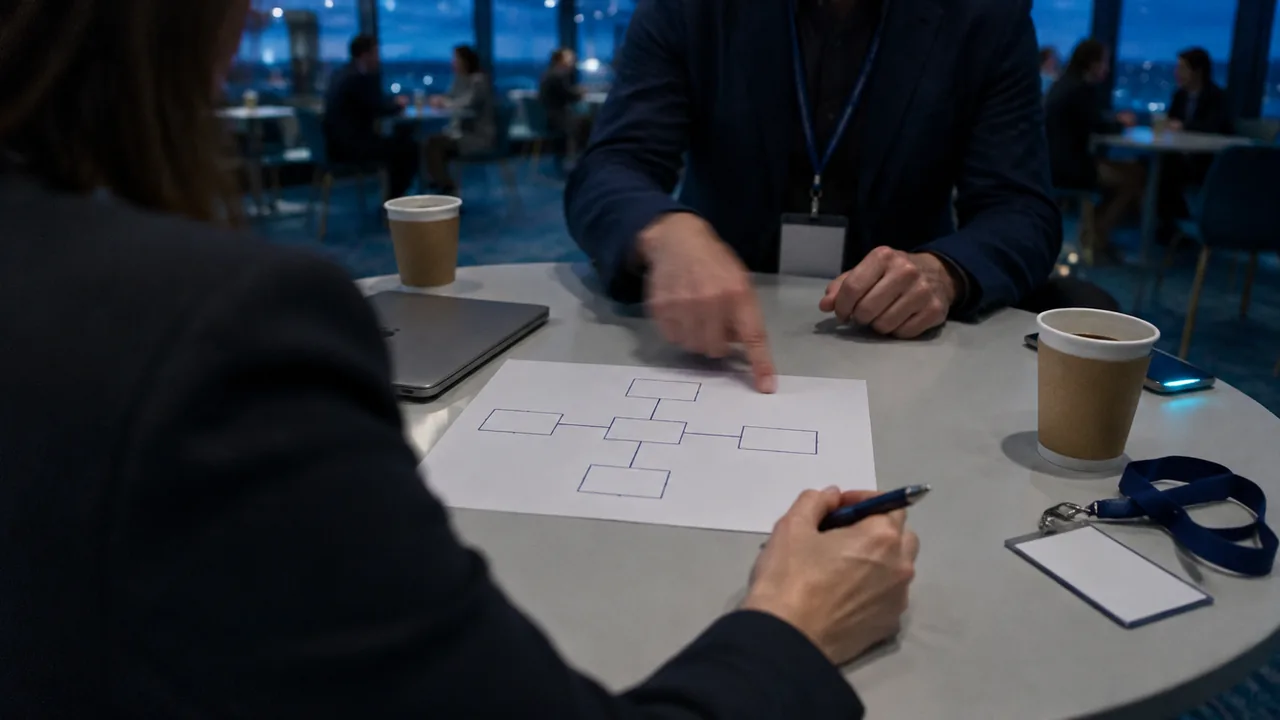
For the fresh fruit edition of its Exporta Mais Brasil programme in Petrolina in September 2026, Brazil’s export agency ApexBrasil put its conditions in writing. Thirty selected producers took part free of charge, in rounds of business meetings with international buyers chosen by ApexBrasil’s offices abroad. In return, each producer had to keep a representative on site for the whole event and fill in the evaluation forms, and risked a fine of 350 reais for pulling out late without an accepted reason (ApexBrasil, programme regulations, 2026). Those conditions help ensure that suppliers are available for the meetings arranged on their behalf.
That is the logic of an inbound buyer mission. A trade promotion agency, chamber, sector body or tourism board invites qualified foreign buyers into its own country and books one-to-one meetings between them and local suppliers, usually alongside visits to farms, plants or stores. In the UK, sector bodies such as the Agriculture and Horticulture Development Board (AHDB) call this an inward mission. In the United States, the same idea is often called a reverse trade mission, and in food exports a buyers mission.
This guide is for teams planning buyer missions and reporting their results to a ministry or funder. It covers formats, buyer recruitment and qualification, visits, scheduling rules and follow-up. The aim is to give buyers time to understand the offer and meet suitable local suppliers.
What is an inbound buyer mission?
The label covers several formats, and they share one direction of travel. Buyers come to the suppliers, not the other way round.
| Format | Who invites | What buyers see first | Example |
|---|---|---|---|
| Buyers mission at a home trade show | Regional export body | The show floor, then a separate meeting area | Food Export USA runs more than 20 events a year, most of them at US trade shows |
| Multi-city buyers mission | Regional export body | Guided store tours in each host city | Food Export’s Summer in the Cities, August 2026, in Detroit, Indianapolis and Albany |
| Supply chain inward mission | Sector body | Farms and processing sites | AHDB, June 2025: 28 red meat buyers visit farms and processors in the West Country |
| Familiarisation trip plus marketplace | National tourism organisation | Regions and products on a tailored trip | VisitBritain’s Global Hosted Buyer Programme: familiarisation trips plus marketplaces with suppliers |
| Reverse trade mission for projects | Government agency | Domestic technology in operation | The US Trade and Development Agency (USTDA) brings foreign project sponsors to the United States |
| National programme of regional rounds | Export agency | Producers in their home region | ApexBrasil’s Exporta Mais Brasil |
Sources: Food Export USA, 2026; AHDB via Meat Management, June 2025; VisitBritain; USTDA, 2026; ApexBrasil, 2026.
Three neighbouring formats are easy to confuse with it. On an outbound trade mission, a delegation of your companies travels abroad, which we cover in our guide to planning B2B meetings on trade missions. A hosted buyer programme is run by a trade show organiser who funds buyers so that its exhibitors can meet them at the show. At a reverse trade show, buyers sit at tables and suppliers visit them, usually without anyone crossing a border.
The difference shapes your planning. Your client is the supplier base of a region or a sector, not an exhibitor list, and success is measured in exports rather than stand bookings. The programme should therefore reflect the needs of the local supplier base.
Why the diary matters more than the itinerary
Whatever the format, every invited buyer arrives with the same question from the office. A manager approved several days away from the desk, and back home that manager will ask what was found: new suppliers, samples worth testing, a price list for the next tender. Meetings with suitable suppliers help buyers return with information they can use in those decisions.
Now picture the programme manager at a regional export agency. She has a budget from the ministry, 40 local companies that want to export and eight buyers flying in from three markets. Her ministry will ask a version of the buyer’s question: how many of our companies met a buyer who could actually buy from them?
Food Export USA, which runs buyers missions for food and agricultural suppliers from the US Midwest and Northeast, publishes what participants in its 2023 missions reported.
What participants in Food Export's 2023 buyers missions reported
These are organiser figures, reported by the participants themselves, so treat them as indicative. The shape is still telling. Introductions come first, and only part of them turn into distribution agreements or first export sales. If you want more of the bottom figures, you need more of the right introductions. Focus recruitment and matching on the needs of the suppliers taking part.
Recruit buyers who can actually buy
Better matches start before the first invitation goes out. The strongest programmes recruit through people on the ground in the source markets. Food Export describes its guests as “pre-screened, qualified international buyers” vetted by its in-market representatives (Food Export USA, 2026). ApexBrasil leaves the selection of buyers to its offices abroad (ApexBrasil, 2026). A contact list bought from a database rarely matches that standard.
Four questions decide whether a buyer belongs on your guest list:
- Purchasing role: does the person decide or prepare purchases in the category, or only scout trends?
- Import route: does the company already import, or does it have a clear route through an importer or distributor?
- Category gap: does the current range have a gap your suppliers can fill?
- Market access: can your suppliers serve that market with their certifications, volumes and prices?
A buyer for a supermarket chain who only handles bakery is a perfect guest for a bakery mission. For your dairy producers, the same buyer is a lost day. The tests that work for trade show buyers apply here too, and our guide on how to qualify hosted buyers lists the questions and the evidence worth asking for.
Make hosting conditional on both sides. A buyer whose flight and hotel you fund agrees to a minimum number of meetings, and a supplier who takes a place commits to attend every one of them. ApexBrasil writes the supplier side into its regulations, down to the fine for a late withdrawal. A free seat without a duty stays empty.
Visits first, meetings second
Once the right buyers are confirmed, the order of the programme decides how much they get out of each meeting. Food Export’s Summer in the Cities mission in August 2026 sent buyers on guided retail tours in every host city before their meetings, so they could see packaging, pricing and product positioning, and it gave them company profiles in advance (Food Export USA, 2026). AHDB took 28 red meat buyers to farms and processors in the West Country in June 2025, so they could see the production behind the products for themselves (Meat Management, June 2025). Tourism works the same way: VisitBritain combines familiarisation trips through selected regions, tailored to each source market, with marketplaces where its hosted buyers meet suppliers face to face (VisitBritain, 2025/26).
A buyer who has stood in a cowshed or a supermarket aisle asks better questions at the table. The supplier no longer explains the basics and can talk about volumes, specifications and delivery dates instead.
Plan the visit days first and the meeting day afterwards, and build buffers into the transfers. A coach that leaves a farm 40 minutes late can cost every buyer on board a meeting or two, and each lost slot is a supplier who waited in vain. See first, then talk.
How to build a fair meeting diary
The meeting day is where the visits pay off. It is also where many programmes lose quality through the way they hand out slots. Some agencies allocate slots first come, first served: Food Export’s 2026 event pages advise suppliers to register early for exactly that reason (Food Export USA, 2026). The method is simple and transparent. It rewards speed, though, not fit.
Request-based scheduling works the other way round. Buyers receive supplier profiles before they travel and mark the companies they want to meet, suppliers do the same, and you confirm the meetings where interest matches. The remaining slots are filled by rules you set in advance:
- Allow each supplier one meeting per buyer, so a large importer sees the breadth of your region rather than three sales managers from the same firm.
- Give every supplier at least one meeting with a buyer it asked for, or tell it early why that is not possible.
- Share the most requested buyer fairly. If all 40 suppliers want the national importer, decide before registration how her eight hours are divided.
- Fix the slot length before you recruit anyone, because both sides plan their day around it.
- Book interpreters for the language pairs that need them; our guide to multilingual buyer seller meetings covers when one is worth the cost.
How many suppliers you can admit for each buyer is a sizing question of its own, which we work through in our guide to buyer to seller ratios at matchmaking events. Get it wrong and the best rules cannot rescue the day.
Converve builds the diary on a meeting matrix. Buyers and suppliers complete structured profiles, both sides send meeting requests, and matching rules you define decide which participant groups may request meetings with each other. Every confirmed meeting gets a time slot and a table. Because the logic is rule-based, you can show a supplier, or your funder, how its meeting partners were selected. You can see the details on our B2B matchmaking page.
A timeline worked backwards from arrival
Fair rules need time to work, which is why the planning starts long before the buyers land. The timeline below is our working recommendation for a mission with one or two visit days and one meeting day, not a published standard. Programmes with visas or several host cities need more lead time.
An inbound buyer mission, worked backwards from arrival
- 6 months Set sector and markets Choose the product category and two or three source markets where your suppliers can compete.
- 5 months Brief partners abroad Agree the buyer profile with your offices or partners in each market and start personal invitations.
- 3 months Open supplier registration Collect supplier profiles in the buyers' business language, with products, certifications and export experience.
- 8 weeks Confirm buyers Confirm hosted buyers in writing, including their meeting commitment and travel dates.
- 6 weeks Open meeting requests Share profiles with both sides and let buyers and suppliers request the meetings they want.
- 3 weeks Publish the diaries Schedule by your rules, confirm every meeting with both sides and send the full itinerary.
- Arrival Visits, then meetings Run site or store visits first and the meeting day afterwards, with buffers on every transfer.
- 6 to 12 months Ask about results Survey suppliers about quotes, distributors and orders in two waves after the mission.
The step most often squeezed is the request window. Six weeks sounds long, yet buyers answer slowly while they travel, and suppliers need time to translate their profiles. Protect it.
Report what your funder will ask
Fair rules also produce the data your report needs. Food Export shows why one survey is not enough: participants in its 2023 missions reported 164 million US dollars in actual sales and a further 112 million in projected sales (Food Export USA, 2026). A projection on the meeting day is a hope. Actual sales need a second and a third question months later.
Collect figures in three waves:
- On the day: meetings held per buyer and per supplier, no-shows on both sides and a quick relevance rating for each meeting.
- After six months: samples shipped, quotes sent, negotiations under way and new distributors signed.
- After twelve months: first orders and repeat orders in the source market.
Add one question funders value: would you have reached this buyer without the mission? Missed appointments deserve their own count, and our guide to the event meeting no-show rate shows how to record and reduce them. For a full set of key performance indicators across all phases, see our KPI framework for B2B event matchmaking.
When the ministry asks the programme manager what the eight buyers brought, she can answer with meetings held, requests met and orders placed. A photo of the coach in front of the factory is a nice extra, not evidence.
Frequently Asked Questions
What is an inbound buyer mission?
An inbound buyer mission is a programme in which a trade promotion agency, chamber, sector body or tourism board invites qualified foreign buyers to its own country and arranges one-to-one meetings with local suppliers, usually combined with site or store visits. In the UK, the term inward mission is common, for example at the Agriculture and Horticulture Development Board (AHDB).
What is the difference between an inbound and an outbound trade mission?
The direction of travel. On an outbound mission, a delegation of domestic companies travels to a foreign market to meet potential customers there. On an inbound mission, the buyers travel, and the domestic suppliers stay at home and receive them, which lets many more local companies take part in a single programme.
Is a reverse trade mission the same as a reverse trade show?
No. A reverse trade mission brings foreign buyers or project sponsors into a country to meet its suppliers; the US Trade and Development Agency, for example, brings foreign project sponsors to the United States to see American products and services in operation (USTDA, 2026). At a reverse trade show, buyers, often local ones, sit at tables and suppliers visit them.
Who pays for an inbound buyer mission?
Usually public money, with a small contribution from suppliers. Food Export’s buyers missions depend on funding from the US Department of Agriculture (USDA) Market Access Program, and suppliers paid a registration price of 250 US dollars for its 2026 foodservice and food ingredients missions, for example (Food Export USA, 2026). ApexBrasil subsidises participation in Exporta Mais Brasil completely, while companies pay their own travel, accommodation and samples (ApexBrasil, 2026).
How far in advance should you plan an inbound buyer mission?
Allow about six months for a mission with one meeting day. Buyer recruitment through partners abroad takes the longest, and both sides need around six weeks to request meetings once the profiles are shared. Missions with visa requirements or several host cities need more time.
How do you measure the success of an inbound buyer mission?
Measure in three waves: meetings held and no-shows on the day, quotes and new distributors after six months, and orders after twelve months. Food Export’s figures show why: participants in its 2023 missions reported 164 million US dollars in actual sales and a further 112 million in projected sales (Food Export USA, 2026).
Conclusion: plan visits and meetings around buyer needs
An inbound buyer mission succeeds or fails on the meetings each buyer holds with suppliers who fit. The visits, the dinners and the coach transfers matter, but they serve the diary. Recruit buyers through partners who know them, make hosting conditional, show buyers the product before they sit down, and set the scheduling rules before anyone registers. Then measure what happened six and twelve months later, not just on the last evening.
If you are planning a mission and want to see how a rule-based meeting diary would work for your buyers and suppliers, get in touch with Converve.