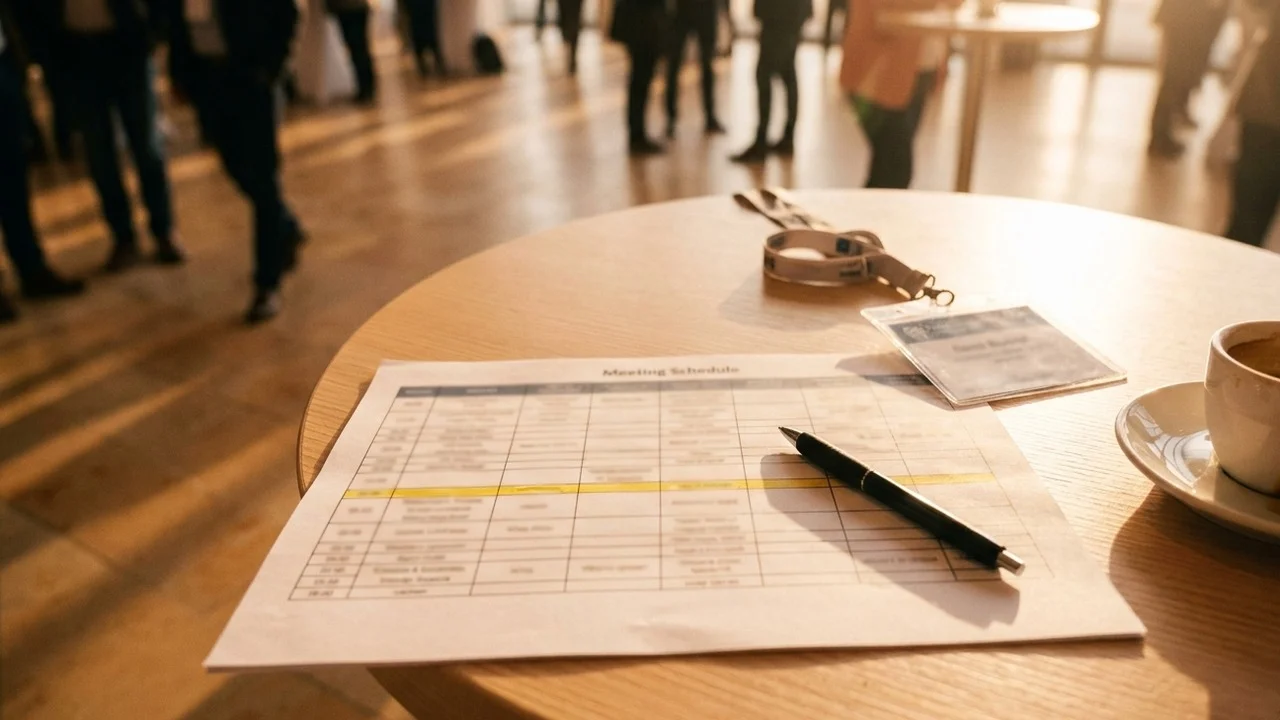
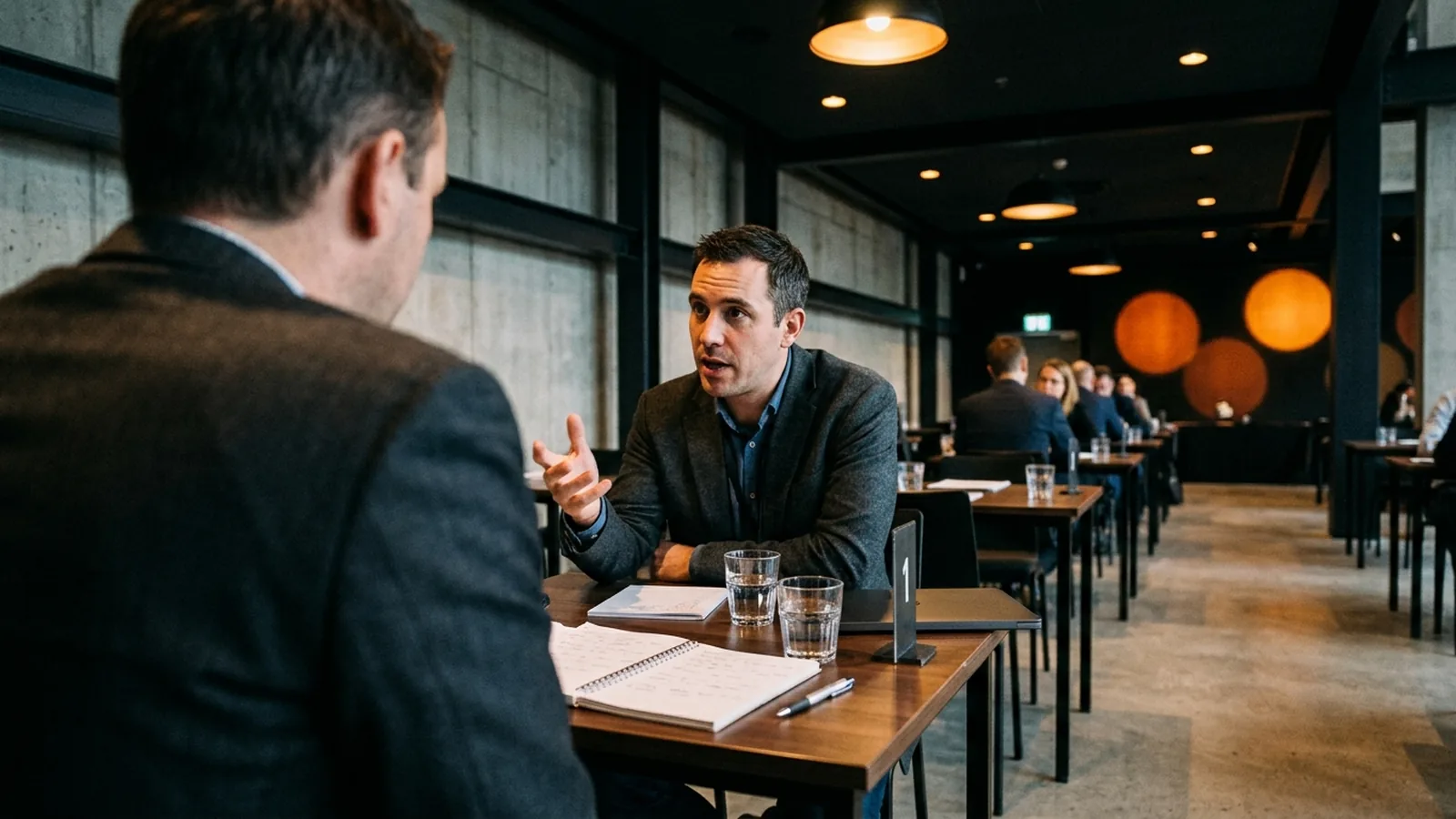
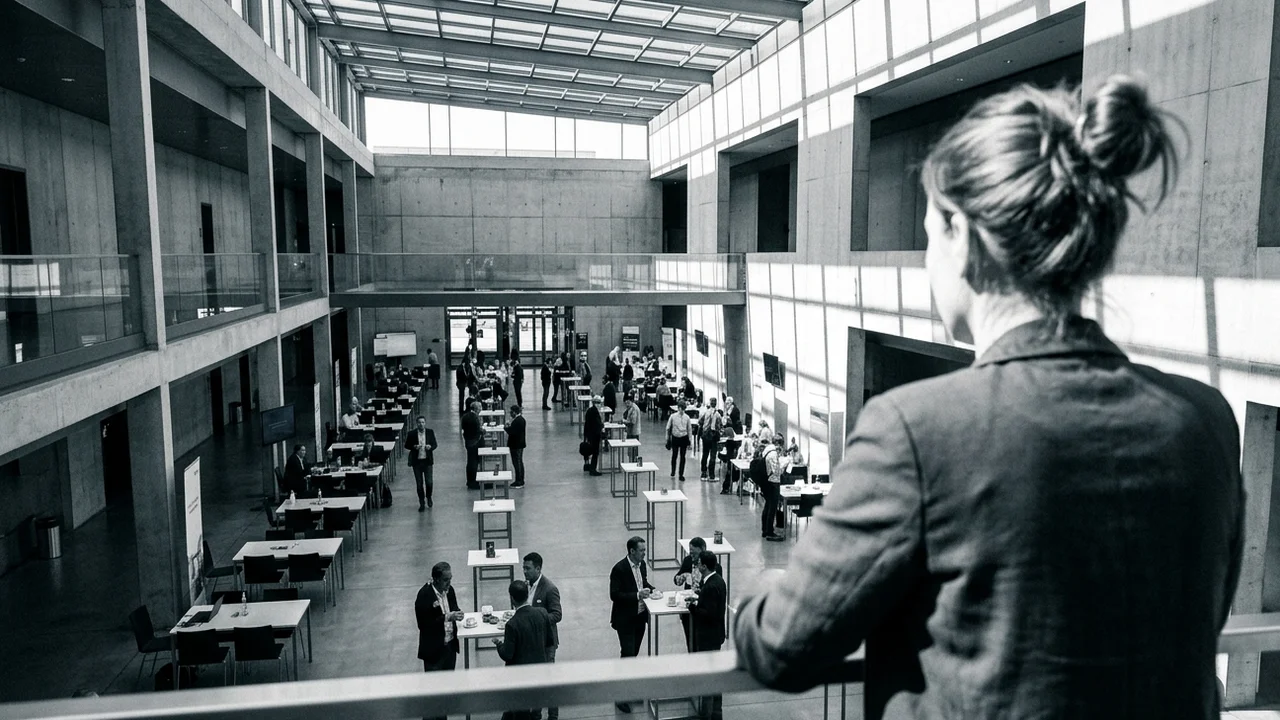
At the Pinellas County Reverse Trade Show in Florida this spring, the exhibitors were not companies. They were 24 government agencies and prime contractors, each behind its own table, and more than 120 businesses walked the room to pitch to them (Pinellas County Economic Development, April 2026). No supplier had built a stand. Nobody had shipped a crate of brochures. The people with the budgets had come to be found.
That is the idea behind a reverse trade show, and it is simple enough to explain in one sentence. What the event pages rarely mention is what the organisers have been changing: by 2026, several well known reverse trade shows had added scheduled one to one meetings to the walk around format, or replaced it altogether. The reason is the thesis of this guide. A reverse trade show turns the stands around, but only a meeting schedule turns the walk into business. Below you will find what a reverse trade show is, how it differs from related formats, why buyers and suppliers both sign up, and how to plan one step by step.
What is a reverse trade show?
A reverse trade show is a B2B event in which the buyers host the tables and the suppliers visit them. Procurement staff from public agencies or purchasing teams from companies sit at stands with information about what they buy and how, and suppliers move from table to table to introduce themselves, learn about upcoming tenders and build relationships.
The National Institute of Governmental Purchasing (NIGP), whose regional chapters run many of these events in the United States, puts it plainly: “It’s called a reverse trade show because the suppliers do not have booths. Instead, the governmental agencies host booths and suppliers roam the trade show floor to meet with individuals from each entity.” The Central Florida chapter sums up the upside for vendors in its 2026 invitation: “Vendors do not have booths to set up, no heavy lifting!”
You will find the format in three settings:
- Public procurement: cities, counties, school districts, ports and transit authorities meet local and small suppliers. Hosts are procurement associations, economic development agencies and small business centres.
- Industry associations: apartment associations in the US run reverse trade shows in which property management companies take the tables and supplier members visit them. The Chicagoland Apartment Association calls its version a Business Exchange.
- Corporate supplier days: a large company or a group of manufacturers invites potential suppliers to meet its category buyers in one place. In Europe the same idea often runs under the name meet the buyer, one of the forms of business matchmaking that chambers and public networks organise.
The setting changes who sits at the table. The mechanics stay the same.
Reverse trade show vs trade show, meet the buyer and hosted buyer
Because the format sits close to several others, it helps to ask two questions of each: who has the stand, and who travels to whom? The table below separates the formats that are most often mixed up.
| Format | Who hosts a table | Who moves | Meetings booked in advance? | Typical organiser |
|---|---|---|---|---|
| Classic trade show | Suppliers (exhibitors) | Buyers and visitors | Rarely, mostly walk in | Trade fair company |
| Reverse trade show | Buyers | Suppliers | Traditionally no, increasingly yes | Procurement association, economic development agency, industry association |
| Meet the buyer event | Nobody, meeting tables only | Both, to numbered tables | Yes, the whole programme | Chamber, public network, corporate supplier programme |
| Hosted buyer programme | Suppliers (exhibitors) | Invited buyers, often with travel paid | Yes, a guaranteed number | Trade show organiser, often in tourism |
| Reverse trade mission | Domestic suppliers | Foreign buyers travel to them | Yes | Trade agency |
Two neighbours deserve a closer look. A hosted buyer programme keeps the exhibitors at their stands and pays for buyers to come to them; we explain the mechanics in what a hosted buyer programme is. A reverse trade mission sounds similar but is a trip: foreign buyers travel to a country to see its suppliers, a format we cover in our guide to trade missions and B2B meetings. The reverse trade show is local by nature. The buyers stay at home and let the market come to them.
Why buyers and suppliers both sign up
The format answers a problem that both sides have with each other. Public buyers spend large sums: public procurement accounts for 12.7 per cent of gross domestic product (GDP) across the member countries of the OECD (Organisation for Economic Co-operation and Development) and 14.8 per cent in its EU members (OECD, Government at a Glance 2025). Yet many small suppliers never find out how to get on a bid list. For them, an afternoon with the purchasing staff of two dozen agencies replaces months of unanswered emails.
For the buyers, the reverse trade show is a transparency tool. Many public agencies are expected to widen their supplier base and to give small and local businesses a fair chance. Meeting a hundred of them in one room, with the same information for everyone, is easier to defend than a series of individual lunches. In the private sector the logic is similar but more practical. One Director of Property Management at the Chicagoland event described it as “an opportunity to focus, in one afternoon, on vendor search for budgeting purposes”.
For the organiser, the event often pays for itself. NIGP chapters use their reverse trade shows to fund scholarships and training. The Arizona State Capitol Chapter reported that its 2025 edition nearly doubled gross revenue compared with the previous show and allowed it to raise the number of full Forum scholarships from five to nine (NIGP Forum 2026 showcase). Suppliers pay to attend, buyers attend for free.
That price asymmetry creates an obligation. The supplier paid for access, so access has to happen.
The weak point of the classic format: the walk
In the original format, access means walking. And the walk has a structural problem that every organiser who has run one will recognise. Picture the programme manager at a regional economic development agency, standing at the back of the hall an hour into her first reverse trade show. The table of the county’s facilities department has a queue of eleven suppliers. The transit authority’s table has one. The facilities buyer has now explained the bid portal nine times, in two minute conversations, and has collected a stack of business cards she will never sort. Half of the suppliers in the queue do not sell anything the department buys.
Nobody did anything wrong. The format simply leaves the most important decision, who talks to whom, to the order in which people arrive. Popular tables get crowded, niche buyers stand idle, and the conversations that happen are short and generic. When the programme manager reports to her board, she can count attendees. She cannot count business.
This is the gap that organisers have been closing, and by 2026 they were doing it in remarkably similar ways.
Reverse trade shows in 2026
From walking the floor to scheduled meetings
Multifamily NW announced a “refreshed, meeting-based format” for its 2026 edition: property management companies sit at tables while suppliers “rotate through scheduled meetings” in three one hour rounds. The Chicagoland Apartment Association runs its Business Exchange as a speed format with a seven minute meeting at every table. And Pinellas County, after its reverse trade show, now schedules a full week of “Virtual Match Makers” between suppliers and the agencies they most wanted to meet. The planning guide of the Utah chapter of NIGP describes the same pull from the supplier side: vendors “will usually register for the event just for” the one-on-one meetings with agency directors.
The direction is clear. The table stays, the walk gives way to a schedule.
How to host a reverse trade show in seven steps
The good news for the programme manager is that the planning work is well documented. The Utah chapter of NIGP publishes a 25 page guide that starts eight months before the event. Combined with the meeting based formats above, the process looks like this.
Planning
Hosting a reverse trade show in seven steps
- Step 1 Set the goal Wider supplier base, local business access, chapter revenue or all three. The goal decides the invitation list.
- Step 2 Recruit the buyers first Suppliers decide whether to come based on which buyers are confirmed. Start seven to eight months out.
- Step 3 Publish buyer profiles What each buyer purchases, upcoming bids, how to register as a vendor and who will be at the table.
- Step 4 Choose the meeting model Open floor, scheduled rounds or both: open tables for everyone, booked slots for the conversations that matter most.
- Step 5 Set the booking rules Slot length, a cap per buyer and a fair, published way to assign slots when demand exceeds supply.
- Step 6 Run the day Check in, a short how to do business session, then tables and meeting rounds on a visible clock.
- Step 7 Follow up and measure Survey both sides, count meetings held and follow up bids, and hold a review before the next edition.
Recruit the buyers before you sell a single ticket
In a classic trade show you sell stands and hope the visitors come. In a reverse trade show the logic flips with the stands: the buyers are the product. The Utah guide calls agency recruiting “the heart of any solid reverse trade show” and warns that vendors often decide to attend or not based on which agencies have committed. Invite heads of purchasing personally, tell them how much time you need from them, and reach beyond the usual large entities. Smaller cities, school districts and technical colleges are often underrepresented, and for many suppliers they are the most realistic first customers.
Decide how much of the day is scheduled
You do not have to abolish the open floor. Many suppliers value the chance to drop by a table and ask a quick question, and the format is known for exactly that. The practical model is a hybrid: open tables for general information, and a set of pre-booked one to one slots with the buyers whose purchases are specific enough to need a real conversation. The Utah guide recommends slots of no more than 15 minutes and no more than 90 minutes of meetings per director, which means six meetings per buyer. That is the capacity you plan against.
Make the booking rules fair and visible
Six slots per buyer and a hundred suppliers who want them: this is the moment where a reverse trade show becomes a matchmaking problem. The Utah guide insists that meetings are arranged “fairly and transparently” and suggests letting suppliers rank the agencies they want to meet, so that the organisers can move to the second choice when the first is full. For public buyers, that transparency is not a courtesy. It is the reason they took part.
Rules that work in practice:
- Match on what is bought: a supplier may request a slot with a buyer whose category matches the supplier’s offer, not with every table in the room.
- Cap the requests: each supplier gets a limited number of requests, so that the most popular buyers are not booked out by the first registrants.
- Let the buyer decide: buyers accept or decline requests before the day, so nobody sits through a meeting that cannot lead to a purchase.
- Publish the slot, the table and the time: every accepted meeting has a fixed slot and table number, visible to both sides.
Which pairings to allow is the same question every business matchmaking organiser faces, and the mistakes are the same too. We cover them in who should meet whom.
Solution: Converve runs this kind of programme on a meeting matrix. As the organiser, you define which participant groups may request meetings with which, for example suppliers in a product category with the buyers who purchase it, and set quotas per buyer and per supplier. Suppliers see the buyer profiles and send requests, buyers accept or decline, and every accepted request lands in a time slot with a table number. The logic is rule-based and visible, so you can explain every pairing to a supplier who asks why they did or did not get a slot. You can see how it works on our B2B matchmaking page.
Think about who pays and who can cancel
Suppliers usually pay a fee; buyers usually attend free. In public procurement, be careful with charging for the meetings themselves. The Utah guide notes that the state’s chief procurement officer has discouraged charging vendors for one to one meetings, because agencies should stay open to all vendors. Charge for attendance, not for access to a specific buyer. On the buyer side, protect the suppliers who paid: the Chicagoland Apartment Association invoices a 50 US dollar fee to management companies that do not show up without notice. A booked slot with an empty chair is the fastest way to lose a supplier for next year. Our analysis of meeting no-show rates shows which levers reduce them.
How to measure whether it worked
Back to the programme manager and her board. After a classic reverse trade show she could report attendance. With scheduled meetings she can report what the board actually wants to know. Four figures carry the story:
- Meetings held per buyer, against the slots you offered.
- The share of suppliers who had at least one confirmed meeting.
- The no-show rate on both sides.
- Follow up actions within three months: vendor registrations, bid responses and contracts, as far as the buyers are willing to share them.
Add a short survey for both sides and a review meeting with the planning committee, as the Utah guide recommends, and the next edition starts with evidence instead of impressions. Attendance fills the room. Meetings fill the pipeline.
Frequently asked questions
What is a reverse trade show?
A reverse trade show is a B2B event in which buyers host the tables and suppliers visit them. Procurement staff from public agencies or purchasing teams from companies sit at stands, and suppliers move from table to table to introduce themselves and learn how to do business with each buyer.
What is the difference between a trade show and a reverse trade show?
At a classic trade show, suppliers exhibit and buyers walk the floor. At a reverse trade show the roles are swapped: buyers host the tables and suppliers walk. Suppliers need no stand, and buyers meet many potential vendors in one place.
Who organises reverse trade shows?
In the United States, most are run by chapters of public procurement associations such as NIGP, by county economic development agencies and small business centres, and by industry associations such as apartment associations. Companies run similar events as supplier days, and in Europe the related format is often called meet the buyer.
How long should meetings at a reverse trade show be?
The planning guide of the Utah chapter of NIGP recommends one to one meetings of no more than 15 minutes and no more than 90 minutes of meetings per buyer. Speed formats in the private sector use shorter slots, for example seven minutes per table at the Chicagoland Apartment Association.
Do suppliers pay to attend a reverse trade show?
Usually yes: suppliers pay an attendance fee, while buyers attend for free. Public procurement organisers should avoid charging for access to specific buyers, and instead charge for attendance as a whole.
Is a reverse trade show the same as a reverse trade mission?
No. A reverse trade show is a local event where buyers host tables and nearby suppliers visit them. A reverse trade mission brings foreign buyers to a country to visit its suppliers, usually organised by a trade agency.
Conclusion: the table is the invitation, the schedule is the business
A reverse trade show solves a real problem: it brings buyers who are hard to reach and suppliers who struggle to be seen into one room, at little cost to either. The flip of the stands is what makes it memorable. What makes it productive is the step more and more organisers have added: a schedule of booked meetings behind the open tables, with rules that both sides can see.
The stands start the conversation. The schedule makes it business. If you are planning a reverse trade show, a supplier day or a procurement matchmaking event and want the meetings to be booked before anyone arrives, get in touch with Converve. You can also see how associations and chambers use our platform on the associations page.