Sit through three platform demos this summer and you will hear the same promise three times: switch on AI matchmaking and your acceptance rates jump. The numbers behind the promise are real. According to Swapcard’s published platform data, acceptance rates roughly double once algorithmic matching is active, and Clarion Events reports 44 per cent more in-person meetings after switching (Grip, 2026). What the demos skip is the question your board will ask in November: why did buyer X meet seller Y, and who decided?
A hosted buyer programme is the worst possible place to leave that question open. You pay for flights and hotel nights, often from public budgets. You guarantee sellers a diary of qualified meetings. Every pairing is a spending decision that someone must be able to defend. Hand that decision to a system nobody on your team can explain, and you have not modernised your programme. You have outsourced its accountability.
This guide shows where AI earns a place in a hosted buyer workflow, where it creates black box risk you cannot afford, and why controlled matchmaking through a meeting matrix remains the foundation that makes any of it defensible.
The short version: AI matchmaking is a ranking layer, not a matching strategy. In a hosted buyer programme it is only safe on top of a controlled, rule-based meeting matrix that enforces eligibility, quotas and an audit trail. Use AI for narrow, supervised jobs such as profile enrichment. Never let it replace the matrix that lets you explain every meeting.
What AI matchmaking actually means at a hosted buyer programme
Defensibility starts with vocabulary, because the industry uses one label for at least three different machines. Before you can decide what to adopt, you need to know which machine a vendor is actually selling:
- Rule-based meeting matrix: Both sides declare explicit attributes such as destination interest, segment, deal size class and language. The organiser defines who may meet whom, how often and when. Every pairing traces back to a rule a human wrote. This is what runs most leading travel trade shows today.
- Recommender layer: A machine learning model ranks possible meetings by predicted fit, learning from profile data and behaviour. It can lift acceptance rates, but its reasoning is a weighted score, not a sentence you can read out to a stakeholder.
- Semantic matching on free text: Embedding models compare open text fields such as company descriptions or imported profiles. Powerful for messy data, and the hardest of the three to explain after the fact.
A working definition for the first kind of clarity: AI matchmaking in a hosted buyer programme is a software layer that uses machine learning to rank meeting recommendations on top of the organiser’s eligibility rules. The rules still decide who may meet whom. The algorithm only proposes who probably should. If a platform cannot show you that separation, it is selling you a black box with a dashboard.
One more piece of vocabulary discipline: matchmaking is the umbrella term, and AI is one way of executing it, not the modern replacement for everything else. Curated, rule-based matchmaking is the default at the leading travel trade shows, not the legacy option. How the algorithmic side works under the bonnet is a topic of its own, and we have unpacked it in our explainer on AI matchmaking at events.
The black box problem: what you trade away
Once you separate the three machines, the trade-off behind the acceptance statistics becomes visible. A learned ranking model does two things at once: it improves the average match, and it removes your ability to explain the individual one.
Picture the moment that matters. A seller stops you in the aisle on day two: his direct competitor met both Brazilian tour operators, he met neither, and his stand cost the same money. With a meeting matrix, you export the rule that decided and walk him through it. With a black box, you relay a probability score. The algorithm cannot answer him. You must.
Then there is the data itself. Switching on an AI layer usually means pouring participant data into it: profiles, company descriptions, imported social media bios, clicking and messaging behaviour. Before any of that happens, you need answers to where the data is processed, whether it trains the vendor’s models, and how long it is retained. Under Article 22 of the GDPR (General Data Protection Regulation), participants also have rights around purely automated decisions that significantly affect them, and who gets access to commercial opportunities at a trade show is exactly such a decision. A fully automated pairing engine without human oversight is not a feature. It is a compliance question you now own.
The regulatory direction confirms this rather than relaxing it. The EU AI Act’s high-risk obligations were postponed to December 2027 by the omnibus regulation that entered into force in July 2026. The postponement buys time, not exemption: transparency and human oversight remain the stated expectations, and if your show reports to a ministry, a destination board or public funders, procurement accountability applies now, not in 2027.
The tension in numbers
AI adoption is racing ahead of accountability
Even on its own terms, the algorithm has documented weak spots. Recommender research calls the biggest one the cold start problem: for a participant with no history, the model has little to learn from, and systematic reviews across a decade of work conclude it remains unsolved in general (Panda et al., Journal of Intelligent Information Systems, 2022). At a recurring show, learned models also drift towards incumbents: the suppliers who met many buyers last year look like safe recommendations this year, which quietly starves your new exhibitors. Your best case is a better average. Your worst case is a bias you cannot see.
Controlled matchmaking: the meeting matrix as your audit trail
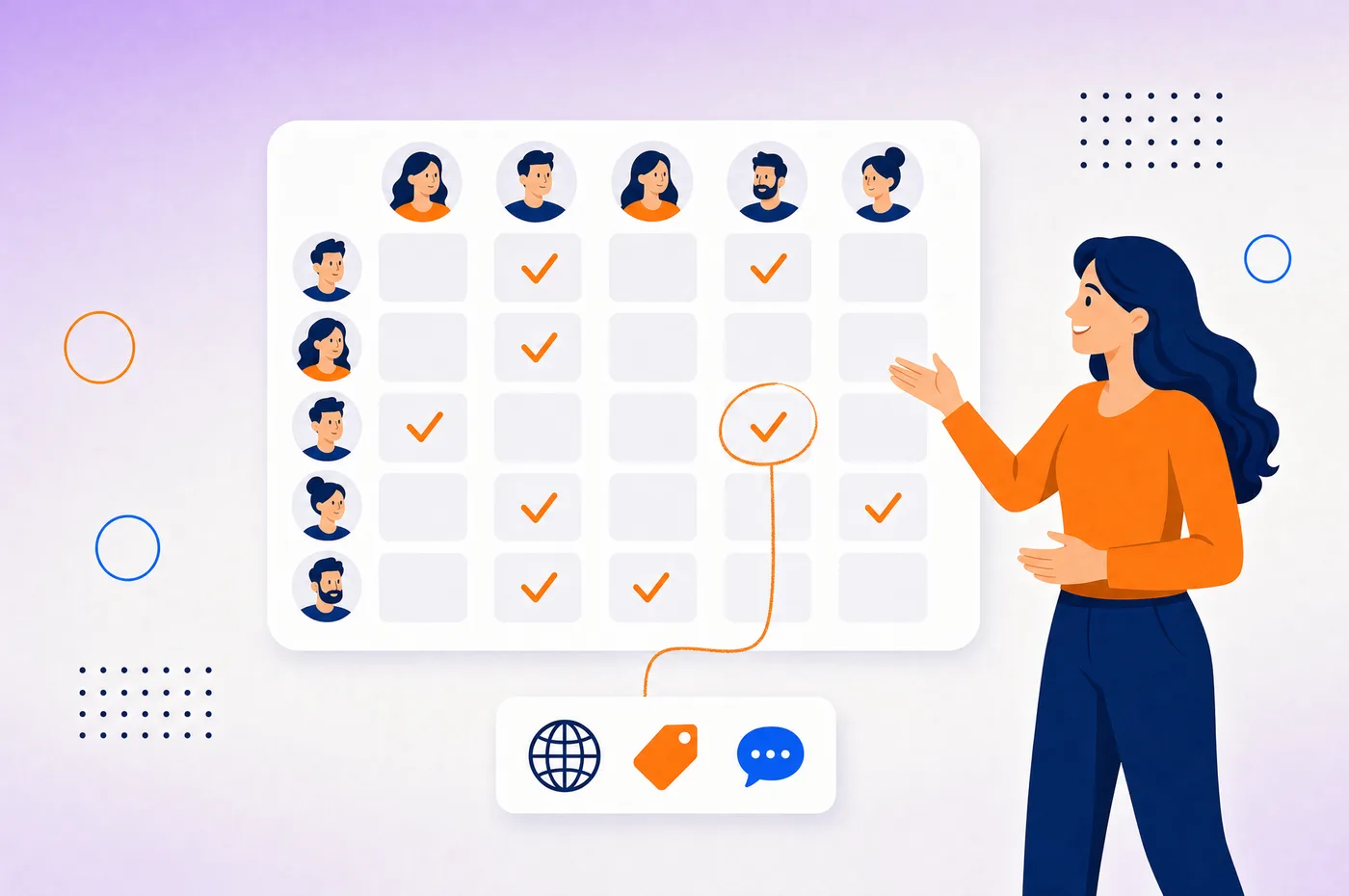
The alternative to the black box is not a return to spreadsheets and gut feeling. It is controlled matchmaking: a meeting matrix in which you define the matching logic over explicit attributes, and software does the heavy scheduling inside your rules.
The mechanics are straightforward. Buyers and sellers declare structured attributes when they register or apply: destination interest, product segment, deal size class, languages, regions. You define eligibility (who may meet whom), quotas (how many meetings each tier is guaranteed), and constraints (VIP handling, competitor separation, language fit). The matrix then fills every diary before the show opens. IMEX hosted buyers arrive with 16 or more pre-scheduled meetings, and hosted formats close around 79 per cent of requested meetings (Swapcard, GovAI Summit 2025). That output comes from disciplined rules, not from a learned model. How many meetings per buyer and day are realistic within those rules is a question of its own, and we work through it in how many meetings each hosted buyer should get.
What control buys you, concretely:
- Every match has a reason: Any pairing can be traced to the rule that produced it, in language a board understands.
- Complaints get answers: Buyer and seller disputes are settled with the rule table, not with an apology and a probability score.
- Compliance is built in: Human-defined rules with human oversight keep you clear of GDPR Article 22 territory and give public funders the paper trail they expect.
- Quotas are enforceable: Tier-1 buyers get their guaranteed diaries and no algorithm quietly starves a paying exhibitor.
- The data stays yours: Attributes are collected to run your matrix, not to train someone else’s model.
This is also why the biggest programmes in travel trade run this way. The hosted buyer formats at the leading shows are curated and rule-driven precisely because their funding structures demand explainability. If you are building such a programme from scratch, start with what a hosted buyer programme is and the five pitfalls that sink hosted buyer programmes.
Solution: Controlled matchmaking is exactly what Converve is built around. Organisers define the matching logic in a configurable meeting matrix: buyer and seller categories, destination interests, languages, deal size classes, quotas and exclusions. The platform turns those rules into full, pre-scheduled diaries for every participant and keeps a complete audit trail, GDPR-compliant and fully under your control. No black box sits between you and your participants’ meetings.
Where AI helps, and where it should stay out
A controlled matrix does not ban AI. It gives AI a safe place to work: narrow jobs, supervised output, rules that always win. Three uses pass that test at a hosted buyer programme.
The first is profile enrichment before the matrix runs. Free text is where structured matching goes to die: a buyer writes “we focus on sustainable adventure travel for the DACH market” into an open field, and no rule can read it. An extraction model can turn that sentence into structured attributes your matrix understands, with your team reviewing the result. The algorithm cleans the input. Your rules still make the decision.
The second is drafting suggestions for first-time participants. This is the cold start problem from above, attacked from the safe side: similarity to historical profiles produces draft recommendations, and your curation team approves or rejects them before anything reaches a diary. Research is candid that no model solves cold start outright (Panda et al., 2022), which is exactly why the human stays in the loop.
The third is recovering slots mid-event. No-shows and cancellations open gaps in diaries that are expensive to refill by hand at 14:30 on day one. A ranking layer can propose replacements from actual behaviour, and the organiser confirms them. Speed from the model, judgement from you.
Keep AI out of the opposite cases: compliance-driven buyer qualification for publicly funded programmes, board-reported Tier-1 pairings where every match must carry a written reason, and small programmes below roughly 500 participants with clean pre-qualified profiles, where the integration cost of an AI layer exceeds any realistic lift.
Adoption sequence
A control-first way to add AI to a hosted buyer programme
- Lock the matrix first Eligibility, quotas and exclusions are stable and documented before any model touches the programme.
- Map the data List what participant data would feed the AI layer, where it is processed and whether it trains vendor models.
- Pilot enrichment only Start with profile extraction from free text, with human review of every generated attribute.
- Keep suggestions inside the rules Any AI recommendation must pass the matrix. Rules always overrule the model.
- Measure against the matrix baseline Compare acceptance rate, meeting satisfaction and complaint volume against your rule-based baseline before scaling.
The honest decision logic is short. If your programme carries public accountability, curated rule-based matchmaking gives you the control you will be asked for. If your buyer pool outgrows what a curation team can rank by hand, add supervised AI assistance on top of the rule core, never instead of it.
Five questions for any vendor before participant data changes hands
The following questions separate an architecture from a sales deck. Ask them in the demo, in this order:
- Can we export a human-readable reason for every proposed match?
- Where is participant data processed, and is any of it used to train your models?
- Can our rules overrule the algorithm in every case, including quotas and exclusions?
- What happens for first-time participants with no history in the system?
- How does your setup stay clear of a purely automated decision under GDPR Article 22?
A vendor with a real control architecture answers all five in minutes, because the answers are design decisions, not workarounds. A vendor who deflects to accuracy benchmarks is telling you where the product ends. No log, no deal.
FAQ: AI matchmaking in hosted buyer programmes
Can AI matchmaking replace the meeting matrix?
No. AI matchmaking is a ranking layer that proposes who probably should meet. Who may meet whom, how often and when is still decided by the rule-based meeting matrix. In a hosted buyer programme, where every pairing is a spending decision, the matrix is what keeps each match traceable to a rule a human wrote.
What does GDPR Article 22 require for fully automated matching?
Article 22 of the GDPR gives participants rights around purely automated decisions that significantly affect them, and access to commercial opportunities at a trade show is exactly such a decision. A fully automated pairing engine without human oversight therefore becomes a compliance question the organiser owns. Human-defined rules with human oversight keep a programme clear of that territory.
What is the cold start problem in AI matchmaking?
For a participant with no history in the system, a learned model has little to learn from, so its recommendations for first-time attendees are weak. Systematic reviews of recommender research conclude the problem remains unsolved in general. The safe workaround is to let the model draft suggestions from similar historical profiles and have a curation team approve or reject them.
Where does AI genuinely help in a hosted buyer programme?
In three narrow, supervised jobs: enriching free-text profiles into structured attributes before the matrix runs, drafting meeting suggestions for first-time participants that a human approves, and proposing replacements when no-shows open gaps mid-event. In every case the rules overrule the model.
Control is the feature, not the compromise
The promise from the demos is not false: algorithmic ranking can lift acceptance rates, and at very large, messy buyer pools it sometimes lifts them a lot. The mistake is treating that lift as the goal. A hosted buyer programme does not run on averages. It runs on the trust of funders who pay for flights, sellers who pay for diaries, and buyers who give you their data. All three of them are owed an answer to the same question, and only a controlled meeting matrix guarantees you can give it. When your board asks in November why buyer X met seller Y, you open the matrix and show them the rule.
Control is the feature. AI, used narrowly and supervised, is a useful assistant inside it. If you are comparing platforms on exactly this point, our comparison of matchmaking software for tourism trade shows looks at nine tools through the organiser’s lens, and our hosted buyer solution page shows how the matrix approach works in practice. Prefer to see a meeting matrix configured live? Talk to us and we will set one up with your categories.