You sit down to plan a hosted buyer programme. Eight hundred sellers want a slot with each buyer. Two hundred buyers will fly in for two days. Somewhere between those two numbers is the right answer for how many 1:1 meetings each buyer should attend. Pick too few, and your sellers feel short-changed. Pick too many, and your buyers run out of energy by lunch on day one.
So what is the right number? The 2026 industry has converged on a clear answer, and the maths behind it is easier than you might think.
TL;DR
In 2026, hosted buyers at the major tourism and business travel trade shows attend six to eight pre-scheduled 1:1 meetings per day. Each meeting runs 15 to 30 minutes, with 20 minutes as the most common slot length. The cognitive cap sits at eight to ten meetings per day. Above that, the extra meeting drops in quality no matter how long the slot is. This guide shows you the benchmarks, the planning maths, and the cases where the rule does not apply.
Why this number matters more than you think
If you run a hosted buyer programme, the meeting count per buyer is not a programme detail. It is the single decision that shapes everything else. It sets how many sellers you can accept. It sets your room layout, your break rhythm and your no-show penalty. It sets your cost per delivered meeting, which is the number your board will ask about.
Get it right, and you protect seller satisfaction, which is the side that pays, while keeping the buyer experience sharp, which is the side that has to come back next year. Get it wrong in either direction, and you spend the next eleven months explaining the survey scores.
What the 2026 industry actually does
Here is what the major tourism and business travel trade shows ask of their hosted buyers in 2026, taken directly from the programme terms of each event.
Benchmark
1:1 meetings per hosted buyer per day, 2026
The industry median band sits at six to eight meetings per day.
The pattern is clear: six to eight meetings per day is the working norm. Some events go up to ten. IBTM World caps daily confirmed appointments at ten 20-minute slots. Some sit at five, where Business Travel Show America runs 15-minute speed slots. Most cluster in the middle.
Three details are worth pulling out of that table.
- Slot length sets the daily ceiling. A 30-minute slot caps you around six per day once breaks are in. A 20-minute slot fits eight comfortably. Fifteen minutes lets you push higher but loses depth.
- Total meetings per show vary by length. IMEX Frankfurt and America average 16 to 18 confirmed meetings per buyer over the show’s three days, roughly six per day. The Meetings Show offers 6, 12 or 16 across its one-day and two-day options. Arabian Travel Market binds buyers to 35 across four days, which works out at 8.75 per day and is one of the strictest minimums in the industry.
- Penalties carry the system. No-show fees range from 50 pounds at The Meetings Show to 100 euros at IBTM World to 2,500 dollars at Business Travel Show America for a full no-show. The fees are not about punishment; they are the mechanism that makes commitments real and keeps completion rates above 78 per cent.
When demand hits the capacity wall
The clearest illustration of why these numbers settle where they do came from an unusually candid LinkedIn post in May 2026. Bob Vaez, chief executive of EventMobi, summed up his company’s IMEX Frankfurt 2026 booth performance:
“We had 312 hosted buyer meetings in a 10x10 booth! Unfortunately we had to cancel over 141 meetings as we didn’t have the space, time or perfect fit.”
Bob Vaez, chief executive of EventMobi, LinkedIn, May 2026
What the ceiling looks like in practice
EventMobi at IMEX Frankfurt 2026
Do the maths: 312 confirmed plus at least 141 cancelled makes at least 453 total meeting requests, which puts the completion rate near 69 per cent. Almost a third of the requested meetings died because of physical capacity, meaning space, time and fit, not because of bad targeting.
EventMobi is not a small player. Bob Vaez has done 25 IMEX shows over 14 years. His team flew in with seven staff and a 50,000 dollar budget. They run their own event technology platform. And they still hit the wall.
What that confirms for you as an organiser: the six to eight daily cap is not a soft preference. It is the throughput ceiling for human beings doing back-to-back 20-minute conversations across a show floor. Plan above it, and you push the cancellation work onto your exhibitors instead of solving it yourself.
Four questions to plan your hosted buyer capacity
Translate the benchmarks into your own programme by answering four questions in order.
Capacity planning
The four decisions, in the order they depend on each other
- Question 1 Slot length 15, 20 or 30 minutes. Everything downstream scales from this.
- Question 2 Meetings per buyer per day Six to eight as the default, ten as the absolute ceiling.
- Question 3 Show days One to three typical, two days the sweet spot for most tourism shows.
- Question 4 No-show penalty From 50 pounds per appointment to 2,500 dollars for a full programme no-show.
1. How long should each meeting be?
Pick 30 minutes when your buyers are C-level and the conversations need depth. Pick 20 minutes when you need breadth across hundreds of sellers, which is the most common choice at IBTM, The Meetings Show and ATM Dubai. Pick 15 minutes only when speed is the point, as it is at Business Travel Show America.
Meeting Professionals International teaches a clean six-phase recipe for a 15-minute slot: one minute of small talk, two minutes of company introduction, five minutes of partner questions, four minutes on solutions, two minutes on follow-up, one minute for notes. It scales up well to 20 and 30 minutes.
2. How many meetings per buyer per day?
Use the industry median. Six per day for 30-minute slots. Eight per day for 20-minute slots. Ten per day is the absolute ceiling and only works for high-stamina business buyers. Below six, your sellers will complain that hosted buyers are not pulling their weight.
3. How many show days?
One day works for regional events. Two days is the sweet spot for most tourism trade shows, including The Meetings Show, some IBTM buyer tracks and Connect North. Three or four days only works when you wrap education days around the meeting days, the way IMEX and ATM do.
4. What no-show penalty?
Pick a number that hurts without feeling arbitrary. One hundred euros per missed appointment, the IBTM World figure, keeps casual no-shows down. Fifty pounds at The Meetings Show signals seriousness for the fully hosted track. Two thousand five hundred dollars at Business Travel Show America is the upper bound, reserved for full programme no-shows. Without any penalty, expect 35 to 40 per cent no-show. With one, expect under 20 per cent.
A worked example: 200 buyers, 800 sellers, two days
Take a national destination marketing organisation (DMO) running an annual inbound show. The numbers below are typical for a mid-sized European or Asia-Pacific programme.
- 200 hosted buyers, qualified and flown in
- 800 sellers from the destination on the floor
- Two days, four 30-minute slots per buyer per day, so eight per buyer in total. This deliberately runs conservative, below the recommended six per day, so the resulting return reads as a floor.
- Total investment across platform, production, travel and staff: 350,000 euros
- Average booking value per converted meeting: 15,000 euros
Total scheduled appointments: 200 x 4 x 2 = 1,600.
Apply the 80 per cent completion rate the industry achieves with a proper no-show penalty, and 1,280 meetings actually happen.
Apply the Center for Exhibition Industry Research (CEIR) six-month conversion benchmark of 20 per cent, and 256 of those meetings turn into bookings.
At 15,000 euros average booking value, that is 3.84 million euros of generated bookings.
The return: (3,840,000 minus 350,000) divided by 350,000, or roughly 10:1. Cost per delivered meeting: 273 euros.
This is the kind of number your board wants to see. Adjust the inputs for your own programme. The structure holds. If you want the full framework behind those inputs, we set it out in how to measure B2B event ROI.
When the industry median is the wrong anchor
Three programme types break the six to eight rule on purpose.
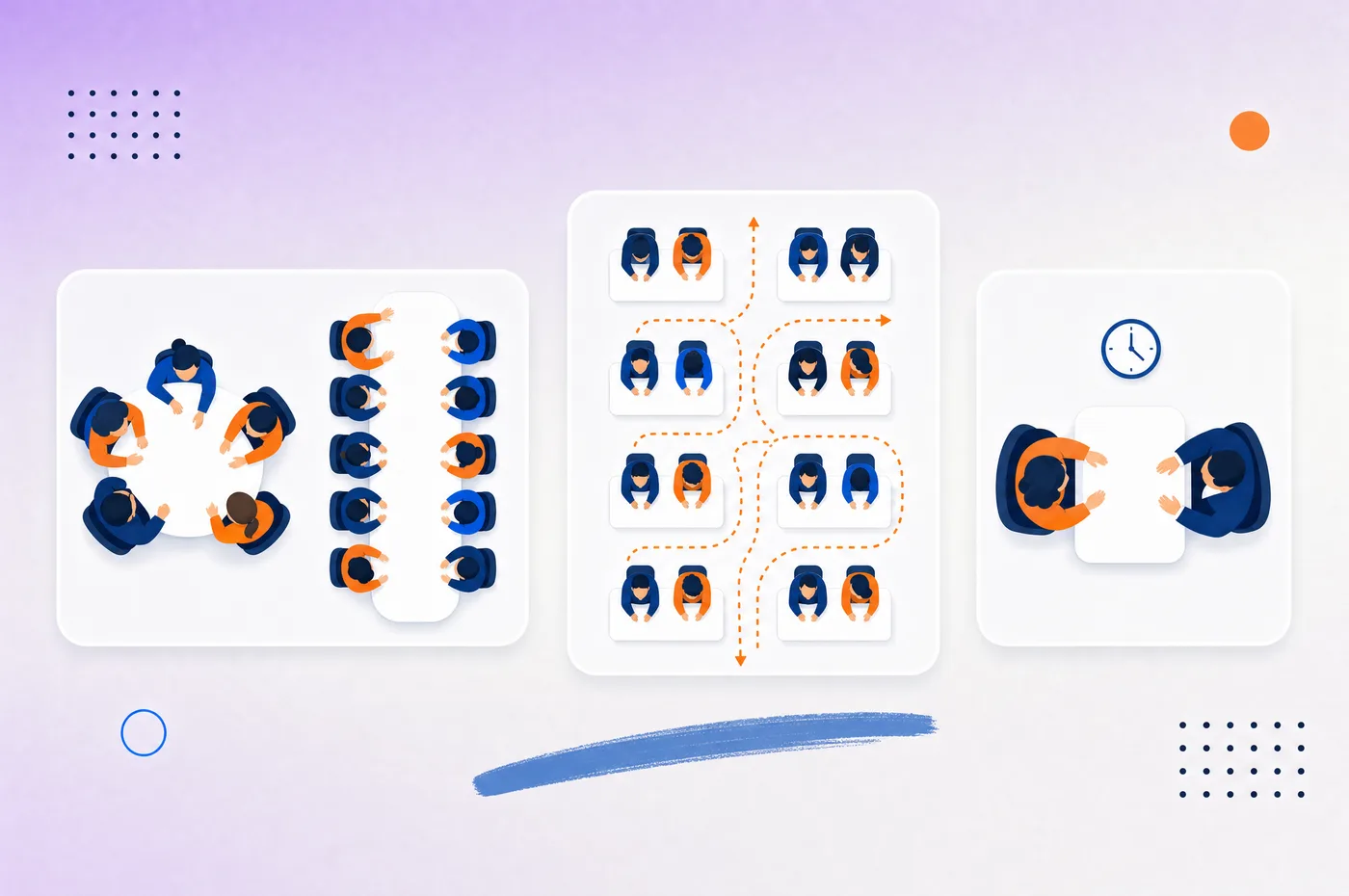
Closed-circle association shows under 60 buyers. If your hosted buyers are long-standing partners and the goal is relationship maintenance, you do not need eight 20-minute slots. You need three 45-minute conversations and a long dinner. The throughput maths does not apply.
Reverse-tabletop formats. PHITEX in the Philippines seats all sellers at once while buyers move between tables. The slot is fixed, the count is high at more than 3,000 scheduled meetings across 80 buyers and 80 sellers over three days, a pace that sits above the fatigue cap by deliberate design of the rotation, and the format is its own beast. The industry median does not transfer.
Smart-meeting and incentive-summit formats. Some incentive summits run curated 60 to 90-minute long-form meetings between very small buyer groups and very specific destination offers. There the conversation is the product, not the throughput.
If any of these describe your programme, treat the median as a reference, not a target.
A note on data protection for European programmes
If you run hosted buyer programmes in the German-speaking market or for European buyers, capacity planning intersects with the General Data Protection Regulation (GDPR). Two specifics to mind.
Visa and passport data. If you collect passport details to book buyer flights, that data falls under Article 9 as a special category. Keep it separate from the meeting platform, delete it within 90 days of the show, and host it in the European Union.
Consent for matching. Buyer-seller matching uses profile data. Get explicit consent for that processing at application time, and let buyers opt out of individual sellers without explanation.
Most modern platforms handle this cleanly. Ask your vendor where they host buyer data and how long they keep it. Our GDPR-compliant event software checklist works through the rest.
Solution: the capacity decisions above are configuration, not spreadsheet work. Converve’s B2B matchmaking platform runs a rule-based meeting matrix, so you set slot length, daily caps and connection caps per buyer profile, and every match decision carries an audit trail. The platform is hosted in the EU. If you want to see how a 200-buyer, 800-seller programme is set up in practice, get in touch with Converve.
The right number of meetings is only half the equation; best practices for tourism buyer-seller meetings covers how to make each of those meetings count.
A quota is also only as binding as the dates around it. The published 2026 terms put the free-cancellation deadline anywhere between 39 and 91 days before the show, and that window decides whether a dropped buyer can still be replaced; our step-by-step guide to running a hosted buyer programme sets out the four dates that belong in your buyer terms alongside the quota.
The daily meeting count also sets how many sellers your buyers can carry: divide the meetings each buyer takes by the meetings each seller needs scheduled, and you have your ceiling, which we work through with real event figures in what the right buyer-to-seller ratio is for a B2B matchmaking event.
Conclusion
The 2026 industry median for hosted buyer 1:1 meetings is six to eight per day at 20-minute slots. Use it as your default. Adjust up or down based on slot length, buyer seniority and the fatigue cap of eight to ten per day. Set a no-show penalty that pulls completion above 78 per cent.
Run the maths before you accept your last seller, not after. The cost of getting it wrong is real, and as EventMobi’s 141 cancelled meetings show, even seasoned vendors hit the wall. And the capacity maths only pays off with the right buyers in the diaries, which is why how to qualify hosted buyers is the companion piece to this one.
FAQ: hosted buyer meeting capacity
How many 1:1 meetings should a hosted buyer attend per day at a tourism trade show in 2026?
The 2026 industry median is six to eight pre-scheduled appointments per day, each lasting 15 to 30 minutes. Programmes with C-level buyers tend to set the lower end. High-velocity business formats run to ten.
How long should each appointment be?
Twenty minutes is the most common slot length across IBTM, The Meetings Show, Business Travel Show Europe and Workplace One-to-One France. IMEX runs 30-minute slots for longer C-level conversations. Business Travel Show America uses 15-minute slots for speed-format throughput.
What completion rate should organisers plan for?
With mandatory-attendance rules and cancellation penalties of 50 pounds and upwards, hosted buyer programmes achieve 78 to 82 per cent meeting completion. Without penalties, completion drops to 60 to 65 per cent, the general business-to-business baseline, or worse.
What no-show penalty is industry standard?
Penalties range from 50 pounds per missed appointment at The Meetings Show and 100 euros at IBTM World to 2,500 dollar non-attendance fines at Business Travel Show America for full programme no-shows. Arabian Travel Market enforces non-attendance contractually under Schedule D, Clause 7a.
How do you calculate the total scheduled appointments?
Multiply hosted buyers by daily slots by show days. A 200-buyer programme with four daily slots over two days schedules 1,600 appointments. Apply the 80 per cent completion benchmark to get 1,280 actual meetings.
What is the cognitive cap per buyer per day?
Eight to ten meetings per day. Beyond that, the extra meeting drops sharply in quality regardless of slot length, and buyer satisfaction scores fall in post-event surveys.
Do shorter slots increase or decrease return?
Shorter slots increase throughput but reduce conversion quality. The 2026 consensus is 20 minutes as the balanced default: long enough for needs discovery, short enough to fit six to eight per day.
When does the six to eight rule not apply?
It does not apply to closed-circle association programmes with under 60 buyers, to reverse-tabletop formats where all sellers sit at once, or to smart-meeting and incentive-summit formats built around curated 60 to 90-minute conversations.