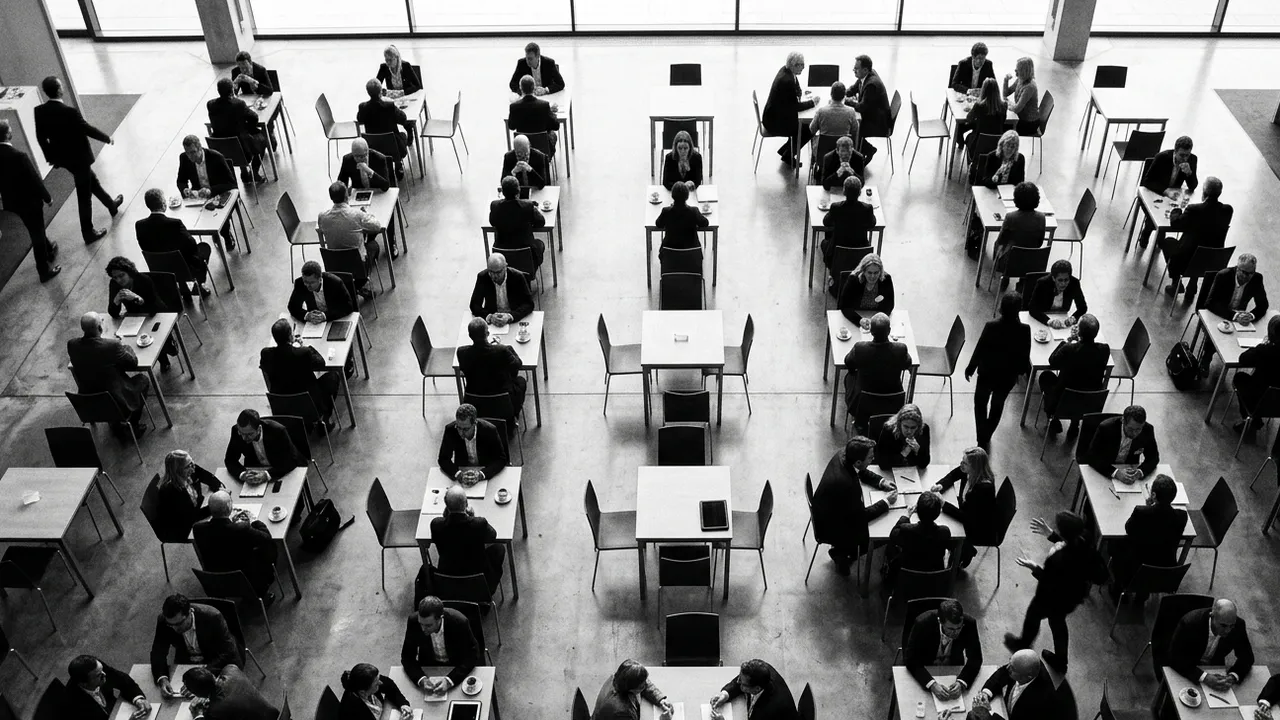
Almost 11,000 appointments in four days. That is what the spring/summer Connect show of Grassroots Outdoor Alliance, a buying group of independent outdoor retailers, had planned for Reno in June 2026: 10,956 meetings between 157 registered retail businesses and their brand partners, adding up to 8,462 meeting hours (Grassroots Outdoor Alliance via Shop Eat Surf Outdoor, April 2026, pre-show figures). Every one of them sat in a calendar before the doors opened. Nobody had to wander the aisles.
That show sits at one end of a wide range. Sports business events run from order shows like this to summits where clubs, leagues, federations, sponsors and media companies meet between keynotes. What they share is that the valuable conversations happen between parties who already know what they want from each other. A sports business event runs three different meeting markets under one roof, and each market needs its own rules for who asks, how long a slot lasts and where the meeting happens. One open networking feed serves none of them well.
This guide is for the show director or summit producer who hears the same question from every exhibitor and partner after the event: did I meet the right people? It explains the three markets, answers how to schedule back-to-back meetings with buyers at a sports trade fair, and lists what a networking app for a sports summit has to do.
What is a sports business event?
A sports business event is a trade fair, summit or market where companies from the sports industry meet to buy, sell and partner, rather than to watch or play. Two families dominate. Sports trade fairs bring brands of sporting goods, bikes, outdoor gear or fitness equipment together with retail buyers. Sports business summits bring clubs, leagues, federations and event owners together with sponsors, agencies, media and technology providers.
Many events mix both. SPORTEL Monaco, a market for sports media rights and technology, counted 2,000 participants from 795 companies and 70 countries in 2025. About a third of them were content buyers, and a similar share represented rights holders (SPORTEL, October 2025). At least as many people came to sell as to buy. A schedule that treats everyone the same wastes the buyers’ time on sellers talking to each other.
Large trade fairs have started to build meeting tools into the ticket. Eurobike in Frankfurt offers exhibitors and trade visitors a networking and matchmaking tool. The fair also shows how quickly the room can shrink: in June 2026 it reported around 800 exhibiting companies and 15,130 trade visitors, after 1,500 exhibitors and 31,270 trade visitors in 2025 (Eurobike, June 2025 and June 2026). When half the trade visitors stay away, every meeting with the ones who come counts for more. The tool exists. The rules behind it are still the organiser’s job.
Two neighbouring topics are covered elsewhere. When destinations and sports commissions meet rights holders to win the hosting of an event, that is a bid process, which we describe in our guide to sports tourism for destinations. How a meeting matrix turns profiles into a schedule at any trade show is explained in our article on trade show matchmaking software. This guide stays with the sports industry’s own business.
Three meeting markets under one roof
The difference between those markets becomes clear when you ask who requests the meeting, who decides, and what counts as a result.
| Meeting market | Who asks | Who decides | Typical slot | Typical place | A good result |
|---|---|---|---|---|---|
| Brand and retail buyer | Buyer, or both sides | Both, buyer requests first | 30 to 60 minutes | Brand stand or showroom | An order or a line placement |
| Rights holder and sponsor | Brand or agency, often | Rights holder | 20 to 30 minutes | Quiet meeting room | A proposal and a second meeting |
| Rights holder and provider | Provider (media, ticketing, technology) | Rights holder | 15 to 20 minutes | Meeting zone | A demo or a request for proposal |
Editorial overview; slot lengths are starting points for your own planning, not a published standard.
The table hides a conflict. In the third market, providers outnumber rights holders many times over, and they all want the same people. Picture the partnership director of a football club opening the event app the week before a summit. She finds 60 meeting requests from ticketing, streaming and fan engagement vendors, and not one from a brand that might sponsor her club. She declines everything and spends the summit in the corridor. The app worked. The market did not.
The sponsor market deserves particular care, because for many sponsors the business contacts are the point. In a survey of 116 firms in the sponsor networks of two Danish clubs, one in football and one in handball, 68 per cent said that using the club’s business network to make business deals was of great importance for their sponsorship, against 45 per cent for advertising (Wagner, Persson and Overbye, Sport, Business and Management, 2017, data from 2013/14). The study is small and old, but the message to rights holders is clear. Introductions are part of what the sponsor pays for. A summit that schedules those introductions well is selling something sponsors already value.
How to schedule back-to-back meetings with buyers at a sports trade fair
The brand and buyer market is where density matters most, and the Grassroots figures show what full density looks like.
Grassroots Connect, spring 2026
A sports trade show where every meeting is pre-scheduled
By our own calculation from those figures, each of the 157 retail businesses had around 70 appointments over the four days, at roughly 46 minutes each. At that density the calendar is the show. The stand, the catering and the evening party only support it.
You do not need 11,000 meetings to use the same method. A sports trade fair with a few hundred buyers can follow the same sequence:
Scheduling timeline
From profiles to a locked schedule in six steps
- 8 weeks before Profiles and categories Buyers state store type, region, product categories and buying season. Brands state categories, price levels and how many sales reps can take meetings at once.
- 6 weeks before Buyer requests first Buyers request and rank the brands they want to see. Opening their side first protects the scarcer party.
- 4 weeks before Brands confirm and fill gaps Brands accept or decline and may then invite buyers into their free slots, within a cap per brand.
- 2 weeks before Lock and publish Each person gets one agenda with times, stand or room and contact name. Changes now go through the organiser.
- Show days Run the floor A meeting desk handles late arrivals, rebooks no-shows into free slots and keeps brands informed.
- After the show Report per brand Meetings held, buyers met by store type and follow-ups requested, sent to every exhibitor within a week.
The sequence matters less than the rules inside it. These are the ones that decide whether back-to-back meetings actually happen back to back:
- Slot length by meeting type: a line review of a full apparel collection needs 45 to 60 minutes, a first introduction 20 to 30. One fixed length for everything either rushes the order or wastes half the slot.
- Capacity per sales rep, not per brand: a brand with four reps can hold four meetings in parallel. Scheduling against the brand as one calendar halves its usable time.
- Buyers, not stores: a store often sends a footwear buyer and an apparel buyer. Grassroots counts 396 individual buyers from 157 businesses, so plan one agenda per buyer.
- Walking time and buffers: ten minutes between halls, none needed at the same stand. A schedule that ignores the floor plan produces late starts by mid-morning.
- Protected blocks: lunch, the main keynote and an hour of open stand time stay free of appointments, so buyers can discover brands they did not request.
- A no-show rule: decide in advance what happens when a buyer misses two meetings. Our article on measuring meeting no-shows explains which rate to track.
How many meetings a buyer can handle in a day depends on slot length and travel effort, and our guide on how many meetings per hosted buyer gives the arithmetic. Where qualified buyers are scarce, some organisers pay for them. Outdoor Retailer, for example, offers qualified retailers a contribution to their travel costs plus concierge matchmaking to book appointments with brands (Shop Eat Surf Outdoor, March 2025). The buyer’s diary is the product exhibitors pay for.
Sports summits: fewer meetings, more preparation
A summit turns those proportions around. The conference programme carries the event, meetings fit into breaks and evenings, and the people in demand are senior. A club’s commercial director or a league’s head of media rights may take six meetings in two days, not sixty. Each of those needs to be worth leaving a session for.
That changes the rules for the show director or summit producer:
- Rights holders decide. Requests to clubs, leagues and federations need their acceptance before a slot is booked, and they should be able to filter requests by purpose.
- Every request carries a purpose tag, such as sponsorship, media rights, technology or hospitality. A partnership director can then accept the five sponsor requests and hand the ticketing demos to a colleague.
- Providers get a request limit. A cap of perhaps ten open requests per provider company stops the flood described above and forces vendors to choose.
- Sponsor talks need a private room. Fees and exclusivity are not discussed at a bistro table next to a competitor.
- Slots follow the agenda. Meetings sit in the breaks, before the first session and after the last, never against the keynote everyone came for.
Rights holders who host their own sponsor summit can use the same mechanics: share the delegate list, let partners rank whom they want to meet, then schedule those meetings. The same logic works at an industry summit. The difference is scale, and who has the right to say no.
What to look for in a networking app for a sports summit
Which brings us to a question organisers often ask: what is the best networking app for a sports summit? There is no single answer, because the right app is the one that can carry your three markets with their own rules. Test any candidate against five points:
- Participant types and matching rules: you define groups such as clubs, brands, agencies, media and technology providers, and decide who may request whom.
- Accepted meetings with a fixed time: a request only becomes a meeting when the other side accepts and the meeting has a slot in both agendas. Where it takes place, at a stand, a table or a room, is part of your floor planning. Chat alone is not scheduling.
- Purpose tags and request limits: requests carry a reason, and you can cap how many open requests one company may send.
- An agenda-aware calendar: slots avoid sessions, respect walking time and allow different lengths per meeting type.
- Reporting per market: meetings requested, accepted and held, broken down by brand and buyer, rights holder and sponsor, rights holder and provider.
Our overview of 23 event networking apps sorts the market into categories, and our test of 1:1 meeting scheduling in conference networking apps checks how individual apps handle requests and slots. Some platforms suggest matches with AI, others work with explicit, rule-based matching. For sports summits, explainable rules have a practical advantage: when a club asks why a vendor was allowed to request a meeting, you can show the rule.
Treat these five points as a checklist for your own planning, whichever tool you choose.
Solution: Converve organises meetings at trade fairs and summits on a rule-based meeting matrix. You define the participant groups and which of them may meet, participants send 1:1 meeting requests, the other side accepts or declines, each confirmed meeting gets a time slot in the agenda, and reports show which meetings took place. How purpose tags, request limits or walking times fit your event is worth discussing with us before you set up the rules. Our solution for trade shows shows the set-up, and how B2B matchmaking works explains the rules behind it.
Conclusion: plan three markets, not one feed
Sports business events bring brands, retail buyers, clubs, leagues, sponsors and providers into one venue, but not into one market. Buyers need dense, pre-scheduled agendas with realistic slot lengths. Rights holders need control over who reaches them and why. Sponsors need introductions that are worth their fee. When each market gets its own rules, the show director can answer the question after the event with numbers instead of impressions.
If you want to plan the meeting rules for your next sports trade fair or summit, get in touch with Converve.
Frequently Asked Questions
What is a sports business event?
A sports business event is a trade fair, summit or market where companies from the sports industry meet to do business. Sports trade fairs connect brands of sporting goods, bikes, outdoor or fitness products with retail buyers. Sports business summits connect clubs, leagues, federations and event owners with sponsors, agencies, media and technology providers.
What is the best way to schedule back-to-back meetings with buyers at a sports trade fair?
Collect profiles about eight weeks ahead, open meeting requests to buyers first, then let brands confirm and fill gaps, and lock the schedule two weeks before the show. Plan slot lengths by meeting type, schedule against each sales rep rather than the whole brand, and add walking time between halls. Grassroots Outdoor Alliance pre-schedules every appointment at its Connect show; 10,956 were planned for June 2026 (Shop Eat Surf Outdoor, April 2026).
What are the best networking apps for sports summits?
The best app is the one that can run separate rules for each meeting market. Look for participant types with matching rules, meetings that need acceptance and get a time and place, purpose tags and request limits, an agenda-aware calendar and reporting per market. Compare candidates against these points rather than against feature lists.
How long should a meeting slot be at a sports trade fair?
It depends on the meeting. A line review of a full collection usually needs 45 to 60 minutes, while a first introduction or a provider demo fits into 15 to 30 minutes. At the Grassroots Connect show in June 2026, the planned meeting hours work out at about 46 minutes per appointment (our calculation from pre-show figures reported by Shop Eat Surf Outdoor, April 2026).
Why do clubs organise business networks for their sponsors?
Because many sponsors join for the business contacts. In a study of two Danish clubs, 68 per cent of sponsor firms said that using the club’s business network to make business deals was of great importance for their sponsorship, against 45 per cent for advertising (Wagner, Persson and Overbye, 2017, data from 2013/14). Well-planned introductions therefore add value to a sponsorship package.