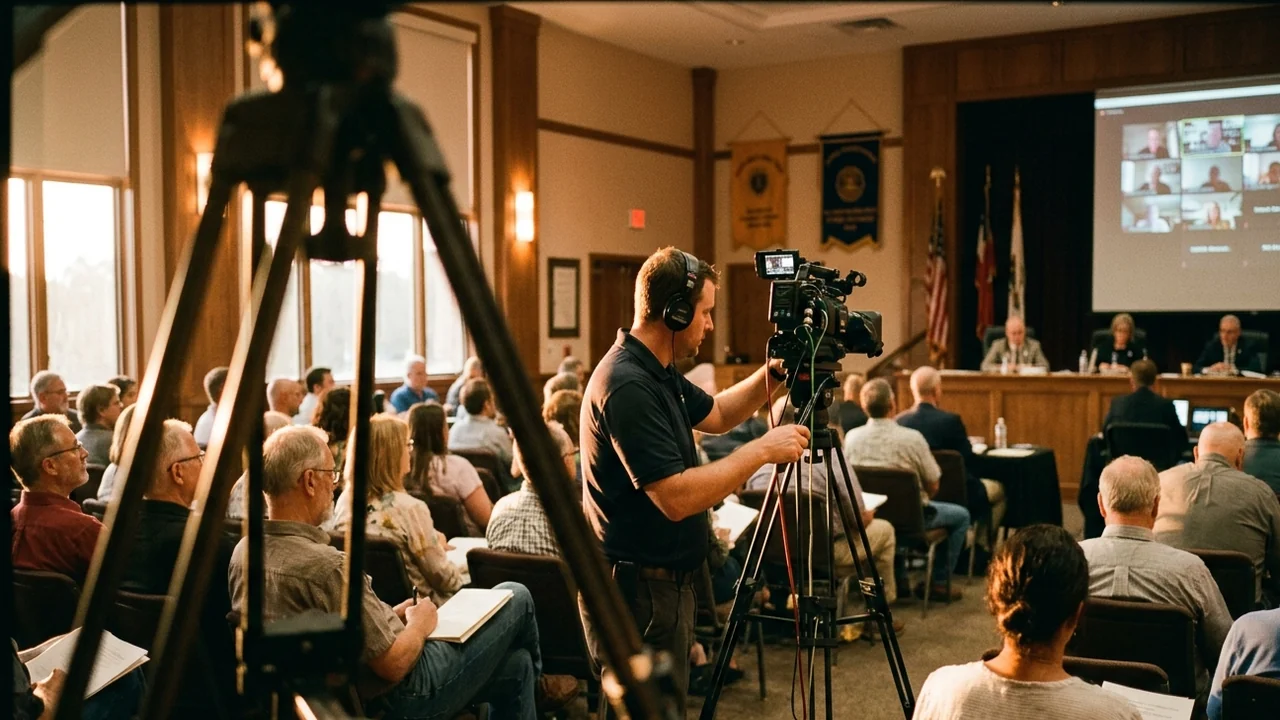
A board picks the city for the 2029 congress in about forty minutes. The agenda item sits between the treasurer’s report and the election of auditors, and the arguments are the familiar ones: a workable rate, a hall that fits the plenary, a destination the membership will turn up for. By the time the vote is taken, most of the event’s carbon footprint has been decided. Nobody in the room mentioned carbon.
That is the awkward part of sustainability for associations. The decisions that matter most are not the ones on the sustainability checklist. They are the ordinary decisions about where the annual meeting happens, how often it moves, and who is expected to be physically present, and they are usually taken by volunteers with a full agenda and a half day to get through it.
This guide prioritises measures by their likely effect: travel first, then catering and materials, supplier contracts and measurement. Published figures help explain the choices and the trade-offs for member participation.
How Can Associations Make Events More Sustainable?
Associations make events more sustainable by deciding travel first and everything else second. Attendee travel accounts for 70 to 90 per cent of the carbon footprint of an average event, according to the measurement methodology published by the Net Zero Carbon Events initiative in December 2023, so the destination, the rotation pattern, rail access and the format offered to distant members carry more weight than every other measure put together. After travel come catering and materials, then sustainability clauses in venue and supplier contracts, then measurement against a recognised framework such as ISO 20121:2024, published by the International Organization for Standardization in April 2024.
The association version of this list has three constraints a commercial organiser does not carry. Your statutes fix when the general meeting happens and often who must attend. Your programme may carry continuing professional development credit, which members need and which usually requires attendance records. And your event exists to hold a membership together across a whole country or continent, which is another way of saying that bringing geographically dispersed members together is part of the association’s purpose. Most of these events are not giant congresses either: of the 11,099 international association meetings ICCA counted in its 2024 Globe Watch report, 39 per cent had fewer than 150 participants and the average was 409, so the organising team is usually small and the travel list is long.
Where the Emissions Actually Sit
Before choosing between measures, it helps to see how uneven the footprint is. In a dataset of business to business exhibitions in the United States and Canada cited in the Net Zero Carbon Events roadmap of November 2022, attendee transport produced 85 per cent of emissions, venue energy 13 per cent and logistics 1 per cent.
The distribution inside that travel share is what makes the decision tractable. Klöwer and colleagues analysed the American Geophysical Union Fall Meeting 2019 in Nature in 2020: 28,000 delegates, roughly 80,000 tonnes of CO2 from travel, about three tonnes per participant. Intercontinental flights over 8,000 kilometres produced 75 per cent of those emissions from 36 per cent of the attendees, while flights under 1,500 kilometres caused 2 per cent from 22 per cent of delegates. Moving the meeting to Chicago would have cut the total by 12.3 per cent; running it as three regional hubs would have cut it by around 80 per cent.
Where an association event's footprint comes from
Travel accounts for most emissions, especially long-distance journeys
For an association that asymmetry is good news and bad news in one line. A small group of far-travelling members carries most of the footprint, so a small change reaches a large share of it. That change also lands on the members who are hardest to hold.
Balance Lower Travel Emissions With Member Participation
The volunteer board member who signed the venue contract carries a second obligation no carbon calculator models. The general meeting has to be quorate because the statutes say so, the regional chapters are held together by the people who travel furthest, and the fee that funds half the office year is paid by members who expect to be in the room. Cutting long-distance attendance is not a neutral efficiency measure. It is a membership decision.
The research does not say the trade is one sided. Skiles and colleagues, writing in Nature Sustainability in 2022, compared virtual conference editions with their in-person predecessors and found higher overall attendance plus gains in geographic spread, gender balance and participation by early career and less well funded institutions. People who could never justify the flight showed up. Tao and colleagues, in Nature Communications in 2021, put numbers on the environmental side: a fully virtual conference cut the footprint by 94 per cent, from about 840 kilograms of CO2 equivalent per in-person participant to about 46 kilograms, while a hybrid format built around carefully chosen regional hubs cut footprint and energy use by roughly two thirds while keeping more than half of participation in person.
Two thirds is a serious number, and it is the one worth designing around, because it does not ask the association to give up the room. Whether a hybrid annual meeting still produces a quorate assembly and an engaged membership is a separate question with its own answers, and we work through it in our guide to hybrid events for associations. Treat it as one lever here, not as the conclusion. Hybrid access still needs a programme that encourages members to participate.
The Order of Measures Matters More Than the Number
Most associations can afford two or three changes per edition, not fifteen. The real question is not which measures are good but which ones survive the budget meeting, and that is easier to argue when effect and effort sit on one page.
| Lever | Effect on the footprint | Effort and risk for the association |
|---|---|---|
| Destination choice and rotation pattern | Large. Up to 12 per cent from relocation alone at one large congress (Klöwer et al., 2020) | Low cost, but a multi-year decision taken once and hard to reverse |
| Venue with good rail connections plus travel guidance in the invitation | Medium. Rail sits far below flying per passenger kilometre (UK government conversion factors, 2025) | Low cost. Limits the shortlist of cities |
| Hybrid participation for the members who would fly furthest | Large. Around two thirds with regional hubs at over half in person attendance (Tao et al., 2021) | Real production cost, and a genuine risk to room presence |
| Plant-focused default menus and accurate headcounts | Small to medium. Around 14.7 per cent of food served is wasted (Fernandez-Zamudio et al., 2024) | Low cost, quick win, occasional member pushback |
| Materials, signage, badges and giveaways | Small in carbon, highly visible to members | Low cost, mostly a procurement decision |
| Sustainability clauses in venue and supplier contracts | Indirect but durable across editions | Contract work, best done once and reused |
| Measurement from registration data | None on its own. It is what makes the rest provable | Staff time, and the discipline to publish the result |
Read top to bottom, the table says something uncomfortable about how most sustainability programmes run. They start at row five, because rows five and six are cheap, visible and safe, and never reach row one, because row one is a governance decision. Reusable badges are useful, but the larger opportunity lies in reviewing travel requirements.
Catering and Materials: the Smaller Lever With the Faster Win
The measures lower in the table still matter. A small association office can often implement them quickly and review them each year.
Start with waste, because it costs money twice. Fernandez-Zamudio and colleagues measured food waste at three congress events with 1,020 diners in the journal Foods in 2024 and found 104.4 kilograms in total, about 100 grams per diner, or 14.7 per cent of everything served. Cereals topped the list, followed by legumes and fish. An association that tightens its headcount process and drops one buffet component cuts its catering invoice and its footprint with one decision.
Then the menu. Poore and Nemecek, in the largest food system meta-analysis published to date (Science, 2018, covering roughly 38,700 farms across 119 countries), put beef from beef herds at around 99 kilograms of CO2 equivalent per kilogram, one to two orders of magnitude above plant proteins such as peas. That gap is why the German federal guideline for the sustainable organisation of events (Federal Environment Ministry, fourth edition, 2020) makes vegetarian and vegan catering the default for government events rather than an option, bans air-freighted produce, asks for tap water in carafes and tells organisers not to buy conference giveaways at all.
Published examples help more than principles. PCMA Convening Leaders 2024 earned Silver certification under the Events Industry Council Sustainable Event Standards by meeting 65 per cent of the criteria, with 4,136 in-person and 949 online participants, roughly 4,000 square feet less vinyl banner than the previous edition, foamcore eliminated entirely, and a waste diversion rate of 44 per cent. That last figure was down from 51 per cent the year before, and they reported it anyway. Report setbacks as well as improvements to give members a complete picture.
The generic version of this layer, from signage to supplier questions to attendee communication, is already written up in our 8 tips for sustainable events, and it applies to associations as much as to commercial organisers. There is no need to rebuild that checklist here.
What Sponsors and Public Funders Now Ask For
One reason this stopped being voluntary is that the people funding your event have their own reporting to file. After the Omnibus I directive, in force from 18 March 2026, reporting under the CSRD (Corporate Sustainability Reporting Directive) applies to undertakings with more than 1,000 employees and net turnover above 450 million euros. Your largest sponsors and exhibitors are likely to sit inside that group, and your event sits in their value chain. The same directive caps what those companies may demand from smaller partners, so the request you receive should be proportionate to a voluntary reporting standard, not a full corporate questionnaire. Knowing that cap exists is worth as much as the data itself when you negotiate a sponsorship package.
What you may say about the result is also narrowing. From 27 September 2026, Directive (EU) 2024/825 on empowering consumers for the green transition bans generic environmental claims and, more sharply, bans carbon neutral or climate neutral claims that rest on offsetting outside the value chain. A congress programme headed “climate neutral congress” on the strength of purchased credits becomes a legal problem rather than a marketing line. What this means in practice for event communication is set out in our guide to the EU green claims rules for event organisers.
The evidence behind that rule change is not thin. Swinfield and colleagues, reviewing six independent evaluations of 44 forest carbon projects in Nature Communications in 2026, found that credits from REDD+ forest protection projects had been issued at roughly eleven times the justified level, while noting that four out of five projects did still protect forest. Distinguish offset purchases from measured reductions in your own event footprint, and keep claims within the evidence you have.
Measuring Without a Sustainability Department
That restriction is manageable, because the data is already being collected. Every association that runs registration asks people where they come from, and the travel share of the footprint is mostly a distance question. Five steps turn registration into a defensible measurement.
From registration data to a reportable number
Five practical steps for a small association office
- Step 1 Capture origin Registration already collects country and postcode. That is the distance basis for the largest emission source.
- Step 2 Ask travel mode One optional question about rail, car, short or long haul flight. Expect gaps and record your assumptions.
- Step 3 Apply published factors Use a public conversion set such as the UK government greenhouse gas factors rather than a vendor calculator you cannot explain.
- Step 4 Add catering and venue Meals served, waste weighed, room nights booked, venue energy where the contract provides it.
- Step 5 Publish and pick one target One result, a clear explanation of its scope and one measure for the next edition. Repeat with the same method.
ISO 20121:2024 is more accessible than its certification reputation suggests. It allows several ways to demonstrate conformity, including self-declaration and supplier validation alongside third-party certification, which makes it workable for an office of two and a board of volunteers. Start with the management system logic and decide later whether a certificate is worth the audit fee.
The bottleneck is usually not measurement but where member data lives. If registration, member records and the programme sit in three unconnected tools, every figure has to be reassembled by hand, which is why most associations measure once and never again. Whether that belongs in your association management system or your event platform has costs on both sides, and we compare the two in our article on association management software versus an event platform. The second bottleneck is money, and what each measure costs is easier to see in a structured event budget template.
Converve sits on the event side of that split. Registration, the programme and the rule-based meeting matrix run on one platform, so the origin and participation data behind a travel calculation comes out of the system you already use to run the congress, not out of a separate survey. For associations, the association solution covers annual meetings and specialist congresses, including hybrid participation for members who would otherwise fly.
Frequently Asked Questions
How can associations make events more sustainable?
By addressing travel before anything else. Attendee travel is 70 to 90 per cent of an average event’s carbon footprint (Net Zero Carbon Events Measurement Methodology, 2023), so destination choice, rotation, rail access and hybrid participation for the furthest travelling members decide most of the result. Catering, materials and supplier contracts follow, and measurement against ISO 20121:2024 makes the whole thing provable.
What share of a conference’s carbon footprint comes from travel?
Between 70 and 90 per cent for an average event (Net Zero Carbon Events, 2023). In one documented set of business to business exhibitions in the United States and Canada, attendee transport was 85 per cent, venue energy 13 per cent and logistics 1 per cent, and Greenbuild 2021 attributed 87 per cent of its emissions to air travel (Net Zero Carbon Events roadmap, 2022).
Does a hybrid format really cut emissions?
Yes, and the size depends on the design. A fully virtual conference cut the footprint by 94 per cent, from about 840 kilograms of CO2 equivalent per in-person participant to about 46 kilograms, while a hybrid format with well chosen regional hubs cut footprint and energy use by around two thirds at over half in person attendance (Tao et al., Nature Communications, 2021). Virtual editions also broadened participation across geography, career stage and institution type (Skiles et al., Nature Sustainability, 2022).
Is ISO 20121 worth it for a small association?
Often yes, as a management framework rather than a certificate. ISO 20121:2024, published in April 2024, allows self-declaration and supplier validation as well as third-party certification, so an association can adopt the structure without paying for an audit. The main value lies in a process you can repeat and improve.
Can we still call our congress climate neutral if we buy offsets?
Not in the EU from 27 September 2026. Directive (EU) 2024/825 bans carbon neutral and climate neutral claims based on offsetting outside the value chain, as well as vague generic claims such as “green” or “eco friendly”. A review of 44 forest carbon projects found credits issued at roughly eleven times the justified level, although four in five projects did protect forest (Swinfield et al., Nature Communications, 2026). Report reductions you measured instead.
How much does catering actually contribute?
Less than travel, more than most organisers assume, and it is the fastest thing to fix. Across three congress events with 1,020 diners, 14.7 per cent of the food served went uneaten, about 100 grams per person (Fernandez-Zamudio et al., Foods, 2024). Beef from beef herds sits around 99 kilograms of CO2 equivalent per kilogram, one to two orders of magnitude above plant proteins (Poore and Nemecek, Science, 2018), which is why public sector guidelines now make plant-based menus the default.
Conclusion: Fewer Measures, in the Right Order
Travel brings members together and accounts for much of an association event’s footprint. A practical sustainability programme needs to address both the environmental impact and the value of meeting in person.
So take the decisions in order of weight. Settle the destination and the rotation pattern where they are actually decided, in front of the volunteer board member who signs the venue contract, with the distance data on the table. Offer a serious hybrid route to the members who would otherwise fly furthest, and accept that it changes the room. Make the plant-focused menu and the tighter headcount your annual quick wins. Write the supplier clauses once and reuse them. Then measure from your own registration data, publish one number with a clear explanation of the scope, and improve it next year.
If the data for that first calculation sits in three systems, that is where to start. Talk to Converve about running registration, programme and rule-based matchmaking for your annual meeting on one platform, so the travel figures come out of the system that runs the congress.