Seventy-two per cent of event professionals expect their costs to rise by up to 20 per cent against 2025, according to EventsAir’s 2026 industry survey. If you copy last year’s budget and add three per cent, you have quietly given away a fifth of your room to move before a single contract is signed.
Picture the head of events at a trade association, or at a convention bureau, or at a founder conference, sitting in front of the finance committee in October with the spring event on the agenda. The committee does not ask what the coffee breaks cost. It asks two questions: does the event pay for itself, and what do the meetings we promise our exhibitors actually cost us? A budget downloaded from a generic template answers neither. It has no revenue side, and it has no line for the meeting programme at all.
This guide builds a B2B event budget in the order that committee reads it: revenue first, then eight cost blocks with benchmark shares, then the fees that never appear in the quote, then the one number that tells you afterwards whether the money worked. The Excel template at the end does the arithmetic for you.
What an event budget is
An event budget is the financial plan for a single event. It lists every expected cost by category, every expected source of revenue, and a buffer for what you did not foresee. For an organiser-run B2B event it carries three things a company-party template leaves out: a revenue side with tickets, sponsorship and exhibitor fees; a distinction between fixed costs and costs that move with every registration; and, where 1:1 meetings are what attendees pay for, a separate block for the meeting programme.
The last point is the thesis of this guide. A budget that does not carry the meeting programme as its own category cannot show what the event is worth, however tidy the catering line looks.
Start with revenue, not with the venue
Most budgets begin with the venue quote because it arrives first. The better sequence runs the other way: decide what the event must earn, discount that figure honestly, and only then decide what you can afford to spend. VenueSight’s line-by-line conference budget describes the failure mode this prevents. Teams build the event around assumed expenses and discover in month four that the revenue does not cover them.
Revenue first
The five-step sequence before you open a single supplier quote
- Set the targets Paid attendance, sponsorship revenue and exhibitor revenue, based on last year or a comparable event. Not on hope.
- Discount the revenue Comped and heavily discounted tickets are 15 to 25 per cent of registrations at mid-size conferences. Model a new sponsorship pipeline at 30 to 40 per cent closed, a returning one at 60 to 70 per cent, and the exhibit floor at 75 to 80 per cent sold.
- Derive the ceiling Discounted revenue minus the margin your organisation requires equals the most you may spend. Write that number down before any quote arrives.
- Build the expense side in eight blocks Venue, food and beverage, production, registration and technology, meeting programme, speakers, marketing, staffing. Fixed or variable for each line.
- Run three scenarios Conservative at 70 per cent of paid attendance, target at 100, stretch at 125. Your variable costs move with them; your fixed costs do not. The conservative column is the one the committee will ask about.
The discount factors in step two come from VenueSight’s 2026 template and match what we see at trade shows and investor conferences. Two of them decide whether the budget survives contact with reality. The comped share matters because speakers, sponsor staff, press and board members all register, all eat, and none of them pay, so a 400-registration event may be a 300-ticket event. The pipeline discount matters because sponsorship is the line most often modelled at 100 per cent. EventMobi’s 2026 budget guide puts realistic sponsorship at 20 to 40 per cent of total event cost for mid-size conferences and trade shows. If your sheet shows 60 per cent, it is a wish list, not a forecast.
Three scenarios sound like extra work. They are the opposite. A committee that sees the event break even at 70 per cent of target stops asking about the coffee.
The eight cost blocks and what each usually takes
With the ceiling fixed, the expense side becomes an allocation problem. The shares below are for organiser-run B2B conferences and trade shows. They come from GoGather’s 2026 benchmarking of US conferences, which puts food and beverage at 32.5 per cent and audio-visual at 19 per cent of a typical 1.62 million dollar budget, from upmetrics’ 2026 industry figures (29.9 and 15 per cent for the same two blocks), and from Invyt’s 2026 corporate benchmarks for venue and hidden fees. The meeting programme share is our own range from matchmaking events and is marked as such.
| Block | Typical share | Fixed or variable | The line people forget |
|---|---|---|---|
| Venue and facilities | 15 to 20 per cent | Fixed | Setup and teardown days, power drops, rigging points, guest room block attrition |
| Food and beverage | 25 to 33 per cent | Variable | Service charge of 18 to 24 per cent and tax on top of the per-head price |
| Audio-visual and production | 15 to 19 per cent | Mostly fixed | Rehearsal day, technician overtime, outside-vendor fee if you do not use the house AV |
| Registration and technology | 5 to 10 per cent | Mixed | Badge printing, payment fees per ticket, dedicated bandwidth |
| Meeting programme (Converve range) | 5 to 12 per cent | Mixed | Matchmaking platform, meeting area, scheduling staff, hosted buyer support, no-show reserve |
| Speakers and content | 5 to 10 per cent | Fixed | Travel and accommodation riders, content production for hybrid streams |
| Marketing and attendee acquisition | 8 to 15 per cent | Fixed | Paid channels tracked against registrations, not impressions |
| Staffing and operations | 5 to 10 per cent | Variable | Union minimums, security hours, insurance, freight |
| Contingency | 10 to 20 per cent on top | Reserve | Its own line, not spread across the others |
Two blocks dominate and always will. Food and venue together take 50 to 70 per cent of most B2B event budgets, and because catering is priced per head, the accuracy of your headcount forecast is the single largest lever on the whole sheet. That is a registration problem before it is a catering problem, which is why the comped share in step two belongs at the top of the budget and not in a footnote.
Everything else is packaging around those two blocks and the one that follows.
The block every template leaves out: the meeting programme
Download any of the templates that rank for this topic and look for the meetings. You will find “networking reception” under attendee experience, and perhaps “event app” under technology. You will not find a block for the thing an exhibitor at a tourism trade show or an investor at a founder conference actually came for, which is a schedule of pre-arranged 1:1 meetings with the right counterpart.
That block has five lines, and they are easy to price once you list them:
- Matchmaking platform: the software that collects profiles, runs the matching and schedules the meetings. Entry-level B2B matchmaking platforms start in the low four figures per event, enterprise suites in the low five figures, as our comparison of 23 event networking apps by category sets out with list prices.
- Meeting area: two-seat tables, numbering, power, signage and a quiet zone. At a 400-person trade show that is 50 to 70 tables in a dedicated hall section.
- Scheduling and on-site staff: the person who chases incomplete profiles before the event and the two people who re-book cancelled slots during it.
- Hosted buyer support: travel contributions, accommodation and airport transfers for the buyers whose attendance your exhibitors pay for. This is the largest line at tourism trade shows and does not exist at most conferences.
- No-show reserve: the spare capacity you keep to re-book slots that fall through. Whatever your no-show rate is, and our guide on event meeting no-shows explains why published rates range from 6.5 to 28 per cent, it costs you either empty tables or extra staff.
Put those five lines under one heading and something changes in the finance committee. The meeting programme stops being a cost buried in “technology” and becomes a product line with its own revenue attached, because hosted buyer fees, meeting-track sponsorship and premium exhibitor packages all sell against it. Our guide on hosted buyer ROI through matchmaking shows what that revenue attachment looks like at a tourism trade show.
The head of events from the opening paragraph can now answer the committee’s second question. Before, the honest answer was “it is in there somewhere”. Now it is a number.
Solution: the reason the meeting programme rarely gets its own block is that its costs are scattered across three or four suppliers and a spreadsheet nobody owns. Converve consolidates the platform lines into one per-event price that covers registration, matching, scheduling and the on-site meeting desk, with an auditable log of every meeting that was booked, held or re-booked. That log is what turns the block into a measurable line, and the B2B matchmaking platform page describes how the meeting matrix behind it works.
The fees that are not in the quote
Every experienced organiser has a story about the invoice that was 30 per cent above the quote. The gap is rarely a surprise item. It is the same six or seven fees, and they are documented well enough to budget in advance.
| Hidden cost | What to expect | Source |
|---|---|---|
| Service charge on food and beverage | 18 to 24 per cent, plus tax on top | Events in Minutes, July 2026 |
| In-house AV markup | 30 to 50 per cent above an outside vendor | Invyt, 2026 |
| Outside AV vendor fee | 1,000 to 10,000 dollars or more if you bring your own crew | Infinity Park, 2026 |
| Dedicated internet bandwidth | 1,500 to 5,000 dollars per day for guaranteed upload | EventNation, April 2026 |
| Guest room block attrition | 70 to 75 per cent of contracted rooms, some venues push 80 to 85 | VenueSight, 2026 |
| Administrative fee | 2 to 5 per cent of the total, separate from the service charge | Events in Minutes, July 2026 |
| Union minimums and overtime | Four-hour minimums for labour calls, overtime past a hard end time | Invyt, 2026 |
The bandwidth line deserves a second look for anyone running a matchmaking programme. A meeting schedule that lives on attendees’ phones is only as good as the hall’s Wi-Fi, and venue Wi-Fi is priced for e-mail, not for 400 people refreshing their next appointment at the same moment. Ask for the bandwidth quote in the same conversation as the room rate.
Then add the buffer. The figures in the literature cluster at 10 to 20 per cent of the total, and the sensible reading is 10 per cent for an event you have run before in a venue you know, 15 for a new venue, and 20 for a first edition or a hybrid stream. The buffer is its own line. Spreading it across the other blocks hides it, and a hidden buffer gets spent.
Why 2026 budgets need more room than 2025 budgets
Cost pressure, per-head costs and the comped share
The number that judges the budget afterwards: cost per meeting
Cost per attendee is the metric every guide recommends, and it is worth tracking. Divide total spend by attendance and you get a figure between 500 and 2,500 dollars for a typical conference, according to GoGather’s 2025 client data. But it tells the finance committee nothing about the meetings, and for a hosted buyer show or an investor conference the meetings are what the exhibitor renews for.
Cost per meeting is the same calculation applied to the block above. Take the five lines of the meeting programme, add them up, and divide by the number of meetings that actually took place, not the number that were scheduled.
A worked example. A two-day tourism trade show with 400 participants budgets 6,000 euros for the matchmaking platform, 9,000 for a meeting area of 60 tables, 7,000 for scheduling and on-site staff, and 6,000 in travel contributions for 40 hosted buyers, 28,000 euros in total. The platform schedules 1,400 meetings; 1,200 are held. Cost per held meeting: 23 euros. Cost per attendee for the whole event, on a 260,000 euro budget: 650 euros.
Now the head of events has a sentence for the committee, and it is a better sentence than “networking is included”. Each meeting an exhibitor gets costs the organisation 23 euros, and exhibitor renewal correlates with meetings held. The KPI chain that connects those two figures, from meetings requested to deals reported, is the subject of our KPI framework for B2B event matchmaking, and the wider question of whether the event paid for itself has its own guide on how to measure B2B event ROI.
Budgets are approved on revenue. They are renewed on cost per meeting.
The template
The Excel file below is built for organiser-run B2B events, not for parties, and it follows the sequence of this guide. It has five sheets:
- Revenue: registration with a comped-share field, sponsorship with a pipeline discount, exhibitor revenue with a floor occupancy rate, and three scenario columns at 70, 100 and 125 per cent.
- Expenses: the eight blocks with a fixed-or-variable flag on every line, so the scenario columns move the variable lines automatically.
- Meeting programme: the five lines, meetings scheduled, meetings held, and the cost per meeting formula.
- Hidden fees: the seven items from the table above with their percentage ranges pre-filled, applied to the lines they attach to.
- Summary: revenue, expenses, contingency, margin and cost per attendee and per meeting for each scenario, on one page for the committee.
Download the Converve event budget template (Excel). Fill the yellow cells, leave the formulas alone, and the summary sheet writes itself. If you prefer Google Sheets, upload the file; the formulas carry over.
Twenty minutes with the file, and last year’s numbers, produces a first draft. The draft will be wrong in places, and that is the point: a budget that is wrong in October can be fixed. One that is wrong in March cannot. Where the budget sits in the wider timeline, from the first goal to the post-event report, is mapped in our event planning checklist.
A budget line is only as reliable as the task behind it, which is why teams running several events a year end up needing a project layer above the spreadsheet. Which tools fit that job, and when a generic project tool is enough, is covered in event project management software.
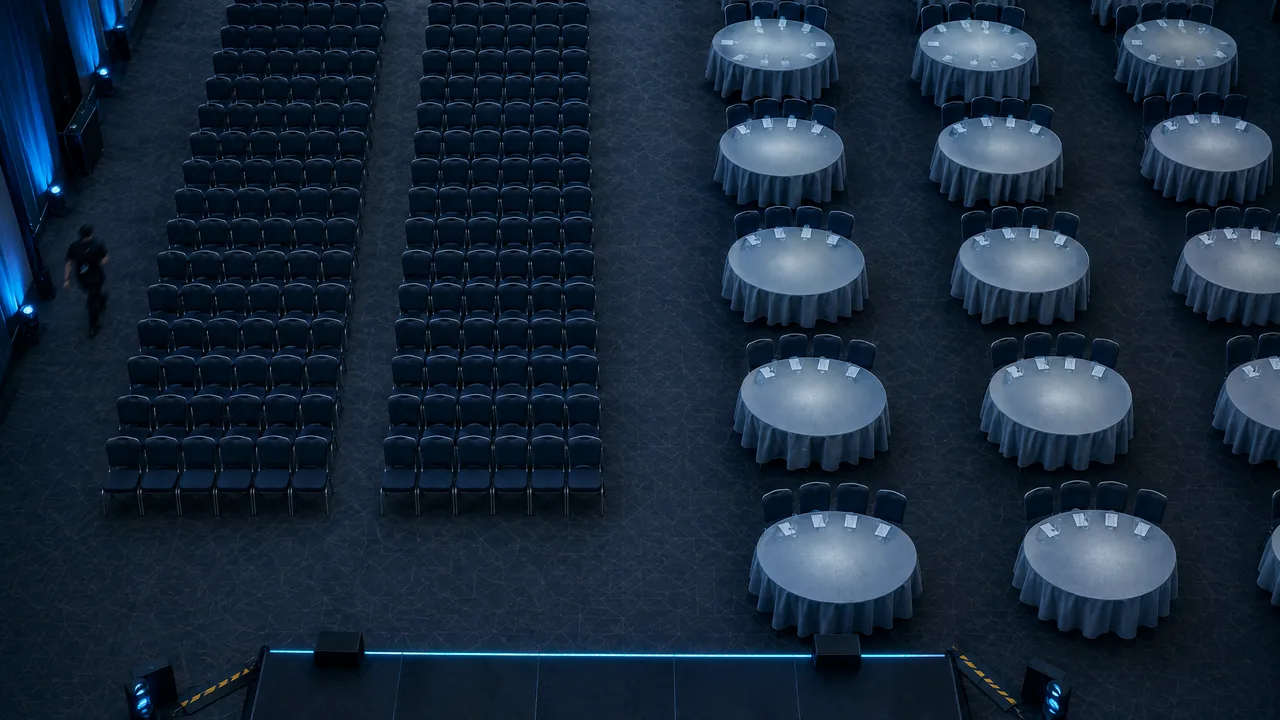
Before any of these cells are filled, someone has to decide whether the event belongs on next year’s list at all. Our guide to event strategy shows how to give every event one job and one number, so this budget can be compared with the other events competing for the same money. The venue line itself depends on a decision that is often made too late: the seating style. Room 101 at the Metro Toronto Convention Centre seats 270 in theatre rows but 150 in classroom style, and every changeover between the two costs crew time, so our guide to event seating styles shows how to read a capacity chart before the venue quote goes into this sheet.
Frequently asked questions
How do I create a budget for a B2B event?
Start with revenue: set paid attendance, sponsorship and exhibitor targets, discount them for comped tickets (15 to 25 per cent), pipeline risk and floor occupancy, and derive an expense ceiling from your margin requirement. Then allocate the ceiling across eight cost blocks, mark each line fixed or variable, add a contingency line of 10 to 20 per cent, and run three scenarios at 70, 100 and 125 per cent of target.
What should an event budget include?
Every expected revenue source (tickets, sponsorship, exhibitor fees, other income), every cost by block (venue, food and beverage, production, registration and technology, meeting programme, speakers, marketing, staffing), a separate contingency line, and the hidden fees attached to venue and catering contracts such as service charges, AV markups and bandwidth.
What percentage of an event budget goes to food and venue?
Food and beverage typically takes 25 to 33 per cent of a B2B conference budget and venue rental another 15 to 20 per cent, so together they account for 50 to 70 per cent of spend (GoGather 2026, Invyt 2026). Because catering is priced per head, the headcount forecast is the largest single lever on the budget.
How much contingency should an event budget have?
Between 10 and 20 per cent of total expenses, as its own line. Use 10 per cent for a repeat event in a known venue, 15 per cent for a new venue, and 20 per cent for a first edition or an event with a hybrid stream.
What is cost per meeting and why track it?
Cost per meeting is the total cost of the meeting programme (platform, meeting area, scheduling staff, hosted buyer support, no-show reserve) divided by the number of 1:1 meetings actually held. For trade shows and investor conferences it links the budget to the outcome exhibitors and investors renew for, which cost per attendee cannot do.
Conclusion
A B2B event budget is not a longer version of a party budget. It has a revenue side that needs discounting, two blocks that take more than half the money, a meeting programme that deserves its own heading, and a set of fees that never appear in the first quote. Build it in that order, keep the buffer on its own line, and measure it afterwards in cost per meeting rather than only in cost per head.
The finance committee in October will still ask whether the event pays for itself. With three scenarios on the summary sheet, you can answer that at 70 per cent of target. And when it asks what a meeting costs, you will have a number instead of a shrug.
If you want to see what the meeting programme block looks like when one platform covers registration, matching, scheduling and the on-site desk, get in touch with Converve and we will walk you through the figures for your event.