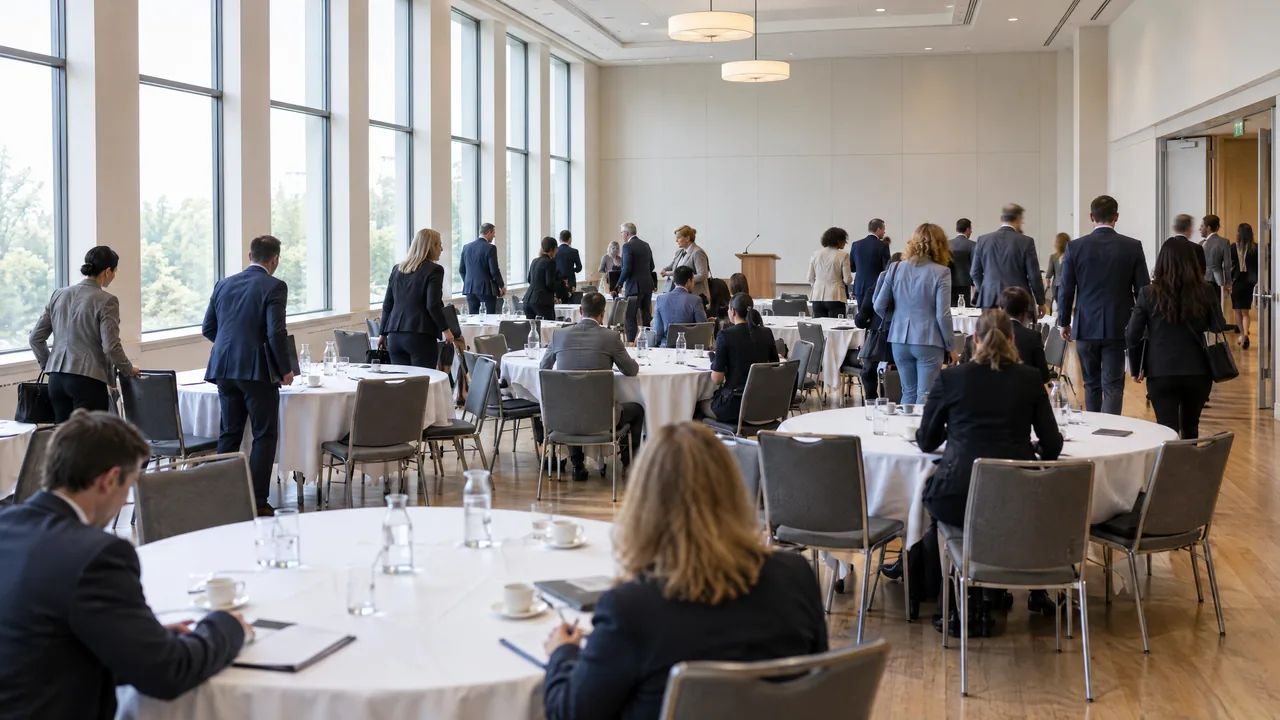
Somewhere on your destination’s partner list sits a hotel that calls itself a MICE hotel because it has a conference room and a coffee machine. If that property slips into your next hosted buyer programme, an international buyer will fly in, tour it for twenty minutes, and quietly cross it off. Not because the destination is weak, but because the supply side could not deliver what the programme promised.
MICE hospitality is the supply side of the business events market. The term covers the hotels, venues, convention centres and destination services that host meetings, incentives, conferences and exhibitions (that is what MICE stands for). For specialised hotels, this business is existential: MICE bookings account for 20 to 30 per cent of revenue at typical properties and up to 40 per cent at dedicated MICE hotels, according to SiteMinder’s 2026 hotel industry guide.
The short version: MICE tourism describes demand, meaning who travels where for which business event. MICE hospitality describes supply, meaning which properties can actually host that business. Organisers and destination marketing organisations (DMOs) who treat the two as one thing build programmes that promise meetings their partners cannot deliver. This guide separates the terms, gives you a three-tier framework for segmenting hospitality partners, and connects both to the mechanics of a hosted buyer programme.
What does MICE hospitality actually mean?
Each letter of the acronym describes a different demand on your suppliers. A property that excels at one may fail at another, which is exactly why the umbrella label “MICE hotel” hides more than it reveals.
- Meetings: short corporate formats such as board sessions and strategy days. They need small rooms, fast turnaround and reliable technology rather than volume.
- Incentives: reward trips for top performers. They need experience quality, not plenary capacity, and they lean heavily on destination services.
- Conferences: multi-day programmes with speakers, tracks and catering cycles. They need plenary space, breakout rooms and professional banqueting logistics.
- Exhibitions: trade shows with exhibitor floors and buyer-seller meetings. They need floor load, logistics access and, increasingly, structured one-to-one meeting zones.

One ambiguity is worth clearing up early, because your partners will use both versions. In the classic reading, the E stands for exhibitions. Some industry sources now read it as events, stretching the term to cover almost any organised gathering. For suppliers the difference is real: an exhibition demands floor logistics and meeting infrastructure, while a generic event may demand neither. When you brief a hotel, name the format. The acronym will not do it for you.
MICE hospitality vs MICE tourism: two sides of one trade show
The two terms are used interchangeably in half the articles ranking for them, and the confusion has operational cost. Tourism is the demand lens: it asks why 10.7 per cent of participants at events in Germany travel internationally and what they spend. Hospitality is the supply lens: it asks whether the ballroom fits 40 tabletop booths and whether the Wi-Fi survives 500 simultaneous video calls. We cover the demand side in depth in our MICE tourism strategic guide; this article deliberately takes the other seat.
| MICE tourism (demand) | MICE hospitality (supply) | |
|---|---|---|
| Core question | Who travels to which business event, and why? | Which properties can host that business? |
| Main actors | Buyers, delegates, corporate planners | Hotels, venues, convention centres, DMOs |
| Success metric | Visitor spend, delegate numbers, destination image | Occupancy, meeting revenue, rebooking rate |
| Typical failure | Empty programme, weak buyer quality | Overpromised capacity, underbuilt meeting zones |
| Your lever as organiser | Buyer recruitment and qualification | Partner selection and tier matching |
A destination wins when both lenses are managed deliberately and separately. That is the thesis of this article, and it is the reason the tier framework below exists at all. Tourism fills the city. Hospitality closes the meeting.
Why hotels fight for MICE business: the 2026 numbers
The supply side is not doing your destination a favour by participating; the business case runs the other way. The Events Industry Council and Oxford Economics put direct global spending on business events at roughly 1.3 trillion US dollars in 2025. Hotels capture a large share of it: industry estimates suggest around 41 per cent of MICE activity takes place in hotel venues, with more than 580 million room nights per year, according to MarketReportsWorld’s 2026 MICE tourism report.
Benchmark
What MICE means for the hospitality side in 2026
Market size estimates for the wider MICE industry range from roughly 1.0 to 1.35 trillion US dollars for 2026, depending on definition. We unpack that spread, and how to cite it without embarrassing yourself in a board paper, in how big is the MICE market in 2026. For partner strategy, the direction matters more than the decimal: every serious forecast has the segment growing at 7 to 11 per cent a year through the early 2030s.
The dependency also cuts both ways, and 2025 proved it. CBRE named falling meeting and convention attendance as one driver of weaker hotel revenue per available room (RevPAR, the industry’s standard revenue yardstick) in the second half of 2025, while its 2026 outlook expects recovery on the back of large events and roughly 10 per cent growth in international business travel. When meetings stall, hotel numbers stall. That is negotiating leverage for you.
The three-tier framework: how DMOs segment hospitality partners
Star ratings measure comfort. They tell you almost nothing about meeting capability, which is why experienced convention bureaus sort their partner landscape into functional tiers instead. Persistence Market Research’s 2026 MICE tourism study provides the anchor data: its industry estimates suggest premium five-star properties host about 32 per cent of large MICE events, while mid-scale hotels serve roughly 48 per cent of corporate travellers.
| Tier | Typical properties | What they carry | Typical role in your programme |
|---|---|---|---|
| Tier 1 | Convention hotels, premium five-star | Plenary capacity, in-house AV (audio-visual) teams, event staff | Host venue, headline conferences, ~32% of large events |
| Tier 2 | Mid-scale hotels with meeting space | Breakouts, delegate accommodation, ~48% of corporate travellers | Room blocks, satellite sessions, buyer accommodation |
| Tier 3 | Boutique and speciality locations | Character, experiences, incentive quality | Incentive programmes, social evenings, differentiation |
Picture the sales director of a solid Tier 2 property at your annual partner briefing, laminated floor plan in hand, arguing for a slot in your hosted buyer programme. She is not wrong to push: her 14 meeting rooms are exactly what a mid-sized buyer delegation needs. She is wrong for the exhibition itself, and a tier framework lets you tell her that without losing the room blocks. Stars measure comfort. Tiers measure meetings.
Where hospitality partners fit in a hosted buyer programme
The tier framework becomes commercially interesting the moment structured meetings enter the picture, because that is where supply quality gets measured in public. IMEX Frankfurt 2026 is the reference case: 3,731 hosted buyers from 94 countries, and a record 73,000 pre-scheduled meetings across three days, up 8 per cent year on year, 63,500 of them one-to-one (IMEX post-show data, May 2026). Almost two thirds of those buyers control annual purchasing budgets above 1 million US dollars, and 22 per cent sit above 10 million.
Numbers like that change the direction of pressure. Sellers compete for buyer slots, not the reverse, and your hospitality partners are sellers too. A hosted buyer flies in with obligations: a minimum number of qualified meetings in exchange for the funded trip. If the properties on your floor cannot state what they sell, to which buyer type, at which tier, those obligatory meetings get filled with polite mismatches. If you are new to the format, start with what a hosted buyer programme is, then work through the step-by-step setup guide. The meeting slot, not the suite, is the product.
Solution: this matching step is where software either helps or hides. Converve builds the meeting matrix on rules you define: buyer categories, seller tiers, capacity per timeslot, and an audit trail showing why each pairing exists, with AI-assisted suggestions as an optional layer rather than a black box. Planners are moving the same way: 35 per cent already name AI-powered matchmaking for attendees and sponsors as a 2026 use case (Amex GBT 2026 Global Meetings and Events Forecast), and the ones who get value from it are those who can still explain every match.
What 2026 changes for your partner strategy
Three fresh signals are worth building into your next partner round, and none of them is a platitude about hybrid.
- Costs rise faster than budgets: 71 per cent of planners expect cost per attendee to increase in 2026, driven by wages and food and beverage rather than room rates (Amex GBT 2026 Forecast). Negotiate meeting infrastructure and staffing into partner packages, not just rate.
- Curation beats crowd size: buyer programmes are tightening entry across the industry, and IMEX’s buyer quality data shows why. Fewer, better-qualified buyers raise the bar for which properties deserve floor access.
- Optimism is real but uneven: 85 per cent of meeting professionals are optimistic about 2026, the strongest reading since 2021, and in Europe 90 per cent expect spend to rise (Amex GBT). Strong demand years are the years to renegotiate tiers, while your leverage is fresh.
How to choose hospitality partners for your next trade show
Framework
Five steps from partner list to meeting-ready floor
- Map your inventory List every property and venue with real meeting data: room count, plenary capacity, one-to-one zones, load-in access.
- Score meeting capability, not stars Rate each partner on the four MICE pillars separately. A conference star can be an exhibition liability.
- Assign tiers openly Tell partners which tier they hold and what would move them up. Transparency turns rejection into a pipeline.
- Match tiers to buyer briefs Route buyer types to the tier that fits their brief, and protect Tier 1 slots for the delegations that justify them.
- Measure per partner Track meetings held, follow-ups and rebooking per property, and feed the numbers into next year's tiers.
Step 5 is the one most destinations skip, and it is the one that turns the framework from a spreadsheet into leverage. The KPIs that make partner performance measurable are the same ones that prove trade show ROI (return on investment) to your board; our tourism trade show KPI framework walks through them.
Partner performance also shows up in the contract. A hotel that holds rooms for your buyers or delegates will ask for an attrition clause, and the way pick-up is measured decides who carries the risk of empty rooms, as our guide to hotel attrition clauses and room blocks for conferences explains.
FAQ: MICE hospitality in brief
What does MICE stand for in hospitality?
MICE stands for meetings, incentives, conferences and exhibitions. In a hospitality context, the term describes the segment of hotels, venues and convention infrastructure that hosts these formats, in contrast to leisure-driven hospitality.
How much revenue does MICE bring a hotel?
MICE business typically contributes 20 to 30 per cent of revenue at hotels with meeting facilities, rising to around 40 per cent at specialised MICE hotels (SiteMinder, 2026). Cvent puts the ceiling at up to 50 per cent for properties built around the segment.
What is the difference between MICE hospitality and MICE tourism?
MICE tourism describes the demand side: who travels to which business event and what they spend. MICE hospitality describes the supply side: the hotels, venues and services that host those events. DMOs and organisers manage both, but with different partners, metrics and levers.
What are the three tiers of MICE hospitality partners?
Tier 1 covers convention hotels and premium five-star properties, which industry estimates suggest host about 32 per cent of large MICE events (Persistence Market Research, 2026). Tier 2 covers mid-scale hotels with meeting space, serving roughly 48 per cent of corporate travellers. Tier 3 covers boutique and speciality locations used for incentives and differentiation.
How do DMOs choose hospitality partners for a hosted buyer programme?
They map the property inventory, score meeting capability separately from star ratings, assign transparent tiers, match each tier to specific buyer briefs, and measure meetings and rebookings per partner. The scale matters: IMEX Frankfurt 2026 alone produced 73,000 pre-scheduled meetings for 3,731 hosted buyers (IMEX post-show data, 2026).
Conclusion: supply decides what demand is worth
MICE hospitality is not a synonym for MICE tourism, and the distinction is not academic. Demand you recruit is only worth what your supply side can convert into held meetings, signed follow-ups and rebooked space. A destination that qualifies its buyers but never tiers its hotels has done half the job, and the sales director with the laminated floor plan deserves a better answer than a shrug.
If structured buyer-seller meetings are the part you want to industrialise, that is precisely what Converve’s B2B matchmaking platform was built for: rule-based matching between buyer briefs and supplier tiers, pre-scheduled one-to-one agendas, and reporting that shows every partner what their slot produced. Talk to us before your next partner round, and bring the floor plan.