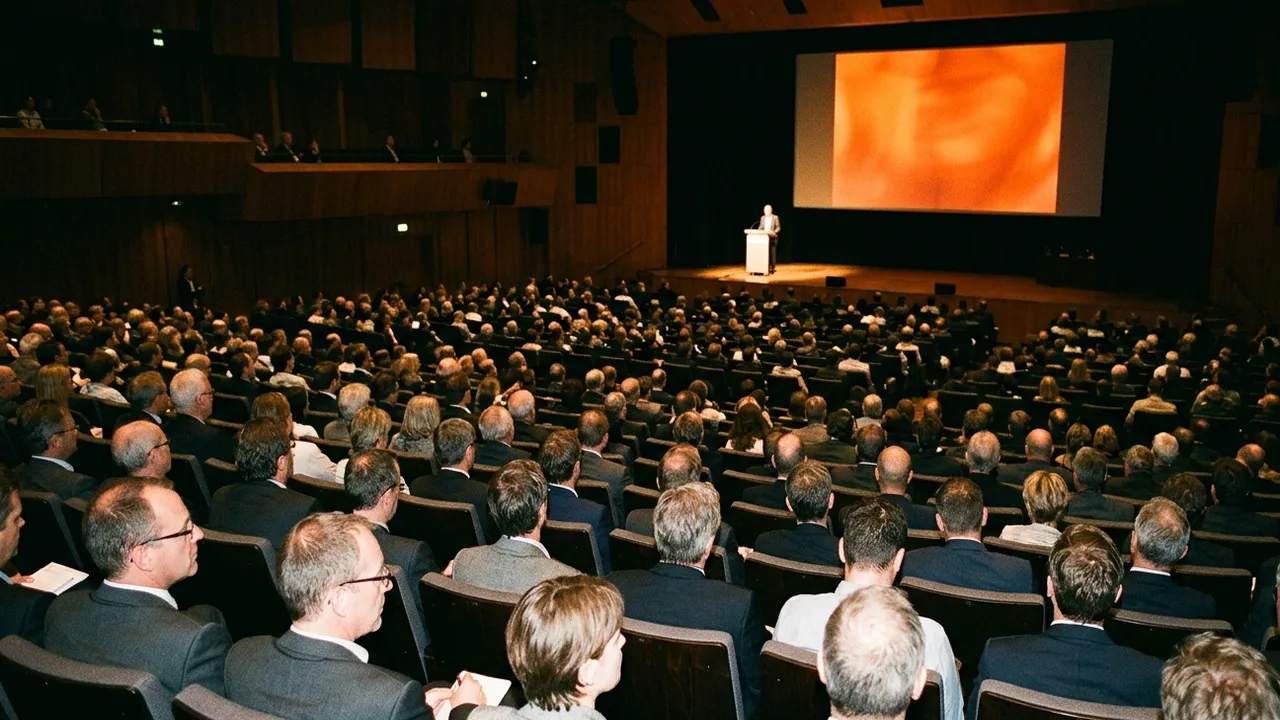
The agenda says the keynote starts at nine. The run of show tells the team who fades the music, opens the microphone and brings up the first slide. Those details keep a stage running. At a B2B conference, though, the stage is only part of the picture.
At 10:15, 150 attendees might be sitting down for their first 1:1 meeting. At 13:30, another meeting block could be starting alongside a workshop. Each needs an owner, a start signal and a plan for delays. Leave them out, and a keynote that runs twelve minutes over can quietly swallow the first meeting slot. This guide explains how to build a run of show that covers the whole conference, with a full day template you can adapt for your team.
What is a run of show?
A run of show is the internal, minute by minute timeline of an event day. Every row is one segment or cue, with its start time, duration, the person responsible and the technical action that has to happen. It is written for the team, not for attendees, and it is the document the production lead holds on event day to decide what happens next when something slips.
The format comes from broadcasting and live production, and the name changes with the industry. The event software provider LASSO lists rundown, run of show, cue sheet, show flow and minute by minute as names for the same document: sports productions tend to say rundown, broadcasters cue sheet, corporate events run of show (LASSO, Rundown Templates 101, May 2026). You will also see the abbreviation ROS. In German speaking agencies, the same document is called Ablaufplan or Regieplan.
Run of show, agenda, checklist: three different documents
The run of show is often confused with two documents that sit next to it. The clearest way to separate them is to ask who reads each one and what question it answers.
| Document | Who reads it | Level of detail | Question it answers |
|---|---|---|---|
| Agenda (programme) | Attendees, speakers, sponsors | Sessions, rooms, start times | What can I attend, and where? |
| Run of show | Event team, AV (audio and video) crew, venue, moderators | Every segment, cue and handover, to the minute | Who does what, when, and what happens if it slips? |
| Planning checklist | Project lead, stakeholders | Tasks and deadlines over months | What has to be done before the event? |
The association platform Clowder puts the difference in simple terms: the agenda is public and partly promotional, while the run of show is guidance for the team that includes every action, transition and cue (Clowder, February 2026). The practical order follows from that. You design the agenda first, which our guide on planning a conference agenda that makes time for networking covers step by step, and then break every agenda item into the rows of the run of show. The months of tasks before that point belong in a checklist, not in the run of show.
One more distinction is worth knowing. Some teams keep a separate production schedule for the build and the load-in the day before. Smaller events usually fold both into one document. What matters is that the event day itself lives in exactly one place.
Why 1:1 meetings belong in the run of show
That one place now has to hold more than the stage. The meeting block used to be something that happened around the programme. That is changing quickly. Forrester’s Q1 2026 State of B2B Events Survey of more than 400 event decision makers found that two thirds of organisations plan more workshops, roundtables and structured networking at their events. The event platform RainFocus reports from its own benchmark data that the average number of sessions attended per person fell from 5.3 in spring 2025 to 4.2 in spring 2026, while meeting participation rose sharply.
Where the day goes in 2026
Attendees spend more of the day in conversations
The RainFocus figures draw on vendor benchmarks and a survey of around 100 professionals, mostly in technology. They suggest a direction rather than a pattern every conference will follow. The planning issue is familiar, though: a meeting block that starts ten minutes late can push later slots into the next session. Attendees then have to choose between a conversation they booked and a talk they wanted to hear.
That is why the run of show for a B2B conference needs a second lane. The stage lane has the host, the AV cues and the speaker handovers. The meeting lane has the meeting desk, the table plan, the reminder before each block and the signal at every slot change. Both lanes run on the same clock, and the production lead has to see both on one page.
The run of show template: a B2B conference day
Here is what the two lanes look like on paper. The template below covers one conference day for around 400 attendees with a main stage, one breakout room and a meeting area with numbered tables. Each segment carries a lane prefix: Stage, Meetings, Networking or Ops. Copy the six columns into a spreadsheet, keep one row per segment and adjust times and names to your event.
| Time | Duration | Segment | Owner | Tech / cue | Note |
|---|---|---|---|---|---|
| 07:00 | 60 min | Ops: AV line check | Production lead | All mics, clicker, confidence monitor tested | Wi-Fi test in the meeting area too |
| 07:30 | 30 min | Meetings: set the meeting area | Meeting desk lead | Table numbers readable from the entrance | Tables = maximum meetings per slot |
| 08:00 | 60 min | Ops: registration opens | Registration lead | Badge printers live, welcome push message | Meeting desk staffed from 08:00 |
| 08:50 | 10 min | Stage: walk-in | Stage manager | Walk-in loop, house lights full | Standby for cue 1 at 08:58 |
| 09:00 | 5 min | Stage: welcome | Host | Cue 1: music out, host mic live, slide 1 | Explain how the meeting blocks work |
| 09:05 | 30 min | Stage: keynote | Stage manager | Handheld mic, clicker, countdown timer | Hard stop at 09:35 |
| 09:35 | 30 min | Stage: panel | Moderator | Four lavalier mics, Q&A mic runner | Moderator closes on time, not on applause |
| 10:05 | 10 min | Buffer | Production lead | Walk-out music | Absorbs stage overrun, never filled |
| 10:05 | 10 min | Meetings: reminder | Meeting desk lead | Push message: meetings start in 10 minutes | Sent even if the stage runs late |
| 10:15 | 60 min | Meetings: 1:1 block 1, three slots of 20 min | Meeting desk lead | Signal at each slot change | No-show check after 5 minutes per slot |
| 10:15 | 60 min | Networking: coffee and open networking | Catering lead | Coffee stations away from meeting tables | For attendees without meetings |
| 11:15 | 45 min | Stage: breakout sessions A and B | Track hosts | Room B mics and recording on | Five minutes for the room change |
| 12:00 | 60 min | Networking: lunch with hosted tables | Catering lead, table hosts | Topic cards on hosted tables | Hosts welcome first-time attendees |
| 13:00 | 30 min | Stage: sponsor keynote | Stage manager | Sponsor video, lower thirds | Sponsor mention read word for word |
| 13:30 | 90 min | Meetings: 1:1 block 2, four slots of 20 min | Meeting desk lead | Reminder at 13:20, signal at each slot change | Freed tables go to spontaneous meetings |
| 13:30 | 90 min | Stage: workshops in side rooms | Workshop leads | Flipcharts, no main stage programme | Keep the main hall quiet |
| 15:00 | 15 min | Buffer and coffee | Production lead | Walk-in loop | Overrunning meetings end here |
| 15:15 | 30 min | Stage: closing panel | Moderator | Four lavalier mics | Hard stop at 15:45 |
| 15:45 | 15 min | Stage: closing remarks | Host | Final slide, push message on follow-up | Tell attendees how to reach new contacts |
| 16:00 | 90 min | Networking: reception | Catering lead | Background music, stage dark | Meeting area stays open |
| 17:30 | 30 min | Ops: team debrief | Production lead | None | Notes go straight into the debrief sheet |
Three rows in this template do more work than they seem to. The buffer at 10:05 is empty on purpose: it exists so that an overrunning panel eats the buffer and not the meeting block. The reminder at 10:05 runs in parallel and is sent whatever the stage is doing, because 150 people need to walk to their tables on time. And the main hall stays quiet at 13:30, so that no headline talk competes with the second meeting block. The stage gives way to the meetings, not the other way round.
How to build a run of show in six steps
The template is a starting point, not a finished plan. The production lead who will hold it on the day should build it, in this order.
Build sequence
A run of show in six steps
- Step 1 Start from the agenda Every agenda item becomes one or more rows. Add everything the attendee never sees: load-in, line checks, room changes.
- Step 2 Split into lanes Stage, meetings, networking, operations. Parallel rows share the same start time.
- Step 3 Name one owner per row A name, not a department. If two people own a row, nobody does.
- Step 4 Write the cues Mic, music, slide, push message, signal. Precise enough that a substitute could run it.
- Step 5 Add buffers and a critical path Labelled buffer rows, and only five to eight items marked as critical.
- Step 6 Lock and rehearse Draft three to four weeks out, lock one week out, rehearse on site.
Name one owner per row
An entry such as “AV team” leaves room for confusion when three people are waiting for a decision at 10:07. Put a name in the owner column. For meetings, choose the person who knows the table plan, sends reminders and handles no-shows. If your team has not assigned that role before, settle it while you are building the document.
Mark buffers and the critical path
The event platform Expopass recommends labelling buffer rows explicitly, so nobody treats them as free time, and marking only five to eight items in the whole document as critical path: the things that cannot slip without a chain reaction (Expopass, April 2026). If everything is critical, nothing is. In a B2B conference, the start of each meeting block belongs on that short list. A late panel is annoying. A late meeting block breaks the agenda of every attendee in it.
Lock the document and give each role its own view
Expopass suggests a first draft three to four weeks out, a refined version two weeks out and a locked document seven days before the event, with one person authorised to change it live. After the lock, hand out filtered versions. Speakers need their slot, their tech check and their contact person. The AV crew needs the cue sheet. The meeting desk needs the meeting lane, the table plan and the no-show rule. Nobody needs all 21 rows on a phone in a loading dock.
Running the meeting lane on the day
Everyone notices a microphone failure on stage. A missed meeting at table 23 may never reach the production lead. Give the meeting area a clear point of contact so the team can spot and resolve those quieter problems too.
The production lead’s most important decision is made in advance: if the stage runs late, the meeting block still starts on time. Attendees who are still in the hall at 10:15 miss the first minutes of one meeting. The alternative is worse. If every block waits for the stage, one twelve minute overrun shifts all three slots, the last one collides with the breakout sessions at 11:15, and the buyer who planned her morning around three meetings loses one of them. Put that rule in the run of show in writing, so nobody has to invent it at 10:07.
Three cues carry the meeting lane:
- Reminder before each block: a push message or announcement ten minutes before the first slot, sent by the meeting desk and not by the stage.
- Signal at every slot change: a sound, a light or a screen message that ends one meeting and starts the next. Without it, good conversations run over and the next meeting starts at a half-empty table.
- No-show rule: after five minutes, the meeting desk marks the meeting as a no-show and the table becomes free for a spontaneous meeting. How to count and reduce those no-shows is the subject of our guide on event meeting no-show rates.
The capacity check belongs in the run of show as well. The number of tables in the meeting area sets the maximum number of meetings per slot. If your meeting schedule plans 180 meetings in one slot and the area holds 150 tables, the problem is visible in the Note column weeks before it becomes visible on the floor.
A reliable meeting schedule gives that part of the run of show something to work from. Converve schedules confirmed 1:1 meetings without clashes, assigns tables and rooms, and brings sessions and meetings together in each attendee’s personal agenda. Your team can use those details to fill in the meeting blocks, capacity and table assignments. Converve’s B2B matchmaking and programme and session management support the schedule your production team runs on the day.
Frequently asked questions
What is a run of show?
A run of show is the internal, minute by minute timeline of an event day. Each row is one segment or cue with start time, duration, owner and technical action. It is written for the event team and differs from the public agenda, which only tells attendees what they can attend and where.
What is another term for run of show?
Common synonyms are rundown, cue sheet, show flow, minute by minute and running order. According to LASSO (May 2026), corporate events mostly say run of show, broadcasters cue sheet and sports productions rundown. In German, the terms Ablaufplan and Regieplan are used.
Is run of show hyphenated?
As a noun, “run of show” is usually written without hyphens. When it describes another noun, many style guides hyphenate it, as in “run-of-show document” or “run-of-show template”.
What should a run of show template include?
At minimum: time, duration, segment, owner, technical action or cue, and a note field. For a B2B conference, add a lane marker so that stage, 1:1 meetings, networking and operations can run in parallel on the same clock, plus labelled buffer rows.
Who owns the run of show on event day?
One person, usually the production lead or event lead. They are the only one who changes the document live and communicates every change to the team. For the meeting lane, a meeting desk lead reports to them.
When should the run of show be final?
A common rhythm is a first draft three to four weeks before the event, a refined version two weeks out and a locked document one week before the event (Expopass, April 2026). The last days are for rehearsal and small corrections, not for new structure.
Conclusion: one clock, two lanes
A useful run of show helps the team act when the day stops following the plan. Put stage activity, meetings, networking and parallel workshops on the same timeline. With named owners and visible buffers, you can see which delays affect other parts of the conference before attendees feel the consequences.
Start with the template, then add your team’s names, cues and rules for handling delays. Our event planning checklist covers the preparation that comes earlier; the demo day playbook applies the same approach to a shorter format. To discuss planning your conference’s 1:1 meetings with Converve, get in touch.