Most event RFPs fail before anyone prices them. A planner sends the same three pages to ten venues, asks for “your best offer for 400 delegates in May”, and gets back ten proposals built on ten different assumptions about room sets, catering and the number of breakout rooms. None of them can be compared. The planner then spends two weeks of emails rebuilding the brief that should have gone out in the first place.
The problem is rarely the template. It is the idea of what an RFP is for. An event RFP is a briefing, not a price request: if it does not describe the format, the goals and how the meetings work, you get ten proposals you cannot compare. This guide shows what to put in it, section by section, how the brief changes depending on who receives it, and what to add when your event is built around scheduled business meetings.
What is an event RFP?
An event RFP (request for proposal) is a structured brief that a planner sends to venues, hotels, destination management companies (DMCs) or agencies. It describes the event’s goals, dates, attendance, space, rooming, food and beverage, budget range and evaluation criteria, so that each supplier can return a priced proposal that can be compared with the others.
Two neighbouring documents are often confused with it. The difference matters, because each one asks a supplier for a different amount of work:
| Document | The question it asks | When to use it |
|---|---|---|
| RFI (request for information) | Who can do this at all? | Early, to build a long list of venues or DMCs in a new destination |
| RFP (request for proposal) | How would you do it, and at what price? | When dates, size and format are clear enough to plan around |
| RFQ (request for quotation) | What does exactly this specification cost? | When the solution is fixed and only the price is open, for example AV hire or coaches |
Most event sourcing needs an RFP, because venues and DMCs are expected to propose a solution, not just a price. That is also why the quality of the brief decides the quality of the answer.
Why so many RFPs produce proposals you cannot compare
The sourcing market has become busier, and that raises the cost of a weak brief. According to the Events Industry Council’s Global Business Events Barometer for the first quarter of 2026 (published June 2026 with Oxford Economics), RFP activity for events more than twelve months out reached 122 per cent of its 2019 level, and 120 per cent in Western Europe. Venues and DMCs are answering more requests than before the pandemic with sales teams that are not larger. An RFP that is quick to read gets read first.
Planners also decide earlier than many suppliers realise. In Cvent’s 2026 Planner Sourcing Report, 50 per cent of planners said meeting room specifications influence whether they send an RFP to a venue at all, and 46 per cent pointed to floor plans. The reverse holds as well: a venue can only answer as precisely as the RFP describes what will happen in those rooms.
Picture the planner from the opening, a congress manager at an engineering association sourcing a 400-delegate annual congress for 2027. Her RFP says “plenary for 400, six breakouts, gala dinner”. One venue prices six breakouts for 60, another for 30. One includes the gala dinner in a separate space, another assumes the plenary is turned around overnight. All four assumptions are reasonable. None of them is what she needs.
Vague briefs do not save time. They move the work into the follow-up.
From goal to contract
An event RFP in six steps
- Step 1 Define goals and format What the event must achieve and how the days run, before anyone talks about rooms.
- Step 2 Write the RFP Ten sections, with firm requirements separated from preferences and open points.
- Step 3 Choose the recipients Five to eight venues or DMCs that already fit on capacity, dates and budget.
- Step 4 Run a question window One deadline for questions, one shared answer document for all bidders.
- Step 5 Evaluate with weights Score every proposal against the same criteria you published in the RFP.
- Step 6 Shortlist and contract Site visit with the top two or three, then negotiate terms, not just rate.
Step one has nothing to do with venues. That is deliberate.
What to put in an event RFP: ten sections
If the RFP is a briefing rather than a price request, its sections have to describe the event, not just list quantities. The ten sections below cover what a venue or DMC needs to produce a proposal it can stand behind. For each section, mark what is confirmed, what is a preference and what is still open. A venue can work with “dates flexible within the second half of May”. It cannot work with silence.
1. Organisation, event and goals
Start with three sentences: who you are, what the event is and what it must achieve. “Annual congress of a professional association, 400 delegates, goal: grow attendance from members under 35 and give exhibitors more qualified contact time” tells a venue more than a page of logistics, because it explains why the logistics look the way they do.
2. Dates, meeting pattern and flexibility
Give preferred dates, acceptable alternatives and the days that are fixed. Add the meeting pattern: arrival day, programme days, departure, plus setup and breakdown times. Flexibility is worth money. A venue that can move you by one week into a quieter period may offer a better rate than any negotiation would achieve.
3. Attendance and audience profile
State the expected number of attendees, the history of the last two or three editions and how many are local, national and international. The profile drives everything from room types to transfer needs and dietary requirements.
4. Meeting space and layout
This is where most proposals diverge. Describe every space you need per day: plenary with seating style and capacity, number and size of breakouts, exhibition or sponsor area, registration, a speaker room and storage. Mention adjacency needs, for example “breakouts within two minutes of the plenary”. If you already know your layout, attach a sketch; our guide to event floor plan software explains how far a drawing gets you and where it stops.
5. Rooming and room block
Give the room block per night (the peak night matters most), the room types, the rate you are aiming for and how the rooms will be booked: by attendees through a booking link, or by you on a rooming list. Add your attrition history if you have one. A hotel prices risk, and your history is the evidence that reduces it.
6. Food and beverage
List every function with numbers and format: coffee breaks, lunches, receptions, the gala dinner. State dietary requirements and whether you expect sustainable sourcing. 73 per cent of planners count food and beverage among their largest expense items (Statista, cited by Cvent in 2026), so a vague catering line produces the widest spread between proposals.
7. AV, production and connectivity
Describe audiovisual (AV) needs such as stage, projection, microphones, streaming and interpretation, and say whether you will bring your own production company. Ask for the Wi-Fi capacity in each space, not just “Wi-Fi available”. If your attendees use an event app all day, that is a load question, not an amenity.
8. Budget range
This is the section planners leave out most often, and the one that causes the most back-and-forth. You do not need to reveal your full budget, but give a range and say what it covers: venue only, or venue plus food and beverage, AV and accommodation. A range filters out venues that cannot meet it before anyone spends two days on a proposal. Our B2B event budget template helps you set the range before the RFP goes out.
9. Contract terms
Ask about the terms that change the final bill, not just the rate: attrition, cancellation, force majeure, deposit schedule, service charges, minimum food and beverage spend and exclusivity of in-house suppliers. The Meeting Professionals International (MPI) guidance on hidden costs makes the same point: an attractive proposal can come with expensive terms attached, and you want to know before the shortlist.
10. Response instructions and evaluation criteria
Say when proposals are due, in which format, who answers questions and by when, and how you will decide. Publishing the evaluation criteria is not a courtesy. It is the most effective way to make proposals comparable, because every bidder now answers the same question.
One RFP, three recipients: venue, DMC or agency
The ten sections are the core. Who receives the RFP decides which of them carry the weight. A hotel needs the room block in detail. A DMC needs to know what happens outside the venue. An agency or professional congress organiser (PCO) needs to know which parts of the job are theirs.
| Section | Venue or hotel | DMC | Agency or PCO |
|---|---|---|---|
| Goals and audience | Important | Essential | Essential |
| Dates and pattern | Essential | Essential | Essential |
| Meeting space and layout | Essential | Helpful | Important |
| Rooming and room block | Essential | Important (if they contract hotels) | Important |
| Food and beverage | Essential | Important (offsite dinners) | Important |
| Transfers, excursions, local experiences | Rarely | Essential | Depends on scope |
| AV and production | Important | Helpful | Essential |
| Budget range | Essential | Essential | Essential |
| Scope of services and fee model | Not needed | Essential | Essential |
A DMC RFP therefore reads differently from a hotel RFP. It describes the programme around the conference: arrival logistics, an offsite dinner, a half day for accompanying persons, perhaps a pre-tour. If you are unsure what a DMC takes on and how it charges, our explainer on what a destination management company does covers the fee models you should ask about in the RFP.
Convention bureaus sit one step earlier. Many destination organisations accept an RFP through a “submit an RFP” form and distribute it to suitable hotels and venues in their city, usually free of charge. For a planner looking at a new destination, that is the fastest route to a qualified long list. Which destinations are worth that effort is the question behind our guide to what makes a MICE destination.
Our congress manager ends up sending two documents: a venue RFP to six venues and a DMC RFP to two DMCs. The core is identical. The emphasis is not.
B2B events with scheduled meetings: what standard templates leave out
Standard templates assume that attendees sit in sessions and meet over coffee. If your event is built around pre-arranged one-to-one meetings, as at a tourism trade show, a hosted buyer programme or a partnering event, the venue needs to understand a second layer of the programme. None of the common templates ask for it, so add it yourself:
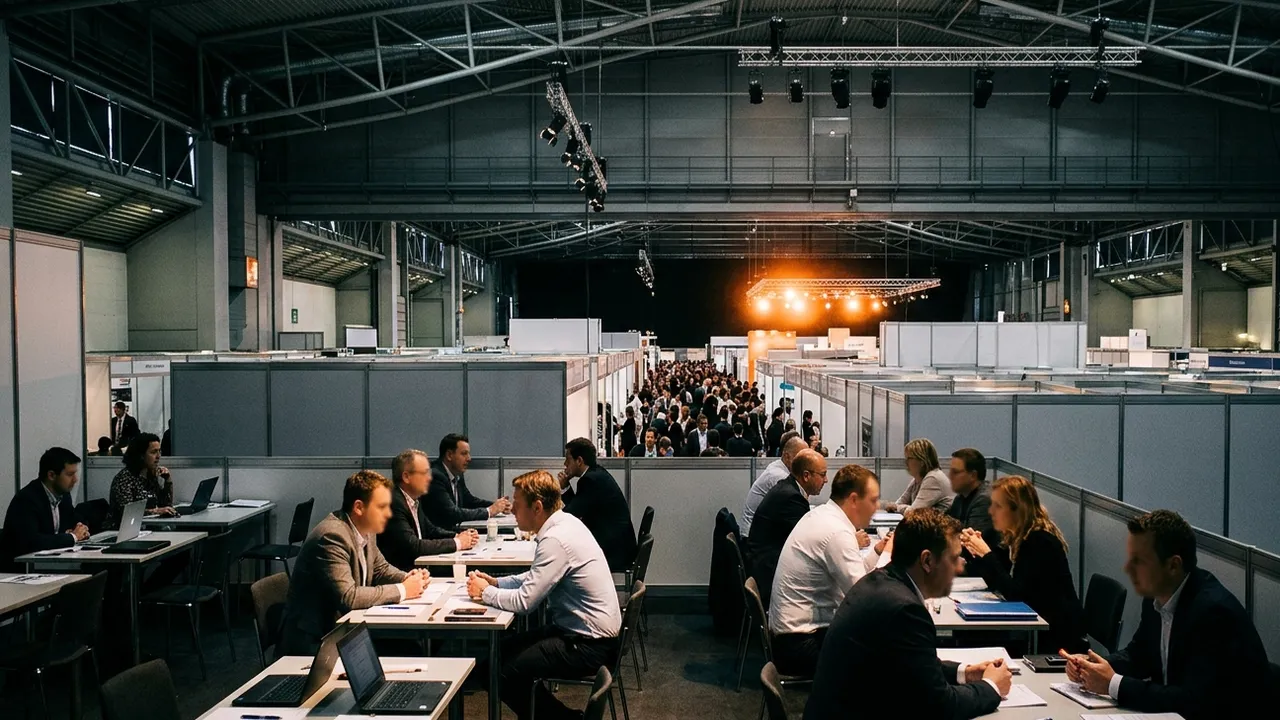
- Meeting zones: how many tables you need, how long each slot runs and how many meetings run in parallel. Three hundred buyers with twelve meetings each is a hall, not a lounge.
- Acoustics and privacy: whether meetings can run in an open area or need separation. Sellers presenting prices to buyers will not do it next to a coffee queue.
- Schedule blocks: when meeting blocks sit in the programme relative to sessions and breaks, so the venue can plan catering and room turnarounds around them. The run of show for a B2B conference is the document where those blocks live.
- Hosted buyer rooming: if you cover accommodation for invited buyers, that block has different rules from the delegate block, and it should be priced separately.
- Connectivity for scheduling: attendees check their meeting schedule on their phones between every meeting. Ask for the concurrent device capacity in the meeting area.
Whether you run that programme as a closed hosted buyer format or with open registration also changes the RFP, because it decides who books and pays for the rooms. We compare both models in hosted buyer programme vs open registration.
Solution: Converve plans one-to-one meetings at B2B events and trade shows, from matching buyers and sellers to scheduling the slots across tables and days. Once the meeting volume is clear, the space and timing requirements for the RFP follow from it, rather than from a guess. You can see how this works for B2B matchmaking at events.
The meeting area is not a side room. For these events it is the product.
How many venues, and how much time to give them
With a complete brief in hand, the next question is distribution. Sending the RFP to twenty venues feels thorough. In practice it signals a planner who has not done the shortlist, and sales teams prioritise accordingly. Sourcing guides such as HopSkip’s recommend five to eight well-chosen properties, a range we would endorse for most conferences: enough competition to compare, few enough that every bidder takes the request seriously.
Speed matters on both sides of the table:
Response times
Planners expect fast answers to RFPs
Those expectations have a consequence for the planner, too. If you want an answer in four days, the RFP has to be answerable in four days. For a 400-delegate congress with a room block and a gala dinner, seven to ten working days is realistic, with a question deadline after three. Answer every question in one shared document, so all bidders work from the same information.
A short deadline only works with a complete brief.
How to compare the proposals
The evaluation starts in the RFP, not after it. If you published your criteria in section ten, every proposal should answer them, and you can score them on one sheet. A simple weighted matrix keeps the decision honest when the cheapest offer and the best offer are not the same:
| Criterion | Weight | What you check |
|---|---|---|
| Fit of space and layout | 25 % | Does the meeting pattern work without compromises? |
| Total cost | 25 % | All-in cost per delegate, including service charges and minimums |
| Contract terms | 15 % | Attrition, cancellation, deposit schedule |
| Accessibility and travel | 15 % | Air access, transfer times, accessibility of the building |
| Sustainability evidence | 10 % | Carbon reporting, catering sourcing, certifications |
| Responsiveness | 10 % | Speed and quality of answers during the process |
Adjust the weights to your goals. An association congress with many international members may put travel above cost. A hosted buyer programme may put the meeting area above everything else.
For our congress manager, the matrix does one more job. Her board will ask why she did not take the cheapest venue. The scored sheet is her answer.
Frequently Asked Questions
What does RFP mean in events?
In events, RFP stands for request for proposal. It is the brief a planner sends to venues, hotels, DMCs or agencies, describing dates, attendance, space, rooming, catering, budget range and evaluation criteria, so that each supplier can return a comparable, priced proposal.
What is the difference between an RFP and an RFQ?
An RFP asks suppliers how they would deliver your event and at what price, so they can propose solutions. An RFQ (request for quotation) asks only for the price of a fixed specification, for example a defined AV package. Use an RFP for venues and DMCs and an RFQ for clearly specified services.
Should I include my budget in an event RFP?
Yes, at least as a range, and say what the range covers. A budget range filters out unsuitable venues before they spend time on a proposal and makes the proposals you receive easier to compare. Leaving it out is the most common cause of back-and-forth after the first round.
How many venues should I send an RFP to?
Five to eight well-chosen venues is a good range for most conferences. More recipients rarely improve the result, because sales teams prioritise requests that look like a real shortlist over requests that look like a mass mailing.
How long should venues have to respond to an event RFP?
Planners expect fast answers: 80 per cent say the ideal response time is under four days (Cvent Planner Sourcing Report 2025). For complex events with room blocks and several functions, seven to ten working days with a fixed question deadline is a realistic window.
Conclusion: write the brief you would want to answer
An event RFP is a briefing, not a price request. The planners who get comparable proposals describe what the event must achieve, how the days run and how the meetings work, and they say which parts are fixed and which are open. They tailor the emphasis to the recipient, send it to a shortlist rather than a list, and publish the criteria they will use to decide.
The effort moves to the start of the process. It comes back as proposals you can actually compare. Write the brief once, properly.
If your event lives on scheduled business meetings and you want the meeting programme planned before the venue search starts, get in touch with Converve. You can also see how Converve supports tourism trade shows and buyer programmes.