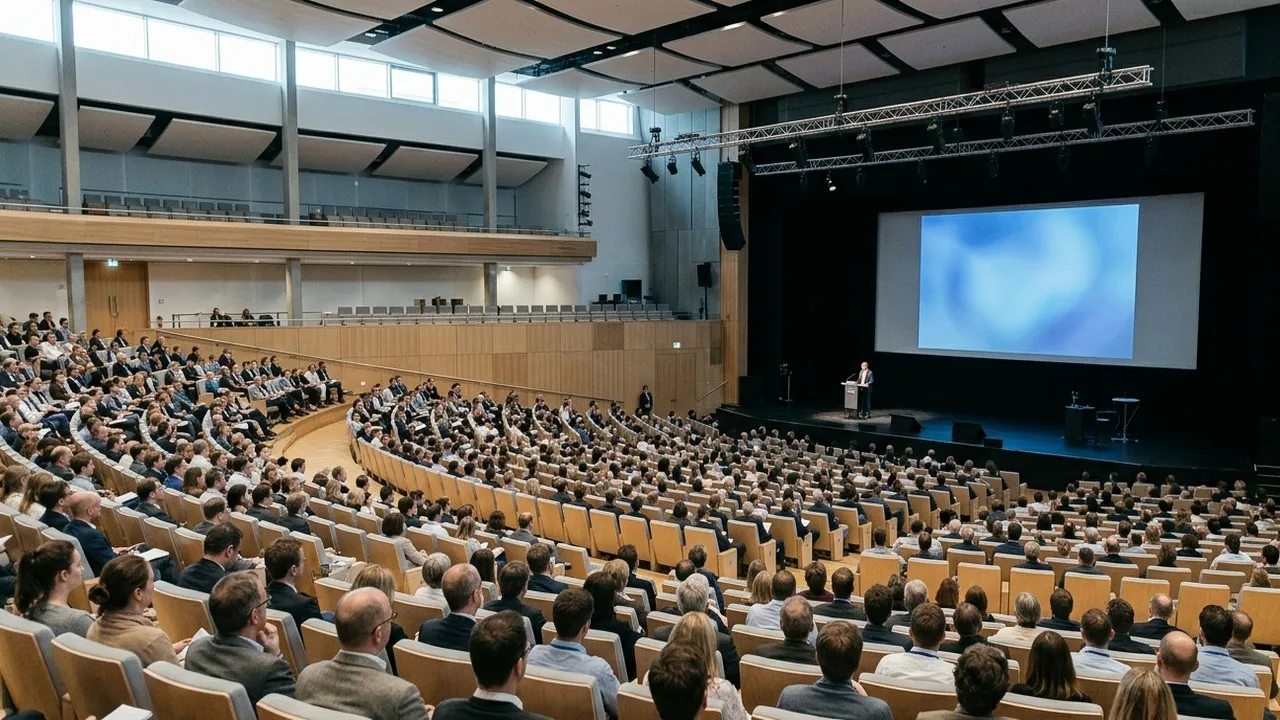
Sixteen speakers in ninety minutes. That is the session size recommended by Mark Jason Dominus, the programmer who named the lightning talk in 2000. For a one-hour session, he recommends eleven speakers. For a programme manager with forty strong submissions and twelve full speaking slots, that arithmetic is tempting. It gives more worthwhile ideas a place in the programme.
The arithmetic is also where many lightning talk sessions go wrong. Five minutes per talk sounds simple, but a successful session also depends on the organiser managing the clock, the changeover between laptops, the running order and what happens when the last speaker leaves the stage. This guide explains the format and its two best-known variants, Ignite and PechaKucha, and shows how to plan a session whose short talks lead to longer conversations.
What is a lightning talk?
A lightning talk is a short presentation of usually five minutes, given back to back with other short talks in one shared session slot. Each speaker presents one main idea, illustrates it with an example and then hands over the stage. Slides are allowed at most events but rarely required.
The practice is older than its name. Short talks of this kind were first used at the Python Conference in 1997, and Dominus coined the term at YAPC (Yet Another Perl Conference) in Pittsburgh in June 2000. Developer conferences still run the classic form today. At PyCon US 2025, lightning talks were capped at five minutes on any topic; speakers were selected at lunchtime and went on stage that evening or the next morning.
Business events have stretched the label. At AWS re:Invent 2022, the AWS Marketplace pavilion ran “lightning talks” as 15 minute sponsor sessions in a mini theatre on the expo floor. That is a different product: a short sponsored slot, not a rapid series of community talks. When you put lightning talks on your agenda, tell speakers and attendees which kind you mean.
Lightning talk, Ignite or PechaKucha: which variant fits?
The classic lightning talk has two well-known variants, and all three share a hard time limit. What separates them is who sets the pace: the speaker or the slides. In Ignite and PechaKucha, slides advance automatically, so nobody can overrun, and nobody can go back.
| Format | Length | Slides | Who sets the pace | Origin |
|---|---|---|---|---|
| Lightning talk | Usually 5 minutes | Optional, any number | The speaker, within a hard stop | Python Conference 1997, named at YAPC 2000 |
| Ignite | 5 minutes | 20 slides, 15 seconds each, advancing automatically | The slides | Seattle, 2006 |
| PechaKucha | 6 minutes 40 seconds | 20 images, 20 seconds each, advancing automatically | The slides | Tokyo, 2003 |
| Expo theatre “lightning talk” | Often 15 minutes | Usually | The sponsor or exhibitor | Trade show floors |
Ignite was started in Seattle in 2006 by Brady Forrest and Bre Pettis, and its slogan sums up the deal: “Enlighten us, but make it quick.” PechaKucha was created in Tokyo in 2003 by the architects Astrid Klein and Mark Dytham. The name is Japanese for “chit chat”, and according to the organisation, PechaKucha Nights take place in more than 1,200 cities.
For a B2B conference, the free five-minute lightning talk is the most practical default. Formats with automatic slides produce a more polished show, but they cost each speaker hours of rehearsal. That is fine for a showcase evening. It is a lot to ask of a member who presents a project between two sessions.
Lightning talks also do a different job from the other conversational formats in your programme. A fireside chat goes deep with one guest, a panel discussion sets several views against each other, and a roundtable puts the audience at the table. Lightning talks trade depth for range. They give the room many starting points in a short time.
When lightning talks fit your programme, and when they do not
Many starting points in a short time is close to what attendees say they want. In a survey of 250 professionals by the speakers’ agency Talent Bureau (October 2025), “schedule length and pace” was the most cited driver of satisfaction with an event, followed by time for networking.
Attendee survey
Pace and time to talk shape how attendees rate an event
Talent Bureau sells speakers, so read the figures as a direction rather than a benchmark. The direction still matters for your agenda. Attendees reward a programme that moves and leaves them time to talk. A lightning talk session can do both, provided it runs on time and ends next to a break.
Lightning talks are a good choice when:
- You have more good voices than slots: members, researchers or customers with one strong idea each, but not enough material for 30 minutes.
- You want new speakers on stage: five minutes is a low barrier for a first talk. Write the Docs deliberately mixes first time and experienced speakers in its lightning talk sessions.
- The audience should choose whom to talk to: each talk works as a public introduction before the networking break.
- Exhibitors or sponsors want visibility: a strict five-minute slot with an editorial rule, such as no product demos, is easier to keep useful than a 30-minute sponsor session.
Avoid the format when a topic needs explanation, evidence and questions. A new regulation, a complex study or a controversial decision deserves a full slot with discussion. Five minutes can raise a question. It cannot settle one.
How to plan a lightning talk session
Once the format fits, the work moves from the stage to the organiser’s desk. Picture the programme manager again: a 60 minute slot, twenty submissions and a conference that starts in eight weeks. These six steps turn her shortlist into a session.
Checklist
A lightning talk session in six steps
- Step 1 Fix the slot Decide the session length, the number of talks and whether slides are free or advance automatically.
- Step 2 Open the call Ask for a title and two sentences per talk, in advance or through a sign-up on the day.
- Step 3 Curate the order Group talks by theme, open with a confident speaker and end with a talk that leads into the break.
- Step 4 Collect one deck All slides as PDF files on one laptop, due the evening before.
- Step 5 Run the clock A visible countdown, a signal at one minute remaining and a firm stop at five minutes.
- Step 6 Bridge to the room Tell the audience where each speaker can be found after the session.
How many lightning talks fit into one session?
Dominus’s own rule is sixteen talks in 90 minutes or eleven in 60. The difference between 80 or 55 minutes of talking and the full slot is the buffer for the host and the changeovers, and you will need it.
| Session slot | Five minute talks | Talking time | Buffer for host and changeovers |
|---|---|---|---|
| 30 minutes | 5 | 25 minutes | 5 minutes |
| 45 minutes | 7 or 8 | 35 to 40 minutes | 5 to 10 minutes |
| 60 minutes | 11 | 55 minutes | 5 minutes |
| 90 minutes | 16 | 80 minutes | 10 minutes |
The rows for 60 and 90 minutes follow Dominus; the shorter slots are our own extrapolation. For PechaKucha talks of 6 minutes 40 seconds, plan around seven talks per hour.
Prepared talks or sign-up on the day?
Developer conferences often collect lightning talks during the event itself. PyCon US 2025 took submissions through its attendee dashboard and selected speakers for that evening’s session at lunchtime. Write the Docs Berlin 2025 opened sign-up on each conference day, and PyCon DE & PyData 2025 in Darmstadt ran a lightning talk desk with a rule of one talk per person per conference.
For a B2B congress or a trade show, a call before the event is usually safer. Your attendees did not come for an open mic, and the programme manager needs to know who will speak. A middle path works well: fill most slots in advance and keep two or three open for sign-ups on the first day. That keeps the session fresh without the risk of an empty stage.
Changeover: the hidden time thief
Every speaker who plugs in their own laptop costs you about a minute. Over eleven talks, that is a fifth of your slot. Collect all slides as PDF files the evening before and run them from one laptop in the right order. Write the Docs Berlin 2025 held a tech check fifteen minutes before its lightning talks, gave each speaker a signal at one minute remaining and had the coordinator stop them at five minutes. Copy all three.
Briefing the speakers: one idea, one example, one ask
The organiser manages the timing, while speakers shape the content. Five minutes gives them less room than they may expect. Send every speaker a short brief with three rules:
- One idea: a single point the audience can repeat afterwards in one sentence.
- One example: a project, a number or a customer story that proves the point.
- One ask: what the audience should do next, and where they can find the speaker after the session.
Dominus tells speakers on his page that a short talk does not have to be taken so seriously: say something brief and interesting, then get off the stage. That tone matters. Lightning talks lose their energy when speakers squeeze a 20 minute presentation into five minutes and talk at double speed.
If you choose Ignite or PechaKucha, ask speakers to rehearse at least twice with automatic slides switched on. Slides that move without the speaker are the charm of these formats, and the most common reason a speaker falls behind. One technical detail from Write the Docs is worth passing on: venue projectors often show low contrast slides poorly, so ask for strong contrast between text and background.
After the last talk: turning five minutes into conversations
The third rule, the ask, helps the audience continue the conversation. A five-minute talk introduces a topic but leaves little room for a detailed explanation. The audience has heard eleven people in an hour and wants to talk to two or three of them. If nothing is planned for that moment, the speakers leave through the side door and the opportunity for conversation is lost.
Schedule the session directly before a break and give each speaker a fixed place in the room afterwards. Our collection of networking event ideas calls this a lightning-talk mixer: short talks first, then every speaker hosts a standing table. The talks seed concrete topics into the room, so conversations start in the middle of a subject instead of from small talk.
Some conversations need more than a standing table: a buyer who wants to discuss a project in detail, or an investor who wants to meet the founder from talk number seven. Give those a scheduled slot. The programme manager will see the effect in her feedback forms.
With Converve, speakers can take part as regular participants with a profile, so attendees can send them a meeting request right after the session. You set the rules for who may request meetings with whom, and accepted meetings land in free slots in both agendas, with requests, acceptances and no-shows recorded. Our B2B matchmaking runs on this rule-based meeting matrix, alongside the programme management for the session itself.
Where the session sits in the day matters as much as its content. Our guide to planning a conference agenda that makes time for networking shows how to place short formats right before protected meeting windows. And if you would rather let attendees set the topics themselves, an unconference takes the idea of many voices one step further.
Frequently Asked Questions
What is a lightning talk?
A lightning talk is a short presentation, usually five minutes long, given back to back with other short talks in one session. The speaker makes one point and leaves the stage. The term was coined at YAPC (Yet Another Perl Conference) in 2000; short talks of this kind were already used at the Python Conference in 1997.
How long is a lightning talk?
Usually five minutes with a firm stop. PyCon US and Write the Docs both capped lightning talks at five minutes in 2025. On trade show floors, sponsor sessions called lightning talks are often longer; at AWS re:Invent 2022 they ran for 15 minutes.
What is the difference between a lightning talk, an Ignite talk and a PechaKucha?
A lightning talk gives the speaker five minutes and full control over the slides. An Ignite talk uses exactly 20 slides that advance automatically every 15 seconds, five minutes in total (Ignite, founded in Seattle in 2006). A PechaKucha uses 20 images at 20 seconds each, 6 minutes 40 seconds in total (PechaKucha, founded in Tokyo in 2003).
How many slides should a five-minute lightning talk have?
The free format has no fixed rule. Five to ten slides is a practical range: enough for one idea and one example without rushing. In the Ignite format the number is fixed at 20 slides of 15 seconds each.
How many lightning talks fit into one session?
Mark Jason Dominus, who named the format, recommends sixteen five-minute talks in a 90-minute slot or eleven in 60 minutes. The remaining minutes cover the host and the changeovers. For a 30-minute slot, plan five talks.
Is it lightning talk or lightening talk?
The correct spelling is lightning talk, after the flash of lightning in a storm. “Lightening” means making something lighter or brighter and is a common misspelling of the format’s name.
Conclusion: give short talks a clear structure
A lightning talk session gives your programme many voices in the time of one keynote. Give it the structure it needs: a session slot with a buffer, one laptop, a visible clock and a clear opportunity for discussion after the last talk. Treat every talk as an introduction, and give your audience a way to continue the conversations it starts.
If you want those conversations to become scheduled meetings, get in touch with Converve.