Somewhere in your agenda sits a sixty-minute networking block, and you have three ways to fill it: an open reception, a speed networking session, or a block of pre-scheduled 1:1 meetings. The reception is the default. It is also the format where the same colleagues talk to the same colleagues, and where the sponsor who paid for the networking lounge walks the room wondering what, exactly, the money bought.
Speed networking exists to fix that. It borrows the mechanics of speed dating, puts a timer on every conversation, and guarantees that each participant meets a steady stream of new contacts instead of orbiting the buffet. The appeal is real: in surveys, the overwhelming majority of professionals say face-to-face contact is essential for building lasting business relationships. A format that manufactures face-to-face contact at scale sounds like exactly what that finding demands.
It can be. But the sessions that produce business relationships differ from the ones that produce a stack of forgotten business cards in two places most guides skip: the structure before the first bell and the follow-up after the last one. This guide covers both, along with the honest question competitors rarely raise: when is speed networking the wrong tool altogether?
What is speed networking?
Speed networking is a structured networking format in which participants hold short, timed one-to-one conversations, typically 3 to 5 minutes, and rotate to a new partner at a fixed signal. A 45 to 60 minute session produces 10 to 15 conversations per person. The format is also known as business speed dating and runs at conferences, trade shows and association meetings, in person or virtually.
That definition already contains the two numbers that shape everything else. Rounds of 3 to 5 minutes are the industry standard across every major playbook, and the 10 to 15 conversation corridor per session is what a well-run rotation realistically delivers (Guidebook, 2026). Push the rounds shorter and exchanges collapse into elevator pitches. Stretch them longer and the energy that justifies the format drains away.
The format in numbers
What a well-run session delivers
Where does it sit among the other formats? Open networking optimises for serendipity, speed networking optimises for volume, and pre-scheduled 1:1 meetings optimise for precision. We compare the last two in depth in our article on event networking versus matchmaking, because the difference decides budgets. For now, one sentence is enough: speed networking guarantees that people meet, matchmaking decides who should.
The three formats and what each is for
Every speed networking session is one of three rotation patterns, and the choice matters more than most agendas admit.
- Twin-row rotation (round robin): Two rows of chairs face each other. One row stays seated, the other shifts one seat at the signal. Simplest to run, zero technology required, and everyone meets everyone in strict sequence. Best for groups up to about 30 where random encounters are the point.
- Station model with pre-matching: Participants receive a personal rotation plan built from registration data, so each round pairs people with a plausible reason to talk. More preparation, better hit rate. Best for mixed audiences, for example buyers and suppliers, where a random pairing wastes rounds.
- Group rotation: Small tables of four to six discuss a prompt, then regroup. Technically speed networking only by courtesy, but useful for community building where 1:1 pressure would feel forced.
The twin-row model is where most first-time organisers start, and for homogeneous groups it works. The moment your audience splits into two sides that need each other, buyers and sellers, founders and investors, exhibitors and visitors, randomness becomes the enemy. A founder who spends three rounds talking to other founders has lost a third of the session. Pre-matching exists to stop that.
The maths your agenda has to survive
Here is the part the standard guides skip entirely: the arithmetic. A rotation that looks generous on a flipchart regularly falls apart against the clock, and it falls apart in predictable ways.
Take 40 participants in a twin-row setup. That is 20 pairs per round, and full coverage, everyone meets everyone across the rows, needs 20 rounds. At 4 minutes per conversation plus 1 minute of movement, 20 rounds cost 100 minutes. Your sixty-minute slot delivers 12 rounds at most, and that is before the welcome briefing and the inevitable late start. Full coverage was never on offer. Twelve rounds is the theoretical ceiling before briefing and buffer; in practice, plan for eight or nine good conversations instead of promising the room they will meet everyone.
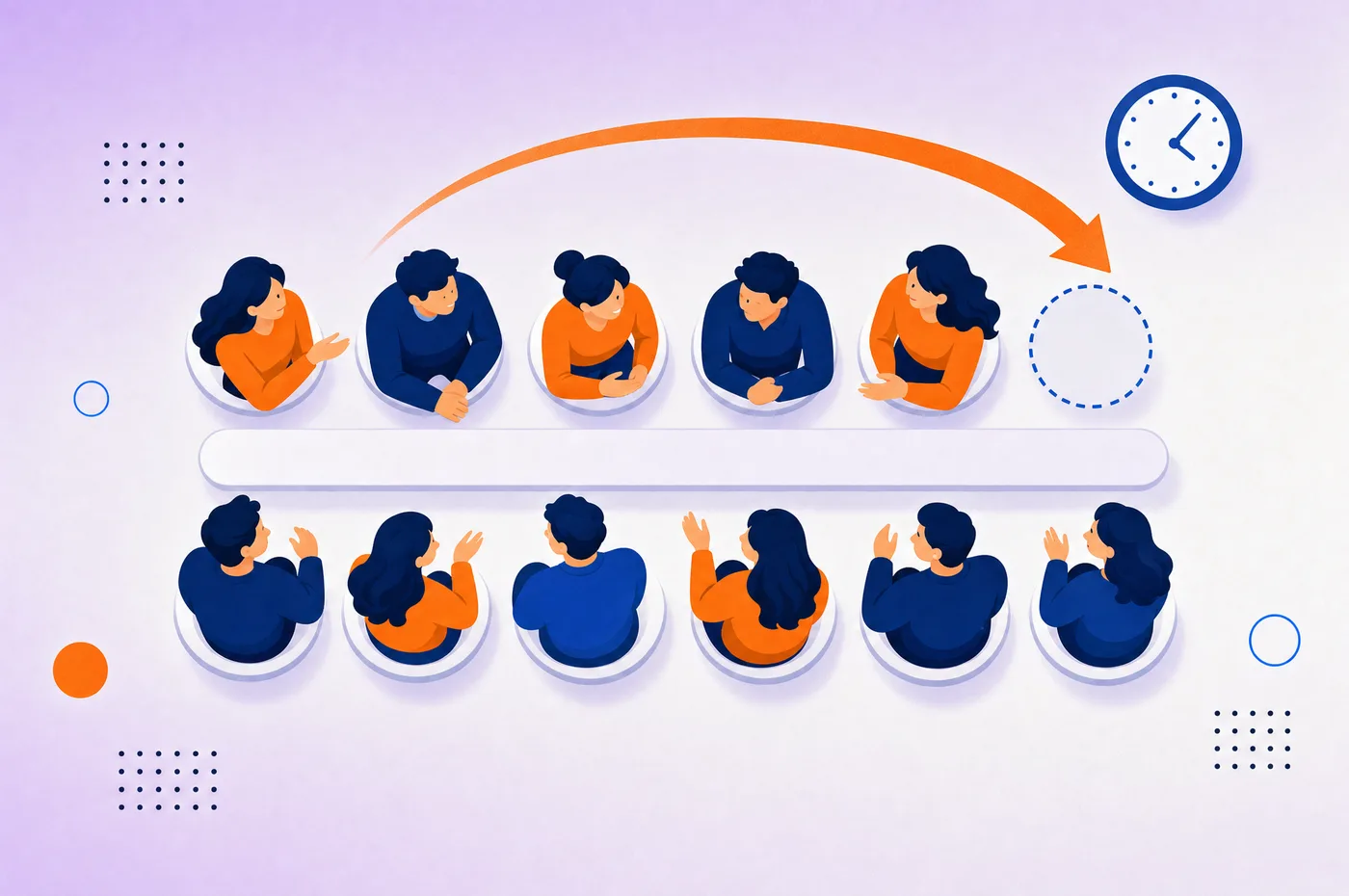
Three planning rules follow directly. First, fix the round count from the time budget, not from the participant count. Second, budget rotation time honestly: 45 to 60 seconds per switch in a twin-row layout, more if the room is tight. Third, protect a buffer at the end, because a session that ends at a sprint leaves no space for the exchanges that participants actually came for.
Run of show
A 60 minute session that holds its schedule
- Min 0 to 10 Doors and seating Seat participants as they arrive using numbered spots. Empty chairs get visible now, not in round one.
- Min 10 to 15 Briefing One rule set, one demo rotation, one clear signal sound. Under five minutes, always.
- Min 15 to 50 Timed rounds Seven to nine rounds of 3 to 4 minutes; nine rounds fit only at the short end. Announce the halfway point so nobody is surprised by the end.
- Min 50 to 55 Final round plus buffer Close with an exchange window: contacts, notes, and the two conversations people want to continue.
- Min 55 to 60 Follow-up bridge Point every participant to one concrete next step, ideally inside your event app, before they leave the room.
One number in that plan deserves a second look: seven to nine rounds, not fifteen. The corridor of 10 to 15 conversations per session (Guidebook, 2026) assumes a tight room and disciplined switching. Planning the lower bound and beating it reads far better in the feedback forms than the reverse.
Qualify before you rotate
A rotation can only be as good as the people it rotates. This is the single biggest difference between sessions that produce follow-ups and sessions that produce polite nods, and it starts at registration, weeks before the first bell.
The minimum is a role field: who is buying, who is selling, who is exploring. With that alone you can seat the twin rows so that opposite sides actually face each other. The next level is intent: what does this person want to leave with? Two or three structured registration questions are enough to pre-match stations so that a destination management company meets tour operators instead of other destinations. Research on networking event design backs the effort: structure and intentional composition, not charisma, drive the outcomes participants report (Mandeno and Baxter, 2021, Business Horizons).
There is also an inclusion argument that organisers underrate. Structured rotation removes the hardest part of open networking, the walk-up. Newcomers and quieter attendees participate at the same rate as the room-workers because the format does the approaching for them. The bell is a great equaliser.
If you want to go deeper on qualification mechanics, connection caps and mutual confirmation, our guide on improving B2B event matchmaking covers the seven levers in detail.
Plan for no-shows before the first bell
Every rotation plan assumes an even, complete grid of participants. Reality sends you 35 people out of 44 registrations, and an odd number at that. Without a plan, every missing person creates an empty chair, and the participant facing it loses a full round while the room watches.
Three defences, stacked: overbook mildly against your historical show rate, the way airlines do, because free registrations at B2B events routinely lose 20 per cent or more of sign-ups. Build one or two host seats into the grid, staffed by your own team members who step out first when the count is odd, and step back in when someone arrives late. And collapse the grid at the door: re-number the seats to the people actually present instead of running the printed plan. A rotation built on attendance beats a rotation built on registration.
The empty chair is not just a scheduling nuisance. It is the visible symbol of the session’s weakest promise, and the participant who sat through a silent round will mention it in the survey.
When speed networking is the wrong tool
Now the question this guide owes you an honest answer to, because the format has a boundary, and good organisers plan against it rather than discover it live.
Speed networking is at its best when the group is moderately sized, reasonably homogeneous, and the goal is breadth: first contacts, community warm-up, opening a conference with energy. At 40 participants full coverage is already gone; in a sixty-minute slot it survives only up to about 24 participants, and every additional attendee lowers the odds that any given conversation is relevant. For heterogeneous audiences the decay is faster. When 200 startups meet 80 investors, a random rotation wastes most rounds on pairings neither side wanted, and the thesis-fit conversations that justify the trip never get scheduled.
At that point the better tool is a meeting matrix: pre-scheduled 1:1 meetings, built from registration data and mutual interest before the event, with times and tables fixed. The comparison with request-based networking makes the difference concrete: Swapcard reports that at large B2B (business-to-business) events, 65 to 75 per cent of open meeting requests go unanswered (2026). A matrix removes both failure modes at once, the unanswered request and the irrelevant rotation, because every slot is agreed before doors open. How the scheduling mechanics differ between apps is a topic we tested separately in our review of conference networking apps for 1:1 meeting scheduling.
Solution: Converve builds its event platform around exactly this rule-based meeting matrix: participants state who they want to meet, the system schedules mutually confirmed 1:1 meetings with times and tables, and organisers keep a transparent audit trail of why each meeting exists. Many of our customers run both layers in one programme, a structured matchmaking backbone for the buyer and seller meetings, plus a speed networking session as the open, energetic opener.
The practical answer is rarely either-or. It is sequencing: speed networking on day one to seed the room, the matrix for the meetings that carry the business case.
Measure connections, not conversations
Remember the sponsor from the beginning, the one walking the lounge and wondering what the money bought? After a speed networking session, the tempting answer is volume: 38 participants, 9 rounds, 171 conversations. Impressive, and empty. A conversation count measures throughput, not outcome.
The evidence for short-format networking is encouraging, but it is specific. In a structured speed mentoring programme evaluated in Academic Pediatrics, roughly 60 per cent of pairs had further contact after the event, and about a third expected the relationship to continue (Cellini et al., 2017). Speed formats can create durable ties. They create them when something happens after the bell, which is why research on tie formation warns that quickly formed ties need reinforcement to persist (Brennecke et al., 2022, Journal of Management).
So measure the chain, not the room: conversations held, contacts exchanged, follow-ups sent within a week, meetings booked as a result. The last link is the one your sponsor actually paid for, and it is the number that decides whether the slot earns its place in next year’s agenda. If your event app captures contact exchanges and follow-up messages, the report writes itself.
FAQ: speed networking in practice
How long should a speed networking session last?
Plan 45 to 60 minutes of total session time, with rounds of 3 to 5 minutes each. That yields 10 to 15 conversations per participant (Guidebook, 2026), which is the point of diminishing returns for most audiences. That corridor assumes pure rotation time; after briefing and buffer, plan seven to nine. Longer sessions trade energy for coverage and usually lose the trade.
How many rounds do I need for full coverage?
In a twin-row rotation, full coverage needs as many rounds as the larger row has seats. Forty participants means 20 rounds, which no sixty-minute slot survives. Plan the round count from your time budget instead: seven to nine rounds in a one-hour session, and pre-match the pairings if relevance matters more than randomness.
What are good speed networking questions?
Skip “what do you do” and give every table three prompts: What brought you to this event? What are you hoping to find here? Who would you like to be introduced to? The third question turns every conversation into a potential warm introduction, which is where short meetings create their long-term value.
What is the difference between speed networking and matchmaking?
Speed networking guarantees that people meet by rotating everyone through timed conversations, without deciding who should meet. Matchmaking decides who should meet, using registration data and mutual interest, and typically fixes 1:1 meetings with times and tables before the event. Speed networking delivers breadth, matchmaking delivers precision, and larger B2B events usually need both.
Conclusion: structure beats speed
Speed networking earns its slot when three things hold. The rotation is planned against the clock instead of against wishful coverage. The pairings are qualified so rounds land on relevant counterparts. And the session ends with a follow-up bridge, because roughly 60 per cent of contacts staying in touch in the closest comparable study (Cellini et al., 2017) only happens where someone built the bridge. None of those three depend on the bell. All of them depend on you.
And when your audience is large, two-sided and travelling for meetings that matter, give the business-critical part of the programme to a pre-scheduled meeting matrix and let speed networking do what it does best: open the room. If you would like to see how both layers run on one platform, get in touch with Converve and we will walk you through it.