The European Commission puts a border check under the new Entry/Exit System (EES) at about 70 seconds. ACI Europe, the association of European airports, reported queues of up to five hours at peak times in an open letter dated 1 July 2026. Somewhere between those two numbers, your first meeting slot of day one either happens or it does not.
Since 10 April 2026, EES has been fully operational at every Schengen external border, and it has changed what “arrival day” means for anyone travelling on a non-EU passport. Its sister system ETIAS, the European Travel Information and Authorisation System, was supposed to follow. It has now been postponed indefinitely. Most of your attendees do not know either of those facts, and a good share of them will confuse the two.
Our position is simple: in 2026 the border is part of your event’s critical path. Entry rules are no longer a travel detail your attendees sort out alone; they decide whether the meetings you promised on day one actually take place. This guide covers what is actually in force, a four-touchpoint communication timeline you can copy, and the buffer rules that protect a hosted buyer programme from the queue at Frankfurt passport control.
EES and ETIAS: What Is Actually in Force in 2026
Before you communicate anything, your own team needs the distinction that trips up almost everyone. EES is a biometric registration that happens at the border and is running now. ETIAS is a pre-travel authorisation that is not in operation, has no start date, and cannot be applied for. Two systems, one active, one paused.
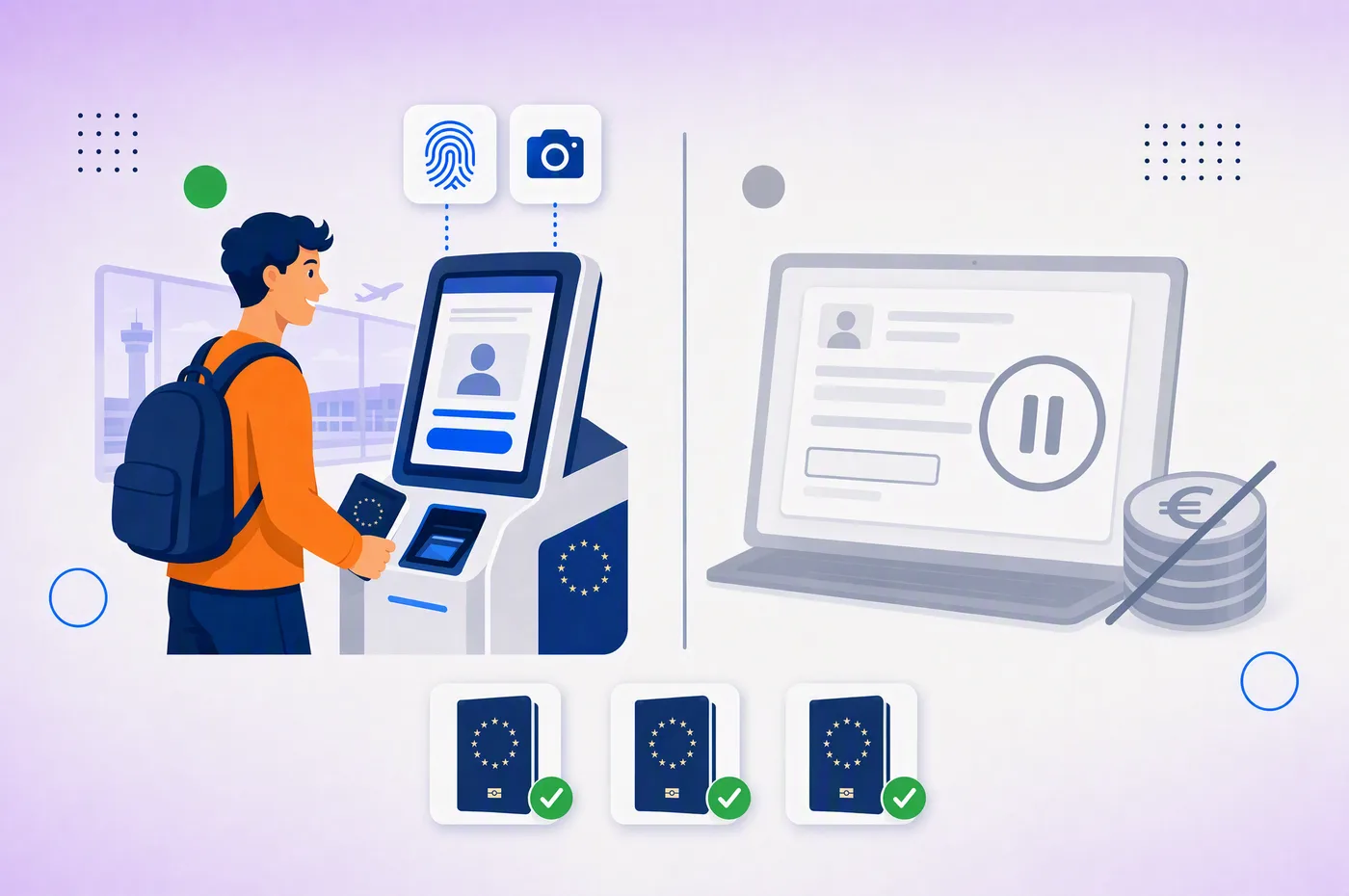
EES replaced passport stamping for non-EU nationals on short stays. On first entry, travellers register fingerprints and a facial image at a kiosk or counter; the system logs every entry and exit and counts down the familiar 90-days-in-180 allowance automatically. Since the progressive rollout began in October 2025, it has registered over 145 million border crossings (European Commission, 27 July 2026). First registration takes the longest. Repeat entries are a document and face check, and noticeably faster.
ETIAS, by contrast, will one day work like the US ESTA: an online application, a EUR 20 fee, an authorisation valid for three years or until the travel document expires. That day is not close. In August 2026 the EU officially postponed the launch indefinitely, and its own portal now states that ETIAS “is currently not in operation” and that no applications are being collected (Euronews, 12 August 2026). A revised timeline is expected after the September board meeting of eu-LISA, the EU agency running the system.
Just as important for your FAQ: who is exempt from EES. Three groups pass unaffected (European Commission, 27 July 2026):
- EU citizens, plus EEA (European Economic Area) and Swiss citizens: nothing changes at the border.
- Holders of long-stay visas or residence permits: they are outside the short-stay logic EES tracks.
- Family members of EU citizens with a residence card: also exempt from biometric registration.
Everyone else with a non-EU passport goes through EES. That includes your visitors from the UK, the US, China, India and Türkiye. German trade fairs alone counted 63,400 international exhibiting companies and over one million international visitors in 2024, a large share of them from outside the EU (AUMA, the association of the German trade fair industry). The exemption list is short. The affected list is your buyer database.
Why the Border Is Now Part of Your Event Planning
Knowing the rules is the easy half. The planning question is what the rules do to your schedule, and the honest answer in the summer of 2026 is: more than the official numbers suggest.
Target versus reality at the Schengen border
The gap your arrival day has to absorb
The five-hour figure is not the everyday case: roughly 20 of about 1,500 border crossing points are seriously affected (Biometric Update, August 2026). But those twenty include precisely the hubs your international guests fly into. In early August, airports in Paris, Amsterdam, Frankfurt, Brussels and Milan were reported to be switching off biometric capture in peak periods to keep queues moving, a practice confirmed by Air France-KLM for its hubs. The legal basis, Regulation (EU) 2025/1534, allows a crossing point to suspend biometrics for up to six hours at a time. A traveller cannot know in advance whether their arrival falls into a fast window or a slow one. Which means you cannot know either.
Germany rehearsed early: the rollout started at Düsseldorf Airport in October 2025, with 35 self-service kiosks for pre-registration, before Frankfurt and Munich followed (AUMA), and airport operators still warned of longer waits in the introduction phase. For a meeting-driven event, that uncertainty lands in one specific place: the first meeting block of day one. A buyer who planned ninety minutes from gate to hall and instead spends three hours at passport control does not miss the event. They miss the 9:30 and the 10:15, the two slots you filled with their most-wanted matches because everyone is fresh on the first morning. The exhibitors on the other side of those tables notice. The border queue becomes your no-show statistic.
There is a second-order effect worth naming for your leadership: the transition calendar is moving. The flexibility to suspend biometric checks is scheduled to expire on 6 September 2026, and nine member states, Germany among them, have asked the Commission in a joint letter to keep it in place beyond that date (Biometric Update, July 2026). Rules that shift monthly are exactly the kind of topic attendees will ask an AI assistant about, get a confidently outdated answer, and then email your support inbox. The organiser who communicates current, dated facts wins that exchange by default.
The Four-Touchpoint Communication Timeline
None of this requires a legal department. It requires putting entry information into channels you already run, at four moments. The pattern mirrors what we recommend for GDPR-compliant event software and the EU AI Act transparency rules: translate the regulation once, so a thousand attendees do not have to.
From registration to arrival day
The entry communication timeline
- Registration One paragraph in the confirmation Add a short border section to the confirmation mail: EES applies to non-EU passports, first registration takes longest, ETIAS is not in operation and nothing needs to be applied for. Link one official source.
- T-4 weeks The practical reminder Name the airports serving your venue and current queue experience. Recommend arrival buffers and, for tight schedules, arriving the evening before day one.
- T-1 week The final logistics mail Repeat the buffer advice in one line, add the embedded FAQ link, and tell attendees where to report a delayed arrival so meetings can be rescheduled instead of lost.
- Day one Monitor and reschedule Watch inbound delays at your key hubs, keep early slots flexible for first-time entrants, and let your matchmaking tool move meetings rather than cancel them.
Two details make this timeline work harder than a generic travel advisory. First, date your statements: “as of August 2026, ETIAS is not in operation” survives a policy change gracefully, an undated claim does not. Second, segment by passport where your registration data allows it. EU citizens do not need the border paragraph at all, and a UK or US buyer reading advice that visibly applies to them takes it more seriously than a blanket disclaimer.
Hosted Buyers: Build the Border into the Meeting Matrix
The stakes concentrate where the meetings are densest. If you run a hosted buyer programme, you have promised exhibitors a schedule of qualified counterparts, often starting first thing on day one. Picture the programme manager who has sold that promise to her top twenty exhibitors: every border delay now has her name on it.
Three buffer rules keep the promise intact:
- Separate first-timers from repeat entrants: ask in the buyer application whether the guest has entered the Schengen area since April 2026. First registration is the slow step; returners clear the border much faster. Give first-timers later day-one slots or an arrival day without meetings.
- Plan transfers against the queue, not the timetable: an airport pickup that assumes 45 minutes from landing to kerb will strand your driver and your buyer. Booking flexibility for transfers costs less than a cancelled meeting block.
- Protect the first slots structurally: hold the 9:00 to 11:00 window on day one for buyers already in town, local attendees or intra-EU guests, and schedule long-haul first-timers from midday. The matrix absorbs the border instead of colliding with it.
Solution: this is scheduling logic, not heroics, and it is exactly what a meeting matrix is for. Converve lets you plan meeting blocks per participant group, keep buffer slots open and reschedule a delayed buyer’s meetings in minutes instead of losing them; the same no-show playbook we describe in how to improve B2B event matchmaking applies here, with the border as the predictable cause. For the full programme design around flights, hotels and qualification, see our hosted buyer solution.
What Not to Communicate
With entry rules, saying the wrong thing is worse than saying nothing, and there are currently three ways to get it wrong.
Do not link or recommend any ETIAS application. There is nothing to apply for, and the EU explicitly warns against third-party sites that sell “applications” for a system that is switched off. If your event website still carries a 2025-era line asking attendees to “anticipate the ETIAS requirement”, delete it: even some official destination guidance published earlier this year still contains that advice, and it now marks the page as outdated. Freshness is credibility here.
Do not present the border as a crisis either. EES exists to make repeat entries faster, the average check really is around 70 seconds, and most attendees will pass without drama. Your message is a calm one: this applies to you, this is the current state with a date on it, plan this buffer, tell us if you are delayed. Attendees forgive queues. They do not forgive an organiser who never mentioned them.
One last line belongs on your entry page: EES and ETIAS only concern visa-free travellers. Guests from visa-required countries still need a Schengen visa, and most will ask you for a letter. Because that letter carries your name to the consulate, decide its content and deadline before the requests arrive, as we set out in our guide to visa invitation letters for event organisers.
FAQ: EES and ETIAS for Event Organisers
Do US or UK attendees need ETIAS in 2026?
No. ETIAS is not in operation and no applications are being collected; the EU postponed the launch indefinitely in August 2026 (Euronews, 12 August 2026). US and UK passport holders travel visa-free as before and go through EES registration at the border instead.
Which attendees are exempt from EES?
EU, EEA and Swiss citizens, holders of long-stay visas or residence permits, and family members of EU citizens holding a residence card (European Commission, 27 July 2026). All other non-EU passport holders on short stays register biometrically.
How much extra time should attendees plan at the border?
For a first EES registration at a major hub, up to three hours at peak times is the prudent planning figure this year; repeat entries are substantially faster. Peak queues of up to five hours were reported at a handful of hubs in summer 2026 (ACI Europe, July 2026), but those extremes stayed the exception: three hours covers the realistic worst case at most airports, while off-peak arrivals often pass in minutes.
What if ETIAS launches before my event?
The EU has said it will announce the start date several months in advance, and a revised timeline is expected after the eu-LISA board meeting in September 2026. If your event falls after the announced start, add the application step to your T-4-weeks mail. A dated FAQ entry is the only maintenance this requires.
Conclusion: The Border Is a Planning Input Now
EES made arrival time a variable, ETIAS made entry rules a moving target, and 2026 is the year both landed on the organiser’s desk. The response is not legal expertise. It is the same discipline you apply to every other risk on the critical path: state the facts with a date, communicate them at four moments, and design your day-one meeting matrix so a border queue bends the schedule instead of breaking it. The programme manager who does this quietly keeps a promise her competitors are still leaving to chance.
If you want meeting scheduling that treats arrival buffers, participant groups and rescheduling as first-class features rather than spreadsheet gymnastics, get in touch with Converve: we have been building B2B matchmaking for international trade shows and hosted buyer programmes for over two decades.