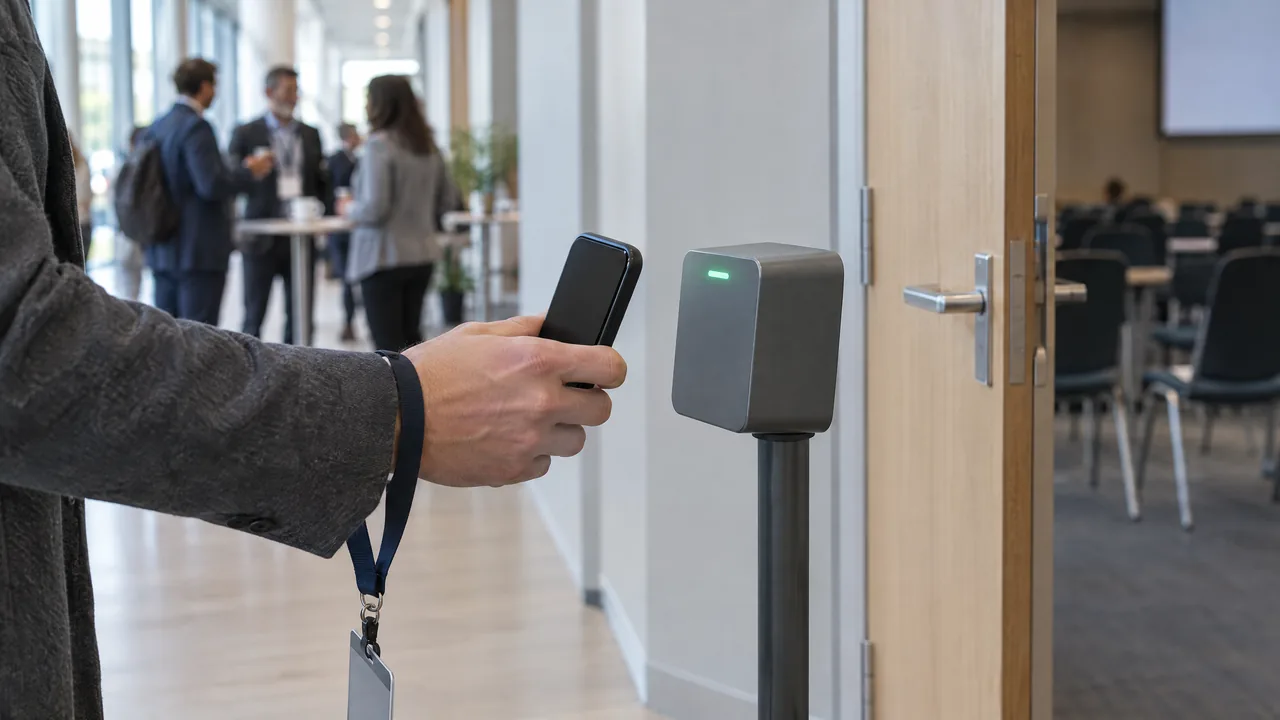
Open any 2026 exhibitor kit and the price of a badge scanner is printed right there: $495 to $545 for a handheld at ATD, $605 to $735 at AAOS, plus a processing fee, plus a loss waiver, plus $205 if you want it delivered to the booth (published exhibitor order forms, verified by Wave Connect, July 2026). A four person booth team pays well past $1,000 per show once fees and delivery are added, just to record who visited.
Now the question that this article is actually about: who receives that money at your event? At most trade shows the answer is a third party, the AV or registration vendor, at $300 to $2,500 per exhibitor per show (industry estimates, 2026). The organiser provides the visitors, prints the badges, carries the data protection risk, and watches the revenue leave the building.
Lead retrieval is not a technical add-on. It is a business model decision, and it deserves the same attention you give to floor space pricing. This guide covers what lead retrieval actually is, the three models for offering it, the maths behind the upsell, and the consent architecture that decides whether any of it is legal in Europe.
What is lead retrieval, seen from the organiser’s side?
Lead retrieval is the service that lets exhibitors capture the registration data of booth visitors by scanning their badges. The data comes from your registration database: name, company, role, and whatever qualification fields you collected. You decide who gets access, at what price, and under which data protection rules.
That last sentence is the strategic point, so it is worth slowing down for. Only the official system can decode the badge ID against your registration database. Universal lead capture apps work around this by photographing the printed badge, running text recognition and enriching the result from third party data sources, at $7 to $10 per lead or $100 to $400 per show (Wave Connect, 2026). They read what is printed. They never see what is registered. The richer your registration data, the bigger the gap between the official channel and the workaround, and the stronger your position as the party that controls it.
One distinction worth keeping sharp: lead retrieval pulls data your attendees already provided at registration, while lead capture describes any tool that records new contacts, including business card scanners. Exhibitors will use both words interchangeably. Your contracts should not.
Why your exhibitors care more about this than about the carpet
Ask the sales director of your anchor exhibitor why the company keeps rebooking, and the answer will not mention the lounge furniture. It will mention pipeline. 85 per cent of exhibitors name lead generation as their primary reason for exhibiting at trade shows (Trade Show Labs, cited by Blinq, 2026). The booth is a lead machine, and lead retrieval is its counting mechanism.
The counting is where most of the value leaks. Industry surveys have put the share of trade show leads that never receive a follow-up near 80 per cent for years, largely because contacts end up on paper, in photos and in five different phones. A structured scan with qualification notes fixes the data problem before it exists. And the economics reward whoever fixes it: the average cost per lead at a trade show runs $112, against $259 for a field sales call (Expo Pass, 2026), but only if the lead actually reaches the CRM (customer relationship management system).
Why exhibitors pay attention
The lead economics behind the booth
For you as the organiser, these numbers translate into retention. Exhibitors now average around $24,000 in spend per show and have become more selective about which shows stay on the calendar (vendor-reported industry data, 2026). The ones that can show a clean lead-to-pipeline story rebook. The ones that leave with a stack of business cards write your show off as a branding expense. A working lead retrieval offer is one of the cheapest retention tools you have. We make the same argument from the exhibitor’s chair in our piece on why exhibitors should use a B2B matchmaking tool.
Retention, not rental fees, is the real revenue line.
The three models, and what each one signals
Every organiser runs one of three models, whether by decision or by default.
- Included in the booth package: Lead retrieval ships free with every stand. Signals a modern, exhibitor-first show and removes the most resented line item from the kit. Costs you the upsell revenue, and undifferentiated inclusion can undervalue the service.
- Paid add-on, sold by you: You price scanning licences yourself, keep the margin and control the data flow end to end. Requires a platform that supports it and a sales moment in the exhibitor journey.
- Outsourced to a third party: The registration or AV vendor sells scanners directly to your exhibitors and keeps most of the revenue. Zero effort for you, and zero control: pricing, support quality and data handling all carry your show’s name but not your standards.
| Model | Who earns | Who carries the exhibitor experience | Best fit |
|---|---|---|---|
| Included in package | Nobody directly, you earn via retention | You | Smaller shows, community events, competitive markets |
| Paid add-on | You | You | Mid-size and large shows with own platform |
| Third party | The vendor | The vendor, under your brand | Shows without their own registration stack |
The third model is the default at most large trade fairs, which is exactly why the first two are worth a look. When the scanner rental is the most complained-about invoice of the show and the complaint lands on your brand anyway, you might as well own the offer.
The maths of the upsell
The revenue side is a short formula: exhibitors, times attach rate, times licence price. A 200 exhibitor show with a 35 per cent attach rate at $400 per licence package produces $28,000 per edition. Raise the attach rate by bundling a first licence into higher sponsor tiers and selling additional seats, and the same show clears $40,000 before the doors open. Against the market anchors, $495 to $735 per rented handheld and $350 to $525 for official app activations on 2026 order forms (Wave Connect, July 2026), a $400 package is not aggressive pricing. It is the going rate, redirected.
The include-it-free calculation is just as legitimate, and for some shows it wins. Free lead retrieval is a booth sales argument that the show down the road may not have, it removes a friction point from the exhibitor kit, and at small events the total upsell potential would not cover the sales effort anyway. If your show competes hard for exhibitors, packaging beats pricing.
What you should not do is leave the question unexamined, because the decision touches more than revenue. This is how the pieces fall into place in sequence:
From decision to invoice
Setting up the offer in five steps
- Define the data Decide which registration fields a scan reveals. Rich fields make the official channel worth paying for.
- Build the consent layer Add granular consent to registration, covering data sharing with exhibitors who scan. Retrofitting this on site is not possible.
- Choose the model Included, add-on or outsourced. Decide who earns and who answers support calls with your brand on the badge.
- Package the licences First licence in premium tiers, extra seats sold per rep. Attach rate follows packaging, not price lists.
- Report and rebook After the show, send exhibitors their scan and meeting statistics. The ROI story does the rebooking for you.
Step 5 is the one that pays twice. Scan counts per exhibitor are also your own sales material: they prove booth traffic in the renewal conversation, and they fit directly into the measurement framework we describe in how to measure B2B event ROI.
A badge scan is not consent
Now the section that decides whether the upsell is an asset or a liability. Under the GDPR (General Data Protection Regulation), the moment an exhibitor scans a badge, that exhibitor becomes a separate data controller with obligations of their own, and the attendee’s registration consent for your event does not automatically cover it (Jigsaw Conferences, 2026). The scan itself is not consent. The consent has to exist before the scan, and it is built at registration, by you.
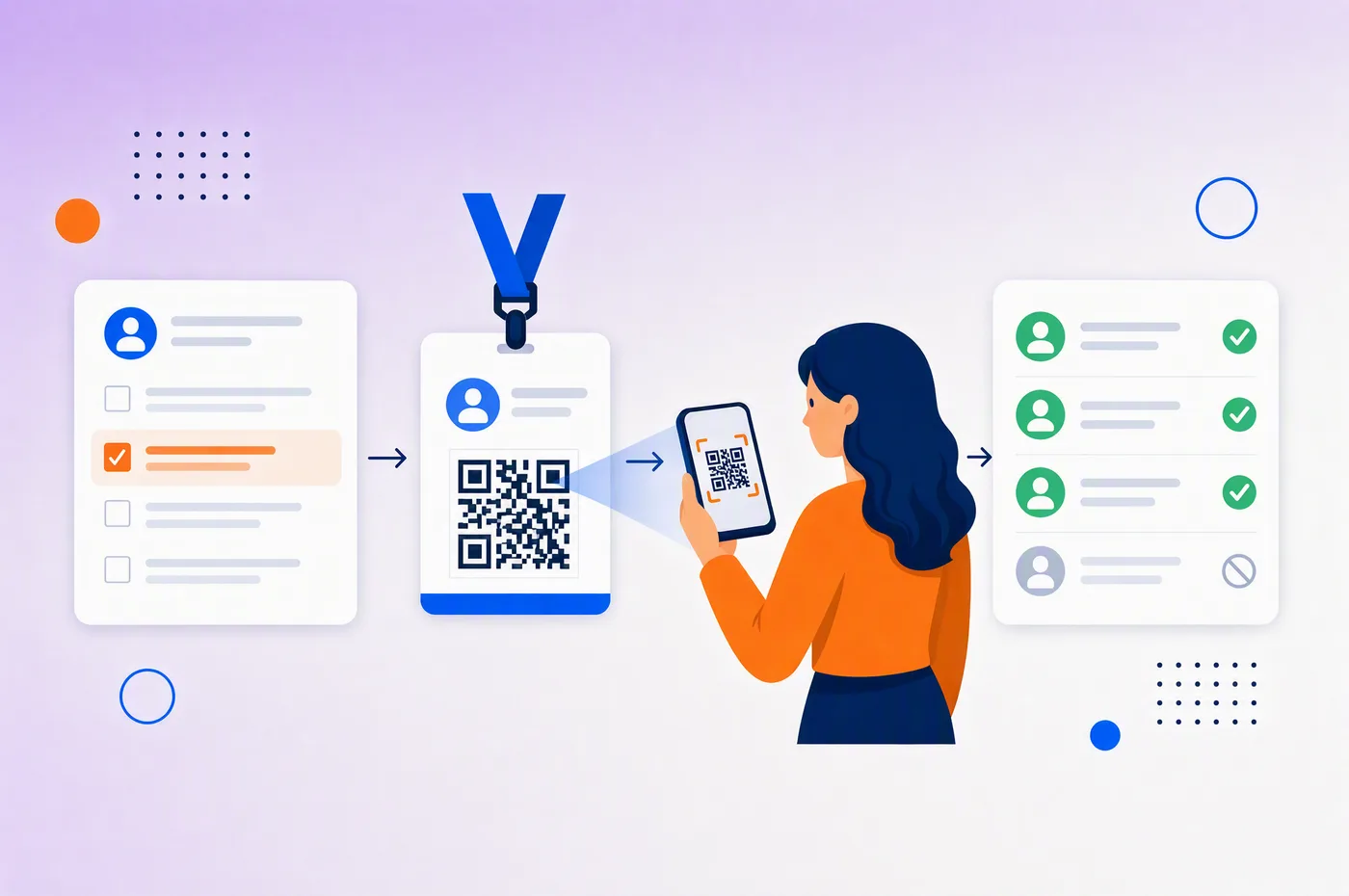
In practice that means a granular consent layer in your registration flow: a separate, specific agreement that badge data may be shared with exhibitors who scan the attendee, ideally with the purpose spelled out. It also means an honest look at the opt-out side, because attendees who decline simply will not appear in scan exports (Integrate, 2026), and your exhibitors should know that before they blame the app. US practice, where consent is typically bundled into event registration terms, does not transfer to European shows (Exhibitor Online), which is precisely why the consent architecture belongs to the organiser and not to the scanning vendor.
None of this is a reason to avoid the topic. It is a reason to own it. If you control registration, badges and the consent text, you are the only party that can make badge scanning clean, and that is a service worth money. The full vendor-side checklist, from processing agreements to hosting locations, is in our GDPR-compliant event software checklist.
Consent is infrastructure. Build it once, at registration.
Scans count traffic. Meetings deliver context.
One honest limitation belongs in every organiser’s calculation: a badge scan records that someone stood at a booth. It does not record why, for how long, or whether the conversation went anywhere. The sales director from earlier can see 300 scans in the export and still not know which ten conversations mattered.
That context comes from a different mechanism: pre-scheduled 1:1 meetings. A meeting that was requested, accepted and held carries intent, an agenda and a follow-up owner by design. The strongest exhibitor ROI story we see combines both layers, scan volume as the reach metric and completed meetings as the substance metric, and it is why shows that run structured trade show matchmaking have an easier renewal conversation than shows that sell scanners alone.
Solution: Converve covers the organiser side of this equation: badge printing and ticket or badge scanning run through the web app, with no extra hardware to rent, and the registration platform carries the consent fields that make scanning compliant. Converve is not a dedicated lead retrieval vendor, and this guide is not a product pitch. The core of the platform is the meeting matrix that turns booth traffic into scheduled, documented 1:1 meetings, which is the data layer exhibitors quote in their own ROI reports.
Lead retrieval starts with a badge that prints on time; event check-in and badge printing capacity shows how many stations that takes.
Scan counts and meeting counts per exhibitor are also what your sales team needs when the renewal calls start, so they deserve a permanent place in your own records; which fields to keep there is covered in our guide to event CRM for organisers.
The same charge-or-include question returns when exhibitors ask for pre-booked meetings. There the organiser sells a promise that depends on buyers turning up, which is why paid meeting packages for exhibitors need buyer obligations and a written shortfall rule before they get a price.
Conclusion: treat it like floor space
Lead retrieval is priced, sold and complained about at every trade show, the only open question is whether the organiser is a bystander or the owner of the offer. Owning it means deciding the model deliberately, packaging licences instead of listing prices, building consent at registration, and reporting results so exhibitors can defend the spend internally. Whether the result is a $28,000 revenue line or a booth sales argument depends on your market. Either way, the decision is yours to make, not your AV vendor’s.
If you want to see how badge scanning, registration and structured 1:1 meetings work as one system, get in touch with Converve and we will walk you through it.
FAQ: lead retrieval for event organisers
What is lead retrieval at a trade show?
Lead retrieval is the organiser-provided service that lets exhibitors capture the registration data of booth visitors by scanning their badges. The data comes from the event’s registration database, so the organiser controls access, pricing and the data protection framework.
How much does lead retrieval cost in 2026?
Published 2026 exhibitor order forms show $495 to $735 for handheld scanner rentals and $350 to $525 for official app activations per show (Wave Connect, 2026). Universal capture apps charge $100 to $400 per show or $7 to $10 per enriched lead. Third party vendors charge exhibitors $300 to $2,500 per show (industry estimates, 2026).
What is the difference between lead retrieval and lead capture?
Lead retrieval decodes the badge against the event’s registration database and returns the data the attendee provided. Lead capture is the broader category of tools that record new contacts, including business card scanning and text recognition apps that read the printed badge without database access.
Should organisers offer lead retrieval for free?
At small events and in competitive exhibitor markets, including it in the booth package is often worth more as a sales argument than the add-on revenue. Larger shows with their own registration platform typically earn more by selling licences, packaged into sponsor tiers.
Is badge scanning GDPR compliant?
Only if consent is built into registration. The attendee must agree, specifically and in advance, that their data may be shared with exhibitors who scan their badge. The scan itself is not consent, and the exhibitor becomes a separate data controller with own obligations (Jigsaw Conferences, 2026).