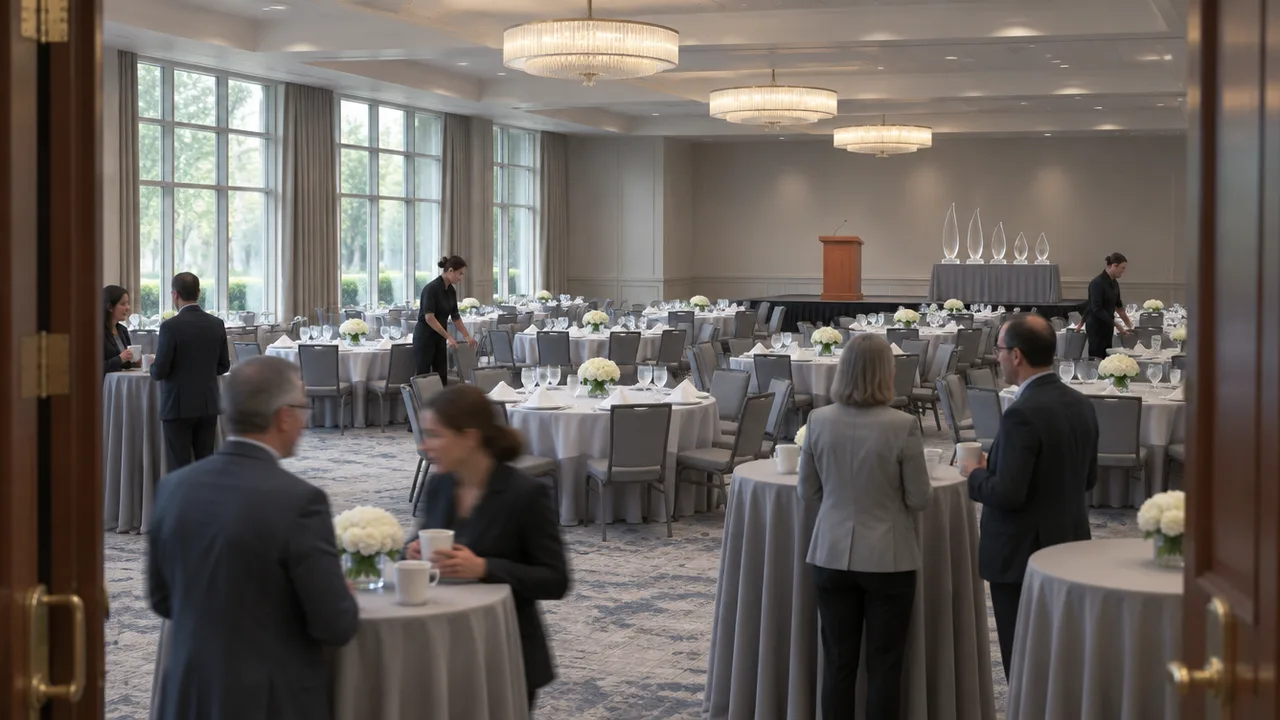
The Joint Statistical Meetings (JSM) are held jointly with 13 societies, from the American Statistical Association to the Royal Statistical Society. They bring together more than 5,000 attendees from 52 countries (American Statistical Association, JSM 2026 conference information). For many statisticians, one trip replaces several society meetings.
“Joint” can mean very different things, though. The American Mathematical Society (AMS) and the Mathematical Association of America (MAA) co-hosted the Joint Mathematics Meetings (JMM) for several decades. Since the 2022 meeting, the AMS alone hosts, organises and manages the event, while partner organisations stay involved in the programme. In the AMS’s own words, the meeting “will remain very much ‘joint!’” (AMS, JMM Reimagined). Same name, different contract.
Two professional societies have agreed to hold a congress together. Before the programme committees meet, their directors need a written agreement on three matters. Who covers a loss? How will the partners handle payments and share a surplus? What member data will each society receive? The answers give both teams a basis for the programme and budget.
What is a joint conference?
A joint conference is one congress that two or more associations plan and present together: one date, one venue, one registration and one programme, under a shared name or under both names. Each society brings its members, its speakers and often its sponsors.
That separates it from two neighbouring formats. A co-located event runs next to a larger event under its own brand and with its own programme. How the agreement with the host works there is covered in our guide to co-located events. A supporting organisation only lends its name. In a joint conference, every partner is an organiser.
Digestive Disease Week (DDW) shows how far the idea can go. The meeting is jointly sponsored by four societies for liver disease, gastroenterology, endoscopy and gastrointestinal surgery, among them the American Association for the Study of Liver Diseases (AASLD). Its name and logo belong to a separate company, DDW LLC (DDW, guidelines and licence for use of DDW content). Few societies need that much structure. All need to know which one they have.
Why associations hold a joint conference, and when not to
Knowing the structure matters because the reasons for a joint conference are usually good. Members in neighbouring fields often belong to both societies and cannot justify two trips a year. Exhibitors and sponsors prefer one larger audience to two small ones.
The Society of American Archivists (SAA) wrote its expectations down. According to the principles its Council adopted in November 2014, a joint meeting should attract new and more diverse attendees and improve the programme. It should also increase revenue from new members and vendors, and not have an unreasonable impact on staff workload (SAA, Principles and Priorities for Planning Joint Meetings with Other Professional Organizations, 2014). The last point is the one most often forgotten. A joint congress saves a venue, but it adds meetings, approvals and a second board to every decision.
There are also reasons to say no, or not yet:
- Your congress carries the annual general meeting, awards and elections, and members see it as their society’s own event.
- Congress revenue funds a large part of your budget, and a split would leave a gap.
- The memberships overlap less than the boards assume. Ask members, not mission statements.
- One partner is so much larger that the smaller society’s members would no longer recognise their meeting.
None of these rules out a joint conference. Each one changes which model fits.
Three ways to share one congress
The model is the first decision, and it settles most of the later ones. In practice, joint conferences follow one of three patterns.
| Model | Who signs venue and supplier contracts | Who carries the financial risk | Fits when |
|---|---|---|---|
| Lead organiser with partner societies | One society | The lead society; partners receive a fixed fee or an agreed share | Sizes differ a lot, or only one office has the staff |
| Rotating host under a joint committee | The host society of that year | The host, under a cost and surplus split agreed in advance | Partners of similar size who meet regularly |
| Separate joint entity | A company or association founded by the partners | The entity, within the capital the partners give it | A long series with its own brand, as at DDW |
The table hides a legal point. If two societies simply run a congress together and share its income and costs, the law may treat them as partners in a business. In England, the Partnership Act 1890 defines partnership as “the relation which subsists between persons carrying on a business in common with a view of profit” (section 1). Under section 9, every partner is liable jointly with the others for the debts of the firm. Other countries have comparable rules. Choose the model on purpose, and have the agreement reviewed by a lawyer in each partner’s country. Nothing in this article is legal advice.
The JMM shows that the model can also change, without the meeting losing its joint character.
What the cooperation agreement must settle
Once the model is chosen, write it down before anyone books a room. The executive director will be tempted to start with the programme, because that is where the enthusiasm is. Start with the agreement instead, and cover at least these points:
- Parties and model: the partners, the model and, with a lead organiser, who signs contracts.
- Term: one edition, a series or a rotation, and how a partner can leave.
- Governance: a steering group with named members and a rule for disagreements.
- Money: who approves the budget, how costs and a surplus or deficit are split, and when accounts close.
- Programme and fees: who sits on the programme committee, and whether all partners’ members pay the member rate.
- Sponsors and brand: who sells packages, the event name and how each society appears.
- Data: who collects registration data, for which purposes, and what each partner receives.
- Cancellation and exit: what happens if the congress is cancelled or a partner withdraws. Our guide to force majeure in event contracts shows what to negotiate with venues and hotels at the same time.
The decision rule deserves extra care. Unanimity sounds fair between two partners and turns into a deadlock with four. Name the questions that need every partner’s consent, such as the budget, the venue and the event name, and let the steering group decide everything else by majority.
Write the deadlock clause while everyone still agrees.
Money: splitting costs and surplus between unequal partners
The money clause is where partners of different size feel the difference first. Suppose your society has 4,000 members and the partner has 600. A fifty-fifty split looks unfair to the larger one. A split by membership size ignores who actually comes.
Three keys are common, and each suits one of the models:
- A fixed share agreed in advance, such as 70 to 30. It is simple and works when attendance from both sides is predictable.
- A share by registrations, counted by the membership each delegate states when registering. It follows the real audience.
- A fixed fee for each partner society, while the lead organiser keeps the risk and the surplus. It suits the lead organiser model.
A worked example shows the second key. A congress has 1,200 paying delegates: 800 state membership of society A, 300 of society B and 100 are non-members. If the agreement allocates non-member registrations in the same ratio as members, society A receives about 73 per cent of a surplus and carries the same share of a deficit. Delegates who belong to both societies need their own rule, for example that each society counts them as half a delegate.
Agree the key before the first invoice arrives.
Then build one budget that both treasurers can read line by line; our event budget template gives a structure for it. Existing sponsors of each society will ask whether their benefits carry over, and our guide to sponsors for association events shows how to build packages for a larger, shared audience.
One programme, not two congresses side by side
Once the partners have agreed how to share costs and risk, they can choose how to build the programme. Two arrangements are common. In the first, each society plans its own share; at DDW, for example, the AASLD’s scientific programme committee develops “AASLD’s portion” of the meeting (AASLD, DDW Scientific Program Committee). In the second, one joint committee plans the whole programme by topic.
Most do best with a mix: a joint programme committee sets the themes, plenaries and review rules, and each society keeps a few slots for its own section meetings and annual general meeting. How to staff the committee and run abstract review is set out in our guide to the conference programme committee. Where the annual general meeting fits in a society’s year is discussed in our guide to association event management.
Watch for one sign of trouble. If the draft reads like two congresses in one booklet, society A in hall 1 and society B in hall 2, the members will not meet. Mix sessions by topic, and plan at least one plenary and one evening event for everyone. Picture a liver specialist and a surgeon who never attend each other’s society meetings, sitting side by side in a shared case session. That conversation is the reason for the whole effort.
Member data: who may see whose members
The next hard question waits in the registration form. A joint conference tempts both offices to swap member lists for promotion, or to hand every partner the full attendee list afterwards.
The General Data Protection Regulation (GDPR) sets the starting point. Where two or more controllers jointly determine the purposes and means of processing, they are joint controllers. They must set out their responsibilities in an arrangement, and its essence has to be made available to the people concerned (GDPR, Article 26). The UK Information Commissioner’s Office (ICO) adds that no contract is required, but that each joint controller can be liable for the entire damage caused by the processing (ICO, guidance on joint controllers). A shared registration therefore needs a written answer to three questions:
- Who runs the registration, and on whose behalf?
- Which data does each partner receive after the congress, and for what purpose?
- Where do delegates find this information before they register?
In practice, each society promotes the congress through its own channels, the registration form asks for the membership, and partners receive only what the delegate agreed to. Our guide to sharing attendee lists explains why meetings are a better promise than lists, for sponsors and partner societies alike.
Solution: With Converve you set up ticket types per participant group, for example members of society A, members of society B and non-members, each with its own price and contingent. Separate promo codes can go out through each partner’s channels. Every ticket includes the invitation to register on the event platform, so delegates create one profile for the whole congress. In the rule-based meeting matrix you decide which groups may request meetings with which, so that members of both societies can book one-to-one meetings with each other. More on the registration page.
A timeline from handshake to final accounts
Data rules, like the agreement, need lead time, and every milestone of a joint congress passes more than one board. Our conference planning timeline shows the single society version; for a joint congress, start a few months earlier and add these steps.
A joint congress of two or more societies in seven steps
- 24 months Agree in principle Both boards confirm the aim, the preferred model and a steering group with named members.
- 20 months Sign the agreement Model, term, decisions, money, programme, data and exit in one document, reviewed in each partner's country.
- 18 months Book venue and dates The contracting society signs, with dates checked against every partner's calendar.
- 12 months Form the programme committee Members from every partner set themes, plenaries and the rules for abstract review.
- 6 months Open one registration One form with a membership field, member rates for all partners and a privacy notice naming each of them.
- Congress Run one event Shared plenaries and evening events, plus separate slots for each society's own meetings.
- 3 months after Settle the accounts Apply the agreed key, share feedback by society and decide on the next edition.
Three months after the congress, the executive director’s board will ask whether it was worth it. Answer with figures by society: registrations from each membership, new members, sponsorship revenue against the last solo edition, and staff hours. The SAA’s warning about workload belongs in that review.
Conclusion: settle the contract, then the programme
For members, a shared congress means one trip to meet people from both societies. For the organising teams, it means agreeing who covers a shortfall, how to divide costs and any surplus, and who may use member data. Put those decisions in writing before the committees start allocating sessions.
If you are planning a joint congress and want to see how ticket types per society, member rates and meetings across both memberships can be set up, get in touch with Converve. More on our solutions for associations.
Frequently Asked Questions
What is a joint conference?
It is one congress that two or more associations plan and present together, with one date, venue, registration and programme. The Joint Statistical Meetings, held jointly with 13 societies (American Statistical Association, 2026), are an example. Unlike at a co-located event, every partner is an organiser.
Who is the legal organiser of a joint conference?
That depends on the model: one lead society signs all contracts, the host rotates under a joint committee, or the partners use a separate entity; at DDW, the name belongs to DDW LLC. Partners who share profit without a clear structure may fall under partnership law. Have the agreement reviewed by a lawyer.
How do associations split the costs of a joint conference?
Common keys are a fixed share agreed in advance, a share by registrations from each society’s members, or a fixed fee for partners while the lead organiser keeps risk and surplus. Write the key into the agreement before the first invoice, with a rule for delegates in more than one society.
Can partner societies share their member lists for a joint congress?
Not simply. Partners that jointly decide on the processing are joint controllers under Article 26 of the GDPR and need a transparent arrangement whose essence delegates can see. Each society should promote the congress to its own members, and partners receive only the data delegates agreed to share.