APEX EXPO 2027 sells 30-minute presentation slots in its Technology Theater on the exhibition floor for 2,500 US dollars each, first come, first served, and every presenter receives a list of scanned participants (APEX EXPO 2027, Technology Theater order form). GrindingHub 2026, a trade fair for grinding technology, takes a different route: its forum is deliberately not a stage for product presentations, every 30-minute session follows the pattern challenge, solution, takeaways, and exhibitors propose talks against a topic agenda the organiser sets (VDW, the German Machine Tool Builders’ Association, and GrindingHub, forum letter to exhibitors, March 2026). AHR Expo 2027 offers 20-minute product presentations, hands out no attendee lists and only counts the audience by scanning badges (AHR Expo, Theater Speaker Checklist, 2027).
Three shows give three different answers to the same questions. Who gets the stage, what does it cost, and what does the exhibitor take home? If you have not answered them before the first slot is sold, the theatre answers them for you, usually with half-empty rows.
A specialist show’s sales team wants to sell twenty theatre slots a day. Before quoting a price, the show manager needs to decide which talks visitors would make time for, when they will be in that part of the hall and where they can speak to the exhibitor afterwards. Those decisions shape both the programme and the offer to exhibitors.
What an exhibitor theatre is, and what it is not
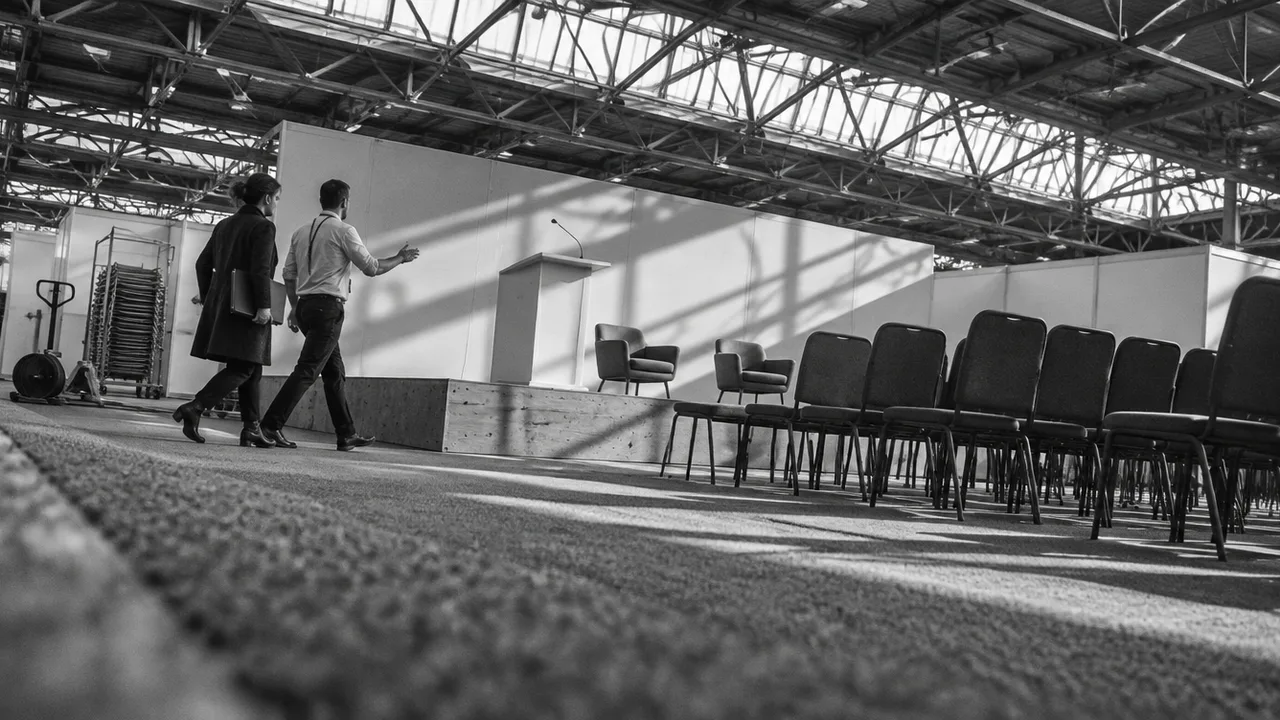
An exhibitor theatre is an open presentation area on the show floor where exhibitors give short talks, usually 15 to 30 minutes long, to visitors who walk in from the aisles. Walls are low or missing, and the audience changes with every slot.
It differs from three neighbouring formats. The conference programme is selected by a committee and runs in separate rooms. Satellite symposia at medical and scientific congresses are industry sessions kept deliberately outside the scientific programme, a separation our guide to satellite symposia explains in detail. Lightning talks are five-minute talks in quick succession, and our article on lightning talks points out that a paid sponsor talk in a show floor forum is a different product, even when it carries the same name.
The exhibitor theatre sits in between. The exhibitor brings the content, but the organiser owns the stage and the audience’s time. That is why the theatre needs rules.
Paid, curated or sponsored: choose the model first
The examples above show that there is no single business model. Four can be told apart, and each one shifts the risk to a different place.
| Model | How slots are allocated | What the exhibitor pays | Main risk |
|---|---|---|---|
| Paid, first come | Order form, the earliest booking wins | A fixed fee per slot, such as 2,500 US dollars for 30 minutes at APEX EXPO 2027 | Sales talks in front of empty seats |
| Curated by topic | The organiser sets the topics, exhibitors submit proposals | Depends on the show; GrindingHub 2026 asks for title, challenge, solution and takeaways | Review workload and more proposals than slots |
| Paid, reviewed | Booking only after the topic is approved | A fixed fee per slot | Exhibitors feel they pay to be judged |
| Sponsored stage | One partner per stage or per day | A package, such as 15,000 US dollars for an exclusive one-hour slot with branding at Commercial UAV Expo 2026 | One brand dominates the stage |
Sources: APEX EXPO 2027 order form; VDW and GrindingHub, forum letter to exhibitors (March 2026); Commercial UAV Expo 2026 sponsorship page; all retrieved 24 November 2026.
The right model depends on the job the theatre has to do for your show. If it is mainly a revenue line, paid slots are easy to sell, and they belong in the same price list as stand space, meeting suites and visibility packages; our guide to booth pricing shows where such add-ons sit in the offer. If the theatre is meant to give visitors a reason to come, the content has to be worth a seat, and somebody has to read it before it reaches the stage.
The show manager does not have to choose between money and quality. A paid slot with a reviewed topic keeps both, as long as the review criteria are published before anyone pays. Price buys the slot. Review protects the audience.
Rules that keep the audience in the seats
Review only works if exhibitors know in advance what you review against. Visitors in an open theatre vote with their feet within the first two minutes, so the rules you publish with the order form decide what they will hear:
- One problem per talk: the abstract names a problem your visitors have and the answer the talk gives. A product name in the title is fine; a product tour as the whole content is not.
- Something to see: a case, a measured result or a short demonstration of a product that is on the exhibitor’s stand. AHR Expo 2027 asks presenters to promote a product or service they show at the event and not to mention or compare competitors’ products.
- A speaker with expertise: an engineer, a product manager or a customer, not whoever happens to be free at the stand that morning.
- Time discipline: the talk ends on time, with questions inside the slot.
- Rights for recordings and slides: if you want to film talks or publish slides after the show, say so in the terms before anyone submits, not in an email the week before.
Two dates protect the programme as well. A deadline for slides a few weeks before the show lets your technicians load every talk onto one machine. A withdrawal cut-off with a fee discourages the cancellation that leaves a hole on the day. GrindingHub 2026 even offers exhibitors two short workshops on presenting in the forum and on building a talk from challenge to takeaways. Which clauses belong in the contract, from recording rights to cancellation, is covered in our guide to the speaker agreement, and the briefing that follows it in our speaker guidelines.
Picture an exhibitor who books a slot in March and sends the title “Our new pump series”. Under these rules, the reviewer sends it back with one question: which problem does it solve for your visitors? The revised title is about cutting energy costs in older buildings. Same speaker, same pump. A full row instead of an empty one.
Build the timetable around the visitors
A strong talk still fails at the wrong time. An open theatre competes with every stand around it, so the timetable has to follow how visitors move through the hall, not how many slots the sales team can sell:
- Plan 20-minute talks in 30-minute slots. The ten minutes in between are for questions, the next speaker’s microphone and a change of audience.
- Group talks by theme into half-day blocks, so that a visitor interested in one topic can plan an hour around it.
- Give the busiest visitor hours to your strongest topics, and never schedule a theatre talk against a conference session on the same subject.
- End the last block before visitors start to leave the hall. Nobody gains from a talk to the cleaning crew.
- Publish the timetable with the rest of the visitor programme, so that the talks appear where visitors plan their day.
Working backwards from the show, the whole process fits into six steps.
From call for presentations to exhibitor report in six steps
- 6 months Open the call Publish the model, the price if any, the review criteria and the withdrawal terms with the exhibitor offer.
- 5 months Close and review Check every abstract against the criteria and send unclear titles back with one question.
- 10 weeks Publish the timetable Group talks into theme blocks and put them into the visitor programme and the event app.
- 4 weeks Collect slides Load all files onto one machine and confirm speakers, times and the withdrawal cut-off.
- Show days Run the theatre Keep time, count the audience and point visitors to the meeting slots at each stand.
- 1 week after Report to presenters Send each exhibitor its audience count, meeting requests and meetings held after the talk.
The show manager now has a calendar the sales team can sell against. What it does not have yet is a reason for visitors to walk from the theatre to the stand.
From talk to meeting: the step most theatres miss
After the talk, a visitor has a detailed question. The exhibitor’s stand is three halls away and lunch is about to start. How can the visitor arrange a conversation before losing track of the speaker?
Three measures close the gap:
- The last slide names the stand and one person to ask for. AHR Expo recommends putting contact details or a follow-up link on the closing slide, and GrindingHub 2026 explicitly invites visitors to continue the conversation at the presenting exhibitor’s stand.
- The exhibitor keeps meeting slots free at the stand in the hour after the talk, and visitors can request them before the show and on the day.
- The talk sits in each visitor’s personal agenda next to the meetings already booked, so that a meeting at the stand cannot clash with the talk itself.
Think of a plant engineer who hears a 20-minute talk on refrigerant changes at 11.00. At 11.40 she is at the exhibitor’s meeting table with two questions about her own site. The talk created the interest. The meeting turned it into a project.
Who receives data about the audience is a separate decision. APEX EXPO hands presenters a list of scanned participants, while AHR Expo only counts heads. If you pass names to exhibitors, visitors need to know before their badge is scanned; our guide to sharing attendee lists with sponsors and exhibitors explains what the General Data Protection Regulation (GDPR) asks of organisers there. Nothing in this article is legal advice. A meeting request that the visitor sends personally is the cleaner route, because the visitor decides. How such requests between visitors and exhibitors are matched is covered in our guide to trade show matchmaking software.
Solution: In Converve’s programme module, theatre talks sit in the agenda next to the rest of your show programme, with session registration, seat limits and session check-in where you need them. Each visitor’s personal agenda stays in sync with their booked one-to-one meetings. In a rule-based meeting matrix you decide which participant groups may request meetings with each other, and accepted meetings land in free slots in both agendas, so a visitor can book a meeting at the stand for the hour after the talk.
Report what the theatre delivered
Once the show is over, every presenter wants to know what the talk brought, and your next sales conversation depends on the answer. Send each one a short report within a week:
- the audience count for the slot, from badge scans or a manual count
- the share of seats filled at the start and at the end of the talk
- meeting requests the exhibitor received on the day of the talk
- meetings held at the stand after the talk
- the slot’s theme block and time, compared with the theatre average
The first two figures tell you whether the programme worked. The last three tell the exhibitor whether the talk was worth the effort. Together they belong in next year’s offer: an exhibitor prospectus that states how many visitors a typical theatre slot reached sells the next slot more easily than a photo of a stage. Exhibitors who leave with meetings rather than just a headcount also have one more reason to rebook, as our guide to exhibitor retention shows.
Conclusion: run the theatre as a programme
Publish the selection criteria before selling the first slot. Group related talks together at times when visitors will be nearby. If someone wants to speak to a presenter afterwards, they should be able to find a free appointment at the stand and add it to their diary. Tell exhibitors upfront what audience data they will receive.
If you want to see how theatre talks, personal agendas and meetings at the stand fit together on one platform, get in touch with Converve. More on our solutions for trade shows and congresses.
Frequently Asked Questions
What is an exhibitor theatre at a trade show?
An exhibitor theatre is an open presentation area on the show floor where exhibitors give short talks, usually 15 to 30 minutes, to visitors walking in from the aisles. It is also called a product theatre, technology theatre or specialist forum. Unlike the conference programme, it runs in the hall and the audience changes with every slot.
Should organisers charge exhibitors for theatre slots?
Both models are common. APEX EXPO 2027 charges 2,500 US dollars for a 30-minute slot, first come, first served (order form, 2027), while GrindingHub 2026 sets a topic agenda and asks exhibitors to propose talks that start from a real challenge (forum letter to exhibitors, March 2026). Charging works if the review criteria are published before anyone pays.
How long should an exhibitor presentation be?
The shows quoted here work with 20 or 30 minutes: AHR Expo 2027 works with 20-minute product presentations, GrindingHub 2026 with 30-minute practice sessions. Plan a 20-minute talk in a 30-minute slot, so that there is time for questions, the speaker change and a new audience.
How do you stop exhibitor talks from becoming sales pitches?
Publish content rules with the order form and review every abstract against them: one visitor problem per talk, a case or measured result, a speaker with expertise and no comparison with competitors’ products. Send unclear titles back with one question about the problem the talk solves.
Do exhibitors receive a list of the people who attended their talk?
That depends on the show. APEX EXPO 2027 gives presenters a list of scanned participants, while AHR Expo 2027 provides no attendee lists and only counts the audience. If you pass on names, visitors must be informed before their badge is scanned. Letting visitors request a meeting at the stand themselves is often the cleaner way to connect them with the exhibitor.