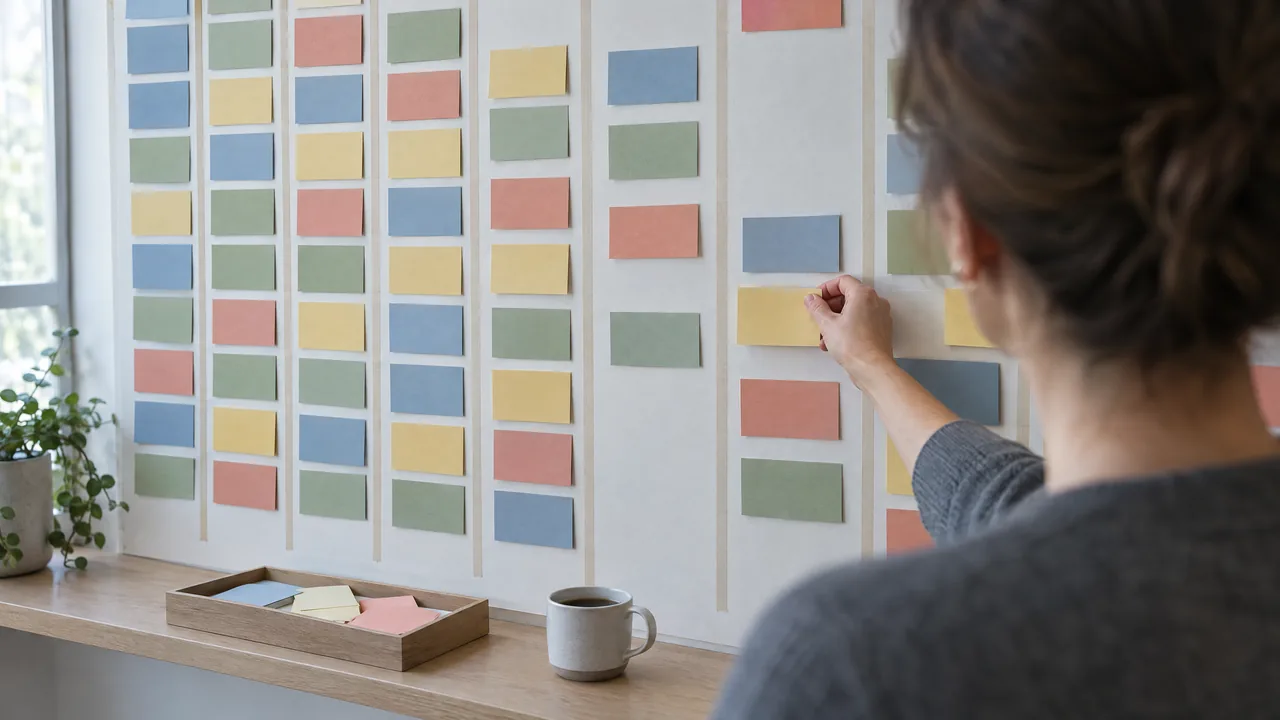
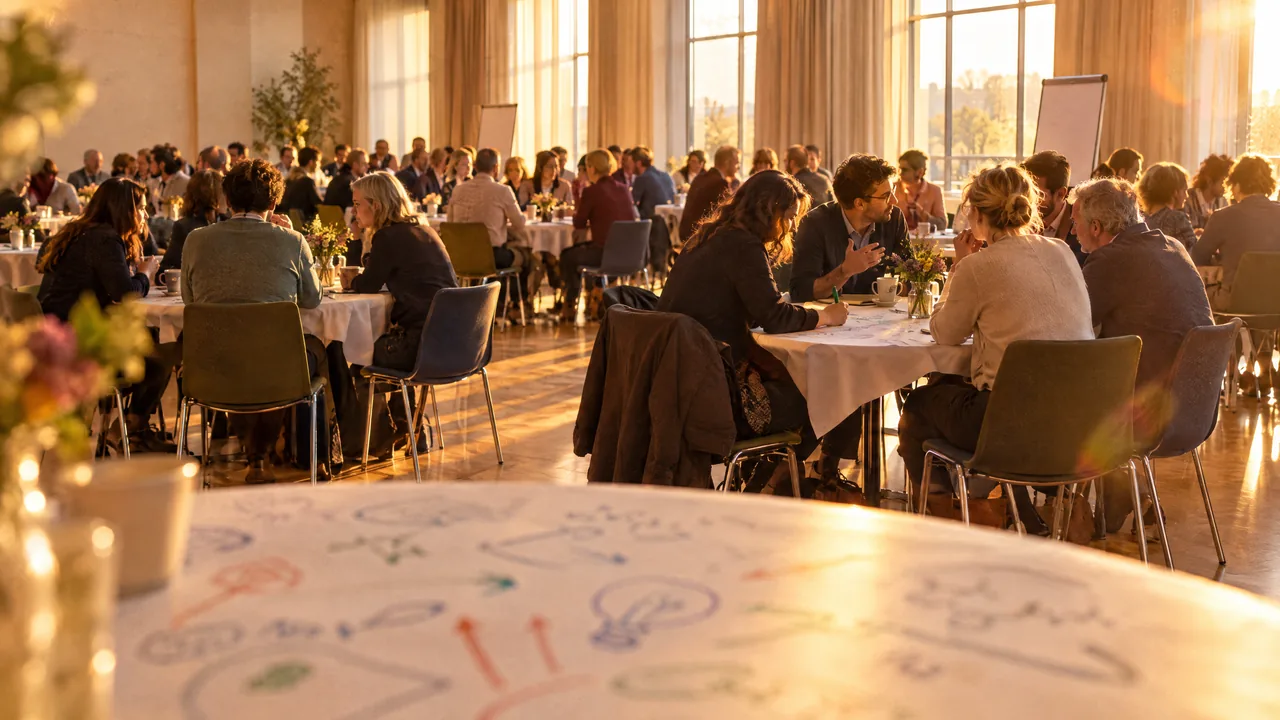
At SC, the international supercomputing conference, a committee selects birds of a feather sessions from more than a hundred proposals. At PyCon AU 2026, attendees can put a topic on a board near registration and gather 10 to 20 people in the foyer. The examples show how the same discussion format can fit both a curated programme and a more spontaneous setting.
A birds of a feather session, or BoF, brings together attendees who share an interest. A host proposes the topic and helps the group discuss it, with the emphasis on participation. As organiser, you provide the time, space and guidance that allow the conversation to work.
This guide helps programme chairs at scientific societies, technical conferences and professional communities add BoFs to their events. It covers the proposal process, rooms and time slots, guidance for discussion hosts and follow-up. With those arrangements in place, attendees can explore interests that the main programme may not cover.
What is a birds of a feather session?
The name already explains the idea. It comes from the proverb “birds of a feather flock together”. The Free On-line Dictionary of Computing (FOLDOC) defines a BoF as “an informal discussion group, scheduled on a conference program or formed ad hoc, to consider a specific issue or subject”. The format is older than any event software. FOLDOC says nobody knows exactly where the term began, but it was reportedly common at SHARE, the IBM user group, from the early 1960s, was used at DECUS (Digital Equipment Computer Users’ Society) meetings, and was “already established” at USENIX conferences by 1984.
That history explains why the format is strongest at technical and scientific events. Communities of practitioners have always needed a place for the problem that is not on the official programme yet. The Internet Engineering Task Force (IETF) made this role explicit. Its RFC 5434 (Request for Comments, Narten, 2009) describes the BoF as the session that often tests whether a topic deserves a new working group: is there a real problem, are enough people willing to do the work, and is the scope clear? For your programme, this means a well-attended BoF is an early signal. Today’s BoF can be next year’s track.
Three features separate a BoF from the sessions you plan yourself:
- One topic from the attendees: the subject comes from a participant or a group, not from your programme committee.
- Discussion first: SC25 allowed presentations for no more than half of the session time, and ISC High Performance says its BoFs “are meant to foster engaging conversations and not formal presentations”.
- Non-commercial: SIGGRAPH 2026, the computer graphics conference, excludes recruitment, sales, product tutorials and company promotion from its BoFs.
BoF, unconference, roundtable: where the format sits
These three features place the BoF among other formats that put attendees in the lead. The difference lies in scope. A BoF is one session inside a conventional programme. An unconference hands the whole agenda to participants, which is why running an unconference is a separate event design with its own session board and opening circle. A roundtable, by contrast, is curated: you choose the topic and invite the people around the table.
| Format | Who proposes the topic | Who leads | Share of the programme | Typical setting |
|---|---|---|---|---|
| BoF session | An attendee or a group | The proposer as host, discussion led | One slot, often lunch or evening | From a table of ten to a room of hundreds |
| Unconference | All participants, on the day | Session conveners | The whole day or event | Many small rooms and a shared board |
| Roundtable | The organiser | A moderator with invited participants | One slot | A small group around one table |
| Panel | The organiser | A moderator with expert speakers | One slot | Stage and listening audience |
| Lightning talks | Speakers who apply or sign up | Each speaker for about five minutes | One slot | Stage and audience |
In the architecture of conference session types, a BoF behaves like a small parallel session whose content you did not plan. That is its value and its risk. If a member wants to present a project rather than open a discussion, a slot in your lightning talks session is the better home. If you need a balanced, moderated exchange between selected experts, the principles of a roundtable discussion fit better than an open door.
Three ways to run BoFs: juried, first come, on the day
Once you know a BoF is the right format, the main design decision is how topics get in. Conferences use three intake models, and each trades control for spontaneity.
Juried call for proposals
SC25 closed its BoF submissions on 14 July 2025 for a conference in November. Proposers wrote a 100 word abstract and a 500 word description, and the committee ranked them “in terms of their potential for community building”. ISC High Performance in Hamburg gives each BoF proposal at least three reviewers and asks for the maximum share of time that will go to presentations. The SIGCSE Technical Symposium, the computer science education conference, reviews 50 minute BoFs through its normal submission system.
This model gives you the most control. Your board knows months in advance what will run under the society’s name. The price is that topics are fixed four months before the event, so the debate that breaks out in week one of the conference has no room.
First come, first served
SIGGRAPH 2026 runs its BoFs without a jury. Organisers request a room, scheduling is first come, first served, and rooms in the convention centre are free, but their layout is fixed. The Association for Computational Linguistics (ACL) asked BoF applicants in 2025 for a short description, expected participant numbers and a preferred time, and kept the right to merge similar requests.
The review effort is low. Your exclusion rules have to be clear, though, because nobody screens the content before it reaches a room.
A board on the day
PyCon AU 2026 asks hosts to write their BoF on a board near the registration desk, pick a spot where 10 to 20 people can gather and announce it in the attendee Discord. FOSS4G 2025, the open source geospatial conference, let anyone claim one of six rooms at lunchtime by editing the schedule page on GitHub. DrupalCon combined both approaches: a form before the event and write-in slots on site (Drupal Association, 2023).
A board gives topics that emerge during the conference a place to land. It also needs the most care on the day, because a board nobody tends fills with clashes and empty promises.
Business events can borrow the lightest version. Business of Software, a conference for software company founders, runs BoF tables at breakfast and lunch, with a topic list set by the organiser that attendees can add to. No extra rooms, just tables with a subject. Pick one model and say so in the call.
When BoFs belong in your programme
The intake model only matters if the format fits your audience. BoFs work when your attendees are practitioners who share problems, when topics move faster than your call for papers, and when people ask for small groups rather than more stage time. The wider market points the same way. Forrester’s Q1 2026 State of B2B Events Survey of over 400 event decision makers found that two thirds of organisations plan more workshops, roundtables and structured networking, while just 18 per cent plan more large hosted events. A BoF track delivers small-group formats without you commissioning each one.
BoFs in numbers
Small, discussion-led and in demand
There is a catch. RainFocus, an event platform, reports from its own benchmark data that average session attendance per person fell from 5.3 sessions in spring 2025 to 4.2 in spring 2026, while scheduled meetings grew (RainFocus 2026 Mid-Year State of Events Report, vendor data). If each attendee goes to fewer sessions, ten BoFs placed against your afternoon tracks will thin out both. A programme chair who schedules BoFs at 14:00 competes with her own speakers.
So use the edges of the day. SC25 placed its BoFs at 12:15 to 13:15 and 17:15 to 18:45, in parallel tracks, where they compete with lunch and the evening rather than with the main programme. BoFs fit poorly where sponsors expect speaking slots, where you need accredited education content with fixed learning goals, or where the audience shares nothing but a ticket.
How to run BoF sessions in six steps
Most of the preparation takes place before the session host enters the room. These six steps cover the arrangements the organising team needs to make.
Organiser run sheet
BoF sessions in six steps
- Months before Choose the intake model Juried call, first come first served or a board on the day. Publish the model together with the call.
- Months before Fix slots and rooms Reserve lunch and evening slots, rooms with movable chairs and one quiet corner for groups that form on site.
- With the call Write the rules One topic, a cap on presentation time, no sales pitches and an open door for anyone interested.
- Weeks before Merge and publish Combine overlapping proposals, publish the schedule with host names and let attendees flag interest so you can size the rooms.
- On the day Brief the hosts One opening question, one note taker, a firm end time and a closing round on what happens next.
- After the event Collect the notes Share the notes within a week and track which topics drew a crowd. They are candidates for next year's programme.
Rules worth copying
Step 3 decides whether a BoF stays a discussion. These rules from existing calls are worth adopting almost word for word:
- Presentation cap: SC25 allows presentations for no more than half of the session. A cap written into the call works better than a request on the day.
- No sales: SIGGRAPH 2026 sends commercial presentations to its exhibits team. Offer sponsors a different slot, or the BoF turns into a product demo.
- Room for newcomers: PyCon AU asks groups to leave a person-sized gap in the circle, which it calls the “Pacman method”, and not to turn anyone away.
- Same place, same channel: if a BoF moves, the host announces it where it was first listed.
- Code of conduct applies: PyCon AU states that its code of conduct covers BoFs as well as the main programme.
How many BoF slots do you need?
Start from the rooms that are free at lunch and in the evening, not from the number of proposals. Here is an editorial rule of thumb, with the arithmetic shown. At a conference of 600 attendees, assume that around a third join a BoF over lunch. That is 200 people. At 20 to 30 people per group, you need seven to ten parallel BoFs, plus one larger room for the topic everyone is talking about. If you have more proposals than rooms, merge them, as ACL and SC both do.
Interest flags before the event tell you which BoF needs the bigger room. A popular BoF in a room for 30 runs into the same problem as an oversubscribed workshop, so the rules on session capacity and waitlists apply here too.
After the hour: turning shared interest into meetings
A BoF often brings together people who would like to keep exchanging ideas after the session. Leave a few minutes at the end to agree how that could happen. A voluntary contact exchange or a named follow-up activity gives interested participants a straightforward next step.
The IETF solves this with a mailing list that exists before and after the BoF. For a conference, three lighter follow-ups work:
- Share the notes with the list of participants who agreed to be contacted.
- Hold a follow-up slot the next day for the people who want to go deeper.
- Point the group to a channel or community space where the topic can live until next year.
Converve’s programme and session module lets attendees register for sessions with capacity limits, and keeps their personal agenda in sync with their booked 1:1 meetings. For a BoF track, that means you see the interest before the day, give the busiest topic the larger room, and let people who met in a BoF arrange a meeting for the next morning in the same agenda.
Frequently Asked Questions
What is a birds of a feather session?
A birds of a feather (BoF) session is an informal discussion session at a conference in which attendees who share an interest meet to discuss one topic. The topic is proposed by attendees, and the session is led by discussion rather than presentations. FOLDOC defines a BoF as “an informal discussion group, scheduled on a conference program or formed ad hoc”.
Why is it called birds of a feather?
The name comes from the proverb “birds of a feather flock together”: people with the same interest gather in one place. In computing, the term was reportedly common at SHARE user group meetings from the early 1960s and was established at USENIX conferences by 1984 (FOLDOC).
How long is a BoF session?
Usually 30 to 90 minutes. SIGCSE TS 2025 planned 50 minute BoFs, ISC High Performance runs 60 minute sessions, SC25 offered 60 and 90 minute slots, and PyCon AU 2026 says its self-organised BoFs often run for half an hour to an hour.
What is the difference between a BoF and a panel?
A panel is planned by the organiser and led by expert speakers on stage, with the audience mainly listening. A BoF is proposed by attendees and led by discussion among everyone in the room. SC25, for example, tells proposers that sessions made up mostly of presentations or expert-only discussion should be submitted as panels instead.
What is the difference between a BoF and an unconference?
A BoF is a single self-organised session inside a conventional programme. An unconference hands the whole agenda to the participants, who propose and schedule all sessions on the day. You can add a BoF track to any conference, while an unconference is a separate event design.
Can sponsors or exhibitors host a BoF?
Most BoF calls say no to commercial content. SIGGRAPH 2026 excludes recruitment, sales, product tutorials and company promotion, and SC25 says vendor product advertising belongs in its Exhibitor Forum. A sponsor employee can still host a BoF on a genuine community topic, as long as the session does not promote a product.
Conclusion: build the frame, leave the content to the room
Birds of a feather sessions give attendees room to explore shared interests within a wider conference. A clear proposal process, suitable rooms and practical guidance help hosts make the most of that time. Plan how interested participants can stay in touch, and use the topics raised as input for future programmes.
If you want session registration, room capacities and 1:1 meetings to run in one personal agenda for every attendee, get in touch with Converve.