In a single year, the share of destination marketing organizations that call brand awareness their primary goal has fallen from 59 to 25 per cent, and almost a third report that their funding is at risk (Sojern, State of Destination Marketing 2026). Behind both numbers sits the same scene: a budget committee asking what the destination actually got back for its marketing spend. If you work for a tourism board, you have probably sat in that meeting.
This guide explains what a destination marketing organization is, how it differs from a convention and visitors bureau, a tourist board and a destination management company, how DMOs are funded, and why the role is quietly shifting from promotion to proof. That shift is the part most definitions leave out, and it is the part your budget committee cares about.
What is a destination marketing organization?
A destination marketing organization (DMO) is the official body that promotes a city, region or country as a destination for leisure travel and business events. DMOs are usually non profit or public entities, funded through occupancy taxes, membership fees and public grants. Alongside consumer campaigns, they attract meetings, incentives, conferences and exhibitions (MICE) and organise structured buyer seller events for their travel trade.
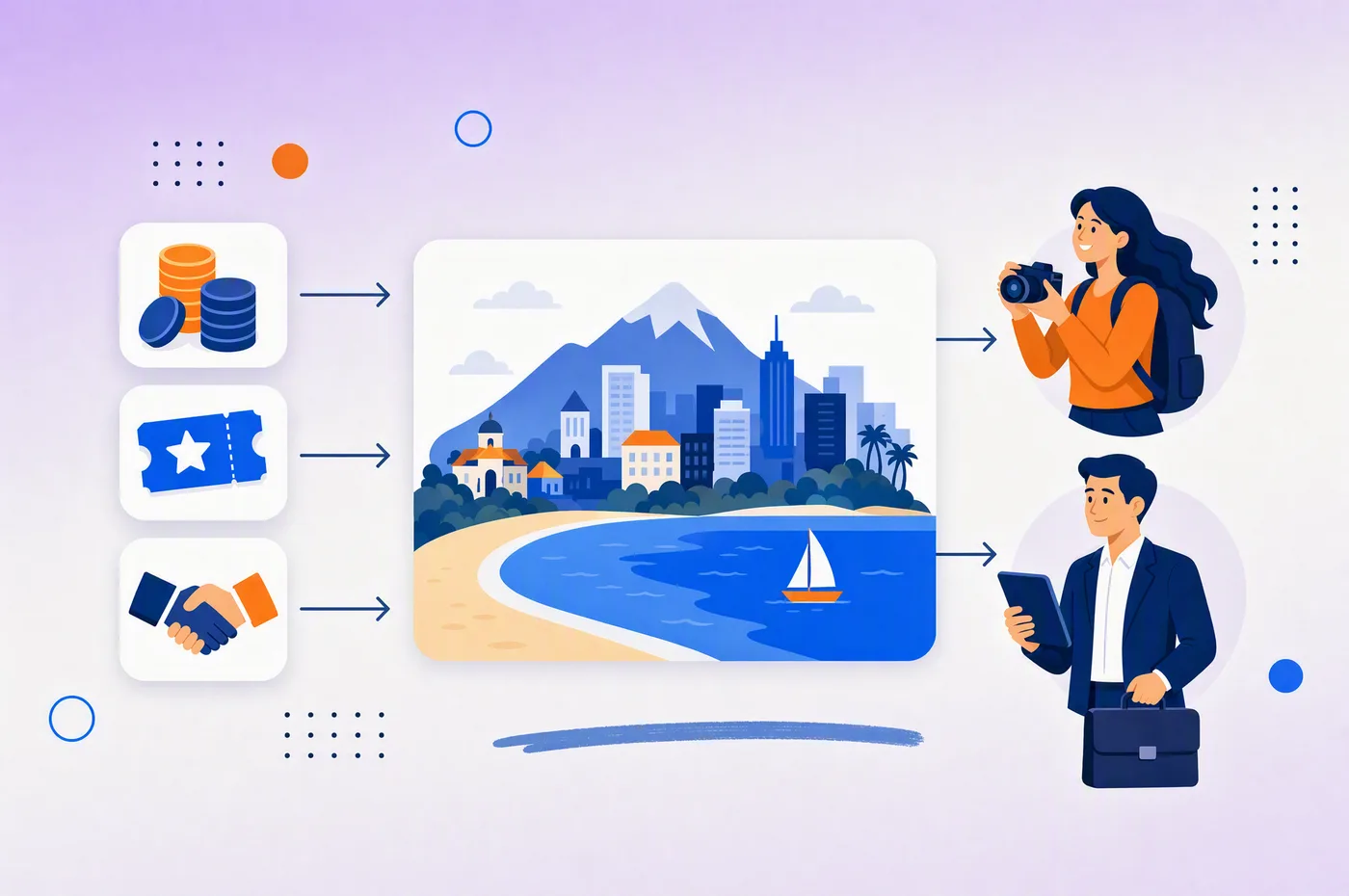
The name on the door varies. Depending on the destination, the same type of organisation is called a convention and visitors bureau (CVB), a tourist board, a tourism authority or simply a destination organisation. You will also meet the reading destination management organization, which stresses coordination and product development over promotion. Many adopted the “Visit” prefix: Visit Sweden, Visit Berlin, Visit Britain. The mandate behind the labels is the same, and it operates at three levels: city (NYC Tourism, Visit Berlin), region or state (Bayern Tourismus Marketing with its brand Bayern.by) and country (Visit Sweden, Switzerland Tourism, Atout France, the German Convention Bureau for the meetings side).
If the meetings and events side of that mandate is new territory for you, our strategic guide to MICE tourism covers that industry in depth. Here we stay on the organisational question: who does what, and who pays for it.
DMO, CVB, tourist board, DMC: who does what?
The four labels get mixed up constantly, and one of them does not belong in the group at all.
| Organisation | Who runs it | Core mandate | Main customer | Revenue model |
|---|---|---|---|---|
| DMO | Non profit or public agency | Market the destination, grow visitor economy | Travellers, planners, travel trade | Taxes, grants, memberships |
| CVB | Non profit, often city level | Win conventions and meetings, support visitors | Meeting and event planners | Taxes, memberships |
| Tourist board | Usually public, often national | National promotion, brand, market research | Leisure travellers, travel trade | Public budgets |
| DMC | Private company | Deliver logistics and experiences on the ground | Corporate clients, agencies, event organisers | Commercial fees |
A CVB is best understood as a DMO with a meetings focus, and a tourist board as a DMO at national scale. The outsider is the destination management company (DMC): a private, for profit business that a client hires to run transport, venues and programmes inside the destination. A DMC sells services. A DMO sells the place.
What does a DMO actually do?
The mandate sounds broad because it is. In practice the work falls into six functions, and the sixth rarely appears in textbook definitions.
- Destination promotion: consumer and trade campaigns, brand work, content and press trips that put the destination on shortlists.
- Visitor information and services: visitor centres, digital guides and increasingly structured content that answers traveller questions directly.
- Convention and meetings sales: bidding for congresses, supporting planners with venue sourcing, and representing the destination at trade shows such as IMEX or IBTM.
- Stakeholder coordination and product development: aligning hotels, venues, carriers and attractions behind one strategy, often with formal fairness obligations attached to public funding.
- Research and data: visitor statistics, economic impact studies and market intelligence that feed both marketing and policy. Shifts in the global meetings map, like the current movement of international B2B events toward Europe, reach destination strategy through exactly this function.
- Organising their own B2B events: hosted buyer programmes, sales missions, workshops and buyer seller trade shows where the destination’s suppliers meet qualified international buyers in pre scheduled one to one meetings.
That sixth function deserves more attention than it gets. When a DMO flies in 200 tour operators and schedules 3,000 meetings with regional hotels and experience providers, it is not marketing in the advertising sense. It is running a marketplace. The format behind it is explained in our guide to what a hosted buyer programme is, and it is the function where a DMO’s economic contribution is most direct and most measurable. The sixth function is where budgets are defended.
How are DMOs funded?
Public money dominates, which explains almost everything about how DMOs behave. Typical sources are occupancy or bed taxes paid by visitors, tourism improvement districts in which local businesses assess themselves, membership fees from hotels and attractions, public grants, and co op campaigns in which partners share media costs. Destinations International, the industry’s global association, draws its line for a “small DMO” at an operating budget under 3 million US dollars, and runs a dedicated task force for that segment because it describes a large share of the market.
Funding tied to public money buys public scrutiny. When the California town of Carmel by the Sea paused roughly 300,000 US dollars of tourism marketing after an overtourism debate, the case travelled through the industry press because every destination marketer recognised the mechanism: budgets that depend on political goodwill can be reduced the moment the value story stops being convincing. Nearly a third of DMOs worldwide now report exactly that risk (Sojern 2026). For you, the consequence is simple. The funding model makes proof of impact a survival skill, not a reporting chore.
From impressions to proof: the accountability shift
The scrutiny is now visible in the industry’s own numbers.
State of Destination Marketing 2026
The accountability shift in three numbers
Measuring economic impact now ranks as the top strategic priority among DMOs, ahead of visitation and engagement (Sojern 2026). The budget committee from the opening paragraph has effectively rewritten the job description: reach, sentiment and impressions are supporting detail, while room nights, visitor spend and signed business are the report.
For the trade side of a DMO’s work, that is good news, because business events produce evidence that campaigns cannot. A hosted buyer programme or destination workshop generates pre scheduled meetings, and meetings can be counted, qualified and followed up. Healthy programmes see 40 to 60 per cent of meeting requests accepted and around 80 per cent of scheduled meetings actually take place, numbers you can put in front of any board. How those meeting outcomes roll up into a defensible value story is the subject of our return on investment (ROI) framework for tourism trade shows.
The third stat card points at the same shift from a different angle: 64 per cent of DMOs already format content for AI search engines, because being the cited answer is becoming part of the mandate too. Where that trend and the wider 2027 planning picture are heading is mapped in our MICE tourism trends for 2027.
Solution: this is the layer where Converve works with DMOs and convention bureaus. A meeting matrix schedules pre qualified buyers and regional suppliers into one to one meetings with clear rules, and the audit trail records requests, acceptances and completed meetings per participant. The result is the one report a funding body never argues with: who met whom, and what came of it. You can see how destination teams use it on our tourism solutions page.
A DMO’s job is to turn a place into a bookable proposition; what a MICE destination is and which criteria define it describes the target state.
Hosting buyers on site is the DMO’s most expensive sales tool, and what a fam trip is and how to measure the trade version shows where that money goes.
The private partner that turns a DMO’s pitch into a delivered programme is the DMC; what a destination management company does, how it prices its work and where it finds its clients completes the picture from the supplier side.
Of the six functions, promotion is the one funders see first, and it now serves two audiences at once; how DMO marketing reaches both travellers and the travel trade, and which half is easier to prove turns this definition into a channel plan.
When the budget committee asks for economic impact, the answer is a calculation with clear rules: only new money from visitors counts, and the multiplier has to fit the region. How destinations calculate the economic impact of events walks through those steps and the errors that inflate the result.
Some DMOs also sell the destination as a business location, hosting or curating events where hotel groups, funds and lenders meet project owners; how tourism investment forums prepare projects and schedule one to one meetings with investors explains the DMO’s part in that format.
FAQ: destination marketing organizations
What does DMO stand for?
DMO stands for destination marketing organization. You will also see destination management organization, which is common in Europe and stresses coordination and development tasks over promotion. In everyday industry use, both abbreviate to DMO and describe the same body.
Is a CVB the same as a DMO?
Broadly yes. A convention and visitors bureau (CVB) is a DMO, typically at city level, with an explicit focus on winning meetings and conventions. The term DMO has become the international umbrella label because not every destination has a convention centre.
How are DMOs funded?
Most DMOs are funded through visitor paid occupancy taxes, tourism improvement districts, membership fees, public grants and co op marketing contributions. Destinations International classes DMOs with operating budgets under 3 million US dollars as small DMOs.
What is the difference between a DMO and a DMC?
A DMO is a non profit or public body that promotes the destination as a whole. A destination management company (DMC) is a private firm hired by a specific client to deliver logistics, venues and programmes inside that destination. One markets the place, the other executes for a customer.
Why do DMOs run their own B2B events?
Because structured buyer seller formats convert destination interest into contracted business. A hosted buyer programme delivers qualified international buyers into pre scheduled meetings with local suppliers, which produces the measurable economic impact that funders increasingly demand.
Conclusion: the DMO of 2027 sells proof, not postcards
A destination marketing organization is the official voice of a place, funded mostly by public money and judged, more sharply every year, on what that money demonstrably returns. The definitions in glossaries still describe the promotional half of the job. The half that decides next year’s budget is the other one: qualified buyers met, meetings completed, business signed and reported.
If your DMO or convention bureau runs buyer seller events and you want the meeting side to produce numbers your board recognises, get in touch with Converve. We have supported tourism trade shows and hosted buyer programmes for more than two decades.