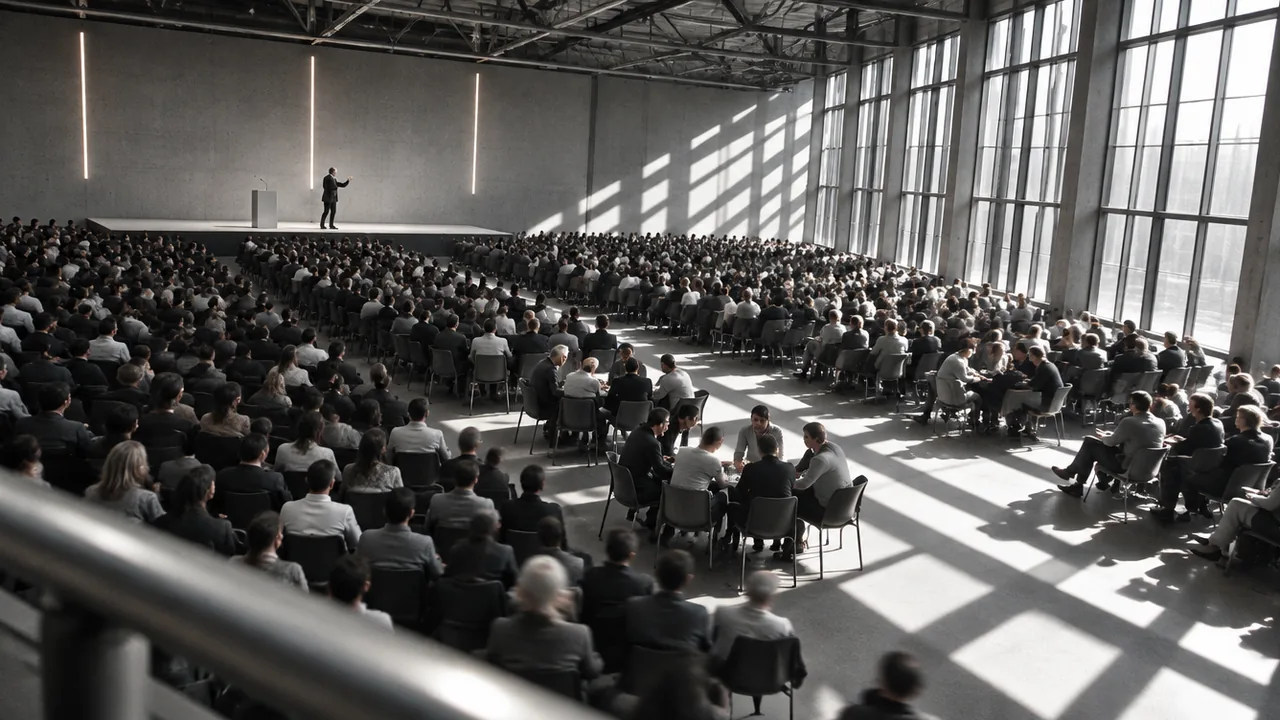
At Worldpac’s STX 2026 Supplier and Training Expo in National Harbor, Maryland, more than 2,500 attendees completed 43,200 hours of training over five days, while more than 100 parts manufacturers exhibited in the hall (Worldpac recap, AftermarketNews, 2026). That is up to about 17 hours of classes per attendee. Each of those hours was an hour not spent at a supplier’s table.
The two halves of such an event compete for the same time. In US distribution, many distributors and buying groups attach a supplier floor to the event where they train their branch staff or their members’ staff. The trade calls it a vendor show, a supplier expo or the vendor hall. Suppliers pay to be there and often teach classes. What they rarely get is a plan for when the trainees will come to them.
Our argument in this guide: at a training event, supplier time works only when it is scheduled into the training agenda, by role, instead of being left to the coffee breaks. We show you how to build those appointment blocks, who should meet which supplier, what vendors pay for and what to report.
Picture the training manager at head office a week after the event. A branch manager asks whether it was worth taking two of his best counter people off the floor for three days. A supplier asks how many trainees it actually reached. This guide helps her answer both with a number.
What a training event with a supplier floor looks like
Both questions come from the same design. A training event with a supplier floor puts learners and vendors in one building, and in practice it comes in three variants:
- Employee training at a distributor: the distributor brings sales and counter staff from its branches together for product and sales training, and its suppliers exhibit and teach.
- Member training at a buying group or network: the group trains the staff of its independent member businesses, often with vendors from its programme on the floor.
- Customer training run by a distributor: the distributor trains the businesses it sells to, such as repair shops or contractors, with the supplier expo as the second pillar.
Four events from 2026 show the range.
| Event | Who is trained | Supplier side | Source |
|---|---|---|---|
| Worldpac STX 2026, National Harbor, 19 to 23 August | Technicians and managers of independent repair shops, Worldpac’s customers | Exhibits from more than 100 parts manufacturers | Worldpac recap, AftermarketNews, 2026 |
| Heavy Duty Education Week 2026, Indianapolis, 12 to 15 May | Distributor employees in the Distributor Training Expo track, 200 places, free of charge | ”Direct access to leading suppliers” with hands-on product training | Trucks, Parts, Service, April 2026 |
| Mac Tools Tool Fair 2026, San Diego, 12 to 14 February | Mac Tools distributors, 937 registered attendees | ”Vendor time” named as part of the appeal, next to training | Vehicle Service Pros, February 2026 |
| NOD/ISN Tool Dealer Expo 2026, Orlando, 5 and 6 June | Sales teams in pre-expo training sessions | About 135 suppliers for about 2,000 attendees | Vehicle Service Pros, June 2026 |
The heavy duty example is not new. When the Commercial Vehicle Solutions Network (CVSN) ran its Distributor Training Expo in Atlanta in 2023, the trade press described it as an event that “enables vendors to train their distributor partner’s field sales professionals”, with classroom and booth instruction at the same event (Trucks, Parts, Service, July 2023). Distributors sent their top sales associates to learn from many vendors over one weekend, which kept their time away from the business short.
That is the real value of the format. One trip replaces many.
Three neighbouring formats are easy to confuse with it. At a buying group conference, members meet vendors mainly to discuss range, promotions and orders, and fair access to the most wanted vendors is the core problem. The supplier days of European cooperative groups follow the same logic. A vendor golf outing gives a few vendors long, informal hours with a small number of members. At a training event, the trainees come to learn, and their employer pays for every hour they spend away from the counter.
Why the coffee breaks are not enough
Because the employer pays for the time, the classes fill the day. The supplier floor gets what is left, and what is left arrives all at once.
Take a two-day event for 240 trainees with 40 suppliers. Classes run from 8.30 am to 5 pm with three 20-minute breaks and a one-hour lunch. If the hall opens only in those gaps, every trainee is free at the same moment.
| Worked example | Coffee breaks only | Two 90-minute blocks per day |
|---|---|---|
| Time on the floor per trainee | about 2 hours per day, in four gaps | 3 hours per day, planned |
| Who is in the hall at peak | all 240 trainees in the same 20 minutes | 40 groups of six, one group per table per slot |
| Who decides which supplier they see | the queue in front of the nearest table | a schedule built from role and product line |
| Result for the supplier | crowded for minutes, empty for hours | 12 planned slots per table over two days |
In the first column, 240 people meet 40 tables in the same 20 minutes, and then the hall empties until lunch. Trainees drift to the suppliers they already know. The new supplier head office wants to push gets the fewest visitors. Peaks are not a meeting plan.
Session sign-ups have the same problem when they clash with one-to-one meetings. Our guide to session capacity and waitlists shows how to check classes and meetings against one calendar.
Put supplier time on the agenda
The fix is to treat supplier time as a session of its own. That costs some class time, and it is the trade-off that makes the floor work. Five design rules cover most training events:
- Protected appointment blocks: two 90-minute blocks per day in which no classes run and all trainees are on the floor in their scheduled groups.
- Groups instead of individuals: trainees from the same branch or role visit a table together, for example six counter staff at a time. A supplier explains a product line once to six people instead of six times.
- Short, fixed slots: 20 minutes with five minutes to change tables. Each table then holds three slots per block and twelve over the event.
- Vendor classes kept separate: a 45-minute product class for 30 trainees belongs in the class timetable. A table appointment is for questions about the branch’s own customers and stock.
- A short open hour: keep one unplanned hour at the end of the first day for the conversations nobody could schedule.
Now the second column adds up. Forty tables with twelve slots give 480 slots, and 240 trainees filling twelve slots each in groups of six need exactly 480. Every trainee sees twelve suppliers, and every supplier sees 72 trainees. How slot length changes the capacity of a meeting area is covered in our guide to B2B meetings at events.
Picture a counter salesperson from a branch in Ohio. Under the break model, she spends her twenty minutes queuing at the supplier she already orders from. Under the block model, her group is sent to the supplier whose new line her branch stocks next quarter. She leaves with answers her customers will need.
Decide who meets which supplier
That counter salesperson did not choose her schedule alone, and that is the point. At a training event, the training manager knows more about what each trainee needs than the trainee does. The schedule should use that knowledge:
- By role: counter staff need product knowledge and cross-selling, outside sales need programme terms and competitive arguments, branch managers need stock and margin questions answered.
- By product line: match each branch group with the suppliers whose lines the branch carries or is about to add. A branch that does not stock a line gets that supplier only if head office wants it to.
- By experience: new hires meet the core suppliers first. Experienced staff get the newer or more technical lines.
- By supplier request: let suppliers ask for branches or roles they want to reach, and let head office approve the request before it goes into the schedule.
Keep one rule from the buying group world: one slot per supplier per group. A popular supplier should bring a second trainer and a second table, not squeeze in double slots.
Solution: With Converve, trainees register with their role, branch and product lines, and you decide in a rule-based meeting matrix which participant groups may meet which suppliers and how many meetings each table takes. Where you want head office to set the schedule, the Meeting Generator builds complete agendas from priority lists for you to review before publishing. The B2B matchmaking module and the programme module keep classes and supplier slots in one personal agenda, so a class and an appointment cannot land in the same slot unnoticed.
What vendors pay for at a training event
A planned slot is what a vendor’s fee should buy. At many training events, suppliers help fund the event through exhibit fees, class sponsorship or both. In return, a supplier should be able to count on:
- a confirmed number of trainee slots and the roles behind them, two weeks before the event,
- a class slot in the timetable if it teaches, with the attendance count afterwards,
- a short profile of each branch group it meets, such as region, role and whether the branch already stocks its line,
- a report after the event, within your company’s data rules.
The coverage of the Mac Tools Tool Fair 2026 put it plainly: training “is no longer just a supporting element”, and vendor time is still part of the draw (Vehicle Service Pros, February 2026). A supplier that taught a full class and then waited at an empty table will cut its budget next year. Both halves have to deliver.
The classes themselves follow the same rule as any internal sales event: practice beats presentation. Our guide to sales kickoff planning shows how to build an agenda around behaviour instead of slides.
A planning timeline for the supplier programme
Promises to vendors need a date by which they are fixed. Working back from the event, the supplier programme follows this sequence:
Supplier appointments at a distributor training event
- 6 months Fix blocks and vendor offer Decide the class timetable, the appointment blocks, slot length and what each vendor fee includes.
- 4 months Confirm suppliers Suppliers book a table and name their trainers; those that teach get a class slot.
- 10 weeks Register trainees Branches register trainees with role, branch, product lines and experience level.
- 6 weeks Collect supplier requests Suppliers name the roles or branches they want to reach; head office approves or adjusts.
- 2 weeks Publish schedules Each trainee group gets its classes and supplier slots in one agenda; each supplier gets its list.
- Event days Run the blocks Cohorts swap at fixed times, table numbers are visible and a help desk handles changes.
- 2 weeks after Report to both sides Branches see who attended which class and slot; suppliers see trainees reached by role.
Six months sounds early for an internal event. It is not, because suppliers plan their event budgets for the year, and a supplier that knows what its fee buys commits sooner.
What to report after the event
Back to the training manager and her two questions. Each side gets the numbers that match what it was promised:
- For branch managers or members: classes attended per trainee, supplier slots held, and the product lines covered, so the manager can see what two days off the counter bought.
- For suppliers: slots held and missed, trainees reached by role and branch, class attendance, and follow-up requests from branches after the event.
The supplier list is also your planning tool for next year. If a supplier reached only half its promised trainees, check whether its slots clashed with a popular class. If one role never came to the floor, its blocks were in the wrong place. Our KPI framework for B2B event matchmaking explains how to define these key performance indicators (KPIs) and compare them across editions.
Count trainees reached, not visitors to the hall.
Conclusion: schedule the floor like a class
A training event with a supplier floor already has what many trade shows struggle to find: trainees chosen by their employer and suppliers who want to teach them. What it lacks, unless you design it, is time for the two to meet. Protected blocks, schedules built from role and product line and a clear promise to every vendor make the supplier floor part of the training, not a place to stand during the breaks.
Next year, the training manager can answer the branch manager and the supplier before either of them asks. If you are planning the supplier programme for your next training event, get in touch with Converve.
Frequently Asked Questions
What is a vendor show at a distributor training event?
It is a supplier exhibition attached to the event where a distributor or buying group trains its branch staff, its members’ staff or its customers. Suppliers exhibit, often teach classes and meet trainees at their tables. Examples from 2026 include Worldpac’s STX Supplier and Training Expo and the Distributor Training Expo track at Heavy Duty Education Week.
How do you get trainees to visit supplier tables during a training event?
Give the supplier floor its own blocks in the agenda instead of relying on coffee breaks. Run two 90-minute blocks per day without classes and schedule all trainees in small groups by role and product line.
How long should supplier appointments at a training event be?
There is no fixed standard. Twenty minutes with five minutes to change tables suits product briefings for a small group and gives three slots per 90-minute block. Longer product classes for a full room belong in the class timetable.
How is a training event different from a buying group conference?
At a buying group conference, members and vendors meet mainly to discuss range, promotions and orders, and the organiser’s main task is sharing out time with the most wanted vendors. At a training event, the attendees come to learn, their employer pays for their time away from work, and the supplier slots have to fit around the class timetable.
What should suppliers receive for their fee at a training event?
A confirmed number of trainee slots with the roles behind them, a class slot if they teach, a short profile of each group they meet and a report with slots held, trainees reached and class attendance. Without that promise, suppliers cannot compare the event with a series of branch visits.