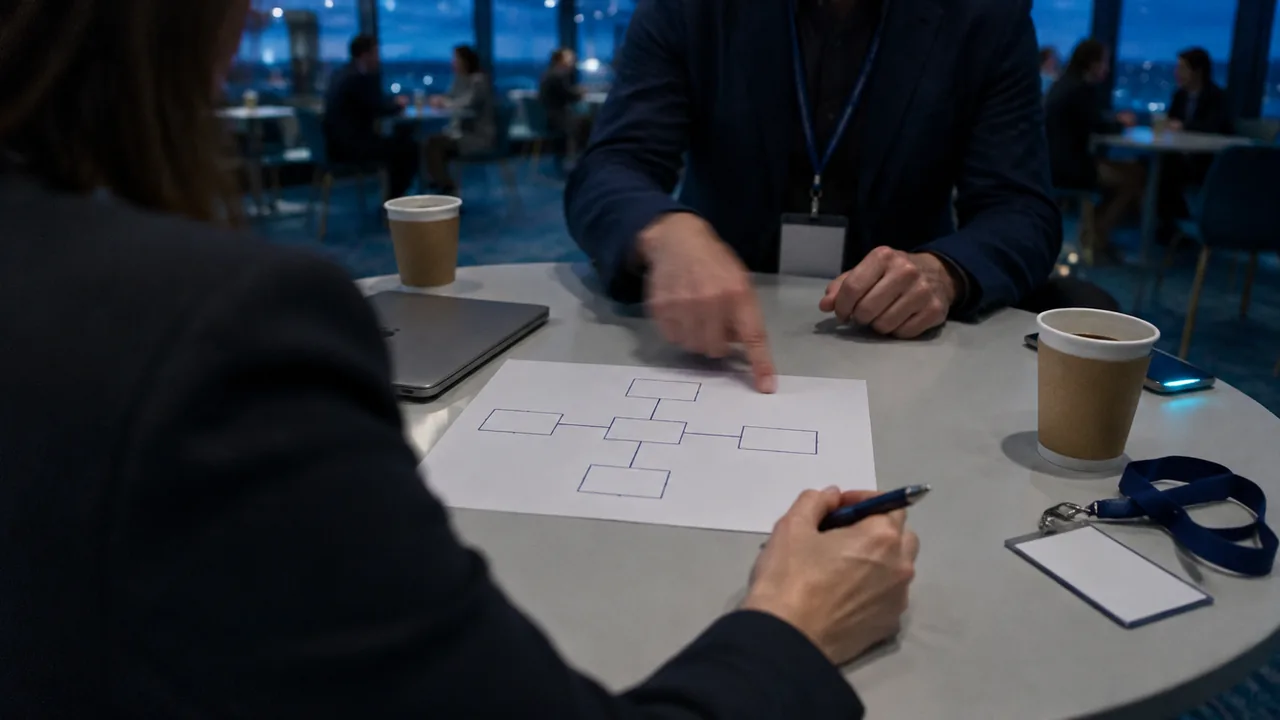
At BIO 2025 in Boston, 5,535 companies held 66,308 partnering meetings in four days, according to the Biotechnology Innovation Organization (BIO), which runs the convention. If every meeting brought together two companies, that is roughly 24 meetings per company. Nobody gets there by chance. Every one of those meetings was requested, accepted and placed in a slot before or during the event.
In the life sciences, partnering means pre-arranged one-to-one meetings between biotech companies, pharma business development teams, investors, research institutions and service providers. This guide explains how to run that programme, step by step. Three rules underpin it: both sides agree to the meeting, each appointment has a fixed slot, and the first conversation stays non-confidential.
What is life science partnering?
Partnering is the life science name for business matchmaking with a specific purpose. A biotech with a promising compound looks for a pharma company to license or co-develop it. A pharma team scouts for assets in a therapeutic area. A university tech transfer office looks for an industry partner for a patent, and a contract research organisation (CRO) looks for new clients. The convention or conference provides the platform, the calendar and the rooms. The participants supply the reasons to meet.
Three features set it apart from meetings at a trade show:
- Everyone can be buyer and seller: a biotech may out-license one asset and in-license another on the same day. That is why classic buyer-to-seller ratios do not apply, as our guide to buyer to seller ratios at matchmaking events explains.
- Companies meet companies: at BIO, meeting requests are sent from company to company, not between individuals, and the receiving company decides which colleagues attend (BIO Partnering System Tutorial, 2022).
- The first meeting is a filter: it decides whether both sides want to exchange confidential data later. The deal comes months afterwards.
The mix of participants shows who drives demand. In BIO’s breakdown of the companies registered for partnering at the 2025 convention by early May, 43 per cent were biotech or pharma companies in therapeutic research and development, and 9 per cent contract manufacturers or CROs (BIO 2025 preparation webinar). For you as an organiser, that means the core of your programme is business development teams with an agenda, not curious visitors.
Partnering is also different from the meetings an association arranges between sponsors and members at its congress. There, members are protected from sales pressure, and the rules work in one direction. How that works is set out in our guide to industry partner meetings at association congresses.
How big partnering programmes run
The scale of the two largest programmes shows what the format can carry. Both organisers publish their own figures, so read them as organiser data.
| Event | Companies | Partnering meetings | Attendees | Countries |
|---|---|---|---|---|
| BIO 2025, Boston | 5,535 partnering companies | 66,308 | 21,600 registrants, 10,780 partnering delegates | 73 |
| BIO-Europe 2025, Vienna | 3,252 | 32,527 one-to-one meetings | 5,827 | 60 |
| BIO 2026, San Diego | not yet published | close to 70,000 scheduled | not yet published | not yet published |
Sources: BIO 2026 Look Book (BIO 2025 figures); EBD Group, About BIO-Europe (2025 figures); Bio.News, 22 June 2026 (BIO 2026, scheduled meetings at opening).
What a partnering programme delivers per company
Twenty meetings over three days is about seven a day. That density only works with fixed slots and a system that schedules them. It also tells you what your participants will measure you by: not the keynote, but how full their diary was.
Picture the partnering lead at a regional life science cluster. She is planning the cluster’s first partnering day for biotech start-ups, two or three pharma scouts, investors and the tech transfer offices of the local universities. Her managing director will ask one question before signing off the budget: how many meetings will we deliver? The rest of this guide answers it.
How a partnering meeting comes about
Those fixed slots come out of a standard process. The mechanics are almost identical at BIO and at the events of EBD Group, which runs BIO-Europe on its partneringONE platform. Six steps lead from registration to the table.
How a partnering meeting comes about
- Before opening Profiles Companies describe themselves, their assets and their partnering objectives. Profiles are non-confidential by design.
- 4 to 6 weeks before The system opens Participants search profiles and send requests. BIO-Europe opens partneringONE fully four to six weeks before the event.
- Request A reasoned request Each request names a target company, often a specific asset, and gives a short reason for the meeting.
- Response Accept or decline The receiving company accepts or declines. No meeting exists without both sides agreeing.
- Scheduling The system finds the slot Accepted meetings are placed automatically in a time both sides marked as available.
- On site Table, room or booth Each meeting gets a location. Changes run through reschedule or cancel in the system.
Two details matter more than they look. First, the calendar starts closed. In the BIO Partnering system, “your calendar is marked as unavailable by default”, and participants have to open time slots themselves (BIO Quick Start Guide). If they forget, accepted meetings sit in the system with a red “No mutual availability” flag. Second, nobody negotiates times by email. partneringONE “will schedule all agreed meetings for you” (EBD Group), and BIO also schedules all accepted requests itself.
For the partnering lead, this means the most common failure is not a bad match. It is an empty calendar. Remind participants to open their availability before scheduling starts, and send a second reminder to everyone with accepted but unscheduled meetings.
Why the 30-minute slot is the standard
The slot itself is short. BIO plans its partnering forum as “30-minute meetings across 3.5 days” (BIO 2024 partnering preview webinar). The consultancy L.E.K. describes meetings at partnering conferences as typically lasting only 20 to 30 minutes, with many delegates holding ten or more per day (L.E.K. Consulting, 2015). BIO-Europe expects its partnering meetings to last 25 minutes (BIO-Europe partnering FAQs).
In its 2025 preparation webinar, BIO split the half hour like this:
- 5 minutes for introductions and context,
- 15 minutes for the pitch and discussion,
- 5 minutes for questions and next steps,
- 5 minutes to move to the next meeting.
The transfer time is the part organisers forget. Without it, a 30-minute slot becomes a 25-minute meeting that starts late. Plan it into the grid, not into the goodwill of your participants.
A participant at BIO-Europe 2018 put the limit of the format plainly: “A 30-minute meeting is good to start, but not enough to make any conclusions” (Informa Connect, 2018). He had personally held 55 meetings in three days, the maximum allowed per participant; his company held 109 in total. That is the right expectation to set. The first meeting qualifies, and the follow-up does the work.
If you want to compare slot lengths across other formats, our guide to B2B meeting formats, length and scheduling sets out when shorter or longer slots make sense.
Partnering tables, rooms and booths
Each scheduled meeting needs a place, and the choice of place shapes what can be said. BIO offers three types of location at its convention: rooms and meeting points in the Business Forum, meeting points in exhibitor booths, and sponsor suites (BIO 2026 first time attendee webinar). A medium suite at BIO 2026 was set with one table and six chairs (BIO 2026 Look Book). More than 10,000 of the 66,000 meetings at BIO 2025 took place in exhibit booths, and BIO allows one meeting point per 100 square feet of booth space, up to ten per booth (BIO, Partner with Purpose webinar, April 2026). If exhibitors take part, their booths are partnering space and belong in your floor plan.
For a smaller event, the same logic applies in miniature. Most first meetings work well at numbered tables in an open partnering area. A few closed rooms are worth keeping for meetings where both sides already know each other and want to talk numbers.
Back to the partnering lead and her managing director’s question. The table below is her answer.
A one-day partnering programme for 150 organisations
Eight meetings per organisation is a sensible target for a first edition, well below BIO’s density. If you reach it, the managing director has a number to report. Your participants have a reason to return.
Confidentiality: what belongs in a first meeting
Open tables raise an obvious question: what can be said there? The partnering system is open by design. Profiles exist to be found by other partnering participants, and the first meeting usually takes place at a table within earshot of other tables. That is why the industry works with non-confidential material first. BIO advises participants to upload a “non-confidential deck, one-pager” to their profile (BIO 2025 preparation webinar). Linda Pullan and Trevor Thompson describe the non-confidential slide deck as the main tool for getting an asset in front of potential partners, and place the confidentiality agreement later, in due diligence (Biopharma Dealmakers, Nature, 2018).
The organiser does not draft anyone’s confidentiality agreement. You do set the frame that makes non-confidential first meetings work:
- State who sees what: tell participants who can see their profile and its documents. At BIO, personal contact details are visible only to companies with which a delegate chooses to share them (BIO Partnering System Tutorial, 2022).
- Separate open and closed space: open tables for first meetings, a small number of bookable rooms for follow-ups.
- Write the house rules down: no recording of meetings, no photography in the partnering area and no forwarding of profile documents without consent.
This is not legal advice. Participants, their legal teams and tech transfer offices handle confidentiality agreements themselves. Your job is a setting in which nobody has to worry about the table next door.
Rules that keep the partnering market fair
Clear booking rules help distribute requests more fairly and keep popular participants from being overwhelmed. A large pharma company can receive hundreds of requests while a small start-up receives none. Organisers counter this with a handful of rules:
- Meeting caps: BIO-Europe 2018 allowed a maximum of 55 partneringONE meetings per participant (Informa Connect, 2018). A cap forces popular delegates to choose, and it frees slots for others.
- Who may request whom: some programmes open requests in both directions, others let investors or pharma request start-ups only, or the other way round. Decide before the system opens.
- An obligation to respond: BIO asks participants to “respond to all meeting requests by either accepting or declining them” (BIO Quick Start Guide). A declined request lets the sender move on; an ignored one blocks a plan.
- A no-show rule: decide how you handle missed meetings before the event, not after. What works is set out in our guide to measuring and reducing meeting no-shows.
The same question of how to stop your best participants from being flooded runs through every matchmaking programme, which our guide to business matchmaking at events addresses with concrete limits.
In Converve, you define who may request meetings with whom in a rule-based meeting matrix, using the attributes captured at registration, such as organisation type, therapeutic area or development stage. Participants send and accept requests, and accepted meetings land in free slots in both agendas without clashes. If you want to see how that fits a partnering day, our B2B matchmaking module is a good place to start.
The registration form is where this begins. The fields you ask for decide which rules you can set later, and our guide to registration questions for matchmaking shows which ones to include. Partnering is not the only meeting format in health. When clinics meet the facilitators who refer international patients, roles and vetting work differently, as described in our guide to medical tourism B2B events.
Frequently Asked Questions
What is partnering at a biotech conference?
Partnering is a system of pre-arranged one-to-one meetings between biotech companies, pharma business development teams, investors, research institutions and service providers. Participants publish profiles, send meeting requests through a partnering platform, and accepted meetings are scheduled automatically in fixed slots. BIO 2025 in Boston recorded 66,308 partnering meetings among 5,535 companies (BIO 2026 Look Book).
How long is a partnering meeting?
Usually 25 to 30 minutes. BIO schedules 30-minute partnering meetings at its convention and recommends five minutes of that for moving to the next meeting; BIO-Europe expects meetings of 25 minutes. L.E.K. Consulting describes 20 to 30 minutes as typical for partnering conferences (2015).
How does BIO partnering work?
Companies create profiles in the BIO Partnering system and request meetings company to company. The receiving company accepts or declines. BIO then schedules each accepted meeting in a time slot both sides have marked as available and assigns a location in the Business Forum, an exhibitor booth or a sponsor suite.
What is partneringONE?
partneringONE is the partnering platform of EBD Group, an Informa company that runs BIO-Europe and other life science events. Participants use it to build profiles, send and answer meeting requests and receive an automatically scheduled meeting calendar. At BIO-Europe 2025 in Vienna, 3,252 companies held 32,527 one-to-one meetings (EBD Group).
Is information shared in partnering meetings confidential?
Not by default. First partnering meetings normally use non-confidential material, such as a non-confidential deck or one-pager. Confidential data is exchanged later, once both sides have signed a confidentiality agreement. Organisers support this with clear rules on profile visibility, open tables for first meetings and closed rooms for follow-ups.
How many partnering meetings can one company hold?
At the largest events, about 20 to 24 per company over three to four days, based on BIO and BIO-Europe 2025 figures. Some organisers set caps: BIO-Europe 2018 allowed up to 55 meetings per delegate, so a company with several delegates can hold more. For a regional one-day event, eight meetings per organisation is a realistic first target.
Conclusion: set clear rules for partnering
Life science partnering needs clear rules about who may request a meeting, how long it lasts, where it takes place and which topics require a separate confidential discussion. BIO and BIO-Europe show how the format works at scale. A regional cluster can use the same principles for a one-day programme with 45 tables.
If you are the partnering lead planning a first programme, start with the rules, then the grid, then the tables. To see how this works for your participants, get in touch with Converve.